
by Julia Herdman | Jun 9, 2017 | American History, Blog, Europe, France, Literature, Marriage, Politics, Romance, Society, Visual arts

Maria Hadfield Cosway, Repelling the Spirit of Melancholy
Maria Cosway was born Luisa Caterina Cecilia Hadfield was born on 11 June 1760 in Florence, Italy to Charles Hadfield, who was a native of Shrewsbury, England, and an Italian mother.
Her father was a successful innkeeper at Livorno, where he had become very wealthy. The Hadfields operated three inns in Tuscany, all frequented by British aristocrats taking the Grand Tour.
One of eight children Maria was born into a comfortable and happy family. Her life should have been a tranquil one. Unbeknown to the family tragedy would overtake them when four of the Hadfield children were killed by their mentally ill nursemaid who claimed she was sending the children to heaven. Luckily she was caught and imprisoned before she could kill Maria.
While still in Florence, Maria Hadfield studied art and painting under Violante Cerroti and Johann Zoffany.
The Florentine Violante Beatrice Siries (1709–1783) was an Italian painter of repute. She studied under Hyacinthe Rigaud and François Boucher in Paris from 1726. When she returned to Florence she married Giuseppe Cerroti. She was talented in several genres, but established herself as a famous portraitist She gained the patronage of the Medici family in 1731 and travelled to Rome and Vienna to paint various members of the family .Her most ambitious work was a fourteen figure family group of the emperor Charles VI, the father of the Austrian Empress Maria Theresa in 1735. Three of her self-portraits are preserved in the Uffizi Gallery.
Johann Zoffany (1733 -1810) was a German neoclassical painter, active mainly in England, Italy and India. His works appear in many prominent British collections such as the National Gallery, London, the Tate Gallery and in the Royal Collection, as well as institutions in Europe, India, the United States and Australia. While Zoffany was painting The Tribuna of the Uffizi in 1773 Hadfield copied Old Masters at the Uffizi Gallery. She continued copying for another five years and experimenting until 1778 when she was elected to the Academia del Disegno in Florence in 1778. She also went to Rome, where she studied art under Pompeo Batoni, Anton Raphael Mengs, Henry Fuseli, and Joseph Wright of Derby.

Self Portrait With Arms Folded
On 18 January 1781, Maria Hadfield married a fellow artist, the celebrated miniature portrait painter Richard Cosway, in what is thought to have been a marriage of convenience.
Richard was born in Tiverton, Devon, the son of a schoolmaster. He was initially educated at Blundell’s School but at the age of twelve he was allowed to travel to London to take lessons in painting. He won a prize from the Society of Artists in 1754 and by 1760 had established his own business. He exhibited his first works at the age of 20 in 1762 and was soon in demand.
Maria’s husband was one of the first group of associate members of the Royal Academy, elected in August 1770, and was elected a full member the following March, on the casting vote of the academy’s president, Sir Joshua Reynolds. He was 20 years Maria’s senior, known as a libertine, and was repeatedly unfaithful to her.
Richard Cosway was “commonly described as resembling a monkey.” Her Italian manners were so foreign that her husband kept Maria secluded until she fully mastered the English language. Cosway also forbade his wife from painting, possibly out of fear of the gossip which surrounded women painters.
Her Self-Portrait with Arms Folded is seen as a response his command. The reprobate Cosway, realised his wife was his best financial asset and changed his mind.
More than 30 of her works were displayed at the Royal Academy of Art from 1781 until 1801. She soon enhanced her reputation as an artist, especially when her portrait of the Duchess of Devonshire in the character of Cynthia was exhibited.
Rather than being a social embarrassment she could claim the Hon. Mrs. Darner, the Countess of Aylesbury; Lady Cecilia Johnston; and the Marchioness of Townshend among her acquaintances.
In 1784, the Cosways moved into Schomberg House, Pall Mall, and developed a fashionable salon for London society. Richard was Principal Painter of the Prince of Wales, and Maria served as hostess to artists, members of royalty including the Prince, and politicians including Horace Walpole, Gouverneur Morris and James Boswell all attended the couples soirees. Maria who could speak several languages and had an international circle of friends.
The man who would be the American President Thomas Jefferson met the Cosways in August 1786 at the Halle aux Bleds in Paris, through the American artist John Trumbull. According to Trumbull, the President’s entourage “was occupied with the same industry in examining whatever relates to the arts …. Mr. Jefferson joined our party almost daily.” Their excursions included sites such as Versailles, the Louvre, Louis XIV’s retreat Marly, the Palais Royal, St. Germain, and the Column at the Désert de Retz.
Jefferson was enchanted by Maria, and her departure from Paris in October 1786 compelled him to write the only existing love letter in the vast collection of his correspondence.
In ‘The dialogue between my Head and my Heart,” dated October 12th and 13th, 1786. Jefferson poured out the contents of both. The bulk of the letter is a dialogue between Jefferson’s calculating reason (for which he is well known) and his spontaneous emotions (for which he is lesser known). Jefferson describes his emotional state after she has left saying he is “the most wretched of all earthly beings” and his reason responds by admonishing him for his attachment. His heart defends itself saying that no one will care for him who cares for nobody.
Their marriage was never a happy one. Richard and Maria had one child together, Louisa Paolina Angelica. The couple eventually separated. Maria took herself back to the continent. On one occasion accompanied by Luigi Marchesi, a famous Italian castrato. Marchesi was reputed to have been the handsomest castrato of all time and was said to have been adored by the whole female population of Rome. Maria, was a beautiful woman who attracted the most gifted and handsome of men.
Whether she ever had a relationship with Jefferson remains a mystery. Though her husband’s extramarital affairs were no secret, Cosway was a married woman and a devout Catholic when she met him so it is unlikely she entered into sexual relationship with him. The pair did however engage in correspondence.
After returning to America in 1789, Jefferson’s letters to her grew less frequent; partly due to the fact that he was increasingly preoccupied by his position as President George Washington’s secretary of state. She, however, continued to write to him. In her letters she vented her frustration at his growing aloofness. She clearly wanted a some passion to pass between them even if it was only in writing. In his last letters, he spoke more of his scientific studies than of his love and desire for her. Finally he admitted that his love for her had been relegated to fond memories of when their relationship had been “pure.” Whatever that meant.
Their relationship was fictionalised in ‘Jefferson in Paris‘ a 1995 Franco-American historical drama film, directed by James Ivory, which had previously entitled Head and Heart. The screenplay, by Ruth Prawer Jhabvala, is a semi-fictional account of Thomas Jefferson’s tenure as the Ambassador of the United States to France before his Presidency and of his alleged relationships with British artist Maria Cosway and his slave, Sally Hemings.
Maria Cosway eventually moved to Lodi, in Italy, where she established a convent school for girls. Cosway and Jefferson wrote to one another occasionally, with letters coming first from Cosway.
At her home in Lodi, Cosway kept the portrait of Jefferson by John Trumbull that is now at the White House. It was presented to the United States by the Italian government on the occasion of the 1976 Bicentennial of the American Revolution.
Today, Cosway’s paintings and engravings are held by the British Museum, the New York Public Library and the British Library. Her work was included in recent exhibits at the National Portrait Gallery in London in 1995–96 and the Tate Britain in 2006.
Julia Herdman writes history ad historical fiction. Her latest book Sinclair, Tales of Tooley Street Vol. 1. is Available on Amazon – Paperback £10.99 and Kindle Also available on:
Amazon Australia
Amazon Canada
Amazon New Zealand
Amazon South Africa
Amazon USA
See Also:
The History of the Love Letter
How to Write a Good Love Letter
by Julia Herdman | Jun 8, 2017 | Blog, British History, Crime and Punishment, Writing about history
Through most of history, men were thought of as the stronger sex. Men were and in many cases still are considered to be the more violent, more intelligent, more courageous, and the more determined sex.
Women were considered more placid and at worst governed by their unpredictable emotions. The ideal woman was expected to be passive, chaste, modest, compassionate, and pious.
Historians claim that the late eighteenth and early nineteenth centuries witnessed a significant separation of the sexes in society. For example, at that time women and men to started to develop separate social lives. Women took tea at home, while men frequented the coffee shops in town. Women started to withdraw from the dining table after a meal to let the men smoke and talk politics while they concerned themselves with more domestic topics of conversation, played cards and drank tea. These social changes were in part due to increased wealth and to some extent, the growing influence of evangelical Christianity, which placed a high moral value on female domesticity, virtue, and religiosity. The women of the comfortably off were not expected to want for anything and if they did they were expected to keep their desires to themselves.
 Those girls and women of the lower classes who broke society’s rules were treated with a mixture of cruelty and disdain. When it came to crime, women were accused of fewer, and different, crimes to men. At the Old Bailey women accounted for only 21% of the defendants tried between 1674 and 1913. This figure masks a significant chronological change, however. While women accounted for around 40% of the defendants from the 1690s to the 1740s (and, highly unusually, over half the defendants in the first decade of the eighteenth century), over the course of the period this proportion declined significantly.
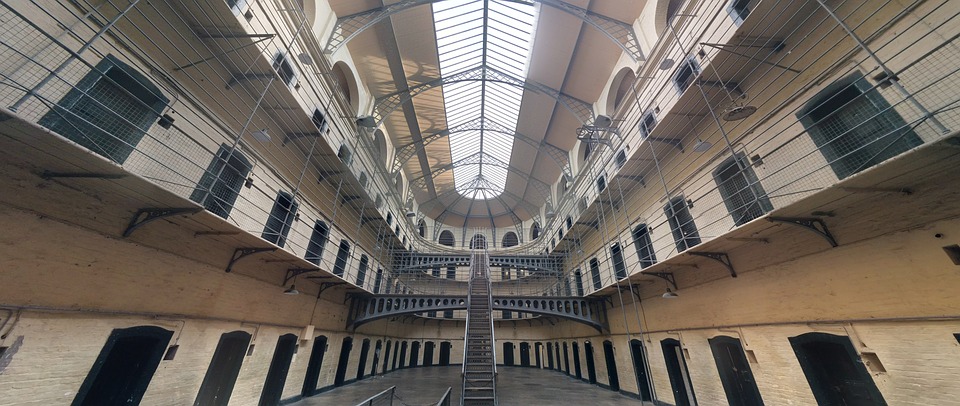
The shadow of Newgate Prison looms over the book Moll Flanders by Daniel Defoe just as the real building must have loomed over surrounding London. Moll starts her life in that cold place, and she comes pretty close to ending it there, too. The prison is mentioned nearly forty times over the course of the book, more than any other place or even any other character’s name. Moll enters the prison as a thief and says looked around upon all the horrors of that dismal place.
‘I looked on myself as lost, and that I had nothing to think of but of going out of the world, and that with the utmost infamy: the hellish noise, the roaring, swearing, and clamour, the stench and nastiness, and all the dreadful crowd of afflicting things that I saw there, joined together to make the place seem an emblem of hell itself, and a kind of an entrance into it.'(Moll Flanders, Daniel Defoe.)
By the early nineteenth century only 22% of defendants were women, and as the twentieth century dawned that percentage had dropped to 9%. By the early twentieth century serious crime had become a mainly male problem and female deviance was viewed as a consequence of sexual immorality and mental defectiveness and was addressed through other agencies such as the asylum. Reasons for admission were various and included Egotism, Fever and Jealousy, Immoral Life, Novel Reading, Nymphomania, Shooting a daughter, Greediness and Self Abuse between 1864 and 1889 according to a poster from the Trans-Allegheny Lunatic Asylum in the US.Similar practices occurred in the UK.
During the 18th century women tended to be accused of certain kinds of theft - pickpocketing, shoplifting, theft from lodging houses, theft from their masters stores, and for receiving stolen goods. The more serious crimes that women were involved in included coining, kidnapping, keeping a brothel, and offences surrounding childbirth such as infanticide, concealing a birth or illegal abortions. Young women who fell prey to their employers and their employer’s sons often found themselves with an unwanted child and no job.Although prostitution itself was not tried at the Old Bailey, keeping a brothel was, and women account for about a third of those prosecuted for brothel keeping.
Of the 47 infanticide cases Naomi Clifford read researching her book, It is Women and the Gallows: Unfortunate Wretches, 13 ended in the acquittal of the manslaughter or murder charge but the conviction rate for the lesser crime of concealing a birth, for which the defendants were given prison sentences ranging from 14 days to 2 years more commonly brought in a guilty verdict. When convicted of infanticide a woman was usually hanged.
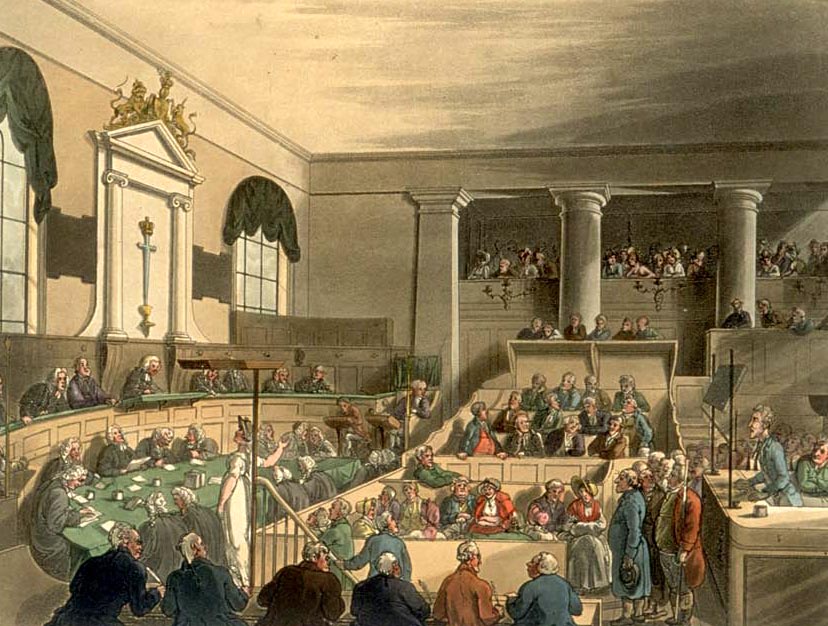
Appearing as a defendant at the Old Bailey must have been a significantly more intimidating experience for women than it was for men. All court personnel, from the judges and jury to lawyers and court officials were men except when a panel of all women was convened. These all female juries were known as a ‘jury of matrons’ and were called to determine the validity of a convicted woman’s plea that she was pregnant. Pregnant women could not be hanged until they had delivered their unborn child.
There is some evidence that juries treated evidence presented by female witnesses more sceptically than that delivered by men. The testimony of women was more likely to be omitted from court proceedings. At the same time, other evidence suggests that juries may have been more reluctant to convict women because women were perceived to be less of a threat to society. The legal principle of the feme covert, which made women responsible for crimes committed in the presence of their husbands (they were presumed to be following their husbands’ commands) was not often applied. A married man was legally responsible for any debts his wife ran up with or without his knowledge.
The pattern of punishments for convicted women was significantly different from that of men, though when sentences for the same offence are compared, the differences are not so significant.
Before 1691, women convicted of the theft of goods worth more than 10 shillings could not receive the benefit of clergy unlike men and were sentenced to death. In practice, they were often acquitted, convicted on a reduced charge, or pardoned. Juries are usually reluctant to convict when they feel the punishment does not fit the crime.
Women convicted of treason or petty treason were sentenced to death by being burned at the stake until 1790 while men convicted of the same offences were hanged, drawn and quartered. It seems the authorities did not want to expose women to this humiliating fate of being undressed in public when they were being executed. Women sentenced to death who successfully pleaded that they were pregnant had their punishments respited and often remitted entirely. From 1848, reprieves granted to pregnant women were always permanent.
Following the suspension of transportation to America in 1776, a statute authorised judges to sentence male offenders otherwise liable to transportation to hard labour improving the navigation of the Thames (they were incarcerated on the hulks), while women, and those men unfit for working on the river, were to be imprisoned and put to hard labour. Only men could be sentenced to military or naval duty, and fewer women were selected for transportation when transportation to Australia began in 1787. The public whipping of women was abolished in 1817 (having been in decline since the 1770s), while the public flogging of men continued into the 1830s (and was not abolished until 1862).
The perception of women as passive and weak and the types of misdemeanours most frequently committed by them made them seem far less of a threat to society than the crimes committed by men. However, when a woman transgressed into the world of ‘male crime’, her punishment was likely to be more severe because as a woman she had not only committed a crime against society she had transgressed the ideal of womanhood and stepped outside her expected gender role.
Source: https://www.oldbaileyonline.org/static/Gender.jsp
Julia Herdman writes historical fiction.
Sinclair is available of Amazon. Click here to get your copy.
Sinclair is set in the London Borough of Southward, the Yorkshire town of Beverley and in Paris and Edinburgh in the late 1780s. Strong female leads include the widow Charlotte Leadam and the farmer’s daughter Lucy Leadam. Sinclair is a story of love, loss and redemption. Prodigal son James Sinclair is transformed by his experience of being shipwrecked on the way to India to make his fortune. Obstacles to love and happiness include ambition, conflict with a God, temptation and betrayal. Remorse brings restitution and recovery. Sinclair is an extraordinary book. It will immerse you in the world of 18th century London where the rich and the poor are treated with kindness and compassion by this passionate Scottish doctor and his widowed landlady, the owner of the apothecary shop in Tooley Street. Sinclair is filled with twists and tragedies, but it will leave you feeling good.
Suffer Little Children to Come Unto Me
London’s Mad House
Women’s Boxing - A Georgian Novelty Act

by Julia Herdman | Jun 7, 2017 | Blog, Europe, European Royal Families, Fashion, France, Politics, Society
Did Queen Marie Antoinette ever say ‘Let them eat cake’?
‘Let them eat cake.’ is one of the most famous quotes in history, but did the queen ever say it and what was going on in France for such a quote to become so popular?
Love her or hate her Marie Antoinette is one of the most famous women in French history but was she blamed for things she never said or had any control over?
The Weather in 1788

Historians and archaeologists are becoming increasingly aware of the influence of weather on the world’s significant events and as someone who has been researching life in the 18th century Britain and France I was amazed to find that the weather could be said to one of the causes of the French Revolution.
In the spring and summer of the year before the Revolution France suffered a drought. Although there was no drought in England the summer of 1788 was an unusually warm one in London. As temperatures soared in the capital, the incidence of Scarlet fever and Typhus spread through the city. In August over 1000 deaths were attributed to fever alone.
As Londoners sweltered the French baked. The French were not particularly competent farmers at the time, the aristocracy and major landowners were not interested in developing and improving their land for agriculture and food production, unlike their British counterparts. Consequently, food production was already pretty miserable when the drought struck.
The drought of 1788 ended when the skies opened and hail the size of fists fell from the sky bashing the fruit from the trees and the smashing the crops in the fields to smithereens so when the French entered the winter of 1788-9 food stocks were at an all-time low. The storms of July caused damage in parts of the country. To make matters worse, the disastrous harvest was followed by months of freezing weather. The temperature barely rose above freezing for three months through November, December and January. In London, the river Thames froze.
The bad weather was most likely caused by the eruption of the Laki volcanic fissure in southern Iceland which spewed out ash for eight months from 8 June 1783 to February 1784 killing much of the livestock and perhaps a quarter of the Icelandic population at the time. The British naturalist Gilbert White described that summer in his classic Natural History of Selborne as “an amazing and portentous one … the peculiar haze, or smokey fog that prevailed for many weeks in this island, and in every part of Europe, and even beyond its limits was a most extraordinary appearance, unlike anything known within the memory of man.”
The State of French Agriculture

Tobias Smollett wrote about Boulogne near Calais in 1763. As much as he hates France he can see that the peasants and landowners around the town have adopted some English farming improvements unlike in the rest of France. ” I am certain that a man may keep house in Boulogne for about one half of what it will cost him in London; and this is said to be one of the dearest places in France. The adjacent country is very agreeable, diversified with hill and dale, corn-fields, woods, and meadows. There is a forest of a considerable extent, that begins about a short league from the Upper Town: it belongs to the king, and the wood is farmed to different individuals. In point of agriculture, the people in this neighbourhood seem to have profited by the example of the English. Since I was last in France, fifteen years ago, a good number of inclosures and plantations have been made in the English fashion. There is a good many tolerable country-houses, within a few miles of Boulogne; but mostly empty. I was offered a compleat house, with a garden of four acres well laid out, and two fields for grass or hay, about a mile from the town, for four hundred livres, about seventeen pounds a year: it is partly furnished, stands in an agreeable situation, with a fine prospect of the sea, and was lately occupied by a Scotch nobleman, who is in the service of France.” ( Project Gutenberg’s Travels Through France and Italy, by Tobias Smollett.)
High Prices and High Taxes
The poorer classes, 95% of whose diet consisted of bread and cereals and which before the drought had to spend about 55% of their earnings on bread, were forced by the famine conditions of the first half of 1789 to spend now 85% and over of their income on this staple food. In France rural taxes called “privilege seigneriaux” or seigniorial privileges, severely burdened farmers.The clergy and nobility exercised a preeminent right over all land property but evaded most of the taxes and financial burdens of managing it. By 1789, some 90% of the population were hungry by the beginning of 1789. The famine added to the woes of the French people who was also suffering from a 10 year economic slump with its attendant unemployment.
The Riots and the Queen’s Response
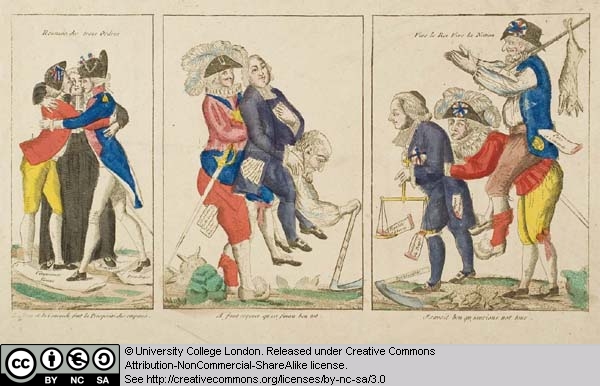
When the riots did come, they were triggered by a chance remark by a wallpaper manufacturer named Reveillon, who said in a public meeting that the government should lower grain prices so that wages could be limited to 15 sous. Rumours of impending wage reductions swept the restless capital and set off the train of events we call The French Revolution.
Queen Marie-Antoinette never said, “Let them eat cake,” on hearing there was no bread to be had in Paris but it was just the sort of thing the crowd thought her capable of saying. As was expected of a woman of her class and position she was remote but she was also totally unaware and untroubled by the plight of her people. She was, as all 18th century monarchs in Europe were, living a life of secluded luxury in their palaces. Marie Antoinette was of course living at one of Europe’s most opulent homes, the Palace at Versailles.
The phrase,’Let them eat cake’ first appeared in a slightly different form about Marie-Thérèse, the Spanish princess who married King Louis XIV in 1660. Marie-Thérèse allegedly suggested that the French people eat “la croûte de pâté” (or the crust of the pastry or the top of the pie - this was usually discarded as pastry was designed to protect the meat while it cooked). Over the next century, several other royals had the phrase attributed to them including two aunts of Louis XVI as it was a phrase that spoke of the royal family’s callousness to their people.
Land Reform

The Revolution brought the repealed feudal tenures, freed all those bound into serfdom, abolished feudal courts, and cancelled all payments not based on real property, including tithes. Once the reforms were in place; however, the peasants seized the land and refused to pay rent to the government, and in 1792, all payments were finally cancelled. Property of the clergy and political emigrants was confiscated and sold at auction, together with common land. The terms of sale, however, often favoured the wealthy, which may explain the rise of a new class of large landowners among the supporters of Napoleon I. The redistribution of land became the basis of French democracy and the small family farm has been the main feature of French agriculture ever since. Having secured their piece of land, there was little incentive or money to improve it for the peasant owners and so the economic benefits of the reforms were limited, France still struggled to feed itself and agricultural improvements that were being introduced in England were slow to be adopted.
France was a rural nation as late as 1940. After the creation of the land owning peasant class after the Revolution a next major change came in with the railways in the 1850s according to Peasants Into Frenchmen (1976), by historian Eugen Weber. Weber traced the modernisation of French villages and argued that rural France went from backward and isolated to modern and possessing a sense of French nationhood during the late 19th and early 20th centuries. He emphasised the roles of railways, republican schools, and universal military conscription. He based his findings on school records, migration patterns, military service documents and economic trends. Weber argued that until 1900 or so a sense of French nationhood was weak in the provinces, a view that has been called into question by several writers. Nevertheless, he gives a good account of the development of rural France in the 19th century. Reforms brought in after World War II and France’s engagement in the European Union has transformed agricultural production again.
Sources:
https://www.britannica.com/topic/land-reform/History-of-land-reform
https://en.wikipedia.org/wiki/French_peasants
Great Historical Events That Were Significantly Affected by the Weather: The Year Leading to the Revolution of 1789 in France, J. Neumann, Department of Atmospheric Sciences, The Hebrew University, Jerusalem, Israel
Drought and the French Revolution:The effects of adverse weather conditions on peasant revolts in 1789, Maria Waldinger (London School of Economics)
Julia Herdman writes historical fiction. Her latest book Sinclair, Tales of Tooley Street Vol. 1. is Available on Amazon – Paperback £10.99 Kindle
Sinclair is available of Amazon. Click here to get your copy.
Sinclair is set in the London Borough of Southward, the Yorkshire town of Beverley and in Paris and Edinburgh in the late 1780s. Strong female leads include the widow Charlotte Leadam and the farmer’s daughter Lucy Leadam. Sinclair is a story of love, loss and redemption. Prodigal son James Sinclair is transformed by his experience of being shipwrecked on the way to India to make his fortune. Obstacles to love and happiness include ambition, conflict with a God, temptation and betrayal. Remorse brings restitution and recovery. Sinclair is an extraordinary book. It will immerse you in the world of 18th century London where the rich and the poor are treated with kindness and compassion by this passionate Scottish doctor and his widowed landlady, the owner of the apothecary shop in Tooley Street. Sinclair is filled with twists and tragedies, but it will leave you feeling good.
Also available on:
Amazon Australia
Amazon Canada
Amazon New Zealand
Amazon South Africa
Amazon USA
18th Century Smuggling Fact and Fiction
by Julia Herdman | Jun 5, 2017 | Blog, British History, British Royal Family, Crime and Punishment, Europe, European Royal Families, Marriage, Society, Writing about history
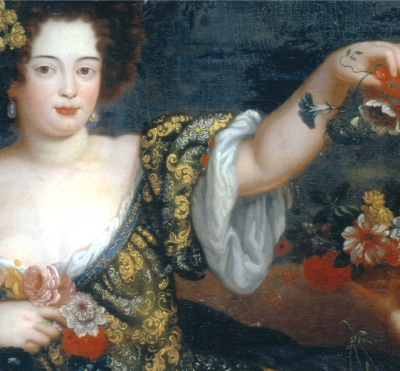
This is the shocking case of the Princess who was married against her will, spurned, divorced, and imprisoned for 33 years.
In August 2016, a human skeleton was found under the Leineschloss (Leine Palace, Hanover) during a renovation project; the remains are believed to be those of Swedish count, Philip Christoph von Königsmarck, (1665-1694) a soldier in the Hanoverian army and the lover of Princess Sophia Dorothea, the wife of the first Hanoverian king of Britain.
Early Life
Sophia Dorothea was just sixteen years old when she was married to her cousin, George Louis of Hanover, the future king of Great Britain and Ireland in 1705.
Poor Princess Sophia Dorothea did not get a good start in life; she was born illegitimately; the daughter of her father’s long-term mistress, Eleonore d’Esmier d’Olbreuse, Countess of Williamsburg (1639–1722) on 15 September 1666, and was considered an inconvenient royal bastard. Without a wife and an heir her father, Prince George William, Duke of Brunswick Lüneburg, eventually did the right thing and married his mistress which had the effect of legitimising his only child.
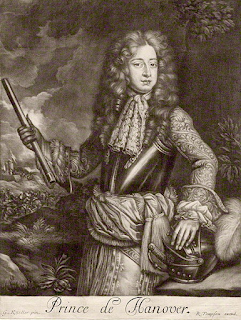 |
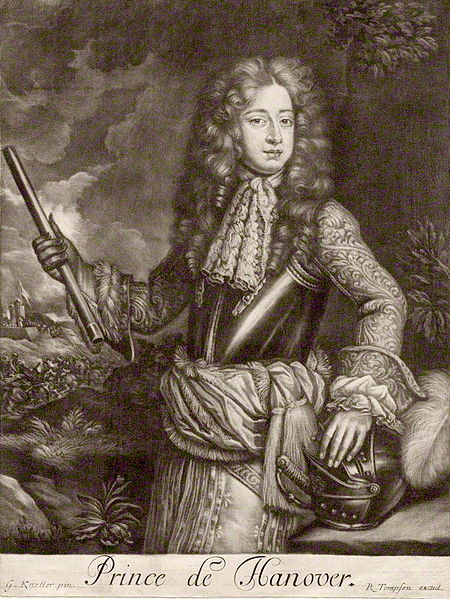
| George I of Britain |
Her Father’s Legitimate Heir
Sophia Dorothea was ten years old when she became heir to her father’s kingdom, the Principality of Lüneburg. This made her a good catch despite her problematic origins because Lüneburg was a wealthy principality and Sophia Dorothea, like her mother, was attractive and lively.
Along with her legitimacy came talk about her marriage. In the six years between her acceptance into the royal family and her eventual marriage, three prospective husbands were considered for her.
Marriage Proposals
First, there was talk of marriage to the Danish heir presumptive. Some years later her engagement to the Duke of Brunswick-Wolfenbüttel was broken off by her father after her aunt, Duchess Sophia of Hanover, convinced him she should marry her cousin, George Louis of Hanover to join their two duchies together. Duchess Sophia hated her niece, whom she considered brazen, coquettish, and uneducated. When told of the change of plan, sixteen-year-old, Sophia Dorothea shouted, “I will not marry the pig snout!”
Twenty-two-year-old George Louis was not keen on the match either; he already had a mistress and was happy with his life as a soldier. Although he was a prince, he was ugly and boring, even his mother didn’t like him. Nevertheless, Duchess Sophia was determined to keep the family fortune together, and despite both Sophia Dorothea’s and her son’s objections, the pair were married on 22 November 1682, in Celle. For his pains, George Louis received a handsome dowry and was granted his father-in-law’s kingdom upon his death, and Sophia was left penniless.
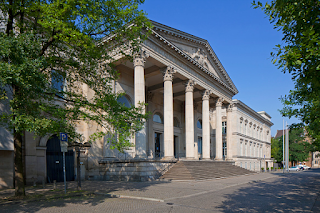 |
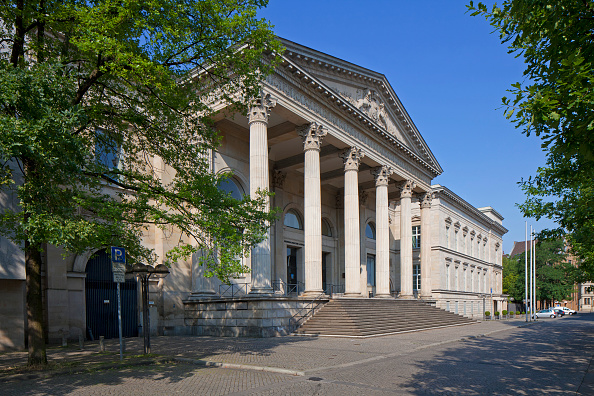
| The state parliament in the former Leineschloss /
Leine Castle in Hannover Lower Saxony Germany |
An Unhappy Marriage
The unhappy couple set up home in Leine Palace in Hanover where Sophia Dorothea was under the supervision of her odious aunt, Duchess Sophia, and spied on by her husband’s spies when he was away on campaign. Despite their unhappiness, the pair produced two children; George Augustus, born 1683, who later became King George II of Great Britain and a daughter born 1686 when Sophia Dorothea was twenty.
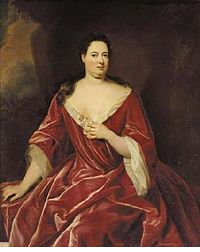 |
| Sophia Charlotte
von Keilmannsegg |
Having produced two children, George became increasingly distant from his wife spending more time with his dogs and horses and his nights with his mistress, the married daughter of his father’s mistress, a woman called Sophia Charlotte von Keilmannsegg, who was rumoured to be George Louis’ half-sister.
Aggrieved, lonely, and unhappy Sophia Dorothea found a friend in the Swedish count Philip Christoph von Königsmarck, (1665-1694) who was a soldier in the Hanoverian army. Philip was a year older than Sophia Dorothea and the antithesis of her ugly, boorish husband.
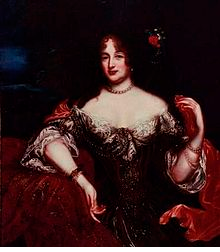 |
| Countess of Platen |
The Fatal Affair
Sophia Dorothea was no saint. She was quick-tempered and rarely discrete, and her choice of Von Königsmarck as a lover was not the best. Königsmarck was a dashing, handsome gigolo and the former lover of her father-in-law’s mistress, the Countess of Platen and the Countess had a jealous nature.
Königsmarck and Sophia Dorothea began a love affair of clandestine trysts, real love, and their coded correspondence facilitated by a trusted go-between. Their love affair was uncovered in 1692 when the Duchess of Platen presented a collection of their letters to her lover, Sophia Dorothea’s father-in-law the Elector of Hanover. Von Königsmarck was banished from the Hanoverian court but soon found a position in the neighbouring court of Saxony where one night when he was buried in his cups he let slip the state of affairs in the bedchambers of the royal house of Hanover. George Louis got wind of what had been said and on the morning of 2 July 1694, after a meeting with Sophia at Leine Palace, Königsmark was seized. No one except his murderers knew what happened to him next.
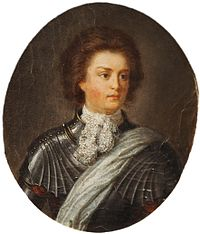 |
| Philip Christoph von Königsmarck,
(1665-1694) |
A Sad and Lonely Death
Dorothea never saw her lover again. George Louis divorced her in December, and early the following year she was confined her to Schloss Ahlden a stately home on the Lüneburg Heath in Lower Saxony. She stayed there for the rest of her life. Her children were taken away from her, and she was forced to live alone.
When Sophia Dorothea died in 1726, she had spent 33 years in her prison. Before she died, she wrote a letter to her husband, cursing him for his treatment of her. A furious George forbade any mourning of her in Hanover and London.
George, I died shortly after the Countess of Platen exonerated him of any involvement in Von Königsmark’s death. Two of her henchmen made deathbed confessions to the crime. Although George I was cleared of Von Königsmark’s death, his son George II never forgave his father for the treatment he had meted out to his mother.
Sources:
https://en.wikipedia.org/wiki/Sophia_Dorothea_of_Celle
Notorious Royal Marriages: A Juicy Journey Through Nine Centuries of Dynasty By Leslie Carroll
The Georgian Princesses By John Van der Kiste
Julia Herdman writes historical fiction. Her latest book Sinclair, Tales of Tooley Street Vol. 1. is Available on Amazon – Paperback £10.99 Kindle.
Sinclair is available of Amazon. Click here to get your copy.
Sinclair is set in the London Borough of Southward, the Yorkshire town of Beverley and in Paris and Edinburgh in the late 1780s. Strong female leads include the widow Charlotte Leadam and the farmer’s daughter Lucy Leadam. Sinclair is a story of love, loss and redemption. Prodigal son James Sinclair is transformed by his experience of being shipwrecked on the way to India to make his fortune. Obstacles to love and happiness include ambition, conflict with a God, temptation and betrayal. Remorse brings restitution and recovery. Sinclair is an extraordinary book. It will immerse you in the world of 18th century London where the rich and the poor are treated with kindness and compassion by this passionate Scottish doctor and his widowed landlady, the owner of the apothecary shop in Tooley Street. Sinclair is filled with twists and tragedies, but it will leave you feeling good.
Amazon Australia
Amazon Canada
Amazon New Zealand
Amazon South Africa
Amazon USA
Princess Anne - The Princess Who Married a Hunchback

by Julia Herdman | May 30, 2017 | Blog, British History, British Royal Family, Marriage, Politics, Romance, Society
Secret and Clandestine Marriage
A clandestine or illicit marriage is a plot device in many 18th and 19th-century stories, think of Jayne Eyre and Mr Rochester, but what seems like the work of fiction was a fact of life for women from all social classes in 18th Century Britain. No one knew who was married to whom until the law of marriage was changed. Even the Prince Regent tried to marry a woman clandestinely and illegally.
On May 11, 1786, the Coachmakers’ Hall, Debating Society debated the following proposition: “Are not the Restraints contained in the Marriage Act, and every other Restriction on the Matrimonial Contract, contrary to the natural Rights of Mankind, and injurious to Conjugal Felicity?” Someone at the Coachmakers’ Hall was clearly stirring the pot of civil discord that evening as the formalities prescribed by the Act were hardly novel, and had been observed even when they were not essential to the validity of a marriage, and the protection afforded by the previous law was not as generous as many who wished to deviate from the new law claimed.
The Marriage Act
The Marriage Act 1753, popularly known as Lord Hardwicke’s Marriage Act, was the first statutory legislation in England and Wales to require a formal ceremony of marriage. The Act came into force on March 25, 1754, making compulsory the reading of the banns, and the registration of a marriage and its witnesses for the first time.
Before the Act, the legal requirements for a valid marriage in England and Wales had been governed by the canon law of the Church of England. This had stipulated that banns should be called or a marriage licence should be obtained before marriage and that the marriage should be celebrated in the parish where at least one of the parties was resident. However, these requirements were not mandatory and the absence of banns or a licence – or even the fact that the marriage was not celebrated in a church – did not render the marriage void. The only essential requirement was that the union be celebrated by an Anglican clergyman. So this left a lot of scope for clandestine marriages and for the wedding of those who were technically under the age of legal consent which was 21 at the time.
The King’s Secret Marriage
Maria Fitzherbert (July 26 1756 - March 27 1837) became the wife of George, Prince of Wales, the future George IV in extraordinary circumstances. Maria came from a respectable Roman Catholic family and was educated in France. She had been married twice before when she met Prince George. Maria married Edward Weld, who was sixteen years her senior, and the wealthy Catholic owner of Lulworth Castle in July 1775. Weld died just three months later after falling from his horse leaving Maria penniless. Her new husband had failed to sign his Will, so his estate went to his younger brother.
Maria, now a widow was left effectively destitute. She received little or no financial support from the Weld family and was obliged to remarry as soon as she could. Three years later, she married again. Her second husband was Thomas Fitzherbert of Swynnerton, Staffordshire who was ten years her senior. They had a son but he died young and then she was widowed again in 1781, but this time she got an annuity of £1000 and a townhouse in Park Street, Mayfair.
In 1783 George, Prince of Wales became infatuated with her after meeting her at the opera. The licentious Prince, he wanted her to become his mistress, but Maria’s devout Catholic beliefs would not allow it. So on December 15, 1785, they were married in a secret ceremony conducted by Robert Burt, an impoverished curate who set aside his scruples for the £500 fee.
The marriage was not legal. It not only contravened the 1753 Marriage Act it was also in breach of the Act of Settlement of 1701, preventing a Roman Catholic from ascending the British throne and the Royal Marriage Act of 1772. How George thought he was going to get away with is a mystery and how Maria could believe she was being married to a Prince of the realm legitimately in such circumstances is beyond belief.
The Illegally Married Couple
George and Maria spent much of their newly married life in Brighton where Mrs Fitzherbert was treated like a queen. Whether she was ignorant or deluded concerning her position is unknown, she never spoke of it. George’s intentions were never earnest, he always had an eye for the ladies.
The couple finally separated when George’s affections turned to Frances, Countess of Jersey in 1794. Their illegal marriage was finally put asunder when George married his cousin Caroline of Brunswick in 1795.
Five years later, in 1800, Maria and George were reunited as George could not stand the sight of his legal wife, Caroline.
By 1807, the Prince’s affections were wandering again, this time towards Lady Hertford. Unable to bear any further humiliation, on December 18 1809, Maria sent George a farewell letter and departed from Brighton where she and the Prince were living.
Following the death of George IV on June 26 1830, it was discovered that he had kept all of Fitzherbert’s letters, and steps were taken to destroy them. Fitzherbert told George IV’s brother, King William IV, about their marriage and showed him the documents in her possession. He asked Fitzherbert to accept a dukedom, but she refused, asking only for permission to wear widow’s weeds and to dress her servants in royal livery. The architect William Porden created Steine House for her, on the west side of Old Steine in Brighton where she lived from 1804 until her death in 1837. The king’s unofficial wife was buried at St John the Baptist’s Church in the Kemp Town area of Brighton.
Julia Herdman writes historical fiction. Her latest book Sinclair, Tales of Tooley Street Vol. 1. is Available on Amazon – Paperback £10.99 and on Kindle.
Also available on:
Amazon Australia
Amazon Canada
Amazon New Zealand
Amazon South Africa
Amazon USA
Princess Sophia Dorothea the Uncrowned Queen of Britain
Dress to Impress Princess

Recent Comments