by Julia Herdman | Jun 15, 2017 | Blog, Europe, Politics, Society, Writing about history
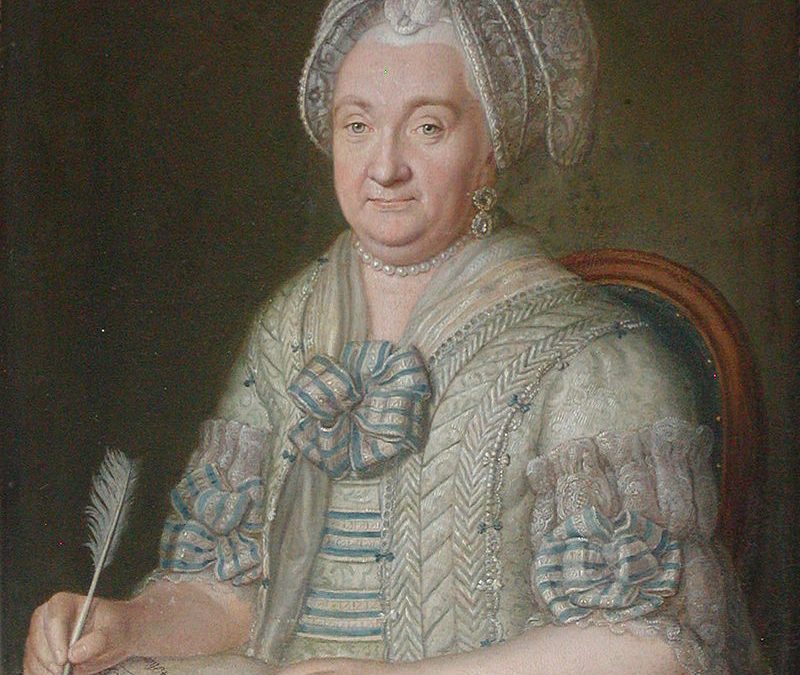
Anna Magdalena Godiche née Høpfner (January 11, 1721 - February 22, 1781) was a Danish book printer and publisher. She managed the biggest printing company in Denmark as the Danish political scene combusted. Born to judge Høpfner in Haderslev Anna married Andreas Hartvig Godiche (1714-1769) of Copenhagen in 1736. Godiche owned one of the biggest printing companies in Denmark and was one of those contributing to the expansion of book printing in the mid 18th century. She took over the company which held the monopoly on printing and publishing the work of Johann Friedrich Struensee and Enevold Brandt, when her husband died in 1769.

Portrait of Johann Friedrich Struensee (1737-1772), Cornelius Høyer (1741-1804) - Frederiksborg Museum
Struensee took over the Danish government in 1770 and held absolute sway for almost thirteen months, between 18 December 1770 and 16 January 1772. With Brandt’s assistance he set about reforming Denmark. Reforms initiated by Struensee included:
- abolition of torture
- abolition of unfree labour (corvée)
- abolition of the censorship of the press
- abolition of the practice of preferring nobles for state offices
- abolition of noble privileges
- abolition of “undeserved” revenues for nobles
- abolition of the etiquette rules at the Royal Court
- abolition of state funding of unproductive manufacturers
- introduction of a tax on gambling and luxury horses to fund nursing of foundlings
- ban of slave trade in the Danish colonies
- rewarding only actual achievements with feudal titles and decorations
- criminalisation and punishment of bribery
- re-organisation of the judicial institutions to minimise corruption
- introduction of state-owned grain storage to balance out the grain price
- assignment of farmland to peasants
- re-organisation and reduction of the army
- university reforms
- reform of the state-owned medical institutions
His reforms were popular at first but Struensee had overstepped the mark with his royal masters, he did not speak Danish, conducting his business in German, his affair with the queen and the birth of their illegitimate child scandalised Danish society and gradually his enemies moved in for the kill.
A palace coup took place in the early morning of 17 January 1772, Struensee, Brandt and Queen Caroline Matilda were arrested in their respective bedrooms, and the perceived liberation of the king, who was driven round Copenhagen by his deliverers in a gold carriage, was received with universal rejoicing. The chief charge against Struensee was that he had usurped the royal authority in contravention of the Royal Law (Kongelov). He defended himself with considerable ability and, at first, confident that the prosecution would not dare to lay hands on the queen, he denied that their liaison had ever been criminal. The queen was taken as prisoner of state to Kronborg Castle.

Enevold Brandt
On 27 April/28 April Struensee and Brandt were condemned first to lose their right hands and then to be beheaded; their bodies were afterwards to be drawn and quartered. The Kongelov had no provisions for a mentally ill ruler who was unfit to govern. However, as a commoner who had imposed himself in the circles of nobility, Struensee was condemned as being guilty of lèse majesté and usurpation of the royal authority, both capital offences according to paragraphs 2 and 26 of the Kongelov.
Struensee awaited his execution at Kastellet, Copenhagen. The sentences were carried out on 28 April 1772 with Brandt being executed first. First, Struensee’s right hand was cut off; next, after two failed attempts his head was severed, stuck on a pole and presented to 30,000 bystanders; then, after disembowelment, his remains were quartered.
The King himself considered Struensee a great man, even after his death. Written in German on a drawing the king made in 1775, three years after Struensee’s execution, was the following: “Ich hätte gern beide gerettet” (“I would have liked to have saved them both”), referring to Struensee and Brandt.
Anna Magdalena Godiche survived the scandal and lived for another 10 years.
Julia Herdman writes historical fiction that puts women to the fore. Her latest book Sinclair, Tales of Tooley Street Vol. 1. is Available on Amazon – Paperback £10.99 Kindle £2.42 Also available on:
Amazon Australia
Amazon Canada
Amazon New Zealand
Amazon South Africa
Amazon USA
by Julia Herdman | Jun 13, 2017 | Blog, Europe, European Royal Families, Fashion, Literature, Marriage, Politics, Romance, Society
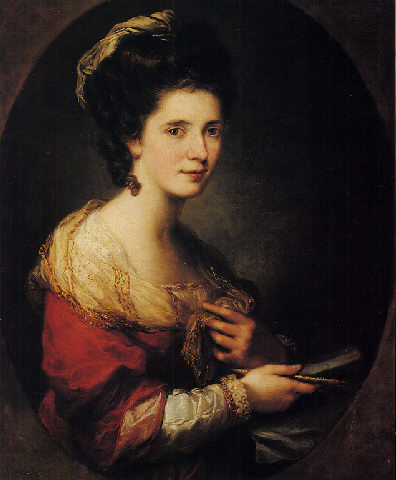
Anne-Louise-Germaine Necker, Baronne de Staël-Holstein, 22 April 1766 – 14 July 1817, was the daughter of the second most important man in France, Louis XVI’s Minister of Finances, Jacques Necker. Madame de Staël was born into a world of political and intellectual prominence. Later, she married Sweden’s ambassador to the French court, and for a span of twenty years, she held the limelight as a political figure and prolific writer. Despite a plain appearance, she was notoriously seductive and enjoyed whirlwind affairs with some of the most influential men of her time. She always attracted controversy and was demonised by Napoleon for her forthrightness, the sheer power of her intellect, and the progressiveness of her salon, which was a hotbed for the expression of liberal ideals. The emperor exiled her, on and off, for the last fifteen years of her life.
Her most famous novel was published in 1802. The story of Delphine tales place in Paris between 1789 and 1792. Delphine d’Albémar, a young widow, arranges a wedding between one of her distant relatives, Matilde de Vernon, and Léonce de Mondoville. But she falls in love with Léonce, and as he is engaged with Matilde, their love is impossible. The story ends tragically with Delphine killing herself.
Germaine grew up in France and was Protestant. Her parents became impatient for her to marry, and they are said to have objected to her marrying a Roman Catholic, which, in France, considerably limited her choice. There is a legend that William Pitt the Younger considered marrying her. The somewhat notorious lover of Julie de Lespinasse, Jacques Antoine Hippolyte, Comte de Guibert, a cold-hearted fop of some talent, certainly paid her attention but she finally settled on Baron Erik Magnus Staël von Holstein, who was first an attaché of the Swedish legation to France and then minister after 1783. For a great heiress possessed of great ambition, the marriage did not seem brilliant, but Germaine had wealth and her future husband had considerable political and social standing. The marriage took place on 14 January 1786 in the chapel of the Swedish embassy in Paris. A singular series of negotiations secured from the king of Sweden a promise of an ambassadorship for 12 years and a pension in case of its withdrawal. At the time of her marriage, Germaine was 20, her husband 37.
On the whole, the marriage seems to have been acceptable to both parties at first, although neither had any affection for the other. The baron obtained great financial benefits, whereas his wife, with the rank of an ambassador’s consort, obtained a much higher position at court and in society than she could have secured by marrying almost any Frenchman, without the inconveniences that might have been expected had she married a Frenchman superior to herself in social rank. In spite of the mutual benefits that each could claim for many years, the marriage did not last. It ended with a formal separation in 1797, although the two remained legally married until the baron’s death in 1802.
Her novels were bestsellers and her literary criticism was highly influential. When she was allowed to live in Paris, she greatly encouraged any political dissident against the regime of Louis XVI. On the day before the September massacres of 1792, she fled writing a florid account of her escape. The fall of Maximilien Robespierre opened the way back to Paris. She reopened her salon and threw herself into opposition to Napoleon Bonaparte. During the years of the Empire she travelled in Germany and Austria and after the death of her husband in 1802 she married a man called Rocca.
In June 1816, she was visited by Lord Byron and she developed a warm friendship with the Duke of Wellington, whom she had first met in 1814. By 1816 she had become confined to her room if not to her bed. She died on 14 July that year. Rocca survived her by little more than six months. Her deathbed conversion to Roman Catholicism surprised many, including Wellington, who remarked that while he knew that she was greatly afraid of death, he had thought her incapable of believing in the afterlife.
Madame de Staël— a force of nature, exuberant idealist, and ultimate enthusiast—waged a lifelong struggle against all that was tyrannical, cynical, or passionless in her time, and left Europe a legacy of enlightened liberalism that radiated throughout the continent during the nineteenth century. There are a couple of notable biographies of this colour woman, Madame de Stael by Maria Fairweather, 2006 and Madame de Stael: The First Modern Woman by Francine du Plessix Gray, 2008.
Julia Herdman writes historical fiction that puts women to the fore. Her latest book Sinclair, Tales of Tooley Street Vol. 1. is Available on Amazon – Paperback and Kindle. Also available on:
Amazon Australia
Amazon Canada
Amazon New Zealand
Amazon South Africa
Amazon USA

by Julia Herdman | Jun 12, 2017 | Blog, British History, Literature, Marriage, Politics, Romance, Society, Writing about history
 Published anonymously, and not attributed to Defoe until 1775, the novel Roxana was a popular hit in the eighteenth century although many readers find it a hard read today.
Roxana was Defoe’s last, darkest, and most commercial novel. It is about a woman who trades her virtue for survival and, once she is secure financially, continues to sacrifice her virtue for greater and greater riches according to John Mullan in the introduction to the Oxford World Classic edition of Roxana.
Money, or lack of it, is the root of Roxana’s problems. The same is true for most female literary characters until the present day. Why is it we girls find it so hard to make ends meet financially?
The book is supposed to be a biography of a woman called Madamoselle Beleau, the lovely daughter of French Protestant refugees, who was brought up in England and married to a good-for-nothing son of an English brewer.
Fictional biographies, an oxymoron if ever there was one, were all the rage in 18th-century literature and Defoe’s story of Roxana was a particularly salacious one filled with moral ambiguity, sex and murder; a sure fired recipe for success even in today’s literature market.
The plot has many twists and turns but begins when after eight years of marriage, our heroine’s spendthrift husband leaves her penniless with five children to look after. Receiving no help from her relatives, she abandons her children to the care of an old woman; abandoning one’s children in any scenario especially a literary one is a sign a woman is about to become morally and socially persona non grata but Roxana justifies abandoning her children on the grounds that they were starving, confessing, ‘the Misery of my own Circumstances hardened my Heart against my own Flesh and Blood.” Of course, her husband has already abandoned them but there is no moral approbation for him.
The penniless Roxana starts up an affair with her landlord whose wife has left him. He offers to share his wealth with her, bequeathing her five hundred pounds in his will and promising seven thousand pounds if he leaves her. Her relationship with the landlord is often condemned by critics as a relationship based on personal gain and not love. A woman should always fulfil the English romantic ideal of giving herself up to love not for financial advantage; an ideal that was more honoured in the breach than in reality especially when it came to families with money in the eighteenth century.
The fictional pair settle down together but Roxana fails to produce a child for her new lover so she sends her maid to do the job for her, which she does. Roxana takes the child as her own to save her maid’s reputation. It seems children were to be traded too in Defoe’s lurid mind. Two years later, Roxana has a daughter of her own but the child dies within six months. A year later, she pleases her lover with a son, the inference being that boys are to be preferred. So far, Roxana’s actions are a curious mixture of adhering to and breaking the social, religious, and cultural norms of the day but with the death of her common-law husband, the landlord, she becomes a devoid of morality and sexual restraint.
 In the next part of the book, Roxana becomes a greedy hedonist and the mistress of a French prince with whom she has a son. She could have stopped her whoring when the landlord died, she had enough money to live as a quiet widow but she did not. The amoral Roxana likes money and sex and seems to have little or no feeling for the children she produces along the way. Finally, she marries a Dutch merchant who has been her longtime lover and friend, has another son and settles down into a respectable life. But, just as she is enjoying life her oldest daughter, Susan, turns up wanting a share of her mother’s new found fortune under threat of blackmail. Luckily Roxana has a maid who will rid her of her troublesome child by murdering her!
When her Dutch husband dies soon after Susan’s murder Roxana enters the final phase of her fall from matronly virtue to a common harlot. She returns to England with her bloom has well and truly gone but she still believes she has sexual power over men but with he looks and body ravaged by age and childbirth her allure fails and she becomes a common prostitute.
The end of the novel was adapted to the moral climate of its publication. In Defoe’s original version Roxana does not die but repents for the life she has lived, and that too—according to Roxana herself—only because she comes to an unhappy end after the death of her husband. However, with the book being published anonymously, as was often the case with fictitious histories in those days, it went through several editions with various endings, in all of which Roxana dies repenting of her sins.
The novel’s importance in feminists’ eyes comes from Roxanna’s celebrated claim that “the Marriage Contract is…nothing but giving up Liberty, Estate, Authority, and everything, to the Man“. It further draws attention to the incompatibility between sexual freedom and the responsibilities of motherhood in a world without contraception. The male characters in the novel seem to receive no moral approbation, unlike Roxana.
Some say the character of Roxana is a proto-feminist like Defoe’s other great female character, Moll Flanders because she works at prostitution for her own ends. Her work earns her independence from men. Indeed Defoe would have been aware of women all over London doing the same but probably with less success than his female characters, neither of which succumb to the pox or the violence that attends such trade.
It is difficult to take any moral or feminist lessons from Roxana because it is a novel of its time and more focused on themes Defoe’s readers would have recognised in the 18th century than any of today’s feminist ideals. I do think Defoe at least recognised an abandoned woman’s plight. As a character, Roxana has her origins in Restoration Comedy. She carries both the hope and optimism of the young that things will turn out well for her financially and in love but she is also burdened by the corruption of those who went before her. Her greed, moral corruption, and self-delusion; were perhaps a reflection of Defoe’s assessment of life.
 The happy ending of Restoration plays is supposed to be a restoration of order from the chaos and confusion fostered by the older generation’s dishonesty and greed. Defoe perhaps cannot blame Roxana for the faults of the older generation and so in his conclusion to the novel he does not seek to punish Roxana with death as so many of its more puritanical publishers did when they re-wrote the ending. I think Defoe knows there is no escape from the corruption of power and money. He had his own scrapes with the law, scrapes in business and got involved in corrupt politics. Perhaps he hopes that in reprieving Roxana his own moral shortcomings will find forgiveness.
by Julia Herdman | Jun 12, 2017 | Blog, Europe, Performing Arts, Romance, Society, Theatre
Giulio Strozzi was the poet and librettist who recognised Barbara as his adopted daughter on 6 August 1619.
She was baptised in the church of Santa Sofia in the Cannaregio district (sestiere) of Venice and officially welcomed into to Strozzi family. Barbara had probably always been part of the Strozzi family as she was his illegitimate daughter by Isabella Garzoni, a long-time servant.
Barbara was lucky. Unlike most women, she was encouraged to develop her musical talents.
Her father introduced her to Venice’s intellectual elite and showcased her talents to advance her career.
Giulio was a member of the Venetian circle of intellectuals known as the Accademia degli Incogniti (“Academy of the Unknowns”), which met to discuss and debate questions of literature, ethics, aesthetics, religion, and the arts. In 1637 Giulio formed a musical subset of the Incogniti, known as the Accademia degli Unisoni (“Academy of the Like-Minded,”) for Barbara where she performed as a singer and suggested topics for discussion.
The Incogniti were early proponents of Venetian opera and Barbara was their leading light, singing for them and writing music for herself and others to perform. Click on the link to hear her haunting cantata - My Mourning sung by Pamela Lucciarini.
 Barbara thrived in the society her father created for her. But her role as hostess of the Unisoni and her very public involvement in music were satirized in an anonymous manuscript that may have been penned by a member of the Incogniti; the author equated her status as a musician with the licentious behaviour of a courtesan.
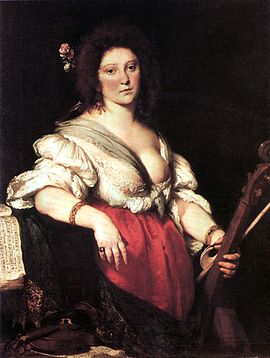
A portrait of her by Bernardo Strozzi (not of the same family) has been interpreted as one implying she was indeed a woman of less than prefect morals and the fact that she never married but had four children rather suggests she was not considered good marriage material by the men she consorted with. Her two daughters became nuns and one of her sons became a monk.
Giulio Strozzi’s proto-feminist sensibilities garnered Barbara an opportunity that would be closed to most women composers for centuries. Barbara published eight collections of her vocal works between 1644 and 1664, seven of which survive.
Barbara Strozzi was a woman ahead of her time — far ahead of her time, as it would still be several centuries before most women could have serious careers as composers. Strozzi published many volumes of music, which in itself indicates that her music was well received. Her compositional output following her first volume of madrigals consisted mostly of arias, cantatas, and ariettas. The arias are generally short strophic pieces (every stanza is sung to the same music), while the cantatas are mostly longer sectional works in which the music changes to suit the meaning of the text. For example, impassioned or pathos-ridden poetry might be set as recitative, whereas music with dance rhythms might be used for poetry with a lighter character. Most of the poetry centres on the theme of love, in a manner consistent with the Marinist aesthetic of the mid-17th century, which valued wit, linguistic virtuosity, and erotic imagery. Her one collection of sacred motets, the Sacri musicali affetti (1655), was linked to the notion of Christian caritas, which represents the church as a benevolent mother; the volume was also connected to the devotional practices of its dedicatee, Anna de’ Medici, archduchess of Innsbruck.
Although she never married, Strozzi had four children; her two daughters joined a convent, and one of her sons became a monk. Barbara died in 1677 leaving behind a body of work praised for its wit, linguistic virtuosity, and erotic imagery.
Sources : Rebecca Cypess Encyclopedia Britannica
Barbara Strozzi
QUICK FACTS
BORN 1619
Venice, Italy
DIED November 11, 1677 (aged 58)
Padua, Italy

RELATED BIOGRAPHIES
Francesca Caccini
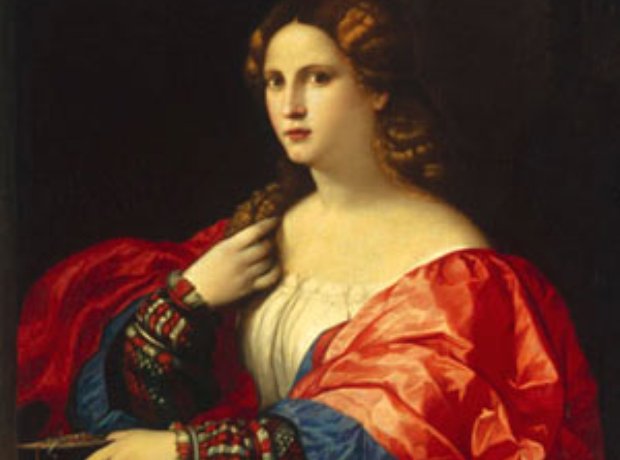
Francesca Caccini was born 18 September 1587 and was an Italian composer, singer, lutenist, poet, and music teacher of the early Baroque era. She was also known by the nickname “La Cecchina”, given to her by the Florentines and probably a diminutive of “Francesca”. She was the daughter of Giulio Caccini. Her only surviving stage work, La liberazione di Ruggiero, is widely considered the oldest opera by a woman composer.
Settimia Caccini
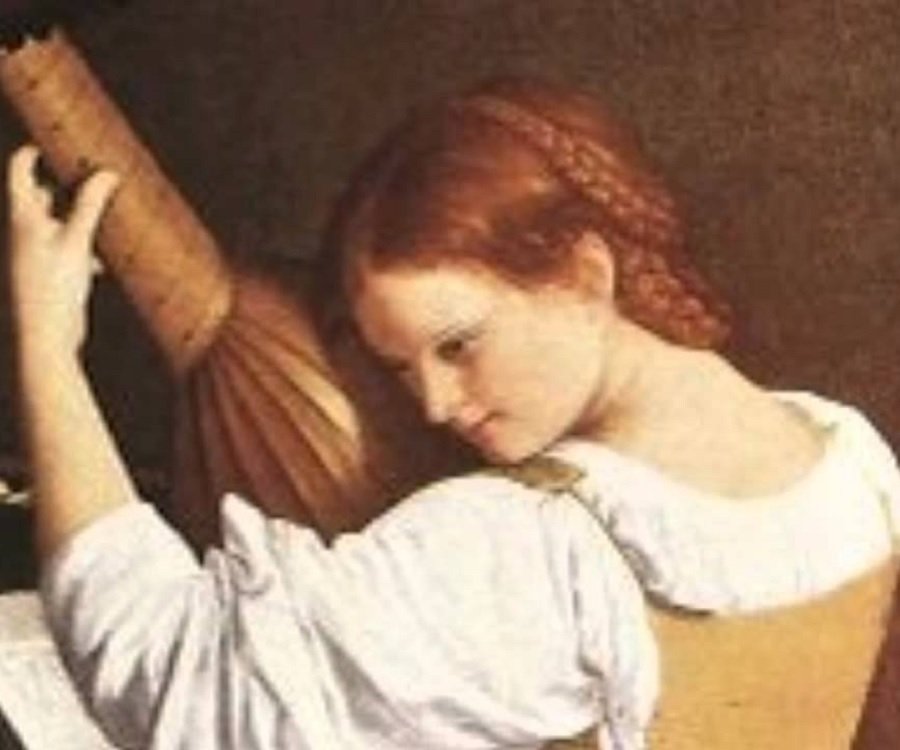
Born 6 October 1591 – ca. 1638, Italy, Settima was a well-known Italian singer and composer during the 1600s being one of the first women to have a successful career in music. Caccini was highly regarded for her artistic and technical work with music. She came from a family of well-known composers and singers, with her father being Giulio Caccini and her sister Francesca Caccini. Steam Caccini was less well-known as a composer because she never published her own collection of works. Instead, nine works are attributed to her in two manuscripts of secular songs. Settimia was known much more for her talent as a singer, and she performed for nobility with the Caccini family consort and as a soloist. Coming from a musical family, she was able to lead herself to her own fame and success.
See Also:
Giovanna Bassi - Ballet Dancer, Mother and Spy
Flowers, Theatre and Fashion - Fanny Abington
Julia Herdman writes historical fiction that puts women to the fore. Her latest book Sinclair, Tales of Tooley Street Vol. 1. is Available on Amazon – Paperback £10.99 and on Kindle Also available on:
Amazon Australia
Amazon Canada
Amazon New Zealand
Amazon South Africa
Amazon USA

by Julia Herdman | Jun 9, 2017 | American History, Blog, Europe, France, Literature, Marriage, Politics, Romance, Society, Visual arts

Maria Hadfield Cosway, Repelling the Spirit of Melancholy
Maria Cosway was born Luisa Caterina Cecilia Hadfield was born on 11 June 1760 in Florence, Italy to Charles Hadfield, who was a native of Shrewsbury, England, and an Italian mother.
Her father was a successful innkeeper at Livorno, where he had become very wealthy. The Hadfields operated three inns in Tuscany, all frequented by British aristocrats taking the Grand Tour.
One of eight children Maria was born into a comfortable and happy family. Her life should have been a tranquil one. Unbeknown to the family tragedy would overtake them when four of the Hadfield children were killed by their mentally ill nursemaid who claimed she was sending the children to heaven. Luckily she was caught and imprisoned before she could kill Maria.
While still in Florence, Maria Hadfield studied art and painting under Violante Cerroti and Johann Zoffany.
The Florentine Violante Beatrice Siries (1709–1783) was an Italian painter of repute. She studied under Hyacinthe Rigaud and François Boucher in Paris from 1726. When she returned to Florence she married Giuseppe Cerroti. She was talented in several genres, but established herself as a famous portraitist She gained the patronage of the Medici family in 1731 and travelled to Rome and Vienna to paint various members of the family .Her most ambitious work was a fourteen figure family group of the emperor Charles VI, the father of the Austrian Empress Maria Theresa in 1735. Three of her self-portraits are preserved in the Uffizi Gallery.
Johann Zoffany (1733 -1810) was a German neoclassical painter, active mainly in England, Italy and India. His works appear in many prominent British collections such as the National Gallery, London, the Tate Gallery and in the Royal Collection, as well as institutions in Europe, India, the United States and Australia. While Zoffany was painting The Tribuna of the Uffizi in 1773 Hadfield copied Old Masters at the Uffizi Gallery. She continued copying for another five years and experimenting until 1778 when she was elected to the Academia del Disegno in Florence in 1778. She also went to Rome, where she studied art under Pompeo Batoni, Anton Raphael Mengs, Henry Fuseli, and Joseph Wright of Derby.

Self Portrait With Arms Folded
On 18 January 1781, Maria Hadfield married a fellow artist, the celebrated miniature portrait painter Richard Cosway, in what is thought to have been a marriage of convenience.
Richard was born in Tiverton, Devon, the son of a schoolmaster. He was initially educated at Blundell’s School but at the age of twelve he was allowed to travel to London to take lessons in painting. He won a prize from the Society of Artists in 1754 and by 1760 had established his own business. He exhibited his first works at the age of 20 in 1762 and was soon in demand.
Maria’s husband was one of the first group of associate members of the Royal Academy, elected in August 1770, and was elected a full member the following March, on the casting vote of the academy’s president, Sir Joshua Reynolds. He was 20 years Maria’s senior, known as a libertine, and was repeatedly unfaithful to her.
Richard Cosway was “commonly described as resembling a monkey.” Her Italian manners were so foreign that her husband kept Maria secluded until she fully mastered the English language. Cosway also forbade his wife from painting, possibly out of fear of the gossip which surrounded women painters.
Her Self-Portrait with Arms Folded is seen as a response his command. The reprobate Cosway, realised his wife was his best financial asset and changed his mind.
More than 30 of her works were displayed at the Royal Academy of Art from 1781 until 1801. She soon enhanced her reputation as an artist, especially when her portrait of the Duchess of Devonshire in the character of Cynthia was exhibited.
Rather than being a social embarrassment she could claim the Hon. Mrs. Darner, the Countess of Aylesbury; Lady Cecilia Johnston; and the Marchioness of Townshend among her acquaintances.
In 1784, the Cosways moved into Schomberg House, Pall Mall, and developed a fashionable salon for London society. Richard was Principal Painter of the Prince of Wales, and Maria served as hostess to artists, members of royalty including the Prince, and politicians including Horace Walpole, Gouverneur Morris and James Boswell all attended the couples soirees. Maria who could speak several languages and had an international circle of friends.
The man who would be the American President Thomas Jefferson met the Cosways in August 1786 at the Halle aux Bleds in Paris, through the American artist John Trumbull. According to Trumbull, the President’s entourage “was occupied with the same industry in examining whatever relates to the arts …. Mr. Jefferson joined our party almost daily.” Their excursions included sites such as Versailles, the Louvre, Louis XIV’s retreat Marly, the Palais Royal, St. Germain, and the Column at the Désert de Retz.
Jefferson was enchanted by Maria, and her departure from Paris in October 1786 compelled him to write the only existing love letter in the vast collection of his correspondence.
In ‘The dialogue between my Head and my Heart,” dated October 12th and 13th, 1786. Jefferson poured out the contents of both. The bulk of the letter is a dialogue between Jefferson’s calculating reason (for which he is well known) and his spontaneous emotions (for which he is lesser known). Jefferson describes his emotional state after she has left saying he is “the most wretched of all earthly beings” and his reason responds by admonishing him for his attachment. His heart defends itself saying that no one will care for him who cares for nobody.
Their marriage was never a happy one. Richard and Maria had one child together, Louisa Paolina Angelica. The couple eventually separated. Maria took herself back to the continent. On one occasion accompanied by Luigi Marchesi, a famous Italian castrato. Marchesi was reputed to have been the handsomest castrato of all time and was said to have been adored by the whole female population of Rome. Maria, was a beautiful woman who attracted the most gifted and handsome of men.
Whether she ever had a relationship with Jefferson remains a mystery. Though her husband’s extramarital affairs were no secret, Cosway was a married woman and a devout Catholic when she met him so it is unlikely she entered into sexual relationship with him. The pair did however engage in correspondence.
After returning to America in 1789, Jefferson’s letters to her grew less frequent; partly due to the fact that he was increasingly preoccupied by his position as President George Washington’s secretary of state. She, however, continued to write to him. In her letters she vented her frustration at his growing aloofness. She clearly wanted a some passion to pass between them even if it was only in writing. In his last letters, he spoke more of his scientific studies than of his love and desire for her. Finally he admitted that his love for her had been relegated to fond memories of when their relationship had been “pure.” Whatever that meant.
Their relationship was fictionalised in ‘Jefferson in Paris‘ a 1995 Franco-American historical drama film, directed by James Ivory, which had previously entitled Head and Heart. The screenplay, by Ruth Prawer Jhabvala, is a semi-fictional account of Thomas Jefferson’s tenure as the Ambassador of the United States to France before his Presidency and of his alleged relationships with British artist Maria Cosway and his slave, Sally Hemings.
Maria Cosway eventually moved to Lodi, in Italy, where she established a convent school for girls. Cosway and Jefferson wrote to one another occasionally, with letters coming first from Cosway.
At her home in Lodi, Cosway kept the portrait of Jefferson by John Trumbull that is now at the White House. It was presented to the United States by the Italian government on the occasion of the 1976 Bicentennial of the American Revolution.
Today, Cosway’s paintings and engravings are held by the British Museum, the New York Public Library and the British Library. Her work was included in recent exhibits at the National Portrait Gallery in London in 1995–96 and the Tate Britain in 2006.
Julia Herdman writes history ad historical fiction. Her latest book Sinclair, Tales of Tooley Street Vol. 1. is Available on Amazon – Paperback £10.99 and Kindle Also available on:
Amazon Australia
Amazon Canada
Amazon New Zealand
Amazon South Africa
Amazon USA
See Also:
The History of the Love Letter
How to Write a Good Love Letter

Recent Comments