
by Julia Herdman | Jul 7, 2017 | Blog, British History, Politics, Romance, Society, Writing about history
The position of women in the historical novel is problematic for authors. I am interested in exploring the strengths and weaknesses of my characters and how they cope with the historical world and I want to show women in a positive and realistic light. However, when it comes to writing about women in past I am confronted with some tricky problems. The main problem is that for most of history women were legally, socially and economically subject to the will of men.
In a strange way, poor women were the freest to be themselves as they worked even when they were married and had children. Poor women earned their own money. The problem for these women was that their earnings were always vastly inferior to men’s. A woman alone in the past was almost invariably a poor and exploited one.
It is true that in London and in other large towns where there was the possibility of social anonymity many women turned to prostitution as a more lucrative way of staying alive.
For women of the middling sort, I hesitate to use the word class here, as for most of history there was no middle class as we know today, financial dependence on men was the norm even into the middle of the last century. Of course, financial dependence on men has not gone away as women are still paid on average 16% less than men for the same work but women are thankfully no longer forced into financial servitude to men.
A single ‘free’ woman in the past was the exception. Any unmarried woman would almost certainly be viewed as unsuccessful.
Marriage and children were the markers of success for a woman in past. With no meaningful contraception, women were constantly burdened with pregnancy and subject to premature death in childbirth. They were responsible for almost all childcare unless a woman was wealthy enough to employ a nurse or nanny.
Of course marriage still an honourable estate for most men and women but more women are going it alone than ever before and are happy with their decision. For the majority of us who marry, it’s a struggle to manage a demanding career and a family no matter how successful we are in our chosen profession.
So how does the modern author go about creating their female historical characters?
Well, some authors focus their attention on the few women who broke the mould in the past while other abandon any sense of historical verisimilitude. Some use the Cinderella formula while others make their female characters masculine, sassy and ruthless. All of these forms can work if the story is good enough but they were not for me in the Tales of Tooley Street as the characters are inspired by actual people who lived and worked at 65 Tooley Street for three generations.
Approaches to representing female characters in the past:
Some argue that The Fortunes and Misfortunes of the Famous Moll Flanders (commonly known simply as Moll Flanders) a novel by Daniel Defoe, first published in 1722 is the prototype for a female character who by the end of the novel controls her own life and is financially independent. Moll achieves what many feminists call success.
Feminist writer Diana Del Vecchio says, “By the end of the book, Moll has completely appropriated the role of the husband, the provider, the masculine, the seeker, the adventurer, the leader, the thinker, and has figuratively donned the clothing of man, while keeping her nature as woman intact. She makes the final decision to enter and sign a legal contract with her son, where he manages her inherited land and gives her an annual compensation of the lands’ produce. When she returns to Jemy, it is she that supplies him with a dowry of a gold watch, a hundred pounds in silver, a deerskin purse, Spanish pistols, three horses with harnesses and saddles, some hogs, two cows, and other gifts for the farm. She enters this relationship with the fortune of her inheritance and the many accouterments that she has acquired and accumulated in her years as a thief. For the first time in her life, she forms a relationship with a man, where she is the one in control.”
The fact that Moll has to step outside the law to become independent is the problem for me but it is probably a realistic one as Defoe was fully aware of the way society worked in the early 18th century. Prostitution and thieving were rife in London in the 18th century but most women involved in the trade did not end up like Moll. Most ended in an early grave, at the end of a noose or transported for life if caught. My character is inspired by a respectable widow who raises her son to be a successful doctor so prostitution and thieving are not options for her.
Historian Lucy Worsley’s most recent BBC TV series on the Wives of Henry III offers an alternative approach to the female character and narrative in history.
In the series, Dr. Worsley looked at the events of Henry’s reign through the eyes of the women involved. She cleverly managed to breath new life into this overworked territory by showing Katherine of Aragon as a competent and popular queen not as the obsessively religious woman of traditional portrayals. She showed Katherine was intelligent, ambitious and for much of her 24-year marriage to Henry, she gave as good as she got. Anne Boleyn too was shown as a clever and ambitious woman betrayed by her husband and removed on trumped up charges of adultery. Jane Seymour was a young and tragic a woman fed to the old lecher of a king by her male relatives only to die in childbirth. Ann of Cleaves was a smart political operator who negotiated herself out of disaster and ended up one of the richest women in England. Catherine Howard was what we would call an abused child who did not know how to say no to powerful and determined men; and, Katherine Parr was a wily woman of great learning and intellect who used her position to promote the establishment of the ‘new religion’ Protestantism and managed to outmaneuver and outwit her enemies at court.
In my own writing, I have taken the Lucy Worsley approach. My heroine, Charlotte Leadam, the widow of the Tooley Street surgeon, Christopher Leadam, is intelligent and resourceful but she is an 18th-century woman living in 18th century London. She faces financial ruin when her husband dies. As a woman, she cannot run the apothecary shop she owns because she cannot hold an apothecary license as a woman but she must pay her husband’s debts. As a widow, she yearns for the return of the feeling of financial security and independence she enjoyed when she was married but she does not want to remarry. Charlotte achieves her desires by complying with some social conventions of the day and by ignoring others but she’s always well within the law. Here’s an excerpt.
“You and John will stay here with us now that Christopher has gone,” her mother said, in a tone that indicated it was not a matter for discussion.
“That’s very kind of you and father, but Christopher has not gone, as you put it. He died; my husband is dead. I am a widow, not an abandoned child.”
“We know that, dearest. Your father and I comprehend the situation all too clearly,” she said, handing her daughter a fresh towel and a bar of soap. “You’re a woman without a husband and without an income. You cannot simply go back to your old life, Charlotte; it no longer exists. Your father and I have discussed the matter, and we have decided that it is best that you and John stay here where we can provide for you. That is until you marry again.”
The flame of ire burning in Charlotte’s chest was rekindled and refuelled. Whilst she could not dispute her mother’s analysis of the situation, she was nonetheless livid with her for expressing it so clearly. She bit her lip, held her tongue and breathed the long slow breaths that Christopher had taught her to use in such situations. Experience told her that this was not the time or the place to have an argument with her mother. Losing her temper never worked; she had to be more cunning than that. As calmly as she could she said, “Mother, I have no plans to remarry.”
“I’m not saying that you have to forget Christopher. I’m not that cruel and insensitive. ” She pointed to the bath. “Your father took this in lieu of payment from a whore in St James’s. The poor woman could not pay her rent either, so your father took the bath before the landlord did. My friend Mrs. Peacock says that bathing is of great benefit for the nerves, so I thought you might like to try it. I shall not be doing so: I’m too old to change the habits of a lifetime. Besides, they cost a fortune in hot water – which is all very well for Mrs. Peacock: her husband is a banker. And I can’t use poor Millie like this again; she is exhausted with carrying the pails from the kitchen.”
When her mother had gone Charlotte launched herself face down onto the bed and let out a long, low scream of frustration. How dare her mother decide what she was going to do with her life without even talking to her about it? And why had she told her about the whore? Was she trying to warn her what happens to women who are left on their own?
Julia Herdman writes historical fiction that puts women to the fore. Her latest book Sinclair, Tales of Tooley Street Vol. 1. is Available on Amazon
Amazon Australia
Amazon Canada
Amazon New Zealand
Amazon South Africa
Amazon USA

by Julia Herdman | May 1, 2017 | Blog, British History
Horse racing is the second largest spectator sport in Great Britain, and one of the longest established, with a history dating back many centuries. It generates over £3.7 billion for the British economy, and the major horse racing events such as Royal Ascot and Cheltenham Festival are important dates in the British and international sporting and social calendar.
In the early 18th century, Queen Anne kept a large string of horses and was instrumental in the founding of Royal Ascot where the opening race each year is still called the Queen Anne Stakes. The first published account of race results was John Cheney’s Historical list of all the Horse Matches run, and all plates and prizes run for in England and Wales which dates to 1727. In a later work, published in York in 1748, the result is recorded of a race run in September 1709 on Clifton and Rawcliffe Ings, near York, for a gold cup of £50.
By 1740 was proving so popular that Parliament introduced an act “to restrain and to prevent the excessive increase in horse racing”; this was largely ignored, and in 1750 the Jockey Club was formed to create and apply the Rules of Racing. The Jockey Club was founded as one of the most exclusive high society social clubs in the United Kingdom, sharing some of the functions of a gentleman’s club such as high-level socialising. It was called ‘The Jockey Club’ based on the late medieval word for ‘horsemen’, pronounced ‘yachey’ and spelt ‘Eachaidhe’ in Gaelic. The club’s first meetings were held at the Star & Garter Pub at Pall Mall, London before later moving to Newmarket; a town known in the United Kingdom as “The Home of Racing”.
Soon racecourses were springing up all over England and many of the classic tracks and races we know today were established such as The St Leger, the Oaks and the Derby were all founded between 1776 and 1780.
The Whitsun meeting was a popular event in the Georgian horse racing calendar. Here is an extract from my novel Sinclair, which is partly set near Beverley in Yorkshire. Beverley was the first racetrack to have a Jockey Club grandstand built to enable spectators to get a better view of the race in 1767 at the cost of £1,000.
” Three days after his father’s funeral, John Leadam and his mother Charlotte was packed into a pony cart by his uncle for the journey to York. They travelled in silence for many dull miles before his uncle spoke. “I’m sorry things turned out as they did, me lad. We had such plans, you know, your father and me. We fancied a day at the point to point.”
“Father would have enjoyed that,” said John.
“As far as I’m concerned, there’s nowt like the thrill of a race. I’ve spent a right few bob on horses in me time as I’m sure your aunt has told you. Lucy loves horses just like me. I’m of a mind to get me hands on one of them thoroughbred mares, but I’ll have to go up north to Bedale or Masham to get one. There’s plenty as wants a good racer or a good hunter in these parts.”
“Would you breed racehorses then, Uncle Robert?”
“Oh, aye, I do already, but they ain’t Arabians. I had great hopes for Blaze. He had a coat as shiny as a conker, but he fell in the first steeplechase I put him in, and I had to shoot the poor bugger. Cost me near fifty guineas. Mariah were furious with me, but when have women known anything about having a bit a fun, eh, John?”
“I heard that, Robert Leadam,” his mother retorted with feigned coolness. “And I’ll ask you not to go corrupting your nephew with ideas about gambling and horses.”
“Now I’m in trouble with your mother,” his uncle chuckled. “I expect you’re more like your dad, John. I bet you’re a sensible boy who works hard at that grammar school you go to in London. It never appealed to me, all that Greek and Latin. What does a farmer need with it? Now, your dad were a different kettle of fish. If the old man hadn’t insisted on educating me there would’ve been enough to send your dad to Oxford, or some such place.”
John looked at his uncle. “I think he would have liked that.” Then he noticed his mother staring out across the frost-covered fields, and said, “But then he wouldn’t have met Mother and everything would have been different.” His mother turned her head and smiled at her son. Robert rattled on, oblivious of the deep emotion that was passing between his passengers, and pushed the piebald ponies on with a swish of his whip.
“Aye, lad, fate’s a funny thing.None of us knows what’s in store for us or how the choices we make will turn out. We just have to make the best of what we’ve got, don’t we?” Charlotte Leadam nodded her head and pressed her hand into her son’s under the blanket, reassuring him of the unbreakable bond between them.”
Julia Herdman writes historical fiction that puts women to the fore. Her latest book Sinclair, Tales of Tooley Street Vol. 1. is Available on Amazon – Paperback £10.99 Kindle £2.42 Also available on:
Amazon Australia
Amazon Canada
Amazon New Zealand
Amazon South Africa
Amazon USA
Royal Ascot - Horses, Hats and Lots of Money

by Julia Herdman | Apr 29, 2017 | Blog
Caroline’s Early Life
Caroline Lucretia Herschel was born March 16, 1750, in Hanover, Germany. Her father, Isaac Herschel, was a talented army oboist. At the age of ten, she was struck down with typhus, the effect of this often fatal disease was stunted growth; she never grew taller than four feet three inches, and her eyesight was impaired too. Caroline made an inauspicious start to becoming one of the leading women in the history of women in science.
Her father, did his best to give Caroline and his other children the best education he could without having any proper education himself. He taught his children astronomy, music, and philosophy and Caroline soaked them up. Her mother believed that her daughter would ever marry and decided she should become a household servant discouraging the girl’s education whenever she could. However, after her father passed away in 1767 when Caroline was just 17, she decided to take greater control of her life and took up dressmaking courses and started to train to be a governess. The combination of her demanding mother and the demands of her studies led Caroline to leave Hanover and join her brother, William, who was working as an organist in Bath in 1772.
Caroline the musician and astronomer
For 10 years brother and sister worked together, William playing the organ and Caroline singing. When William decided to abandon his musical career, Caroline followed. In addition to assisting her brother in his observations and in the building of telescopes, Caroline became a brilliant astronomer in her own right, discovering new nebulae and star clusters. She was the first woman to find a comet (she discovered eight in total) and the first to have her work published by the Royal Society. She was also the first woman in Britain to get paid for her scientific work, when William, who had been named the king’s personal astronomer following his discovery of Uranus in 1781, persuaded his patron to reward his assistant with an annual salary.
After William’s death in 1822, Caroline retired to Hanover. There she continued her astronomical work, compiling a catalogue of nebulae. The Herschels’ work had increased the number of known star clusters from 100 to 2,500. Caroline died in 1848 at age 97 after receiving many honours. She was the first woman to be awarded a Gold Medal of the Royal Astronomical Society (1828), and to be named an Honorary Member of the Royal Astronomical Society. The King of Prussia presented her with a Gold Medal for Science on the occasion of her 96th birthday in 1846. In her journal, autobiographical writings and letters to relatives Caroline complained a great deal about her lot, she had spent a great deal of her life caring for her brother and her family. She neither meekly accepted nor publicly challenged the demands they made on her, but she was was delighted by the formal recognition she received later in life.
Sources: Wikipedia, https://www.britannica.com/biography/Caroline-Lucretia-Herschel, Rebekah Higgitt, lecturer in history of science and formerly a curator at the Royal Observatory, Greenwich writing in the Guardian 16/3/2016.
Julia Herdman writes historical fiction. Her latest book Sinclair, Tales of Tooley Street Vol. 1. is Available on Amazon – Paperback £10.99 Kindle
Also available on:
Amazon Australia
Amazon Canada
Amazon New Zealand
Amazon South Africa
Amazon USA
Witch or Saint ? Maria Gaetana Agnesi
Nursing by Numbers
Physicist Dies in Childbirth
by Julia Herdman | Apr 9, 2017 | Blog, British History, Disasters, Science, Writing about history
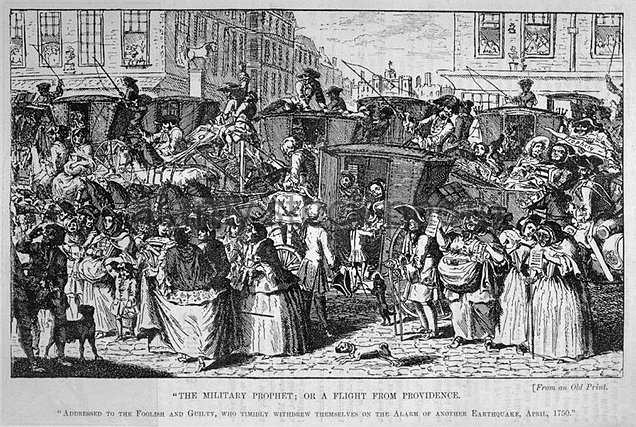
On the 8th of March, 1750, an earthquake shook London. The shock was at half past five in the morning. It awoke people from their sleep and frightened them out of their houses. A servant maid in Charterhouse-square, was thrown from her bed, and had her arm broken; bells in several steeples were struck by the chime hammers; great stones were thrown from the new spire of Westminster Abbey; dogs howled in uncommon tones; and fish jumped half a yard above the water. London had experienced a shock only a month before, namely, on the 8th of February 1750, between 12 and 1 o’clock in the day and at Westminster, the barristers were so alarmed that they imagined the hall was falling!
Most people (including academics) saw the tremors as the work of God. However, The Gentleman’s Magazine, (founded by Edward Cave, alias ‘Sylvanus Urban’, in 1731) which was interested in everything, told its readers that there were three kinds of earthquake; the ‘Inclination’, which was a vibration from side to side, the ‘Pulsation’, up and down, and the ‘Tremor’, “when it shakes and quivers every way like a flame.” Scholars were agreed that the origins of earthquakes were to be found in the underground voids with which the earth was believed to be honeycombed, especially in mountainous regions; but whether it was the surges of air, water or fire within these caverns that were the actual cause of the shock was still disputed.
Despite only the minor damage, Londoners were worried. One earthquake was remarkable, but two earthquakes in a month was unprecedented. Were they a warning from God? Thomas Sherlock, the Bishop of London, was sure of it. In a letter to the clergy and inhabitants of London, he called on them to “give attention to all the warnings which God in his mercy affords to a sinful people…by two great shocks of an Earthquake”. He pointed out that the shocks were confined to London and its environs, and were therefore ‘immediately directed’ at that city.
On Sunday, March 18, at about 6 pm, Portsmouth and the Isle of Wight were shaken, and, as they trembled, the air vibrated to a noise like the firing of great guns. The shock was even felt, though faintly, at Bath. On Monday, April 2, at about 10 pm, Liverpool and an area about 40 miles round vibrated to ‘a smart shock of an earthquake’ for two or three seconds.
1750 was a year when the earth trembled up and down the land. The weather was also considered freakish. People lived in trepidation waiting for the next catastrophe.
The last, and strongest, English earthquake of 1750 shook Northamptonshire and several other counties, just after noon on September 30. It was ‘much stronger than that felt in London”, and lasted nearly a minute. Part of an old wall in Northampton was thrown down, a lady in Kelmarsh was tossed from her chair, and all over the shaken district people ran into the street. At Leicester, a rushing noise was heard, and the houses heaved up and down. The convulsion caused terror, but passed off with only the loss of some slates, chimney parts, and a few items of glassware. Near Leicester, an unfortunate child was shaken out of a chair into a fire, and was ‘somewhat burnt’.
Sinclair, Tales of Tooley Street Vol. 1 is Available on Amazon – Paperback £10.99 Kindle £2.29
Amazon Australia
Amazon Canada
Amazon New Zealand
Amazon South Africa
Amazon USA

Recent Comments