The annual RHS Chelsea Flower Show opened today - 22nd May 2017 with a visit from HM Queen Elizabeth and in the evening with its traditional charity preview. The RHS patron, HM the Queen, is the guest of honour at each show. The show is so popular tickets are restricted to four per person and are already sold out. Tickets for the Gala dinner start at £700 per head for; champagne, canapés and live music followed by a three-course meal.
Chelsea is probably the world’s most famous horticultural shows and is the place to see cutting-edge garden design, find new plants and new ideas to enhance your garden. The show is held in the grounds of Royal Hospital Chelsea which was once the site of the famous 18th century Ranelagh Gardens.
Ranelagh was one of the great melting pots of 18th century society. Entry cost two shillings and sixpence, compared to a shilling at Vauxhall and Horace Walpole wrote soon after the gardens opened, “It has totally beat Vauxhall… You can’t set your foot without treading on a Prince, or Duke of Cumberland.” Novelist Fanny Burney described how the nightly illuminations and magic lanterns ‘made me almost think I was in some enchanted castle or fairy palace’. Originally designed to appeal to wealthier tastes, pleasure gardens soon became the haunt of the rich and poor alike.
When it first opened in 1746, Ranelagh boasted acres of formal gardens with long sweeping avenues, down which pedestrians strolled together on balmy summer evenings. Other visitors came to admire the Chinese Pavillion or watch the fountain of mirrors and attend musical concerts held in the great 200-foot wide Rotunda, the gardens’ main attraction where Mozart performed as a child. Yet the novelty soon waned. In June of that year Catherine Talbot wrote to a friend that “…it is quite vexatious at present to see all the pomp and splendour of a Roman amphitheatre devoted to no better use than a twelvepenny entertainment of cold ham and chicken.” And Ranelagh soon lost out to the cheaper and more exciting Vauxhall Gardens. It probably didn’t help that the Rotunda proved to have dreadful acoustics, there was no drinking or gambling allowed and the grounds were too well lit for assignations. However, Ranelagh remained open for sixty years weathering the storms and frosts of the 1780s, London riots and the French wars until 1803.
The RHS Chelsea Flower Show is organised by the Royal Horticultural Society which was founded in 1804. The Chelsea Flower Show started over 100 years ago it was just a few tents and was nothing like the spectacle it is today. The Royal Hospital is proud of its links with the Royal Horticultural Society. Today the show is a highlight of the social calendar for the English elites and the Great Pavilion is one of main attractions covering roughly 11,775 square metres or 2.90 acres, enough room to park 500 London buses.
One of the RHS’s campaigns they will be promoting at the show this year is ‘Greening Grey Britain.’ Watch this wonderful transformation.
Julia Herdman writes historical fiction that puts women to the fore. Her latest book Sinclair, Tales of Tooley Street Vol. 1. is Available on Amazon – Paperback and Kindle. Also available on:
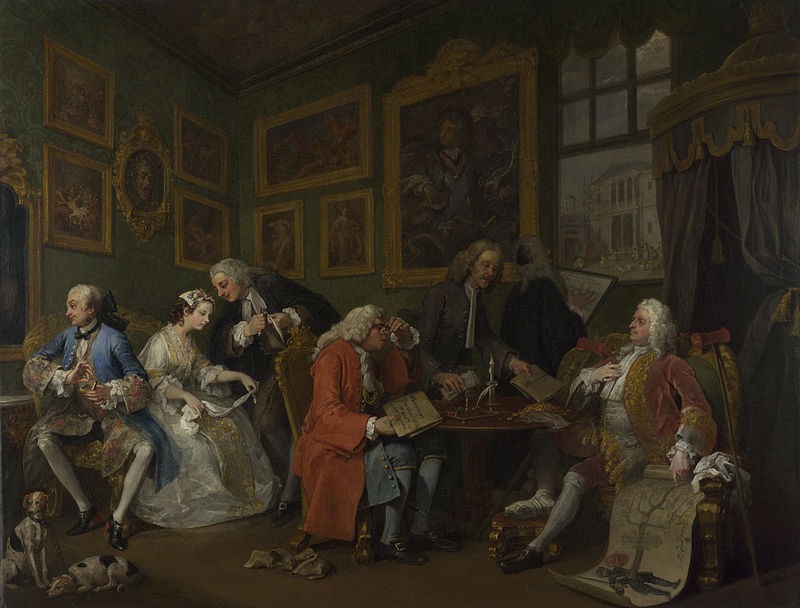
Marital ethics were the topic of much debate in 18th-century Britain. The many marriages of convenience and their attendant unhappiness came in for particular criticism, with a variety of authors taking the view that love was a much sounder basis for marriage than money. Hogarth for one felt the disquiet in British society sufficient to satirise it in a series of paintings called Marriage a la mode.
In the first of the series, The Marriage Settlement Hogarth shows an arranged marriage between the son of bankrupt Earl Squanderfield and the daughter of a wealthy but miserly city merchant. The construction on the Earl’s new mansion, visible through the window, has stopped as a usurer negotiates payment for further work at the centre table. The gouty Earl proudly points to a picture of his family tree. The son views himself in the mirror, showing where his interests in the matter lie. The distraught merchant’s daughter is consoled by the lawyer Silvertongue while polishing her wedding ring. Even the faces on the walls appear to have misgivings. Two dogs chained to each other in the corner mirror the situation of the young couple.
The pressure put on many young people to marry the ‘right’ person led to many secret marriages with the right people for them. This was possible because until the middle of the 18th century marriages could take place anywhere provided they were conducted before an ordained clergyman of the Church of England. Of course, this also left a lot of scope for bigamy and marriages to girls who were under age.
The trade in these irregular marriages had grown enormously in London by the 1740s and led to the introduction of the Marriage Act 1753, popularly known as Lord Hardwicke’s Marriage Act. This Act was the first statutory legislation in England and Wales to require a formal ceremony of marriage. The Act came into force on 25 March 1754 making the reading of banns, registration of a marriage and need for the marriage to be witnessed compulsory for the first time.
No marriage of a person under the age of 21 was valid without the consent of parents or guardians. Clergymen who disobeyed the law were liable for 14 years transportation. Jews and Quakers were exempted from the 1753 Act, but it required other religious non-conformists and Catholics to be married in Anglican churches.
The idea of secret marriage was taken up in the 1766 play, The Clandestine Marriage by George Colman the Elder and David Garrick. The play is a comedy and was first performed in 1766 at Drury Lane. The plot concerns a merchant, Mr Sterling, who wants to marry off his elder daughter to Sir John Melvil, who is in love with his younger daughter, Fanny. Fanny, however, is in love with a humble clerk, Lovewell, whom she has secretly married. Her attempts to extricate herself from the arrangement with Melvil lead to her being offered as a bride to Melvil’s elderly uncle, Lord Ogleby. But the truth comes out and she is saved from the awful fate of having to marry a man many years her senior whom she does not love and she and Lovewell are forgiven. In 1999, the play was made into a film directed by Christopher Miles and starring Nigel Hawthorne, Joan Collins, Timothy Spall, Emma Chambers and Tom Hollander.
Paul Nicholls and Natasha Little as the lovers in The Clandestine Marriage, 2000.
The Act did not change the position of a wife in law. On marriage, a woman became the property of her husband as soon as she said. “I do.” Clandestine and illegal marriages were not the exclusive domain of the wealthy. Many poor women where duped by unscrupulous, indecisive and inconstant men. Perhaps the most famous woman to be duped in this was Maria Fitzherbert (26 July 1756 - 27 March 1837) the secret wife of George, Prince of Wales, the future George IV.
In 1783 George, Prince of Wales became infatuated with her, wanting her to become his mistress but Maria’s devout Catholic beliefs would not allow it. So on 15 December 1785 they were married in a secret ceremony conducted by Robert Burt, an impoverished curate who set aside his scruples for the £500 fee. The marriage of course was not legal. It not only contravened the 1753 Marriage Act it was also in breach of the Act of Settlement of 1701, preventing a Roman Catholic from ascending the British throne and the Royal Marriage Act of 1772.
George and Maria spent much of their time in Brighton where Mrs Fitzherbert was treated as queen although George must have known that she never would be. Whether she was ignorant or deluded concerning her position is unknown. The couple separated when George’s affections turned to Frances, Countess of Jersey in 1794 and Maria’s position was finally put asunder when George married his cousin Caroline of Brunswick in 1795 with the benefit of law.
Illustration: Hogarth, Marriage a la mode - The marriage settlement.
Julia Herdman writes historical fiction that puts women to the fore. Her latest book Sinclair, Tales of Tooley Street Vol. 1. is Available on Amazon – Paperback £10.99 Kindle £2.29 Also available on:
Anne, The Princess Royal, married the hunchback William of Orange in 1734.
Princess Anne, or the Princess Royal as she was known, was the eldest daughter of George II. The title Princess Royal is a substantive title customarily (but not automatically) awarded by a British monarch to his or her eldest daughter. There have been seven Princesses Royals. The daughter of Queen Elizabeth II is currently holds the title. The title Princess Royal came into existence when Queen Henrietta Maria (1609–1669), daughter of Henry IV, King of France, and wife of King Charles I (1600–1649), wanted to imitate the way the eldest daughter of the King of France was styled “Madame Royale”. Thus Princess Mary (born 1631), the daughter of Henrietta Maria and Charles, became the first Princess Royal in 1642. Anne,the daughter of George II was the second Princess Royal.
Dysfunctional Family
Anne was born into what we would call an extremely dysfunctional family in May 1709. George II was the only son of the German prince George Louis, elector of Hanover (King George I of Great Britain from 1714 to 1727), and Sophia Dorothea of Celle. George, I had divorced and locked Sophia Dorothea in a castle in Celle for her adultery with a Swedish cavalry officer and taken their children, which include the boy who would become George II away from her. George II had, of course, never forgiven his father for his cruel treatment of his mother.
George II’s daughter Anne was a remarkable woman in many ways. She was criticised and praised in equal measure by contemporary chroniclers. Some said she was arrogant others that she was accomplished.
Early Life
Although Anne was an English princess, she was born at Herrenhausen Palace, Hanover. Her mother was Caroline of Ansbach. According to a recent biography of Caroline, The First Iron Lady: A Life of Caroline of Ansbach By Matthew Dennison, she was the real power behind George II. When she arrived in England in 1714, she became the first Princess of Wales since Prince Henry married Catherine of Aragon in 1509. She was blonde, buxom and above all, intelligent. Anne was one of the couple’s four children.
Her parents’ relationship with King George I was a troubled one. Her mother, Caroline of Ansbach, had been brought up in the Prussian Court where she had been treated as a surrogate daughter to the Prussian King and had been well educated.
When she married, she joined the Hanoverian Court, which was by comparison boorish. How much that experience influenced her opposition to George I in England we do not know, but the two did not get on. One wonders if Caroline suspected her father-in-law of having her mother-in-law’s lover killed? There were always rumours surrounding the disappearance of her Swedish lover.
Political differences between George I and his son the Prince of Wales led to factions in the court. The family dispute came to a head following the birth of George and Caroline’s second son, Prince George William in 1717. At the baby’s christening, the Prince of Wales publicly insulted the Duke of Newcastle one of his father’s allies. This so infuriated George I he banished his son and daughter-in-law from St James’s Palace, but he kept their children, including Anne under his guardianship at Leicester House.
The Prince and Princess of Wales were sent packing without their children. George, I kept them separated until 1720 when Anne’s brothers were returned to the care of her parents, but the girls remained the wards of the King.
Smallpox and Variolation
In that year, Anne’s body was ravaged by smallpox; she was 11 years old. The disease killed an estimated 400,000 Europeans a year during the closing years of the 18th century.
Smallpox had no respect for wealth or rank, anyone could catch it. Her own father had suffered from the disease in the first year of his marriage. Her personal near-death experience and the experience and her father led the family to support the introduction of variolation (an early type of immunisation against smallpox), which had been witnessed by Lady Mary Wortley Montague and Charles Maitland in Constantinople.
Variolation or inoculation was the method first used to immunise an individual against smallpox (Variola) with material taken from a patient or a recently variolated individual in the hope that a mild, but the protective infection would result. The procedure was most commonly carried out by inserting/rubbing powdered smallpox scabs or fluid from pustules into superficial scratches made in the skin. The patient would develop pustules identical to those caused by naturally occurring smallpox, usually producing a less severe disease than naturally acquired smallpox. Eventually, after about two to four weeks, these symptoms would subside, indicating successful recovery and immunity.
To test the process, Caroline ordered six prisoners who had been condemned to death to take part in the trial. They were offered the chance to undergo variolation instead of execution. They all agreed, and they all survived, as did the six orphan children who were also part of the test. (There were no medical ethics committees then). The tests convinced Caroline of variolation’s safety, and the Queen had her two younger daughters, Amelia and Caroline, inoculated. Royal patronage of the process was a boon to the doctors who were prescribing the process, and variolation began to spread amongst the upper classes.
On 22 June 1727, George I died making Anne’s father king. The following year, her elder brother, Frederick, who had been educated in Germany, was brought to England to join the court. Father and son had not seen one other in 14 years, and when they did, the fireworks began. Their relationship was even more tempestuous than the one between George I and George II especially after 1733 when Frederick purchased Carlton House and set up what George II considered to be a rival court.
Marriage
As a daughter of the future British King Anne’s marriage was always going to be a dynastic one. But, as a princess requiring a protestant marriage, her options were limited, most of the continent was ruled by Catholic princes. The government hit on the idea of a union with the rather lowly William, Prince of Orange-Nassau to sure up their anti-French alliance.
George II was not enamoured with the proposal, and Anne was concerned herself. The Dutch Prince William had a well-known physical deformity. Anne wanted to know more about his deformity before she agreed to see him, so she dispatched Lord Hervey, a close confidant, to report on its extent. Hervey said that William was no Adonis. William suffered from a pronounced curvature of the spine, which was probably the result of sclerosis, the same condition suffered by the English King Richard III. or Kyphosis the hunchback disease.
William’s Deformity
A normal thoracic spine extends from the 1st to the 12th vertebra and should have a slight kyphotic angle, ranging from 20° to 45°. When the “roundness” of the upper spine increases past 45° it is called kyphosis or “hyperkyphosis”. Scheuermann’s kyphosis is the most classic form of hyperkyphosis and is the result of wedged vertebrae that develop during adolescence. The cause is not currently known and the condition appears to be multifactorial and is seen more frequently in males than females. The condition must have made life very hard for William who apart from the problem with his spine was considered an attractive, educated, and accomplished Prince.
Having taken Hervey’s report into consideration and the inferiority of William’s territory, Anne decided she would take him. She was 25 years old, and it seems she did not want to end up an old maid surrounded by her warring relatives. When they married in 1734, her mother and sisters wept through the ceremony, and Lord Hervey described the marriage as more sacrifice than celebration.
As an outsider and British, Anne was not popular in the Netherlands. Her life must have been a lonely one because she did not get along with her mother-in-law, and her husband was frequently on campaign. France was an ever-present threat to William’s protestant country and his power base dependent on his ability to protect the states of the Dutch Republic from its enemies.
In these lonely years, Anne concentrated her efforts on literature and playing the harpsichord; she was an accomplished, artist, musician, and lifelong friend of her music teacher Handel.
Producing the required heir was problematic too. In 1736, she gave birth to a stillborn daughter and another in 1739. Her first live birth came in 1743 with the arrival of Princess Carolina of Orange-Nassau who was followed by another daughter, Princess Anna two years later. Her only son arrived in 1748 when she was 39 years old.
Regent
Anne became a widow in 1751 at the age of 40 and was appointed as Regent for her 3-year-old son, Prince William V. She was given all prerogatives usually given a hereditary Stadtholder of the Netherlands, except for the military duties of the office, which were entrusted to Duke Louis Ernest of Brunswick-Lüneburg. To say that she took to the role like a duck to water would not be an exaggeration. Finally free to exercise some power of the own, in true Hanoverian style, Anne used her wit and her determination to secure her personal power base and with it the dominance of her family and the Orange dynasty.
As Regent she was hard-working, but she remained unpopular. The commercial rivalry between the Dutch and the British East India Companies was part of the cause, her Dutch subjects were never entirely sure she was on their side because she pursued a foreign policy, that favoured the British-German alliance over alliance with the French. Another reason was the constitution of the United Provinces. But what made her most unpopular was that she seized the opportunity to centralise power in the office of the hereditary Stadtholder over the traditional rights of the Dutch states, particularly the State of Haarlem.
Ultimately, as a woman, she was reliant on the men around her, and it is fair to say that her husband and her son were fighting a losing battle against the tide of history at the end of the 18th century. Even Anne, with all her skills, could not realise the ambitions of the House of Orange on her own. She ruled the Netherlands for eight years. She died of dropsy (an accumulation of fluid in the body that leads to heart failure) in 1759. Her son was twelve and still too young to take the reins of power.
Anne was replaced as Regent by her mother-in-law, Marie Louise of Hesse-Kassel and when she died in 1765, Anne’s daughter, Carolina, was made Regent until her younger brother William V turned 18 in 1766.
Legacy
Anne was a remarkable woman in many ways. Her beauty was shredded by smallpox, but she took on the world and won. (I am sure she took the opportunity to show herself in the best light in her self-portrait above.) She accepted and made a success of her marriage, which on the face of it held little prospect for personal happiness. She was an intelligent if haughty woman who endured years of loneliness, the pain of giving birth to two stillborn children and then she was widowed. Anne exercised the role of Stadholder (chief executive of the Dutch Republic) as effectively as any man and the centralisation of power she created laid the foundations of the Dutch state and its royal family. Her grandson, William I became the first king of the Netherlands in 1815.
Picture: Self Portrait
Sources:
George II: King and Elector By Andrew C. Thompson, 2011, Yale University Press
Julia Herdman writes historical fiction that puts women to the fore. Her latest book Sinclair, Tales of Tooley Street Vol. 1. is Available on Amazon – Paperback £10.99 and on Kindle.
Sinclair is set in the London Borough of Southward, the Yorkshire town of Beverley and in Paris and Edinburgh in the late 1780s. Strong female leads include the widow Charlotte Leadam and the farmer’s daughter Lucy Leadam. Sinclair is a story of love, loss and redemption. Prodigal son James Sinclair is transformed by his experience of being shipwrecked on the way to India to make his fortune. Obstacles to love and happiness include ambition, conflict with a God, temptation and betrayal. Remorse brings restitution and recovery. Sinclair is an extraordinary book. It will immerse you in the world of 18th century London where the rich and the poor are treated with kindness and compassion by this passionate Scottish doctor and his widowed landlady, the owner of the apothecary shop in Tooley Street. Sinclair is filled with twists and tragedies, but it will leave you feeling good.
With another General Election announced by British Prime Minister Theresa May yesterday, my mind turned to politics and satire. It’s one of life’s best spectator sports for history lovers like me and a good political caricature or cartoon adds to the fun.
Theresa May is often portrayed as a long lanky woman with an enormous witch like nose and bags under her eyes - not very flattering but some how it’s accurate.
Being interested in all things late 18th century my mind naturally turned to James Gillray. As a writer of history and historical fiction set in the late 18th and early nineteenth centuries these satirical cartoons provide a snapshot of the age.
In satire the people in question are caricatured. The word comes from the Italian carico and caricare, meaning, to “load” and “to exaggerate.” Members of the 16th-century Carracci family in Bologna were the first to apply the terms to pen drawings of people with exaggerated features, noses, eyebrows, lips, or hair.
The art of political cartoonist and satirist is to pick out those features of a person that makes them instant recognisable and to sum up the political situation in a flash of inspiration that lays it bear. James Gillray had a gift for this type of art and left behind a treasure trove of political portraits that summed up an age.
Gillray, who was born in August 1756 was raised in a strict Protestant sect that stressed the depravity of mankind and saw death as a release from human failings. The religious beliefs he grew up in informed Gillray’s attitude to the political world of the late 18th century which was an age of big issues and big personalities, The Prince Regent, the main protagonists of the French Revolution and the parliamentary contest between Whig leader Charles James Fox and Pitt. These larger than life characters provided him with a rich seam for satire and material for 1,500 caricatures between 1786 and 1811 and established him as “the foremost living artist in his genre” at the time.
Gillray was apprenticed to a London writing engraver then honed his skills in the Royal Academy schools, though he resented the fact that engravers were denied membership of the academy. He began his working life in book illustration and engraving trade cards and moved into satire and caricature full-time in 1786. The Bridal Night is one of his early productions.
The Bridal Night print above, shows the grotesquely corpulent 6 ft 11 inch Prince of Würtemberg [3], conducting his new wife Charlotte, the Princess Royal and the eldest daughter of George III [4] towards the bridal chamber led by her father King George III [1] in a farmer’s hat carrying a candlestick in each hand and her mother, the Queen [2], who is shown covered with jewels with her face hidden by a poke-bonnet. The queen carries a steaming bowl of ‘Posset’ (hot milk, egg, treacle and nutmeg) a celebratory nightcap for the newly weds.
On the back of the Prince’s coat are slung five ribbons from which dangle the jewels of orders; three garters encircle his leg; a star decorates the bag of his wig. The Princess gazes at him from behind her fan. Round her waist is the ribbon of an order, to which is attached a jewel containing a whole length miniature of her husband, which exaggerates his corpulence. Gillray exaggerates their girth to show just how indulgent and greedy they were. The common people who paid the taxes to keep the royals in their well fed splendour were not living off the fat of the land.
The Princess Royal and Queen of Württemberg
Behind the Princess is a group of princes: the Prince of Wales in his regimentals [5], is fat and sulky. Prince William of Gloucester stands with splayed-out feet[6]. The Duke of Clarence [7] puts a hand on the right arm of the Prince of Wales. Behind is the more handsome head of the Duke of York [8]. Lord Salisbury, the Lord Chamberlain [9], stands with a staff and key holds open the door through which the King is about to pass. Pitt, on the outskirts of the procession [10], carries a sack inscribed ‘£80,000’ (the amount of the Princess’s dowry). On the wall is a large picture, inscribed ‘Le Triomphe de l’Amour’,depicted as an elephant with a little cupid sitting on his neck blowing a trumpet. Needless to say the marriage was not a great success. The pair had one still born child.
In the last two decades of the eighteenth century, one of the great London attractions was the ever-renewed spectacle of the new Gillray caricature in the window of his patron and employer Mrs Humphreys in Old Bond Street. For the main political actors of the day, it was a harrowing moment, even more so if they discovered they had been left out of the picture.
Hannah Humphrey, one of the leading London print sellers, whose shop window displayed his latest creations. Gillray had few material wants, and lived above Hannah Humphrey’s shop, fuelling speculation that they were lovers. He spent his days sketching potential subjects for his caricatures or in his workroom, etching the copper plates from which the prints were produced.
By 1807, Gillray’s eyesight was failing. Shortly after his last signed print appeared in 1809, he sank into depression and alcoholism. After an unsuccessful suicide attempt in 1811, he was cared for by Hannah Humphrey. Gillray died on 1 June 1815, having successfully established the legitimacy of caricature as a weapon of political propaganda.
George Cruikshank became the leading cartoonist in the period following Gillray (1820s–40s). His early career was renowned for his social caricatures of English life for popular publications. He gained notoriety with his political prints that attacked the royal family and leading politicians and was bribed in 1820 “not to caricature His Majesty” (George IV) “in any immoral situation”. His work included a personification of England named John Bull who was developed from about 1790 in conjunction with Gillray, and Thomas Rowlandson.
Think of the words ‘white’ and ‘chocolate’ and the images that come to mind are those of the ‘The Milky Bar Kid’ or that luxury white chocolate flecked with fine black vanilla seeds but White’s and chocolate in the 18th century meant something entirely different; gambling.
The impetus for London’s chocolate craze came from France, introduced as an ‘excellent west indian drink’ in the mid 17th century. A decade later pamphlets proclaimed the miraculous, panacean qualities of the new drink, saying that it would boost fertility, cure consumption, alleviate indigestion and reverse ageing: with a mere lick, it was said, it would ‘make old women young and fresh and create new motions of the flesh’.
Unlike in Paris and Madrid, chocolate drinking was not confined to the social elite in London however it was never as popular as coffee with its enlivening caffeine boost.. It was only around St James’s Square that a cluster of super-elite self-styled ‘chocolate houses’ flourished. The principal chocolate houses were Ozinda’s and White’s, both on St James’s Street, and the Cocoa Tree on Pall Mall.As befitted their location their interiors were a cut above the wooden, workmanlike interiors of the City coffeehouses, boasting sofas, polished tables, dandyish waiters and, at least in Ozinda’s case, a collection of valuable paintings for the customers to admire. In fact Ozinda’s comfortable surroundings became a hot bed of Jacobite intrigue. On one occasion in 1715, Jacobite supporters were arrested there and taken off to Newgate prison.
White’s started life at 4 Chesterfield Street, off Curzon Street in Mayfair, in 1693; owned by an Italian immigrant named Francesco Bianco. It was later re-named Mrs. White’s Chocolate House with a side line in tickets for the King’s Theatre and Royal Drury Lane Theatre White’s quickly made the transition from cafe into an exclusive club. It was notorious as a gambling house; those who frequented it were known as “the gamesters of White’s.” The club gained a reputation for both its exclusivity and the often raffish behaviour of its members. Jonathan Swift referred to White’s as the “bane of half the English nobility.” In 1778 it moved to 37–38 St James’s Street and was from 1783 the unofficial headquarters of the Tory party, while the Whigs’ club Brooks’s was just down the road.
White’s had such a terrible reputation Hogarth depicted its inner gambling room as ‘Hell’, in the sixth episode of Hogarth’s Rake’s Progress. The place is on fire but no one seems to notice. It is a picture of greed and despair so far removed from the images of chocolate we have today.
Illustration: Meissen Chocolate Cup and Saucer.
Julia Herdman is a novelist. Her latest book Sinclair, Tales of Tooley Street Vol. 1 is Available on Amazon – Paperback £10.99 Kindle £2.29
Philippa Gregory is an English historical novelist who has been writing since 1987. I have always enjoyed her books and have been inspired by her approach. The best known of her works is The Other Boleyn Girl (2001), which in 2002 won the Romantic Novel of the Year Award from the Romantic Novelists’ Association and has been adapted into two separate films.
Gregory has rejected the traditional way of writing about historical events which either centres on men deemed to have made history or, if they focus on women, the women are written into largely in romantic roles. Gregory writes about women as the makers of a history which exists in parallel with the history of men; links women on equal terms with men’s traditionally superior role; or highlights the disadvantages affecting women who, despite these, operate capably with intelligence and fortitude. The women are also often portrayed as manipulative, cruel, antagonistic to other women and veritable ‘lionesses’ on behalf of the men in their family – son, brother, husband or father. They also neglect, or are actively antagonistic, to daughters, sisters, or mothers.
Speaking to Kate Kellaway in the Observer in 2013 Gregory says she always puts women centre stage in her work. “The more research I do, the more I think there is an untold history of women.” She says that whenever she is writing about a remarkable woman, people comment that the woman was “exceptional”. But she thinks there were lots of remarkable women “striving for their lives, trying to satisfy their own needs”.
Gregory is fascinated by the way patriarchy operates: “In the medieval world, patriarchy is naked. Nobody pretends to respect women. Women are criticised as sexually uncontrollable or stupid. In our society, you’ll sometimes get a remnant of this – you know, when a man wants to help park your car. It is an absolute insult.”
However, it has been said that the lack of ‘sisterhood’ amongst her female protagonists raises the question: how feminist are Gregory’s historical novels? Firstly, Gregory places women at the centre of her work. In non-romantic work, this is an important feature of feminist fiction. Secondly, women are acting in as wide a community as the men with whom they are associated. The only activity in which they are not physically present is in battle. Admittedly this is a major portion of the lives of men: it was the work of kings, would-be kings and their supporters. However, while uninvolved directly in the wars to win land and crown women are also depicted in physical and life-threatening battle. One of the most dangerous is their fight to bear a son. Gender controlled the means by which women and men fought for the crown or land. Gregory makes it abundantly clear that women’s dangerous role was to provide a male heir for either purpose. Women and men united in seeking advancement for their family. As individuals, women were pitted against each other, often as pawns of the male members of their family.
In an interview with the Radio Times in 2015, Gregory said that she, “didn’t set out to be a woman’s historian or a feminist historian. It’s how it turned out, really. I was those things, but I didn’t think my work would reflect that as closely as it has.” Gregory, who has a PhD in 18th century history said, “The books which really mean a lot to me and that have sold hugely worldwide do tend to be those ones where I’m looking at women who have been previously either totally ignored or really neglected – or else it’s a new view of a woman we know well.”
Gregory is writing historical fiction that is soundly researched and realistically charts the tempo of the times. However, by placing women at the centre of her work she provides a feminist account of that history. Most importantly, Gregory graphically illustrates the discrimination against women that is the foundation to the history she writes.
She has written novels set in several different historical periods, though primarily the Tudor period and the 16th century. Reading a number of novels set in the 17th century led her to write the best-selling Lacey trilogy – Wideacre, which is a story about the love of land and incest, The Favoured Child and Meridon. This was followed by The Wise Woman. A Respectable Trade, a novel of the slave trade in England, set in 18th-century Bristol, was adapted by Gregory for a four-part drama series for BBC television. Gregory’s script was nominated for a BAFTA, won an award from the Committee for Racial Equality, and the film was shown worldwide.
Sources:
Women’s History Network, Wikipedia, Kate Kellaway, The Observer online, July 2013, Ellie Walker-Arnott, Radio Times, August 2015.






Recent Comments