The actress Frances Barton or Frances “Fanny” Barton was the daughter of a private soldier who started her working life as a flower girl and a street singer. As an actress, she performed in taverns and resorted to selling herself as many hard-up women did in those days before she made it onto the stage.
Her first step to success came when she got a job as a servant to a French milliner. Fanny learned about costume and acquired some French which afterward stood her in good stead as she mingled in London’s high society as a famous actress.
Actress Fanny first appeared on the stage was at Haymarket in 1755 as Miranda in Mrs. Centlivre’s play, Busybody. Following that she became a member of the Drury Lane Company, where she was overshadowed by its more established actresses Hannah Pritchard and Kitty Clive. However, Fanny was an she was an ambitious actress and travelled to Ireland where she had her first major success Lady Townley in The Provok’d Husband by Vanbrugh and Cibber. Fanny worked at her trade, she became a consumate actress and five years after she began her career she received an invitation from David Garrick to return to Drury Lane.
Fanny married her music teacher, James Abington, a royal trumpeter, in 1759. It was not happy and the pair separated but she retained his name calling herself Mrs. Abington. She remained at Drury Lane for eighteen yearsFanny played Mrs. Teasel in Sheridan’s School for Scandal making the role her own. She also played Shakespearean heroines – Beatrice, Portia, Desdemona and Ophelia and the comic characters Miss Hoyden, Biddy Tipkin, Lucy Lockit, and Miss Prue. Mrs. Abington’s Kitty in “High Life Below Stairs” put her in the foremost rank of comic actresses, making the mop cap she wore in the role the reigning fashion“.
This cap was soon referred to as the “Abington Cap” and frequently seen on stage as well as in hat shops across Ireland and England. Adoring fans donned copies of this cap and it became an essential part of the well-appointed woman’s wardrobe. The actress soon became known for her avant-garde fashion and she even came up with a way of making the female figure appear taller. She began to wear a tall-hat called a ziggurat adorned with long flowing feathers and began to follow the French custom of putting red powder on her hair.
An example of Fanny’s influence on fashion - the high ziggurat style hat.
Sir Joshua Reynolds painted her as Miss Prue a character from Congreve’s Love for Love. The portrait is the best-known of his half-dozen or more portraits of her. In 1782 she left Drury Lane for Covent Garden. After an absence from the stage from 1790 until 1797, she reappeared, quitting it finally in 1799. Her ambition, personal wit, and cleverness won her a distinguished position in society, in spite of her humble origin.
Source; Wikipedia
Illustrations: Fanny Abington, Joshua Reynolds, Portrait of Marie-Dauncey,1789, James-Northcote, Fanny as Miss Prue, Joshua Reynolds.
Julia Herdman writes historical fiction that puts women to the fore. Her latest book Sinclair, Tales of Tooley Street Vol. 1. is Available on Amazon
Maria Hadfield Cosway, Repelling the Spirit of Melancholy
Maria Cosway was born Luisa Caterina Cecilia Hadfield was born on 11 June 1760 in Florence, Italy to Charles Hadfield, who was a native of Shrewsbury, England, and an Italian mother.
Her father was a successful innkeeper at Livorno, where he had become very wealthy. The Hadfields operated three inns in Tuscany, all frequented by British aristocrats taking the Grand Tour.
One of eight children Maria was born into a comfortable and happy family. Her life should have been a tranquil one. Unbeknown to the family tragedy would overtake them when four of the Hadfield children were killed by their mentally ill nursemaid who claimed she was sending the children to heaven. Luckily she was caught and imprisoned before she could kill Maria.
While still in Florence, Maria Hadfield studied art and painting under Violante Cerroti and Johann Zoffany.
The Florentine Violante Beatrice Siries (1709–1783) was an Italian painter of repute. She studied under Hyacinthe Rigaud and François Boucher in Paris from 1726. When she returned to Florence she married Giuseppe Cerroti. She was talented in several genres, but established herself as a famous portraitist She gained the patronage of the Medici family in 1731 and travelled to Rome and Vienna to paint various members of the family .Her most ambitious work was a fourteen figure family group of the emperor Charles VI, the father of the Austrian Empress Maria Theresa in 1735. Three of her self-portraits are preserved in the Uffizi Gallery.
Johann Zoffany (1733 -1810) was a German neoclassical painter, active mainly in England, Italy and India. His works appear in many prominent British collections such as the National Gallery, London, the Tate Gallery and in the Royal Collection, as well as institutions in Europe, India, the United States and Australia. While Zoffany was painting The Tribuna of the Uffizi in 1773 Hadfield copied Old Masters at the Uffizi Gallery. She continued copying for another five years and experimenting until 1778 when she was elected to the Academia del Disegno in Florence in 1778. She also went to Rome, where she studied art under Pompeo Batoni, Anton Raphael Mengs, Henry Fuseli, and Joseph Wright of Derby.
Self Portrait With Arms Folded
On 18 January 1781, Maria Hadfield married a fellow artist, the celebrated miniature portrait painter Richard Cosway, in what is thought to have been a marriage of convenience.
Richard was born in Tiverton, Devon, the son of a schoolmaster. He was initially educated at Blundell’s School but at the age of twelve he was allowed to travel to London to take lessons in painting. He won a prize from the Society of Artists in 1754 and by 1760 had established his own business. He exhibited his first works at the age of 20 in 1762 and was soon in demand.
Maria’s husband was one of the first group of associate members of the Royal Academy, elected in August 1770, and was elected a full member the following March, on the casting vote of the academy’s president, Sir Joshua Reynolds. He was 20 years Maria’s senior, known as a libertine, and was repeatedly unfaithful to her.
Richard Cosway was “commonly described as resembling a monkey.” Her Italian manners were so foreign that her husband kept Maria secluded until she fully mastered the English language. Cosway also forbade his wife from painting, possibly out of fear of the gossip which surrounded women painters.
Her Self-Portrait with Arms Folded is seen as a response his command. The reprobate Cosway, realised his wife was his best financial asset and changed his mind.
More than 30 of her works were displayed at the Royal Academy of Art from 1781 until 1801. She soon enhanced her reputation as an artist, especially when her portrait of the Duchess of Devonshire in the character of Cynthia was exhibited.
Rather than being a social embarrassment she could claim the Hon. Mrs. Darner, the Countess of Aylesbury; Lady Cecilia Johnston; and the Marchioness of Townshend among her acquaintances.
In 1784, the Cosways moved into Schomberg House, Pall Mall, and developed a fashionable salon for London society. Richard was Principal Painter of the Prince of Wales, and Maria served as hostess to artists, members of royalty including the Prince, and politicians including Horace Walpole, Gouverneur Morris and James Boswell all attended the couples soirees. Maria who could speak several languages and had an international circle of friends.
The man who would be the American President Thomas Jefferson met the Cosways in August 1786 at the Halle aux Bleds in Paris, through the American artist John Trumbull. According to Trumbull, the President’s entourage “was occupied with the same industry in examining whatever relates to the arts …. Mr. Jefferson joined our party almost daily.” Their excursions included sites such as Versailles, the Louvre, Louis XIV’s retreat Marly, the Palais Royal, St. Germain, and the Column at the Désert de Retz.
Jefferson was enchanted by Maria, and her departure from Paris in October 1786 compelled him to write the only existing love letter in the vast collection of his correspondence.
In ‘The dialogue between my Head and my Heart,” dated October 12th and 13th, 1786. Jefferson poured out the contents of both. The bulk of the letter is a dialogue between Jefferson’s calculating reason (for which he is well known) and his spontaneous emotions (for which he is lesser known). Jefferson describes his emotional state after she has left saying he is “the most wretched of all earthly beings” and his reason responds by admonishing him for his attachment. His heart defends itself saying that no one will care for him who cares for nobody.
Their marriage was never a happy one. Richard and Maria had one child together, Louisa Paolina Angelica. The couple eventually separated. Maria took herself back to the continent. On one occasion accompanied by Luigi Marchesi, a famous Italian castrato. Marchesi was reputed to have been the handsomest castrato of all time and was said to have been adored by the whole female population of Rome. Maria, was a beautiful woman who attracted the most gifted and handsome of men.
Whether she ever had a relationship with Jefferson remains a mystery. Though her husband’s extramarital affairs were no secret, Cosway was a married woman and a devout Catholic when she met him so it is unlikely she entered into sexual relationship with him. The pair did however engage in correspondence.
After returning to America in 1789, Jefferson’s letters to her grew less frequent; partly due to the fact that he was increasingly preoccupied by his position as President George Washington’s secretary of state. She, however, continued to write to him. In her letters she vented her frustration at his growing aloofness. She clearly wanted a some passion to pass between them even if it was only in writing. In his last letters, he spoke more of his scientific studies than of his love and desire for her. Finally he admitted that his love for her had been relegated to fond memories of when their relationship had been “pure.” Whatever that meant.
Their relationship was fictionalised in ‘Jefferson in Paris‘ a 1995 Franco-American historical drama film, directed by James Ivory, which had previously entitled Head and Heart. The screenplay, by Ruth Prawer Jhabvala, is a semi-fictional account of Thomas Jefferson’s tenure as the Ambassador of the United States to France before his Presidency and of his alleged relationships with British artist Maria Cosway and his slave, Sally Hemings.
Maria Cosway eventually moved to Lodi, in Italy, where she established a convent school for girls. Cosway and Jefferson wrote to one another occasionally, with letters coming first from Cosway.
At her home in Lodi, Cosway kept the portrait of Jefferson by John Trumbull that is now at the White House. It was presented to the United States by the Italian government on the occasion of the 1976 Bicentennial of the American Revolution.
Today, Cosway’s paintings and engravings are held by the British Museum, the New York Public Library and the British Library. Her work was included in recent exhibits at the National Portrait Gallery in London in 1995–96 and the Tate Britain in 2006.
Julia Herdman writes history ad historical fiction. Her latest book Sinclair, Tales of Tooley Street Vol. 1. is Available on Amazon – Paperback £10.99 and Kindle Also available on:
In the now famous words of Cheap Trick, “I Want You to Want Me,” is a common refrain in many a love letter. The song only reached number 29 in the UK Charts in 1979 but was used in the 1999 hit romcom, 10 Things I Hate About You. In the story, new student Cameron (Gordon-Levitt) is smitten with Bianca (Larisa Oleynik) and, in order to get around her father’s strict rules on dating, attempts to get “bad boy” Patrick (Heath Ledger) to date Bianca’s ill-tempered sister, Kat (Julia Stiles).
Written by Karen McCullah Lutz and Kirsten Smith, it is a modern version of William Shakespeare’s comedy The Taming of the Shrew. The song plays to a montage of Ledger pursuing Stiles as he tries to persuade Kat (Stiles) to go to the prom with him and of course they fall in love with each other in the end.
It seems that Kings too were not above a bit of begging when cupid’s arrow hits its mark. Henry VIII’s State Papers contain a letter he wrote to his then mistress Anne Boleyn who was residing in Hever Castle in 1527.
The love struck Henry VIII wrote:
“I beg to know expressly your intention touching the love between us.Necessity compels me to obtain this answer, having been more than a year wounded by the dart of love, and not yet sure whether I shall fail or find a place in your affection, ….
But if you please to do the office of a true loyal mistress and friend, and to give up yourself body and heart to me, who will be, and have been, your most loyal servant, (if your rigour does not forbid me). I promise you that not only the name shall be given you, but also that I will take you for my only mistress, casting off all others besides you out of my thoughts and affections, and serve you only.
I beseech you to give an entire answer to this my rude letter, that I may know on what and how far I may depend…..
Written by the hand of him who would willingly remain yours, H. R.”
Anne was playing a longer game than Henry imagined at the time, determined to be his wife, not just his mistress. She keeps him on tenterhooks, torturing his heart for as long as she can being tardy with her replies. Of course, she gets her way, but things did not turn out exactly as she had planned!
The Taming of the Shrew has been the subject of critical controversy. Dana Aspinall writes “Since its first appearance, sometime between 1588 and 1594, Shrew has elicited a panoply of heartily supportive, ethically uneasy, or altogether disgusted responses to its rough-and-tumble treatment of the ‘taming’ of the ‘curst shrew’ Katherina, and obviously, of all potentially unruly wives.”
Some scholars argue that even in Shakespeare’s day, the play must have been controversial, due to the changing nature of gender politics. Marjorie Garber, for example, suggests Shakespeare created the Induction so the audience wouldn’t react badly to the misogyny in the Petruchio/Katherina story; he was, in effect, defending himself against charges of sexism. G.R. Hibbard argues that during the period in which the play was written, arranged marriages were beginning to give way to newer, more romantically informed unions, and thus people’s views on women’s position in society, and their relationships with men, were in a state of flux. As such, audiences may not have been as predisposed to tolerate the harsh treatment of Katherina as is often thought. Evidence of at least some initial societal discomfort with The Shrew is, perhaps, to be found in the fact that John Fletcher, Shakespeare’s successor as house playwright for the King’s Men, wrote The Woman’s Prize, or The Tamer Tamed as a sequel to Shakespeare’s play. Sadly for Anne Boleyn, she suffered the full weight of the King’s misogyny when he had her killed to bed his new fancy, the luckless Jane Seymour.
Julia Herdman writes historical fiction. Her latest book Sinclair, Tales of Tooley Street Vol. 1. is Available on Amazon – Paperback £10.99 Kindle
Sinclair is set in the London Borough of Southward, the Yorkshire town of Beverley and in Paris and Edinburgh in the late 1780s. Strong female leads include the widow Charlotte Leadam and the farmer’s daughter Lucy Leadam. Sinclair is a story of love, loss and redemption. Prodigal son James Sinclair is transformed by his experience of being shipwrecked on the way to India to make his fortune. Obstacles to love and happiness include ambition, conflict with a God, temptation and betrayal. Remorse brings restitution and recovery. Sinclair is an extraordinary book. It will immerse you in the world of 18th century London where the rich and the poor are treated with kindness and compassion by this passionate Scottish doctor and his widowed landlady, the owner of the apothecary shop in Tooley Street. Sinclair is filled with twists and tragedies, but it will leave you feeling good.
The landscaped park was a British style which would influence gardens throughout Europe from the 18th century onwards.
The style at a glance:
Informal layout designed as a classical Arcadia
Lakes created to reflect the landscape as well as for recreation
Cascades add drama and animation to the scene
Temples, grottoes and follies doubled up as tea rooms, and viewing towers
Clumps and shelter belts to provide shelter and privacy to the park
Shrubberies planted with the newly introduced exotics from abroad
The Ha-ha, an invisible boundary to keep livestock away from the house
Circuit walks taking you on a tour around the park
It drew inspiration from paintings of landscapes by Claude Lorrain and Nicolas Poussin. The new style that became known as the English garden was invented by landscape designers William Kent and Charles Bridgeman, working for wealthy patrons, including Richard Temple, 1st Viscount Cobham, Richard Boyle, 3rd Earl of Burlington, and banker Henry Hoare; men who had large country estates, were members of the anti-royalist Whig Party, had classical educations, were patrons of the arts, and had taken the Grand Tour to Italy, where they had seen the Roman ruins and Italian landscapes they reproduced in their gardens.
William Kent (1685–1748) was an architect, painter and furniture designer who introduced Palladian style architecture to England. Kent’s inspiration came from Palladio’s buildings in the Veneto and the landscapes and ruins around Rome—he lived in Italy from 1709 to 1719, and brought back many drawings of antique architecture and landscapes. His gardens were designed to complement the Palladian architecture of the houses he built. Charles Bridgeman (1690–1738) was the son of a gardener and an experienced horticulturist, who became the Royal Gardener for Queen Anne and Prince George of Denmark, responsible for tending and redesigning the royal gardens at Windsor, Kensington Palace, Hampton Court, St. James’s Park and Hyde Park. He collaborated with Kent on several major gardens, providing the botanical expertise which allowed Kent to realise his architectural visions.
Kent created one of the first true English landscape gardens at Chiswick House for Richard Boyle, 3rd Earl of Burlington. The first gardens that he laid out between 1724 and 1733 had many formal elements of a Garden à la française, including alleys forming a trident and canals, but they also featured something novel: a picturesque recreation of an Ionic temple set in a theatre of trees. Between 1733 and 1736, he redesigned the garden, adding lawns sloping down to the edge of the river and a small cascade. For the first time the form of a garden was inspired not by architecture, but by an idealised version of nature.
Stowe, in Buckinghamshire, (1730–1738), was an even more radical departure from the formal French garden. In the early 18th century, Richard Temple, 1st Viscount Cobham, had commissioned Charles Bridgeman to design a formal garden, with architectural decorations by John Vanbrugh. Bridgeman’s design included an octagonal lake and a Rotunda (1720–21) designed by Vanbrugh Stowe is frequently used as a setting for TV dramas and films. Here are just a few scenes filmed at Stowe Park:
Illustrations: Ryan O’Neal in Barry Lyndon (1975), Keira Knightly in Pride and Prejudice (2005),
Film director, Amma-Asante and Star Gugu Mbatha-Raw filming Belle (2013).
Julia Herdman writes historical fiction that puts women to the fore. Her latest book Sinclair, Tales of Tooley Street Vol. 1. is Available on Amazon – Paperback £10.99 Kindle £2.29 Also available on:
The 18th century saw an explosion of opera across Europe. Opera houses were built in all the major European cities and new operas were commissioned for each season. The King’s Theatre in London became the home of opera in the 18th and 19th centuries where operas were the main offering in the evening’s entertainment, usually interspersed with dances and sometimes a short play or farce as an afterpiece.
It was the music of Frederick Handel that really established the popularity of opera in London. Operas were composed for individual singers who were the great stars. The composer’s job was to produce music to show off the star’s voice and many composers could write an opera in just two or three weeks. These star singers had considerable freedom to improvise within the music. Indeed certain passages of ornamentation were left to the singer’s own inclination and would change from night to night.
Going to the opera was a social occasion in the 18th and 19th centuries. The rise in the popularity of theatre and opera reflected the growing leisure time and wealth of the upper middle classes. Theatres were noisy, chaotic places and the aim was to see and be seen. The stage and the auditorium were lit from great chandeliers that hung from the ceiling and the audience was as visible as the performers. Audiences would chat, walk around and play games. It wasn’t unknown for ladies to have a card table in the box for a game of cards during the performance.
The aisles in the pit were known as ‘Fops Alley’ and young men would cruise up and down flirting with the ladies. In addition there was standing room on stage for audience members which provided another distraction from the focus of the performance. Audiences stopped talking to listen to the aria which was the great show piece that everyone recognised. Then they would resume their conversation, card game or perusal of other members of the audience.
Here is a scene from my novel Sinclair which is based on the programme of an actual show in 1787.
“Frank Greenwood joined Sinclair and Bowman at the Sadler’s Wells theatre, buoyed up by the eight guineas in his pocket he had earned from Lord Wroxeter. The atmosphere was vibrant and expectant as the fashionably dressed audience took their seats. A pair of red velvet curtains hung across the gilded proscenium, hiding the delights to come, and in the pit there were two enormous A frames supporting a slack line that ran front to back, high above the audience’s heads, ready for a display of rope-walking.
“Goodness, I haven’t been to the theatre for years,” Greenwood gushed, taking his seat. “I’ve spent far too long in barracks or in the country chasing foxes. This is wonderful,” he rejoiced, gazing at the tiers of ornately gilded boxes opposite and admiring the young women playing coyly with their fans.
“As a married man I have no interest in the ladies,” said Bowman with happy resignation. “One woman is more than enough for me.”
“But looking is permitted,” said Sinclair, “and from what I can see is positively encouraged. I prefer it that way if I’m honest. I find that admiration from afar is often preferable to an actual encounter with the female of the species.”
“In your situation, Sinclair, it would be wise to stay well out of Cupid’s range. Wives have many delights and great benefits, but they’re fearfully expensive creatures to keep and you, my dear friend, are broke.” Bowman turned to Greenwood. “I blame Sinclair for my addiction to the theatre; he drags me out whenever he’s in town.”
“Aye,” Sinclair chuckled. “I’m making up for all those years of misery in Scotland.”
The drums rolled, and the Master of Ceremonies stepped in front of the curtain. “Tonight for your delight and delectation, ladies and gentlemen, we have a show featuring breathtaking rope-walking from Naples; death-defying tumbling, acrobats from China and the music of an angel, the virtuoso Madame de Chanson with her timeless songs of amour.” The three men roared their approval with the rest of the audience, the red curtains opened and the show began.
The friends watched open mouthed as Signor Romeo and Adriani walked the rope at the same time as they juggled with batons and hoops. The act finished with Signor Romeo performing the splits above the heads of the audience, who thundered their applause. The Joseph Brothers somersaulted and rotated across the stage at amazing heights in their yellow and red costumes, and the Chinese acrobats made a tower of human flesh ten men high. Finally, Madam de Chanson, a buxom woman dressed in white with flowers in her hair, played a golden harp and sang French songs with an exquisite and lilting voice that moved the audience so much that even the hardest hearted of them were forced to wipe a tear from their eyes.
When the performances were over, the friends made their way to the lobby feeling happy and relaxed, enjoying the jostling crowd with its smell of perfume and powder and the opportunities for surreptitious bodily contact with the ladies and girls as they made their way out onto the crowded street. Bowman managed to attract the attention of a driver with an empty cab, and soon they were on their way to Bread Street. “I’m sorry I can’t ask you in at the moment,” he apologised. “It’s just that Emma has banned Sinclair from the house for stealing one of her father’s patients.”
Julia Herdman writes historical fiction that puts women to the fore. Her latest book Sinclair, Tales of Tooley Street Vol. 1. is Available on Amazon – Paperback £10.99 Kindle £2.29 Also available on:
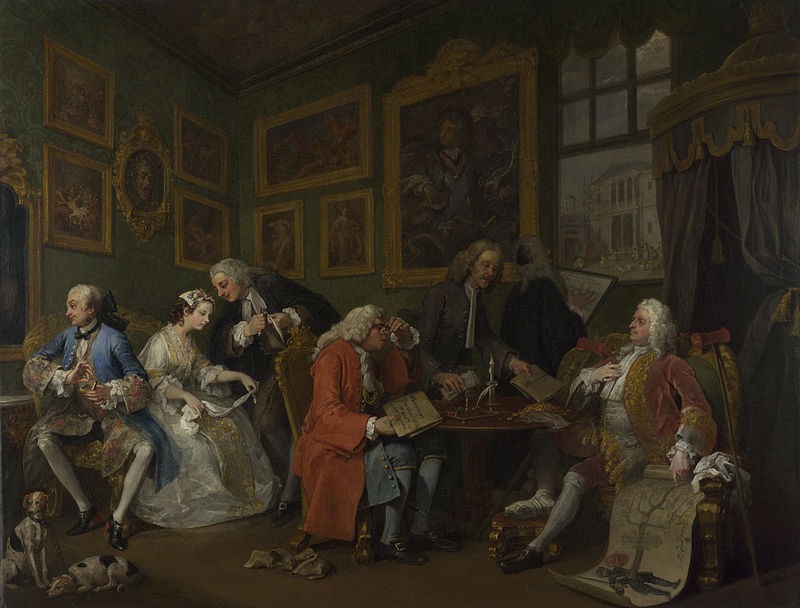
Marital ethics were the topic of much debate in 18th-century Britain. The many marriages of convenience and their attendant unhappiness came in for particular criticism, with a variety of authors taking the view that love was a much sounder basis for marriage than money. Hogarth for one felt the disquiet in British society sufficient to satirise it in a series of paintings called Marriage a la mode.
In the first of the series, The Marriage Settlement Hogarth shows an arranged marriage between the son of bankrupt Earl Squanderfield and the daughter of a wealthy but miserly city merchant. The construction on the Earl’s new mansion, visible through the window, has stopped as a usurer negotiates payment for further work at the centre table. The gouty Earl proudly points to a picture of his family tree. The son views himself in the mirror, showing where his interests in the matter lie. The distraught merchant’s daughter is consoled by the lawyer Silvertongue while polishing her wedding ring. Even the faces on the walls appear to have misgivings. Two dogs chained to each other in the corner mirror the situation of the young couple.
The pressure put on many young people to marry the ‘right’ person led to many secret marriages with the right people for them. This was possible because until the middle of the 18th century marriages could take place anywhere provided they were conducted before an ordained clergyman of the Church of England. Of course, this also left a lot of scope for bigamy and marriages to girls who were under age.
The trade in these irregular marriages had grown enormously in London by the 1740s and led to the introduction of the Marriage Act 1753, popularly known as Lord Hardwicke’s Marriage Act. This Act was the first statutory legislation in England and Wales to require a formal ceremony of marriage. The Act came into force on 25 March 1754 making the reading of banns, registration of a marriage and need for the marriage to be witnessed compulsory for the first time.
No marriage of a person under the age of 21 was valid without the consent of parents or guardians. Clergymen who disobeyed the law were liable for 14 years transportation. Jews and Quakers were exempted from the 1753 Act, but it required other religious non-conformists and Catholics to be married in Anglican churches.
The idea of secret marriage was taken up in the 1766 play, The Clandestine Marriage by George Colman the Elder and David Garrick. The play is a comedy and was first performed in 1766 at Drury Lane. The plot concerns a merchant, Mr Sterling, who wants to marry off his elder daughter to Sir John Melvil, who is in love with his younger daughter, Fanny. Fanny, however, is in love with a humble clerk, Lovewell, whom she has secretly married. Her attempts to extricate herself from the arrangement with Melvil lead to her being offered as a bride to Melvil’s elderly uncle, Lord Ogleby. But the truth comes out and she is saved from the awful fate of having to marry a man many years her senior whom she does not love and she and Lovewell are forgiven. In 1999, the play was made into a film directed by Christopher Miles and starring Nigel Hawthorne, Joan Collins, Timothy Spall, Emma Chambers and Tom Hollander.
Paul Nicholls and Natasha Little as the lovers in The Clandestine Marriage, 2000.
The Act did not change the position of a wife in law. On marriage, a woman became the property of her husband as soon as she said. “I do.” Clandestine and illegal marriages were not the exclusive domain of the wealthy. Many poor women where duped by unscrupulous, indecisive and inconstant men. Perhaps the most famous woman to be duped in this was Maria Fitzherbert (26 July 1756 - 27 March 1837) the secret wife of George, Prince of Wales, the future George IV.
In 1783 George, Prince of Wales became infatuated with her, wanting her to become his mistress but Maria’s devout Catholic beliefs would not allow it. So on 15 December 1785 they were married in a secret ceremony conducted by Robert Burt, an impoverished curate who set aside his scruples for the £500 fee. The marriage of course was not legal. It not only contravened the 1753 Marriage Act it was also in breach of the Act of Settlement of 1701, preventing a Roman Catholic from ascending the British throne and the Royal Marriage Act of 1772.
George and Maria spent much of their time in Brighton where Mrs Fitzherbert was treated as queen although George must have known that she never would be. Whether she was ignorant or deluded concerning her position is unknown. The couple separated when George’s affections turned to Frances, Countess of Jersey in 1794 and Maria’s position was finally put asunder when George married his cousin Caroline of Brunswick in 1795 with the benefit of law.
Illustration: Hogarth, Marriage a la mode - The marriage settlement.
Julia Herdman writes historical fiction that puts women to the fore. Her latest book Sinclair, Tales of Tooley Street Vol. 1. is Available on Amazon – Paperback £10.99 Kindle £2.29 Also available on:


Recent Comments