by Julia Herdman | Jun 5, 2017 | Blog, British History, British Royal Family, Crime and Punishment, Europe, European Royal Families, Marriage, Society, Writing about history
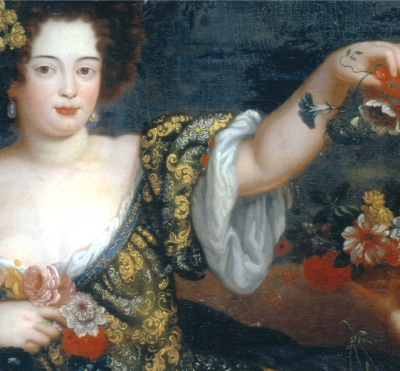
This is the shocking case of the Princess who was married against her will, spurned, divorced, and imprisoned for 33 years.
In August 2016, a human skeleton was found under the Leineschloss (Leine Palace, Hanover) during a renovation project; the remains are believed to be those of Swedish count, Philip Christoph von Königsmarck, (1665-1694) a soldier in the Hanoverian army and the lover of Princess Sophia Dorothea, the wife of the first Hanoverian king of Britain.
Early Life
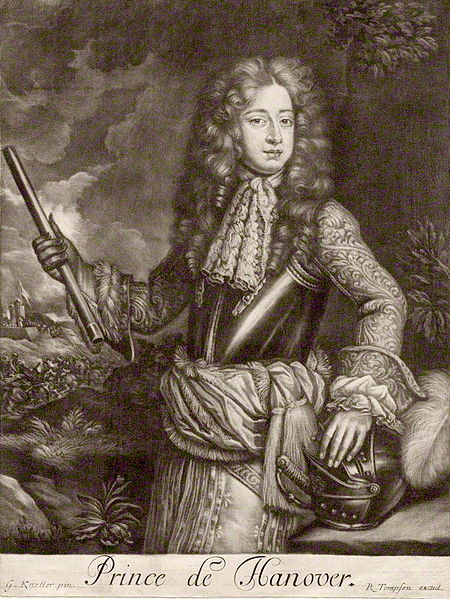
Sophia Dorothea was just sixteen years old when she was married to her cousin, George Louis of Hanover, the future king of Great Britain and Ireland in 1705.
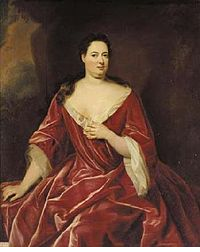
Poor Princess Sophia Dorothea did not get a good start in life; she was born illegitimately; the daughter of her father’s long-term mistress, Eleonore d’Esmier d’Olbreuse, Countess of Williamsburg (1639–1722) on 15 September 1666, and was considered an inconvenient royal bastard. Without a wife and an heir her father, Prince George William, Duke of Brunswick Lüneburg, eventually did the right thing and married his mistress which had the effect of legitimising his only child.
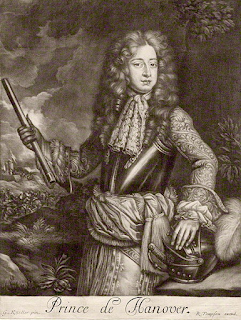 |
| George I of Britain |
Her Father’s Legitimate Heir
Sophia Dorothea was ten years old when she became heir to her father’s kingdom, the Principality of Lüneburg. This made her a good catch despite her problematic origins because Lüneburg was a wealthy principality and Sophia Dorothea, like her mother, was attractive and lively.
Along with her legitimacy came talk about her marriage. In the six years between her acceptance into the royal family and her eventual marriage, three prospective husbands were considered for her.
Marriage Proposals
First, there was talk of marriage to the Danish heir presumptive. Some years later her engagement to the Duke of Brunswick-Wolfenbüttel was broken off by her father after her aunt, Duchess Sophia of Hanover, convinced him she should marry her cousin, George Louis of Hanover to join their two duchies together. Duchess Sophia hated her niece, whom she considered brazen, coquettish, and uneducated. When told of the change of plan, sixteen-year-old, Sophia Dorothea shouted, “I will not marry the pig snout!”
Twenty-two-year-old George Louis was not keen on the match either; he already had a mistress and was happy with his life as a soldier. Although he was a prince, he was ugly and boring, even his mother didn’t like him. Nevertheless, Duchess Sophia was determined to keep the family fortune together, and despite both Sophia Dorothea’s and her son’s objections, the pair were married on 22 November 1682, in Celle. For his pains, George Louis received a handsome dowry and was granted his father-in-law’s kingdom upon his death, and Sophia was left penniless.
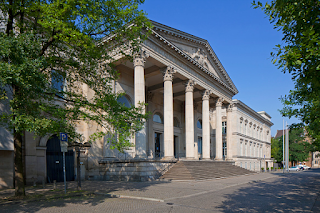 |
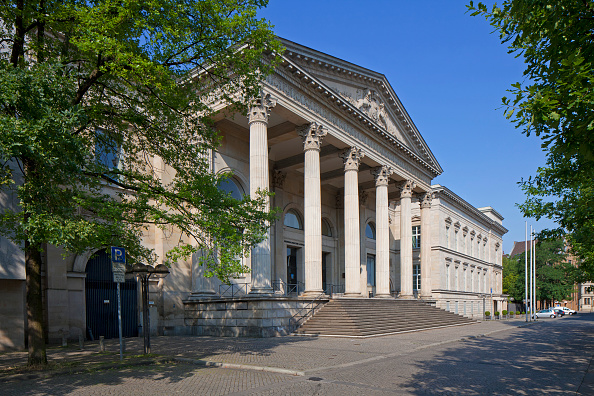
| The state parliament in the former Leineschloss /
Leine Castle in Hannover Lower Saxony Germany |
An Unhappy Marriage
The unhappy couple set up home in Leine Palace in Hanover where Sophia Dorothea was under the supervision of her odious aunt, Duchess Sophia, and spied on by her husband’s spies when he was away on campaign. Despite their unhappiness, the pair produced two children; George Augustus, born 1683, who later became King George II of Great Britain and a daughter born 1686 when Sophia Dorothea was twenty.
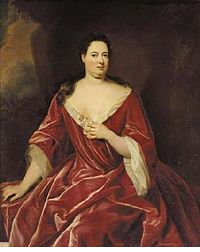 |
| Sophia Charlotte
von Keilmannsegg |
Having produced two children, George became increasingly distant from his wife spending more time with his dogs and horses and his nights with his mistress, the married daughter of his father’s mistress, a woman called Sophia Charlotte von Keilmannsegg, who was rumoured to be George Louis’ half-sister.
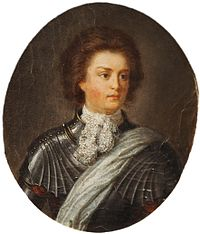
Aggrieved, lonely, and unhappy Sophia Dorothea found a friend in the Swedish count Philip Christoph von Königsmarck, (1665-1694) who was a soldier in the Hanoverian army. Philip was a year older than Sophia Dorothea and the antithesis of her ugly, boorish husband.
 |
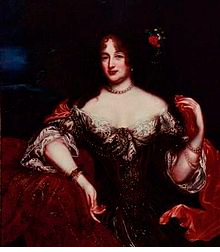
| Countess of Platen |
The Fatal Affair
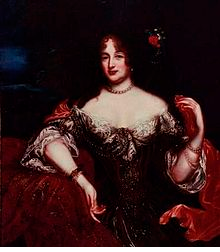
Sophia Dorothea was no saint. She was quick-tempered and rarely discrete, and her choice of Von Königsmarck as a lover was not the best. Königsmarck was a dashing, handsome gigolo and the former lover of her father-in-law’s mistress, the Countess of Platen and the Countess had a jealous nature.
Königsmarck and Sophia Dorothea began a love affair of clandestine trysts, real love, and their coded correspondence facilitated by a trusted go-between. Their love affair was uncovered in 1692 when the Duchess of Platen presented a collection of their letters to her lover, Sophia Dorothea’s father-in-law the Elector of Hanover. Von Königsmarck was banished from the Hanoverian court but soon found a position in the neighbouring court of Saxony where one night when he was buried in his cups he let slip the state of affairs in the bedchambers of the royal house of Hanover. George Louis got wind of what had been said and on the morning of 2 July 1694, after a meeting with Sophia at Leine Palace, Königsmark was seized. No one except his murderers knew what happened to him next.
 |
| Philip Christoph von Königsmarck,
(1665-1694) |
A Sad and Lonely Death
Dorothea never saw her lover again. George Louis divorced her in December, and early the following year she was confined her to Schloss Ahlden a stately home on the Lüneburg Heath in Lower Saxony. She stayed there for the rest of her life. Her children were taken away from her, and she was forced to live alone.
When Sophia Dorothea died in 1726, she had spent 33 years in her prison. Before she died, she wrote a letter to her husband, cursing him for his treatment of her. A furious George forbade any mourning of her in Hanover and London.
George, I died shortly after the Countess of Platen exonerated him of any involvement in Von Königsmark’s death. Two of her henchmen made deathbed confessions to the crime. Although George I was cleared of Von Königsmark’s death, his son George II never forgave his father for the treatment he had meted out to his mother.
Sources:
https://en.wikipedia.org/wiki/Sophia_Dorothea_of_Celle
Notorious Royal Marriages: A Juicy Journey Through Nine Centuries of Dynasty By Leslie Carroll
The Georgian Princesses By John Van der Kiste
Julia Herdman writes historical fiction. Her latest book Sinclair, Tales of Tooley Street Vol. 1. is Available on Amazon – Paperback £10.99 Kindle.
Sinclair is available of Amazon. Click here to get your copy.
Sinclair is set in the London Borough of Southward, the Yorkshire town of Beverley and in Paris and Edinburgh in the late 1780s. Strong female leads include the widow Charlotte Leadam and the farmer’s daughter Lucy Leadam. Sinclair is a story of love, loss and redemption. Prodigal son James Sinclair is transformed by his experience of being shipwrecked on the way to India to make his fortune. Obstacles to love and happiness include ambition, conflict with a God, temptation and betrayal. Remorse brings restitution and recovery. Sinclair is an extraordinary book. It will immerse you in the world of 18th century London where the rich and the poor are treated with kindness and compassion by this passionate Scottish doctor and his widowed landlady, the owner of the apothecary shop in Tooley Street. Sinclair is filled with twists and tragedies, but it will leave you feeling good.
Amazon Australia
Amazon Canada
Amazon New Zealand
Amazon South Africa
Amazon USA
Princess Anne - The Princess Who Married a Hunchback

by Julia Herdman | May 30, 2017 | Blog, British History, British Royal Family, Marriage, Politics, Romance, Society
Secret and Clandestine Marriage
A clandestine or illicit marriage is a plot device in many 18th and 19th-century stories, think of Jayne Eyre and Mr Rochester, but what seems like the work of fiction was a fact of life for women from all social classes in 18th Century Britain. No one knew who was married to whom until the law of marriage was changed. Even the Prince Regent tried to marry a woman clandestinely and illegally.
On May 11, 1786, the Coachmakers’ Hall, Debating Society debated the following proposition: “Are not the Restraints contained in the Marriage Act, and every other Restriction on the Matrimonial Contract, contrary to the natural Rights of Mankind, and injurious to Conjugal Felicity?” Someone at the Coachmakers’ Hall was clearly stirring the pot of civil discord that evening as the formalities prescribed by the Act were hardly novel, and had been observed even when they were not essential to the validity of a marriage, and the protection afforded by the previous law was not as generous as many who wished to deviate from the new law claimed.
The Marriage Act
The Marriage Act 1753, popularly known as Lord Hardwicke’s Marriage Act, was the first statutory legislation in England and Wales to require a formal ceremony of marriage. The Act came into force on March 25, 1754, making compulsory the reading of the banns, and the registration of a marriage and its witnesses for the first time.
Before the Act, the legal requirements for a valid marriage in England and Wales had been governed by the canon law of the Church of England. This had stipulated that banns should be called or a marriage licence should be obtained before marriage and that the marriage should be celebrated in the parish where at least one of the parties was resident. However, these requirements were not mandatory and the absence of banns or a licence – or even the fact that the marriage was not celebrated in a church – did not render the marriage void. The only essential requirement was that the union be celebrated by an Anglican clergyman. So this left a lot of scope for clandestine marriages and for the wedding of those who were technically under the age of legal consent which was 21 at the time.
The King’s Secret Marriage
Maria Fitzherbert (July 26 1756 - March 27 1837) became the wife of George, Prince of Wales, the future George IV in extraordinary circumstances. Maria came from a respectable Roman Catholic family and was educated in France. She had been married twice before when she met Prince George. Maria married Edward Weld, who was sixteen years her senior, and the wealthy Catholic owner of Lulworth Castle in July 1775. Weld died just three months later after falling from his horse leaving Maria penniless. Her new husband had failed to sign his Will, so his estate went to his younger brother.
Maria, now a widow was left effectively destitute. She received little or no financial support from the Weld family and was obliged to remarry as soon as she could. Three years later, she married again. Her second husband was Thomas Fitzherbert of Swynnerton, Staffordshire who was ten years her senior. They had a son but he died young and then she was widowed again in 1781, but this time she got an annuity of £1000 and a townhouse in Park Street, Mayfair.
In 1783 George, Prince of Wales became infatuated with her after meeting her at the opera. The licentious Prince, he wanted her to become his mistress, but Maria’s devout Catholic beliefs would not allow it. So on December 15, 1785, they were married in a secret ceremony conducted by Robert Burt, an impoverished curate who set aside his scruples for the £500 fee.
The marriage was not legal. It not only contravened the 1753 Marriage Act it was also in breach of the Act of Settlement of 1701, preventing a Roman Catholic from ascending the British throne and the Royal Marriage Act of 1772. How George thought he was going to get away with is a mystery and how Maria could believe she was being married to a Prince of the realm legitimately in such circumstances is beyond belief.
The Illegally Married Couple
George and Maria spent much of their newly married life in Brighton where Mrs Fitzherbert was treated like a queen. Whether she was ignorant or deluded concerning her position is unknown, she never spoke of it. George’s intentions were never earnest, he always had an eye for the ladies.
The couple finally separated when George’s affections turned to Frances, Countess of Jersey in 1794. Their illegal marriage was finally put asunder when George married his cousin Caroline of Brunswick in 1795.
Five years later, in 1800, Maria and George were reunited as George could not stand the sight of his legal wife, Caroline.
By 1807, the Prince’s affections were wandering again, this time towards Lady Hertford. Unable to bear any further humiliation, on December 18 1809, Maria sent George a farewell letter and departed from Brighton where she and the Prince were living.
Following the death of George IV on June 26 1830, it was discovered that he had kept all of Fitzherbert’s letters, and steps were taken to destroy them. Fitzherbert told George IV’s brother, King William IV, about their marriage and showed him the documents in her possession. He asked Fitzherbert to accept a dukedom, but she refused, asking only for permission to wear widow’s weeds and to dress her servants in royal livery. The architect William Porden created Steine House for her, on the west side of Old Steine in Brighton where she lived from 1804 until her death in 1837. The king’s unofficial wife was buried at St John the Baptist’s Church in the Kemp Town area of Brighton.
Julia Herdman writes historical fiction. Her latest book Sinclair, Tales of Tooley Street Vol. 1. is Available on Amazon – Paperback £10.99 and on Kindle.
Also available on:
Amazon Australia
Amazon Canada
Amazon New Zealand
Amazon South Africa
Amazon USA
Princess Sophia Dorothea the Uncrowned Queen of Britain
Dress to Impress Princess

by Julia Herdman | May 1, 2017 | Blog
When I think of May Day I think either of Maypoles, Morris Dancing and the Jack in the Green or the old Soviet military processions in Red Square.
The origins of May Day stretch back into the mists of time. In the late Middle Ages people in England started to dance around a Maypole (a pole with no ribbons) as a celebration of Spring and to encourage fertility in the soil and people. This was banned by the Puritans but came back with the Restoration in 1660 and has remained with us ever since – the Victorians added the ribbons.
By the seventeenth century England was on the long march to modernity and urban living and London was well on the way to being the first great modern city in the world so May Day in London had nothing to do with May Poles or flowers. It was one of a number of days of the year; Shrove Tuesday, Ascension Day, Midsummer and St Bartholomew’s Day; when disorder reigned. Between 1603 and 1642 Shrove Tuesday riots involved apprentice boys attacking brothels, bawdy houses and playhouses to reduce temptation during Lent! In the same period there were eight May Day riots. The attacks on bawdy houses seem to peter out after the Restoration and the nature of May Day and other celebration days changes again.
In the late seventeenth century there is evidence of what are called ‘ridings’ in London and other towns. In a ‘riding’ those who are viewed to have transgressed the sexual morality of the day were harangued in the street by the mod who beat their pots and pans and shouted at the tops of their voices in what was called ‘rough music.’ In June 1664 a woman appeared before a magistrate in Middlesex accused of following a woman down the street shouting, ‘whore, whore’ and clapping her hands. She was joined by others and soon there was a riot. On May Day those who were deemed to have offended their community were spat on, had dirt and stones thrown at them as well as the contents of chamber pots. In London the haranguing husbands who had beaten or cheated on their wives was particularly popular as was terrorising brothel keepers and the mothers of illegitimate children.
Historian Charles Pythian-Adams has argued that during the eighteenth century May Day celebrations in London were transformed. The population of the city was becoming socially segregated with the rich withdrawing from popular or plebeian activities, but this notion leaves out the growing urban middle class and the effects of growing religious non-conformity. As the eighteenth century progressed so did social separation (both class and gender) but it was not exclusively the elites separating themselves from the poor, the middle class were able to buy their way into urban elite culture, they may not have had a box at the theatre but they could have a seat in the stalls; and as for the poor they separated into those who chose the strictures of religious non-conformity (no pagan rituals) over the perceived laxity of the established church were certain pagan rituals were accepted. This new urban culture was not conducive to what we think of as May Day traditions and its celebration or marking lapsed until it was re-invented and sanitised by the Victorians who gave us children holding ribbons and dancing round the May Pole in the Board School yard.
Source: The Eighteenth-Century Town: A Reader in English Urban History 1688-1820, By Peter Borsay, Routledge 2013
Illustration: Country Dances round a Maypole (decorative painting for a supper-box at Vauxhall Gardens, London), Francis Hayman (1708–1776), Victoria and Albert Museum.
Julia Herdman writes historical fiction that puts women to the fore. Her latest book Sinclair, Tales of Tooley Street Vol. 1. is Available on Amazon – Paperback £10.99 Kindle £2.29 Also available on:
Amazon Australia
Amazon Canada
Amazon New Zealand
Amazon South Africa
Amazon USA
by Julia Herdman | Apr 18, 2017 | Blog, British History, Europe, France, Literature, Politics, Romance, Society, Women and Children, Writing about history
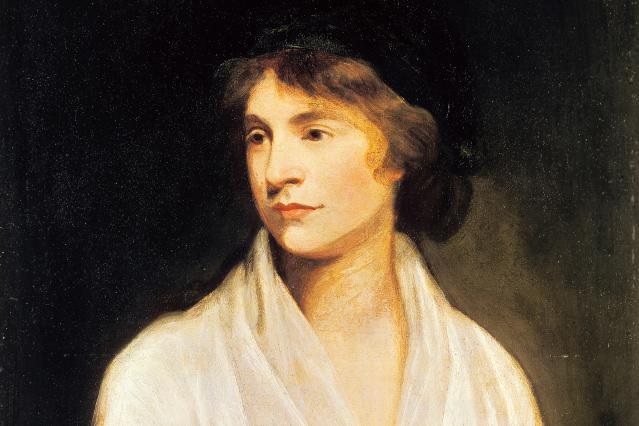
Mary Wollstonecraft was born on 27 April 1759 she is one of the world’s first feminist writers.
Wollstonecraft decided to become a writer in 1787, 230 years ago, when she moved to 45 George Street, in Southwark, now called Dolben Street. It was from Dolben Street[1] that she launched her career, with the publication of her novel, Mary: A Fiction or Maria: or, The Wrongs of Woman is a philosophical and gothic novel that revolves around the story of a woman imprisoned in an insane asylum by her husband. The story focuses on the societal rather than the individual “wrongs of woman” and criticises what Wollstonecraft viewed as the patriarchal institution of marriage in eighteenth-century Britain and the legal system that protected it. However, the heroine’s inability to relinquish her romantic fantasies also reveals women’s collusion in their oppression through false and damaging sentimentalism. The novel pioneered the celebration of female sexuality and cross-class identification between women. Such themes, coupled with the publication of Godwin’s scandalous Memoirs of Wollstonecraft’s life, made the novel unpopular at the time it was published.
Two friendships shaped Wollstonecraft’s early life. The first was with Jane Arden. At the age of nine Wollstonecraft was taken to a farm near Beverley in Yorkshire with her brothers and sisters. They lived a wild life, roaming around the flat land of the Humber estuary until her father took a house in the town opposite the Minster. It was in Beverley she met Jane Arden. Life in Beverley was remarkably civilised, there was a theatre, dances at the Assembly Rooms and a race course with a spring meeting that co-inside with the Spring Fair. Part of my own novel Sinclair is set in Beverley.
.jpg)
Beverley, Yorkshire
The girls frequently read books together and attended lectures presented by Arden’s father, a self-styled philosopher and scientist. John Arden was the descendant of the playwright Arden of Faversham but was disinherited by his family, and forced to set himself up as a roving teacher of practical mathematics and experimental philosophy. After a spell in Germany, he settled in Bath for a while where he became a founder member of the Bath Philosophical Society. Then moved onto Derby where he made friends with the artist Joseph Wright. Wright painted him as the Philosopher in his work entitled: A Philosopher Lecturing on the Orrery, or the full title, A Philosopher giving a Lecture on the Orrery in which a lamp is put in the place of the sun, in 1766.
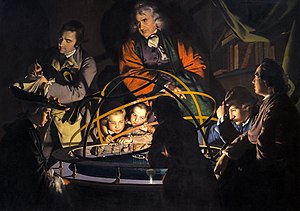
The Orrery, Joseph Wright of Derby - Derby Museum and Art Gallery
The Orrery, which now hangs in the Derby Museum, caused a sensation at the time because it replaced a classical motif with a scientific one. In this picture, Wright replaces the awe inspired by God with the wonder of science. [John Arden – The Philosopher Lecturing on the Orrery, iOpening Books 2016.]
At fourteen Wollstonecraft revelled in the intellectual atmosphere of the Arden household and valued her friendship with Jane Arden greatly, sometimes to the point of being emotionally possessive. Wollstonecraft wrote to her: “I have formed romantic notions of friendship … I am a little singular in my thoughts of love and friendship; I must have the first place or none.” In some of Wollstonecraft’s letters to Arden, she reveals the volatile and depressive emotions that would haunt her throughout her life. Mary’s crush for Jane ended badly, in quarrel spiked with jealousy and rage.
Her second and more important friendship was with Fanny (Frances) Blood, who was introduced to Wollstonecraft by the Clares, an elderly couple from Hoxton who became parental figures to her. Mr Clare was a retired clergyman with a taste for poetry, and Mrs Clare encouraged Mary’s reading, providing her with copies of Milton, Shakespeare, Pope and Johnson. Like Fanny, Mary learned the accomplishments expected of a middle-class woman from Mrs Clare - sewing, drawing and letter writing. Above all, she learned to be feminine and neat.
Unhappy with her home life, Wollstonecraft struck out on her own in 1778 and accepted a job as a lady’s companion to Sarah Dawson, a widow living in Bath. However, Wollstonecraft had trouble getting along with the irascible woman (an experience she drew on when describing the drawbacks of such a position in Thoughts on the Education of Daughters, 1787).
In 1780 she returned home because she was called back to care for her dying mother. Rather than return to Mrs Dawson’s employ after the death of her mother, Wollstonecraft moved in with the Bloods.
Fanny Blood was paid by the botanist William Curtis to paint wildflowers for his book Flora Londinensis. When Mary was living with the Bloods Fanny became engaged to Hugh Skeys, but the pair could not marry immediately and Skeys was forced to go the sea to finance the marriage. Fanny’s brother Lieutenant George Blood (1762–1844), became good friends with Mary so much so that William Godwin, Mary’s husband wrote that Mary had “contracted a friendship so fervent, as for years to have constituted the ruling passion of her mind”.
Blood, together with Mary Wollstonecraft and Wollstonecraft’s sisters, Eliza and Everina, opened a school first in Islington, which soon failed, and then in Newington Green. The school was combined with a boarding house for women and their children.
On February 24, 1785, Fanny Blood married Hugh Skeys who had made himself into a successful wine merchant based in Dublin. When Blood married and left the school, Wollstonecraft left too, and so their other school failed.
Fanny died in childbirth in Lisbon, Portugal, on November 29, 1785. Wollstonecraft was deeply affected by Blood’s death and in part inspired her first novel, Mary: A Fiction in 1788. She also named her own daughter, Fanny Imlay (1794–1816), after her friend.Frances “Fanny” Imlay was Mary’s daughter by the American commercial speculator and diplomat Gilbert Imlay. The pair never married and when Mary died Fanny remained part of the family of the man her mother had married, William Godwin. She was born in Le Havre in 1794 as the French Revolution took hold. Her half-sister Claire Clairmont would become Byron’s lover and her sister by Godwin would elope with the poet Shelley and write the gothic novel Frankenstein.
In later years, Mary realised during the two years she spent with the Blood family she had idealised Fanny as a woman like herself, fiercely independent and intellectual but Fanny was not like Mary, she wanted to be a wife and a mother more than a revolutionary. Nevertheless, Mary loved the Bloods and remained dedicated to them throughout her life. Wollstonecraft had envisioned living in a female utopia with Blood; they made plans to rent rooms together and to support each other emotionally and financially, but this dream come to nothing. The weight of economic reality and social conformity as well as being women in what was to all intents and purposes a world designed and run by men for men made their dream impossible to fulfil.
Mary followed the publication of Mary: A Fiction, with works on the education of children. Her own experience of motherhood forcing her to reconsider her views on women and children.
Through her association with her friend and publisher Joseph Johnson, she met Thomas Paine, the writer of The Rights of Man. Paine who would become one of the great influencers of the both the French Revolution and the development of the American state opposed the idea of hereditary government and the belief that dictatorial government is necessary, because of man’s corrupt nature. She also met her future husband and one of the forefathers of the anarchist movement William Godwin through Johnson. The first time Godwin and Wollstonecraft met, they were both disappointed in each other. Godwin had come to hear Paine, but Wollstonecraft assailed him all night long, disagreeing with him on nearly every subject.
It was after she left Dolben Street in 1791 that she published A Vindication of the Rights of Woman (1792). There is no doubt that her time at Dolben Street, Southwark was the furnace of her intellectual development, and was the site of her most intensely creative years.
For more information on Wollstonecraft see: https://podcasts.ox.ac.uk/keywords/mary-wollstonecraft
Notes:
[1] George Street was formed circa 1776 and the houses on either side were completed and tenanted by 1780 when the street name first occurs in the sewer rate books. It was built across the open fields shown as “tenter grounds” on Rocque’s maps, on part of what became known as Brown’s Estate. The formation of George Street was part of the rapid development of the area which followed the erection of Blackfriars Bridge. The street was renamed Dolben Street in 1911 in honour of John Dolben (1625–86), Archbishop of York, who in 1671, when Bishop of Rochester, officiated at the consecration of Christ Church. Throughout the period that these houses are shown in the rate books and directories they have been occupied by small tradesmen, chandlers, bakers, etc., and by artisans. https://www.british-history.ac.uk/survey-london/vol22/pp127-128
Southwark was the location of several London prisons, including those of the Crown or Prerogative Courts, the Marshalsea and King’s Bench prisons, those of the local manors’ courts, e.g., Borough Compter, The Clink and the Surrey county gaol originally housed at the White Lion Inn (also informally called the Borough Gaol) and eventually at Horsemonger Lane Gaol.
One local family of note, was the Harvards. John Harvard went to the local parish free school of St Saviour’s and on to Cambridge University. He migrated to the Massachusetts Colony and left his library and the residue of his will to the new college there, named after him as its first benefactor. Harvard University maintains a link, having paid for a memorial chapel within Southwark Cathedral (his family’s parish church).
Sources:The Life and Death of Mary Wollstonecraft By Claire Tomalin, Mary Wollstonecraft and the Feminist Imagination by Barbara Taylor, & Wikipedia
My own novel, Sinclair takes place in Southwark and Beverley.
Julia Herdman is a novelist. Her latest book Sinclair, Tales of Tooley Street Vol. 1 is Available on Amazon – Paperback £10.99 on Kindle
Also available on:
Amazon Australia
Amazon Canada
Amazon New Zealand
Amazon South Africa
Amazon USA
Byron’s Daughters - A Tale of Three Sisters
Madame Staël - A woman who abored all that was tyrannical, cynical, or passionless

by Julia Herdman | Apr 8, 2017 | Blog, British History, Literature, Marriage, Medicine, Politics, Romance, Science, Women and Children, Writing about history
Tooley Street in Southwark is the location of my new novel Sinclair. Today is it’s one of London’s best known streets, home to London Bridge Station and the London Dungeon, and is close to the London Shard and City Hall.
Running parallel to the Thames on the south side Tooley Street is one of the oldest streets in London. Its name is said to be a strange corruption of its former name, St. Olave’s Street, which is hard to believe but I suppose we’ll just have to accept what the local experts tell us on that one.
It’s a thriving place today with state of the art offices, clean and tidy streets and modern communications and although it was no less thriving in the past it was a very different place then. Here are some of the residents and trades listed as living and operating in the area in the 18th and 19th century:
Wharfingers (warehouse owners), merchants, instrument makers, factors, and agents; outfitters, biscuit-bakers, store-shippers, ship-chandlers, slop-sellers, block-makers, rope-makers, engineers, and then there were the surgeons who worked at the great charitable hospitals: Guy’s, St Thomas’ and the London.
My novel is set in eighteenth century Tooley Street in a house inhabited by my family’s ancestors for three generations. They owned an apothecary shop at No. 65 and worked as surgeons at Guy’s Hospital just a stone’s throw away. Members of the Leadam family pop in and out of the historical record; appearing in trade directories, hospital correspondence, or as witnesses in Old Bailey cases or giving evidence to Government enquiries on issues such as public health.Some members of the family are mentioned in magazine and newspaper articles of the day and some have published obituaries and their own publications.
In my story which is a fiction not a family history, a Scottish doctor down on his luck comes to live at No 65 Tooley Street after the unexpected death of Christopher Leadam who is based on the real Christopher Leadam who was born in Yorkshire and worked at Guy’s hospital as a surgeon and was secretary to one of its weekly committees. He died young leaving a widow, whom I have called Charlotte Leadam in the book and a teenage son. My story focuses on his widow’s struggle to keep the apothecary shop open and get her son, John, trained as a surgeon.
Illustration: Guy’s Hospital, London, opened 1725.
You can read my fictionalised account of life at No. 65 Tooley Street in Sinclair.
Available on Amazon – Paperback £10.99 Kindle £2.29
Amazon Australia
Amazon Canada
Amazon New Zealand
Amazon South Africa
Amazon USA

Recent Comments