by Julia Herdman | Jun 19, 2017 | Blog, European Royal Families, Marriage, Politics, Society
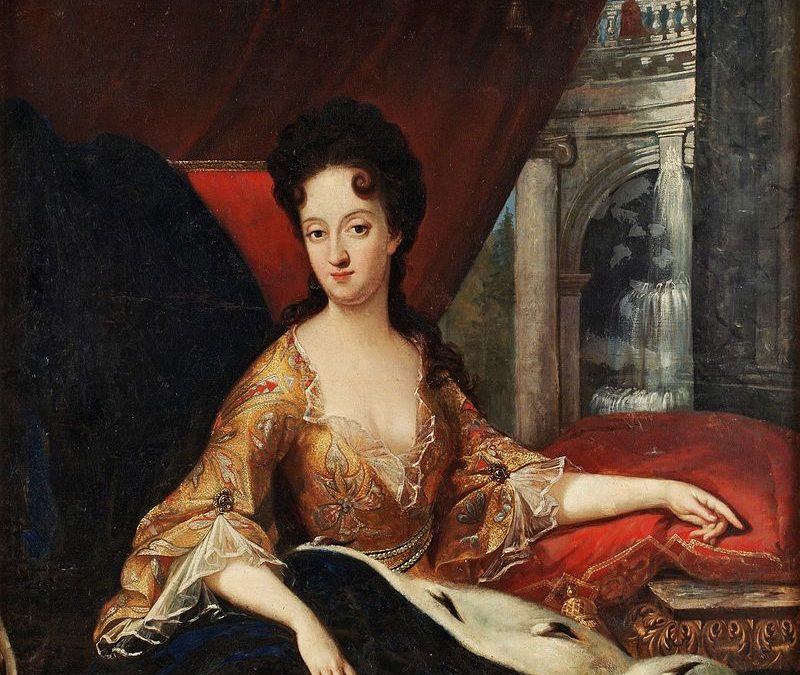
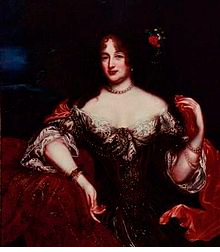
Queen Ulrika Eleonora the Younger (1688 – 1741), was Queen regnant of Sweden from 5 December 1718 to 29 February 1720, and then Queen consort until her death in 1741. She was the youngest child of King Charles XI and Ulrika Eleonora of Denmark. She had an elder brother and sister so never expected to be queen.
Her mother died in 1693 when she was five and little Ulrika and her elder sister, Princess Hedvig Sophia, were set off to be brought up by their grandmother, Hedwig Eleonora at Karlberg Palace. Grandmother was a consummate operator, she was the guiding light in her husband’s administration and she dominated her son so much that he referred to her as the Queen ignoring his wife. Her grandmother described Ulrika as a stubborn little girl who would pretend to be ill when it came to doing things she didn’t like riding and dancing. It seems little Ulrika was not the physical type but she was a talented musician, and when performing with her sister at court concerts, she would play the clavier while her sister sang. Although she was friendly, modest and dignified, with good posture and beautiful hands she was regarded as neither intelligent nor attractive and no match for her older sister.
Her father died in 1697 when Ulrika was 9 years old and the crown passed to her brother Charles XII (1682 –1718). Grandmother was sure he was too young to take on full royal responsibilities, he was only 15, and petitioned to act has his regent; a caretaker government was put in place which lasted for seven months then Charles took full command. Charles was an absolutist monarch; he believed he had been put in charge by God, an idea that was already encountering quite a bit of resistance in Europe at the time. He was, however, a successful war leader and achieve considerable success in defending Sweden in the Great Northern War.
On 12 May 1698, Princess Hedwig Sophia married her cousin, Frederick IV, Duke of Holstein-Gottorp. Her marriage was arranged as a part of the traditional Swedish policy of alliance with Holstein-Gottorp against Denmark. The marriage took place against her consent and she was not happy; Frederick IV had a string of mistresses and whores he preferred over his reluctant wife. Hedwig Sophia was a widow with a young son by 1702 but Ulrika was still unmarried. Hedwig Sophia returned to the Swedish court where she was the centre of attention, partying with her brother the king and lauded for her beauty and fashion sense. She was known as the “The Happy Princess” unlike her stubborn little mouse of a sister. Unfortunately, Hedwig Sophia caught smallpox in 1708 nursing her son who also had the disease. Hedwig Sophia died but her son survived.
With no marriage in prospect for her brother the king in sight Ulrika’s position suddenly changed with her sister’s death. In 1710, she received a marriage proposal from Prince Frederick of Hesse, he was a widower with an eye on her crown. The marriage was supported by her grandmother because it would force Ulrika to leave Sweden and so increased the chance of her favourite granddaughter’s son becoming king when Charles died. Although her prospective husband liked the idea of inheriting her crown his advisers were telling him that Ulrika was no great catch describing her as imperious, haughty, and suffering from bad breath and a weak bladder. Their engagement was announced four years later on 23 January 1714, and the wedding took place on 24 March 1715. During the wedding, her brother Charles XII remarked: “Tonight my sister is dancing away the crown”. But it turned out she wasn’t. When a musket ball went clean through her brother’s head in 1718 the Swedish nobles opposed to the war which had been waging for nearly two decades seized their chance and offered Ulrika the throne on the condition that she accepted a modern constitution for the country. She accepted but years of living as an autocrat made accepting what was required of her very difficult so she abdicated giving her crown to her husband who did the deed for her and Sweden took its first steps into the modern age. All of which goes to show that you don’t have to be clever, or beautiful to make history you just have to seize the opportunities life throws at you and do the right thing.
Julia Herdman writes historical fiction that puts women to the fore. Her latest book Sinclair, Tales of Tooley Street Vol. 1. is Available on Amazon – Paperback and on Kindle. Also available on:
Amazon Australia
Amazon Canada
Amazon New Zealand
Amazon South Africa
Amazon USA
by Julia Herdman | Jun 13, 2017 | Blog, Europe, European Royal Families, Fashion, Literature, Marriage, Politics, Romance, Society
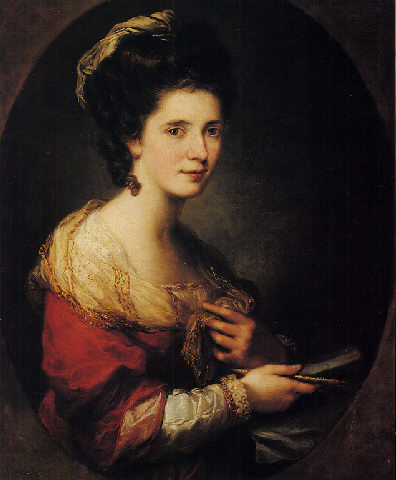
Anne-Louise-Germaine Necker, Baronne de Staël-Holstein, 22 April 1766 – 14 July 1817, was the daughter of the second most important man in France, Louis XVI’s Minister of Finances, Jacques Necker. Madame de Staël was born into a world of political and intellectual prominence. Later, she married Sweden’s ambassador to the French court, and for a span of twenty years, she held the limelight as a political figure and prolific writer. Despite a plain appearance, she was notoriously seductive and enjoyed whirlwind affairs with some of the most influential men of her time. She always attracted controversy and was demonised by Napoleon for her forthrightness, the sheer power of her intellect, and the progressiveness of her salon, which was a hotbed for the expression of liberal ideals. The emperor exiled her, on and off, for the last fifteen years of her life.
Her most famous novel was published in 1802. The story of Delphine tales place in Paris between 1789 and 1792. Delphine d’Albémar, a young widow, arranges a wedding between one of her distant relatives, Matilde de Vernon, and Léonce de Mondoville. But she falls in love with Léonce, and as he is engaged with Matilde, their love is impossible. The story ends tragically with Delphine killing herself.
Germaine grew up in France and was Protestant. Her parents became impatient for her to marry, and they are said to have objected to her marrying a Roman Catholic, which, in France, considerably limited her choice. There is a legend that William Pitt the Younger considered marrying her. The somewhat notorious lover of Julie de Lespinasse, Jacques Antoine Hippolyte, Comte de Guibert, a cold-hearted fop of some talent, certainly paid her attention but she finally settled on Baron Erik Magnus Staël von Holstein, who was first an attaché of the Swedish legation to France and then minister after 1783. For a great heiress possessed of great ambition, the marriage did not seem brilliant, but Germaine had wealth and her future husband had considerable political and social standing. The marriage took place on 14 January 1786 in the chapel of the Swedish embassy in Paris. A singular series of negotiations secured from the king of Sweden a promise of an ambassadorship for 12 years and a pension in case of its withdrawal. At the time of her marriage, Germaine was 20, her husband 37.
On the whole, the marriage seems to have been acceptable to both parties at first, although neither had any affection for the other. The baron obtained great financial benefits, whereas his wife, with the rank of an ambassador’s consort, obtained a much higher position at court and in society than she could have secured by marrying almost any Frenchman, without the inconveniences that might have been expected had she married a Frenchman superior to herself in social rank. In spite of the mutual benefits that each could claim for many years, the marriage did not last. It ended with a formal separation in 1797, although the two remained legally married until the baron’s death in 1802.
Her novels were bestsellers and her literary criticism was highly influential. When she was allowed to live in Paris, she greatly encouraged any political dissident against the regime of Louis XVI. On the day before the September massacres of 1792, she fled writing a florid account of her escape. The fall of Maximilien Robespierre opened the way back to Paris. She reopened her salon and threw herself into opposition to Napoleon Bonaparte. During the years of the Empire she travelled in Germany and Austria and after the death of her husband in 1802 she married a man called Rocca.
In June 1816, she was visited by Lord Byron and she developed a warm friendship with the Duke of Wellington, whom she had first met in 1814. By 1816 she had become confined to her room if not to her bed. She died on 14 July that year. Rocca survived her by little more than six months. Her deathbed conversion to Roman Catholicism surprised many, including Wellington, who remarked that while he knew that she was greatly afraid of death, he had thought her incapable of believing in the afterlife.
Madame de Staël— a force of nature, exuberant idealist, and ultimate enthusiast—waged a lifelong struggle against all that was tyrannical, cynical, or passionless in her time, and left Europe a legacy of enlightened liberalism that radiated throughout the continent during the nineteenth century. There are a couple of notable biographies of this colour woman, Madame de Stael by Maria Fairweather, 2006 and Madame de Stael: The First Modern Woman by Francine du Plessix Gray, 2008.
Julia Herdman writes historical fiction that puts women to the fore. Her latest book Sinclair, Tales of Tooley Street Vol. 1. is Available on Amazon – Paperback and Kindle. Also available on:
Amazon Australia
Amazon Canada
Amazon New Zealand
Amazon South Africa
Amazon USA

by Julia Herdman | Jun 7, 2017 | Blog, Europe, European Royal Families, Fashion, France, Politics, Society
Did Queen Marie Antoinette ever say ‘Let them eat cake’?
‘Let them eat cake.’ is one of the most famous quotes in history, but did the queen ever say it and what was going on in France for such a quote to become so popular?
Love her or hate her Marie Antoinette is one of the most famous women in French history but was she blamed for things she never said or had any control over?
The Weather in 1788

Historians and archaeologists are becoming increasingly aware of the influence of weather on the world’s significant events and as someone who has been researching life in the 18th century Britain and France I was amazed to find that the weather could be said to one of the causes of the French Revolution.
In the spring and summer of the year before the Revolution France suffered a drought. Although there was no drought in England the summer of 1788 was an unusually warm one in London. As temperatures soared in the capital, the incidence of Scarlet fever and Typhus spread through the city. In August over 1000 deaths were attributed to fever alone.
As Londoners sweltered the French baked. The French were not particularly competent farmers at the time, the aristocracy and major landowners were not interested in developing and improving their land for agriculture and food production, unlike their British counterparts. Consequently, food production was already pretty miserable when the drought struck.
The drought of 1788 ended when the skies opened and hail the size of fists fell from the sky bashing the fruit from the trees and the smashing the crops in the fields to smithereens so when the French entered the winter of 1788-9 food stocks were at an all-time low. The storms of July caused damage in parts of the country. To make matters worse, the disastrous harvest was followed by months of freezing weather. The temperature barely rose above freezing for three months through November, December and January. In London, the river Thames froze.
The bad weather was most likely caused by the eruption of the Laki volcanic fissure in southern Iceland which spewed out ash for eight months from 8 June 1783 to February 1784 killing much of the livestock and perhaps a quarter of the Icelandic population at the time. The British naturalist Gilbert White described that summer in his classic Natural History of Selborne as “an amazing and portentous one … the peculiar haze, or smokey fog that prevailed for many weeks in this island, and in every part of Europe, and even beyond its limits was a most extraordinary appearance, unlike anything known within the memory of man.”
The State of French Agriculture

Tobias Smollett wrote about Boulogne near Calais in 1763. As much as he hates France he can see that the peasants and landowners around the town have adopted some English farming improvements unlike in the rest of France. ” I am certain that a man may keep house in Boulogne for about one half of what it will cost him in London; and this is said to be one of the dearest places in France. The adjacent country is very agreeable, diversified with hill and dale, corn-fields, woods, and meadows. There is a forest of a considerable extent, that begins about a short league from the Upper Town: it belongs to the king, and the wood is farmed to different individuals. In point of agriculture, the people in this neighbourhood seem to have profited by the example of the English. Since I was last in France, fifteen years ago, a good number of inclosures and plantations have been made in the English fashion. There is a good many tolerable country-houses, within a few miles of Boulogne; but mostly empty. I was offered a compleat house, with a garden of four acres well laid out, and two fields for grass or hay, about a mile from the town, for four hundred livres, about seventeen pounds a year: it is partly furnished, stands in an agreeable situation, with a fine prospect of the sea, and was lately occupied by a Scotch nobleman, who is in the service of France.” ( Project Gutenberg’s Travels Through France and Italy, by Tobias Smollett.)
High Prices and High Taxes
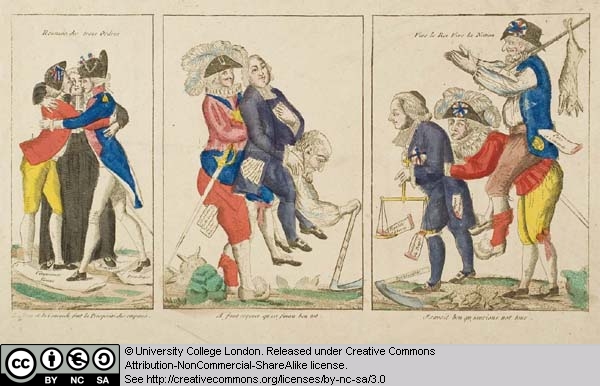
The poorer classes, 95% of whose diet consisted of bread and cereals and which before the drought had to spend about 55% of their earnings on bread, were forced by the famine conditions of the first half of 1789 to spend now 85% and over of their income on this staple food. In France rural taxes called “privilege seigneriaux” or seigniorial privileges, severely burdened farmers.The clergy and nobility exercised a preeminent right over all land property but evaded most of the taxes and financial burdens of managing it. By 1789, some 90% of the population were hungry by the beginning of 1789. The famine added to the woes of the French people who was also suffering from a 10 year economic slump with its attendant unemployment.
The Riots and the Queen’s Response
When the riots did come, they were triggered by a chance remark by a wallpaper manufacturer named Reveillon, who said in a public meeting that the government should lower grain prices so that wages could be limited to 15 sous. Rumours of impending wage reductions swept the restless capital and set off the train of events we call The French Revolution.
Queen Marie-Antoinette never said, “Let them eat cake,” on hearing there was no bread to be had in Paris but it was just the sort of thing the crowd thought her capable of saying. As was expected of a woman of her class and position she was remote but she was also totally unaware and untroubled by the plight of her people. She was, as all 18th century monarchs in Europe were, living a life of secluded luxury in their palaces. Marie Antoinette was of course living at one of Europe’s most opulent homes, the Palace at Versailles.
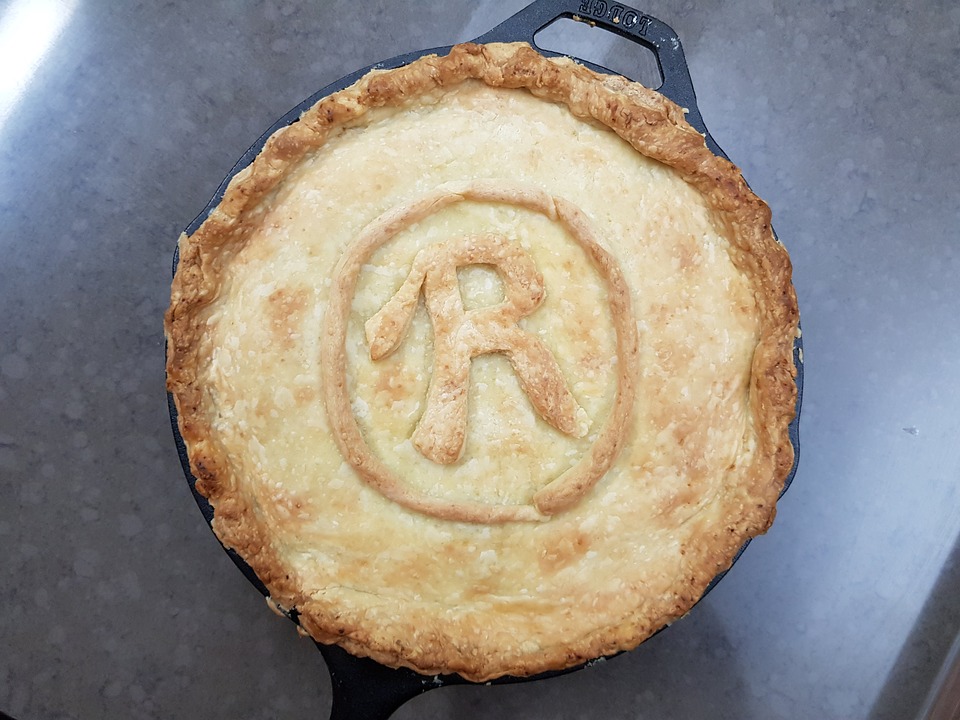
The phrase,’Let them eat cake’ first appeared in a slightly different form about Marie-Thérèse, the Spanish princess who married King Louis XIV in 1660. Marie-Thérèse allegedly suggested that the French people eat “la croûte de pâté” (or the crust of the pastry or the top of the pie - this was usually discarded as pastry was designed to protect the meat while it cooked). Over the next century, several other royals had the phrase attributed to them including two aunts of Louis XVI as it was a phrase that spoke of the royal family’s callousness to their people.
Land Reform

The Revolution brought the repealed feudal tenures, freed all those bound into serfdom, abolished feudal courts, and cancelled all payments not based on real property, including tithes. Once the reforms were in place; however, the peasants seized the land and refused to pay rent to the government, and in 1792, all payments were finally cancelled. Property of the clergy and political emigrants was confiscated and sold at auction, together with common land. The terms of sale, however, often favoured the wealthy, which may explain the rise of a new class of large landowners among the supporters of Napoleon I. The redistribution of land became the basis of French democracy and the small family farm has been the main feature of French agriculture ever since. Having secured their piece of land, there was little incentive or money to improve it for the peasant owners and so the economic benefits of the reforms were limited, France still struggled to feed itself and agricultural improvements that were being introduced in England were slow to be adopted.
France was a rural nation as late as 1940. After the creation of the land owning peasant class after the Revolution a next major change came in with the railways in the 1850s according to Peasants Into Frenchmen (1976), by historian Eugen Weber. Weber traced the modernisation of French villages and argued that rural France went from backward and isolated to modern and possessing a sense of French nationhood during the late 19th and early 20th centuries. He emphasised the roles of railways, republican schools, and universal military conscription. He based his findings on school records, migration patterns, military service documents and economic trends. Weber argued that until 1900 or so a sense of French nationhood was weak in the provinces, a view that has been called into question by several writers. Nevertheless, he gives a good account of the development of rural France in the 19th century. Reforms brought in after World War II and France’s engagement in the European Union has transformed agricultural production again.
Sources:
https://www.britannica.com/topic/land-reform/History-of-land-reform
https://en.wikipedia.org/wiki/French_peasants
Great Historical Events That Were Significantly Affected by the Weather: The Year Leading to the Revolution of 1789 in France, J. Neumann, Department of Atmospheric Sciences, The Hebrew University, Jerusalem, Israel
Drought and the French Revolution:The effects of adverse weather conditions on peasant revolts in 1789, Maria Waldinger (London School of Economics)
Julia Herdman writes historical fiction. Her latest book Sinclair, Tales of Tooley Street Vol. 1. is Available on Amazon – Paperback £10.99 Kindle
Sinclair is available of Amazon. Click here to get your copy.
Sinclair is set in the London Borough of Southward, the Yorkshire town of Beverley and in Paris and Edinburgh in the late 1780s. Strong female leads include the widow Charlotte Leadam and the farmer’s daughter Lucy Leadam. Sinclair is a story of love, loss and redemption. Prodigal son James Sinclair is transformed by his experience of being shipwrecked on the way to India to make his fortune. Obstacles to love and happiness include ambition, conflict with a God, temptation and betrayal. Remorse brings restitution and recovery. Sinclair is an extraordinary book. It will immerse you in the world of 18th century London where the rich and the poor are treated with kindness and compassion by this passionate Scottish doctor and his widowed landlady, the owner of the apothecary shop in Tooley Street. Sinclair is filled with twists and tragedies, but it will leave you feeling good.
Also available on:
Amazon Australia
Amazon Canada
Amazon New Zealand
Amazon South Africa
Amazon USA
18th Century Smuggling Fact and Fiction
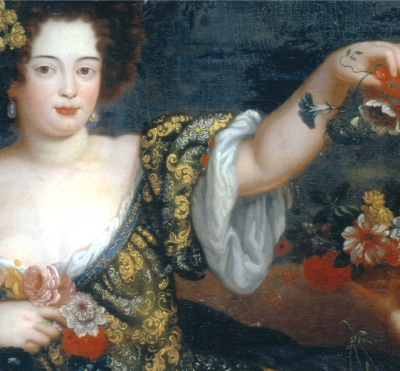
by Julia Herdman | Jun 5, 2017 | Blog, British History, British Royal Family, Crime and Punishment, Europe, European Royal Families, Marriage, Society, Writing about history
This is the shocking case of the Princess who was married against her will, spurned, divorced, and imprisoned for 33 years.
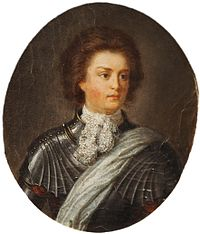
In August 2016, a human skeleton was found under the Leineschloss (Leine Palace, Hanover) during a renovation project; the remains are believed to be those of Swedish count, Philip Christoph von Königsmarck, (1665-1694) a soldier in the Hanoverian army and the lover of Princess Sophia Dorothea, the wife of the first Hanoverian king of Britain.
Early Life
Sophia Dorothea was just sixteen years old when she was married to her cousin, George Louis of Hanover, the future king of Great Britain and Ireland in 1705.
Poor Princess Sophia Dorothea did not get a good start in life; she was born illegitimately; the daughter of her father’s long-term mistress, Eleonore d’Esmier d’Olbreuse, Countess of Williamsburg (1639–1722) on 15 September 1666, and was considered an inconvenient royal bastard. Without a wife and an heir her father, Prince George William, Duke of Brunswick Lüneburg, eventually did the right thing and married his mistress which had the effect of legitimising his only child.
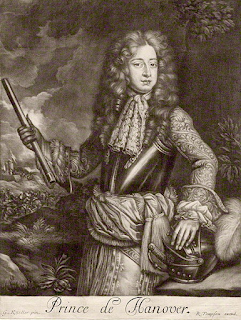 |
| George I of Britain |
Her Father’s Legitimate Heir
Sophia Dorothea was ten years old when she became heir to her father’s kingdom, the Principality of Lüneburg. This made her a good catch despite her problematic origins because Lüneburg was a wealthy principality and Sophia Dorothea, like her mother, was attractive and lively.
Along with her legitimacy came talk about her marriage. In the six years between her acceptance into the royal family and her eventual marriage, three prospective husbands were considered for her.
Marriage Proposals
First, there was talk of marriage to the Danish heir presumptive. Some years later her engagement to the Duke of Brunswick-Wolfenbüttel was broken off by her father after her aunt, Duchess Sophia of Hanover, convinced him she should marry her cousin, George Louis of Hanover to join their two duchies together. Duchess Sophia hated her niece, whom she considered brazen, coquettish, and uneducated. When told of the change of plan, sixteen-year-old, Sophia Dorothea shouted, “I will not marry the pig snout!”
Twenty-two-year-old George Louis was not keen on the match either; he already had a mistress and was happy with his life as a soldier. Although he was a prince, he was ugly and boring, even his mother didn’t like him. Nevertheless, Duchess Sophia was determined to keep the family fortune together, and despite both Sophia Dorothea’s and her son’s objections, the pair were married on 22 November 1682, in Celle. For his pains, George Louis received a handsome dowry and was granted his father-in-law’s kingdom upon his death, and Sophia was left penniless.
 |
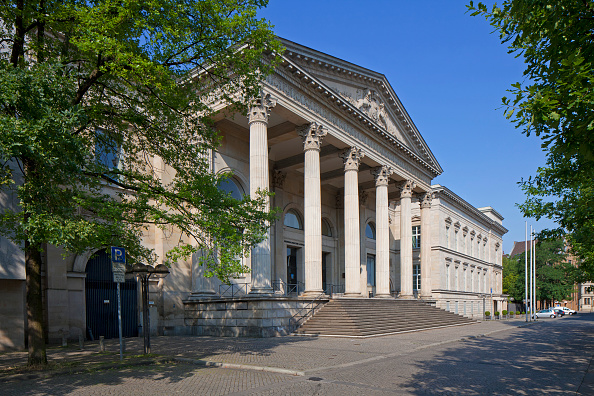
| The state parliament in the former Leineschloss /
Leine Castle in Hannover Lower Saxony Germany |
An Unhappy Marriage
The unhappy couple set up home in Leine Palace in Hanover where Sophia Dorothea was under the supervision of her odious aunt, Duchess Sophia, and spied on by her husband’s spies when he was away on campaign. Despite their unhappiness, the pair produced two children; George Augustus, born 1683, who later became King George II of Great Britain and a daughter born 1686 when Sophia Dorothea was twenty.
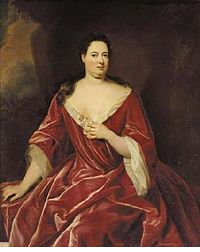 |
| Sophia Charlotte
von Keilmannsegg |
Having produced two children, George became increasingly distant from his wife spending more time with his dogs and horses and his nights with his mistress, the married daughter of his father’s mistress, a woman called Sophia Charlotte von Keilmannsegg, who was rumoured to be George Louis’ half-sister.
Aggrieved, lonely, and unhappy Sophia Dorothea found a friend in the Swedish count Philip Christoph von Königsmarck, (1665-1694) who was a soldier in the Hanoverian army. Philip was a year older than Sophia Dorothea and the antithesis of her ugly, boorish husband.
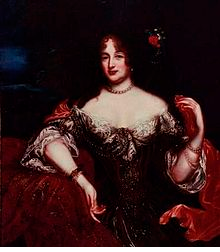 |
| Countess of Platen |
The Fatal Affair
Sophia Dorothea was no saint. She was quick-tempered and rarely discrete, and her choice of Von Königsmarck as a lover was not the best. Königsmarck was a dashing, handsome gigolo and the former lover of her father-in-law’s mistress, the Countess of Platen and the Countess had a jealous nature.
Königsmarck and Sophia Dorothea began a love affair of clandestine trysts, real love, and their coded correspondence facilitated by a trusted go-between. Their love affair was uncovered in 1692 when the Duchess of Platen presented a collection of their letters to her lover, Sophia Dorothea’s father-in-law the Elector of Hanover. Von Königsmarck was banished from the Hanoverian court but soon found a position in the neighbouring court of Saxony where one night when he was buried in his cups he let slip the state of affairs in the bedchambers of the royal house of Hanover. George Louis got wind of what had been said and on the morning of 2 July 1694, after a meeting with Sophia at Leine Palace, Königsmark was seized. No one except his murderers knew what happened to him next.
 |
| Philip Christoph von Königsmarck,
(1665-1694) |
A Sad and Lonely Death
Dorothea never saw her lover again. George Louis divorced her in December, and early the following year she was confined her to Schloss Ahlden a stately home on the Lüneburg Heath in Lower Saxony. She stayed there for the rest of her life. Her children were taken away from her, and she was forced to live alone.
When Sophia Dorothea died in 1726, she had spent 33 years in her prison. Before she died, she wrote a letter to her husband, cursing him for his treatment of her. A furious George forbade any mourning of her in Hanover and London.
George, I died shortly after the Countess of Platen exonerated him of any involvement in Von Königsmark’s death. Two of her henchmen made deathbed confessions to the crime. Although George I was cleared of Von Königsmark’s death, his son George II never forgave his father for the treatment he had meted out to his mother.
Sources:
https://en.wikipedia.org/wiki/Sophia_Dorothea_of_Celle
Notorious Royal Marriages: A Juicy Journey Through Nine Centuries of Dynasty By Leslie Carroll
The Georgian Princesses By John Van der Kiste
Julia Herdman writes historical fiction. Her latest book Sinclair, Tales of Tooley Street Vol. 1. is Available on Amazon – Paperback £10.99 Kindle.
Sinclair is available of Amazon. Click here to get your copy.
Sinclair is set in the London Borough of Southward, the Yorkshire town of Beverley and in Paris and Edinburgh in the late 1780s. Strong female leads include the widow Charlotte Leadam and the farmer’s daughter Lucy Leadam. Sinclair is a story of love, loss and redemption. Prodigal son James Sinclair is transformed by his experience of being shipwrecked on the way to India to make his fortune. Obstacles to love and happiness include ambition, conflict with a God, temptation and betrayal. Remorse brings restitution and recovery. Sinclair is an extraordinary book. It will immerse you in the world of 18th century London where the rich and the poor are treated with kindness and compassion by this passionate Scottish doctor and his widowed landlady, the owner of the apothecary shop in Tooley Street. Sinclair is filled with twists and tragedies, but it will leave you feeling good.
Amazon Australia
Amazon Canada
Amazon New Zealand
Amazon South Africa
Amazon USA
Princess Anne - The Princess Who Married a Hunchback

by Julia Herdman | May 11, 2017 | Blog, British History, British Royal Family, Europe, European Royal Families, Marriage, Politics, Romance, Visual arts, Women and Children
Anne, The Princess Royal, married the hunchback William of Orange in 1734.
Princess Anne, or the Princess Royal as she was known, was the eldest daughter of George II. The title Princess Royal is a substantive title customarily (but not automatically) awarded by a British monarch to his or her eldest daughter. There have been seven Princesses Royals. The daughter of Queen Elizabeth II is currently holds the title. The title Princess Royal came into existence when Queen Henrietta Maria (1609–1669), daughter of Henry IV, King of France, and wife of King Charles I (1600–1649), wanted to imitate the way the eldest daughter of the King of France was styled “Madame Royale”. Thus Princess Mary (born 1631), the daughter of Henrietta Maria and Charles, became the first Princess Royal in 1642. Anne,the daughter of George II was the second Princess Royal.
Dysfunctional Family
Anne was born into what we would call an extremely dysfunctional family in May 1709. George II was the only son of the German prince George Louis, elector of Hanover (King George I of Great Britain from 1714 to 1727), and Sophia Dorothea of Celle. George, I had divorced and locked Sophia Dorothea in a castle in Celle for her adultery with a Swedish cavalry officer and taken their children, which include the boy who would become George II away from her. George II had, of course, never forgiven his father for his cruel treatment of his mother.
George II’s daughter Anne was a remarkable woman in many ways. She was criticised and praised in equal measure by contemporary chroniclers. Some said she was arrogant others that she was accomplished.
Early Life
Although Anne was an English princess, she was born at Herrenhausen Palace, Hanover. Her mother was Caroline of Ansbach. According to a recent biography of Caroline, The First Iron Lady: A Life of Caroline of Ansbach By Matthew Dennison, she was the real power behind George II. When she arrived in England in 1714, she became the first Princess of Wales since Prince Henry married Catherine of Aragon in 1509. She was blonde, buxom and above all, intelligent. Anne was one of the couple’s four children.
Her parents’ relationship with King George I was a troubled one. Her mother, Caroline of Ansbach, had been brought up in the Prussian Court where she had been treated as a surrogate daughter to the Prussian King and had been well educated.
When she married, she joined the Hanoverian Court, which was by comparison boorish. How much that experience influenced her opposition to George I in England we do not know, but the two did not get on. One wonders if Caroline suspected her father-in-law of having her mother-in-law’s lover killed? There were always rumours surrounding the disappearance of her Swedish lover.
Political differences between George I and his son the Prince of Wales led to factions in the court. The family dispute came to a head following the birth of George and Caroline’s second son, Prince George William in 1717. At the baby’s christening, the Prince of Wales publicly insulted the Duke of Newcastle one of his father’s allies. This so infuriated George I he banished his son and daughter-in-law from St James’s Palace, but he kept their children, including Anne under his guardianship at Leicester House.
The Prince and Princess of Wales were sent packing without their children. George, I kept them separated until 1720 when Anne’s brothers were returned to the care of her parents, but the girls remained the wards of the King.
Smallpox and Variolation
In that year, Anne’s body was ravaged by smallpox; she was 11 years old. The disease killed an estimated 400,000 Europeans a year during the closing years of the 18th century.
Smallpox had no respect for wealth or rank, anyone could catch it. Her own father had suffered from the disease in the first year of his marriage. Her personal near-death experience and the experience and her father led the family to support the introduction of variolation (an early type of immunisation against smallpox), which had been witnessed by Lady Mary Wortley Montague and Charles Maitland in Constantinople.
Variolation or inoculation was the method first used to immunise an individual against smallpox (Variola) with material taken from a patient or a recently variolated individual in the hope that a mild, but the protective infection would result. The procedure was most commonly carried out by inserting/rubbing powdered smallpox scabs or fluid from pustules into superficial scratches made in the skin. The patient would develop pustules identical to those caused by naturally occurring smallpox, usually producing a less severe disease than naturally acquired smallpox. Eventually, after about two to four weeks, these symptoms would subside, indicating successful recovery and immunity.
To test the process, Caroline ordered six prisoners who had been condemned to death to take part in the trial. They were offered the chance to undergo variolation instead of execution. They all agreed, and they all survived, as did the six orphan children who were also part of the test. (There were no medical ethics committees then). The tests convinced Caroline of variolation’s safety, and the Queen had her two younger daughters, Amelia and Caroline, inoculated. Royal patronage of the process was a boon to the doctors who were prescribing the process, and variolation began to spread amongst the upper classes.
On 22 June 1727, George I died making Anne’s father king. The following year, her elder brother, Frederick, who had been educated in Germany, was brought to England to join the court. Father and son had not seen one other in 14 years, and when they did, the fireworks began. Their relationship was even more tempestuous than the one between George I and George II especially after 1733 when Frederick purchased Carlton House and set up what George II considered to be a rival court.
Marriage
As a daughter of the future British King Anne’s marriage was always going to be a dynastic one. But, as a princess requiring a protestant marriage, her options were limited, most of the continent was ruled by Catholic princes. The government hit on the idea of a union with the rather lowly William, Prince of Orange-Nassau to sure up their anti-French alliance.
George II was not enamoured with the proposal, and Anne was concerned herself. The Dutch Prince William had a well-known physical deformity. Anne wanted to know more about his deformity before she agreed to see him, so she dispatched Lord Hervey, a close confidant, to report on its extent. Hervey said that William was no Adonis. William suffered from a pronounced curvature of the spine, which was probably the result of sclerosis, the same condition suffered by the English King Richard III. or Kyphosis the hunchback disease.
William’s Deformity
A normal thoracic spine extends from the 1st to the 12th vertebra and should have a slight kyphotic angle, ranging from 20° to 45°. When the “roundness” of the upper spine increases past 45° it is called kyphosis or “hyperkyphosis”. Scheuermann’s kyphosis is the most classic form of hyperkyphosis and is the result of wedged vertebrae that develop during adolescence. The cause is not currently known and the condition appears to be multifactorial and is seen more frequently in males than females. The condition must have made life very hard for William who apart from the problem with his spine was considered an attractive, educated, and accomplished Prince.
Having taken Hervey’s report into consideration and the inferiority of William’s territory, Anne decided she would take him. She was 25 years old, and it seems she did not want to end up an old maid surrounded by her warring relatives. When they married in 1734, her mother and sisters wept through the ceremony, and Lord Hervey described the marriage as more sacrifice than celebration.
As an outsider and British, Anne was not popular in the Netherlands. Her life must have been a lonely one because she did not get along with her mother-in-law, and her husband was frequently on campaign. France was an ever-present threat to William’s protestant country and his power base dependent on his ability to protect the states of the Dutch Republic from its enemies.
In these lonely years, Anne concentrated her efforts on literature and playing the harpsichord; she was an accomplished, artist, musician, and lifelong friend of her music teacher Handel.
Producing the required heir was problematic too. In 1736, she gave birth to a stillborn daughter and another in 1739. Her first live birth came in 1743 with the arrival of Princess Carolina of Orange-Nassau who was followed by another daughter, Princess Anna two years later. Her only son arrived in 1748 when she was 39 years old.
Regent
Anne became a widow in 1751 at the age of 40 and was appointed as Regent for her 3-year-old son, Prince William V. She was given all prerogatives usually given a hereditary Stadtholder of the Netherlands, except for the military duties of the office, which were entrusted to Duke Louis Ernest of Brunswick-Lüneburg. To say that she took to the role like a duck to water would not be an exaggeration. Finally free to exercise some power of the own, in true Hanoverian style, Anne used her wit and her determination to secure her personal power base and with it the dominance of her family and the Orange dynasty.
As Regent she was hard-working, but she remained unpopular. The commercial rivalry between the Dutch and the British East India Companies was part of the cause, her Dutch subjects were never entirely sure she was on their side because she pursued a foreign policy, that favoured the British-German alliance over alliance with the French. Another reason was the constitution of the United Provinces. But what made her most unpopular was that she seized the opportunity to centralise power in the office of the hereditary Stadtholder over the traditional rights of the Dutch states, particularly the State of Haarlem.
Ultimately, as a woman, she was reliant on the men around her, and it is fair to say that her husband and her son were fighting a losing battle against the tide of history at the end of the 18th century. Even Anne, with all her skills, could not realise the ambitions of the House of Orange on her own. She ruled the Netherlands for eight years. She died of dropsy (an accumulation of fluid in the body that leads to heart failure) in 1759. Her son was twelve and still too young to take the reins of power.
Anne was replaced as Regent by her mother-in-law, Marie Louise of Hesse-Kassel and when she died in 1765, Anne’s daughter, Carolina, was made Regent until her younger brother William V turned 18 in 1766.
Legacy
Anne was a remarkable woman in many ways. Her beauty was shredded by smallpox, but she took on the world and won. (I am sure she took the opportunity to show herself in the best light in her self-portrait above.) She accepted and made a success of her marriage, which on the face of it held little prospect for personal happiness. She was an intelligent if haughty woman who endured years of loneliness, the pain of giving birth to two stillborn children and then she was widowed. Anne exercised the role of Stadholder (chief executive of the Dutch Republic) as effectively as any man and the centralisation of power she created laid the foundations of the Dutch state and its royal family. Her grandson, William I became the first king of the Netherlands in 1815.
Picture: Self Portrait
Sources:
George II: King and Elector By Andrew C. Thompson, 2011, Yale University Press
https://en.wikipedia.org/wiki/Anne,_Princess_Royal_and_Princess_of_Orange
Julia Herdman writes historical fiction that puts women to the fore. Her latest book Sinclair, Tales of Tooley Street Vol. 1. is Available on Amazon – Paperback £10.99 and on Kindle.
Sinclair is available of Amazon. Click here to get your copy.
Sinclair is set in the London Borough of Southward, the Yorkshire town of Beverley and in Paris and Edinburgh in the late 1780s. Strong female leads include the widow Charlotte Leadam and the farmer’s daughter Lucy Leadam. Sinclair is a story of love, loss and redemption. Prodigal son James Sinclair is transformed by his experience of being shipwrecked on the way to India to make his fortune. Obstacles to love and happiness include ambition, conflict with a God, temptation and betrayal. Remorse brings restitution and recovery. Sinclair is an extraordinary book. It will immerse you in the world of 18th century London where the rich and the poor are treated with kindness and compassion by this passionate Scottish doctor and his widowed landlady, the owner of the apothecary shop in Tooley Street. Sinclair is filled with twists and tragedies, but it will leave you feeling good.
Also available on:
Amazon Australia
Amazon Canada
Amazon New Zealand
Amazon South Africa
Amazon USA
Princess Sophia Dorothea the Uncrowned Queen of Britain
A Labour in Vain - The Tragic Death of Princess Charlotte Augusta

Recent Comments