
by Julia Herdman | Aug 27, 2017 | Arts and Literature, Blog, Literature, Writing about history
The profession or the jobs of your character does plays a major role in making your novel a hit.
That’s because a character’s profession affects the entire story.
A job or profession gives an indication of personality, class, wealth and motivation. You can use it as a stereotype or as a short-hand description or develop the character with it.
Just think for a moment. What character attributes would you give to a teacher?
Perhaps the teacher in your imagination is a dotty old professor. A man dressed in tweed with patches on his elbows, a mop of thick grey hair and horn-rimmed spectacles. He teaches classics and quotes passages from Cesar’s Gallic Wars.
Alternatively, the teacher of your imagination may be a young ambitious woman of Anglo-Caribbean descent who teaches physics. She wears a smart white lab coat and red, five-inch heel stilettos. She’s sassy. She drives a sports car and the boys in the class don’t know where to look when she comes into the lab.
Muriel Spark’s character Jean Brodie from the novel The Prime of Miss Jean Brodie is a highly idealistic character with an exaggerated romantic view of the world. The phrases Spark gives her character are now clichés in the English language. “Give me a girl at an impressionable age and she is mine for life.” “These years are still the years of my prime. It is important to recognise the years of one’s prime, always remember that.” ‘I am a teacher! First, last, always!’ Spark gives the character the name of the historical Jean Brodie the common law wife or mistress of Deacon Willie Brodie. Brodie was an Edinburgh cabinet maker and thief hanged from a gallows of his own design. The fictional Jean is doomed like her namesake whose husband was the was the inspiration for the gothic novel, The Strange Case of Dr. Jekyll and Mr. Hyde by Robert Louis Stevenson.
Now think about a taxidermist? Somehow there is always something a bit creepy about this job. Is it the association with dead things, the dismembering of bodies or the macabre nature of the results of their work - an animal that looks alive but is dead? The Taxidermist’s Daughter by Kate Moss is a story in which ghosts and ghoulish patriarchal secrets, estranged female psyches, and tumultuous bird-life. All these elements coexist in a compulsively readable yarn.The novel is a cabinet of curiosities, a tale of sexual predation and female revenge. The protagonist Connie is bright, beautiful, determined, and has a very strong stomach. She’s a victim of traumatic memory loss. The plot involves her mind’s recuperation from obscene events 10 years ago. A crime opens the story. A woman’s corpse is found outside Blackthorn House, where Connie is attempting to stuff a jackdaw. The woman has been garrotted with taxidermist’s wire.
These examples show that giving your character a profession enables you to start building that character and the character, in turn, helps you to build the story. In my novel Sinclair, which is set in the late 18th century, Sinclair is a man of the Enlightenment who has rejected religion. This leaves him isolated from his family and much of society. He is a dedicated doctor who wants to heal people.
Fantasy jobs
If the story is a realistic fiction, it’s best to avoid ridiculous characters and professions that don’t exist in the real world.On the other hand, if you are writing a general fiction story, an absurd and unrealistic profession is perfectly acceptable as long as you stick to the descriptions you have given about that character and his or her profession. For example, if you plan on writing a fantasy fiction, your character will probably include mythical creatures such as goblins, trolls, giants, or unicorns. The main character will possibly possess magical powers again consistency is the key here - what can your character do with magic and what are their limitations? Limitations are often the making of a character.
Sci-fi
Even in Sci-fi, the best characters have jobs: Ship’s captain, the General of an invading army, the pilot or navigator of a space of underwater cruiser. Phillip Dick’s Do Androids Dream of Electric Sheep? is a science fiction novel describing humanity’s struggle for survival in a post-apocalyptic world after a nuclear war has irradiated the Earth, forcing humans to create a separate colony on Mars. Character Rick Deckard is a bounty hunter who is about to have one bad day.
Unlike the bounty hunters of the Wild West, this space age cowboy will, within the space of twenty-four hours, have to kill six state-of-the-art androids, have an inter-galactic corporation mess with his mind, meet a metaphysical god twice, and discover an extinct animal.
Rick clearly lacks empathy for androids, his electric sheep, and for his wife which, in an ironic twist, is the very fault androids are accused of and as a result, they must be killed. Rick is a hypocrite, in a way he represents the hypocrisy of mankind. He punishes androids for lacking empathy when he’s the least empathetic person on the planet.
Ironic Jobs
Some authors and screenwriters choose to write an ironic character that doesn’t match their profession. Other times, a profession can be used to create a twist in the plot. This is usually true for novels with a dramatic theme. A character could be shown doing something they don’t enjoy at all. They are bored of their ordinary life and their ordinary profession.
Take “Fight Club”, a book by Chuck Palahniuk for example; in this novel, his protagonist who is never named is a man who works as a product recall specialist. Our protagonist hates his job and his lifestyle. In this anti-capitalist story, the narrator attempts to treat his depression and insomnia through obsessive consumerism and knowledge of brands.
On a flight home from a business trip, the Narrator meets Tyler Durden, a soap salesman with whom he begins to converse after noticing the two share the same kind of designer briefcase. After the flight, the Narrator returns home to find that his apartment has been destroyed by an explosion.
With no one else to contact, he calls Tyler and Tyler invite the Narrator to stay at his place but requests that the Narrator hit him first, which escalates into a minor fistfight. The Narrator then moves into Tyler’s home, a large dilapidated house in an industrial area of their city and begins assisting with Tyler’s handmade soap business. They have further fights outside the bar on subsequent nights, and these fights attract growing crowds of men.
The fighting eventually moves to the bar’s basement where the men form a structured club (“Fight Club”) which routinely meets to provide an opportunity for disaffected local men to fight safely for recreation. Ultimately, the story degenerates into a stop the bad guy destroying capitalism movie but the initial idea is interesting.
See also: 10 Things that can turn a character bad.
About the author: Julia Herdman writes historical fiction. Her debut novel Sinclair is available worldwide in print or as an Ebook. Go to Amazon to find out more.

by Julia Herdman | Aug 17, 2017 | Arts and Literature, Blog, Literature, Marriage, Romance, Women and Children
I loved Mary Wesley’s books. I think I read them all in the 1980s and 1990’s before my children were born. I really enjoyed the TV adaptations too. Her work was refreshing, vivid and bittersweet, her style was effortless. She is a great influence on me still.
Mary Wesley, died aged 90. She amazed the literary world by having her first novel published when she was 70, in 1983.
She went on to write nine more (three of which were filmed for TV), figured regularly in the bestseller lists and was appointed CBE in 1995. A remarkably good-looking woman, she had a commanding presence and could appear reserved when meeting people she did not know. But she was much less confident than she seemed and she had a wonderful sense of humour. She was also a generous friend.
She often claimed that her novels were not autobiographical, but aspects of her life are reflected in the themes that run through them. A typical Wesley heroine is a young woman, damaged by parental dislike or neglect, who ties herself to a conventional man who does not understand her, only to find happiness later with an eccentric, tender lover, who values in her all the qualities no one else has recognised.
The third child of Colonel Harold Mynors Farmar and his wife, Violet, Mary Aline was born at Englefield Green, Windsor Great Park. She grew up hardly knowing her father and believing that her mother preferred her elder sister.
It was assumed that she would never have to work for her living and so she was not sent to school, which added to her isolation. Her beloved nanny was sacked when she was three and her minimal education was left to a series of foreign governesses.
Regretting this, in the 1930s she attended lectures on international politics and anthropology at the London School of Economics (60 years later she was awarded an honorary fellowship there).
She was presented at court and married Lord Swinfen in 1937. Having given birth to two sons, she had fulfilled her parents’ expectations, only to scandalise them when she left her husband. They were divorced in 1945. The second world war, which was to form the background to many of her novels, changed everything for her.
Like so many well-bred young women, she found work in intelligence. She once told an interviewer that the war years gave her generation a very good time: “an atmosphere of terror and exhilaration and parties, parties, parties”.
It was in 1944, dining at the Ritz, that she met Eric Siepmann, the Winchester and Oxford-educated playwright, and journalist. Siepmann’s father was German and his mother Irish. Her family strongly disapproved.
They lived together until his second wife could be persuaded to divorce him and then married in 1952, settling in Devon. Ten years after their first meeting he wrote in his autobiography, Confessions Of A Nihilist, that she was “somebody whom I really loved, who believed in God and who thought that loving meant what you give and not what you take”.
Their years together were so happy that Siepmann’s death in 1970 devastated Wesley. She felt as though she had been cut in half, “like a carcass at the butcher’s”. Siepmann had changed jobs frequently and never accumulated any capital, and his death left her bereft and without an income. Wesley sold her jewellery and knitted for whatever her customers could pay.
She had been writing for years but had no confidence in what she produced, in spite of her husband’s encouragement, and threw most of it away. Her first published works, in 1968, were two children’s books, and a third followed in 1983. It was only after Siepmann’s death that she found her voice.
Then, in Jumping The Queue, she wrote about a woman who could not bear to go on living after her beloved but eccentric husband’s death and planned a suicidal picnic.
This quirky, sad and very funny novel was quite unlike anything else that was being published in the early 1980s. Had it not been for the intervention of her friend Antonia White, it might have followed its predecessors into the bin. With White’s encouragement, Wesley began to submit the manuscript to publishers.
Several companies turned down Jumping The Queue on the grounds that there was no interest in “that kind of book”, but when her then agent Tessa Sayle sent the book to James Hale of Macmillan, he confounded his rivals. Her work soon found a wide public and was admired by critics.
Much was made of the fact that the novels are full of illicit sex and that the characters are free with the sort of four-letter words that few women of Wesley’s age and class would use. Perhaps more interesting, although it was less remarked at the time, is the hate and violence beneath the surface. Several of her heroines kill, from Mathilda in Jumping The Queue to Sophie, the unloved but deeply lovable child of The Camomile Lawn (1984, and filmed for TV in 1992).
It is the violent expression of long-buried anger and distress, quite as much as the frank sexuality of her heroines, that makes her work so different. Her novels are suffused not only with her humour but also with the emotions she preferred not to discuss, and they are inimitable. A book about the West Country with photographer Kim Sayer, Part Of The Scenery, was published in 2001.
She had always dressed elegantly, even when she couldn’t afford a railway ticket to London. She enjoyed success, the strange circus of book launches and the excitement of planning the film of a book (even if she tended to dislike the films that emerged). Book promotion tours made her feel she was earning her living and doing something for her publishers in return. She delighted in good reviews and was stung when she was attacked, especially since she avoided reviewing books which she did not like.
She really enjoyed writing, and that quality of pleasure is in everything she wrote. She complained bitterly when a plot got stuck, but she was desolate and lonely when a book was completed and had been handed over.
Her best-known book, The Camomile Lawn, set on the Roseland Peninsula in Cornwall, was turned into a television series and is an account of the intertwining lives of three families in rural England during World War II. After The Camomile Lawn (1984) came Harnessing Peacocks (1985 and as a TV film in 1992), The Vacillations of Poppy Carew (1986 and filmed in 1995), Not That Sort of Girl (1987), Second Fiddle (1988), A Sensible Life (1990), A Dubious Legacy (1992), An Imaginative Experience (1994) and Part of the Furniture(1997). A book about the West Country with photographer Kim Sayer, Part of the Scenery, was published in 2001. Asked why she had stopped writing fiction at the age of 84, she replied: “If you haven’t got anything to say, don’t say it.”
Her take on life reveals a sharp and critical eye which neatly dissects the idiosyncrasies of genteel England with humour, compassion, and irony, detailing in particular sexual and emotional values. Her style has been described as “arsenic without the old lace”. Others have described it as “Jane Austen plus sex”, a description Wesley herself thought ridiculous.[6] As a woman who was liberated before her time Mary Wesley challenged social assumptions about the old, confessed to bad behaviour and recommended sex. In doing so she smashed the stereotype of the disapproving, judgemental, past-it, old person. This delighted the old and intrigued the young.
Sources: https://www.theguardian.com/news/2003/jan/01/guardianobituaries.books1, Wikipedia

by Julia Herdman | Aug 8, 2017 | Arts and Literature, Blog, British History, Literature, Medicine, Politics, Romance, Society, Writing about history
The dead are always present, says Hilary Mantel, they live with us in our memory, in our genes and in the legacy of their decisions and actions that shaped the world we live in today. In the words of St Augustine, she says, they are ‘invisible, they are not absent’. My inspiration for it Sinclair was family history. Whoever we are we all have some sort of family and some sort of history, we could not have got here without it even if we do not know that history.
There is a poem by WH Auden, called “As I Walked Out One Evening”:
‘The glacier knocks in the cupboard,
The desert sighs in the bed,
And the crack in the tea-cup opens
A lane to the land of the dead’
Like most people I come from a long line of very ordinary people; people who struggled most of their lives to make ends meet them to keep a roof over their head. These are not the people we think of when we think of history. History was, until the last century, very much the domain of great men and great events. When we imagine the past in drama, in books, and, in films, the characters are always the movers and shakers of history; their decisions and actions change the world. Rarely do we think of the ordinary run of the mill people in the background who were most likely our ancestors.
My grandparents were born at the turn of the 19th century, they were Victorians. They lived through great events, the Great War, the economic depression of the 1930s, the Second World War, and the post-war boom but they did not shape them. They were lucky, they survived these huge historic events and so did their children; all of them living to ripe old age thanks to the introduction of the National Health Service in 1947. They were the first generation to live in Council Houses, proud tenants who always paid the rent on time. They worked hard and life was not easy but it was certainly better than it had been for their parents who had lived in overcrowded city-centre tenements with no interior sanitation. My Victorian ancestors worked hard, feared the workhouse, died young and were buried unceremoniously and as cheaply as possible.
My novel, Sinclair, is inspired by my husband’s family, the Leadams, who came from Walkington near the market town of Beverley and city of Hull. Christopher Leadam trained as a surgeon in York then moved to London sometime in the 1770s. I recently visited Walkington to look at the place he left to work at Guy’s Hospital. The contrast between this rural idle of the East Riding and the busy streets of Southwark could not be greater. Walkington is a beautiful place but as the 10th child in a family of farmers Christopher, who was clearly bright and adventurous, knew that if he was going to make a life for himself he had to leave the place of his birth.
Christopher died when he was relatively young, probably around 40. We know from the historical record that when he died he was the owner of an apothecary shop in Tooley Street and that he had a 14-year-old son and a wife. Christopher was not a great man of medicine but he was one of the cast of players who helped to heave medicine out of its medieval roots into the modern scientific age.
The Leadams of Tooley Street has led me on a journey into the 18th century and early 19th century. My novel begins in the aftermath of the disastrous American War and ends as France is about to throw the shackles of the ancient regime. Most historical romance is about aristocratic families, families with connections and status. My fiction is about a family too but this family has to make their own way in the world. They have no estate or inheritance to come into; they have to use their hands and their brains to make their way in the world. Men like the Leadams and the fictional Sinclair were men of the professions, industry, ideas, and commerce; they were the men for a new and enlightened age, the men who shaped the world we know today.
As a novelist, I want to tell the story of that change, of the development of the middle class if you like. The middle class is much maligned and forgotten in the pages of history and novels. Today middle-class values are under attack from libertarian capitalists who view government as a barrier to the unfettered accumulation of personal wealth, they do not believe in society or collective endeavour. In the historical novel, the middle class gets lost between the aristocratic splendour of the ballroom and the rags to riches stories of the poor.
‘The pursuit of the past makes you aware, whether you are novelist or historian, of the dangers of your own fallibility and inbuilt bias’ says Mantel. I agree I am the product of my own history. I am not the past I am now writing about the past in a language that is understood today. I am a writer of fiction but I am a historian too; an anachronism an oxymoron. The 19th-century historian Lord Macaulay said, “History has to be burned into the imagination before it can be received by the reason.” I burn with a passion for the past, but I also burn with a passion for the future, for a better future for my children and mankind. I’m biased and I don’t feel guilty about it; all history is biased, I am not perturbed about my desire to tell stories about people who live in townhouses and not country estates, people who value education for its own sake, people who want to engage in the political life of the nation because they want to improve the lives of others and build a better future.
Mantel says, “The historian and the biographer follow a trail of evidence, usually a paper trail. The novelist does that too, and then performs another act, puts the past back into the process, into action, frees the people from the archive and lets them run about, ignorant of their fates, with all their mistakes unmade.” Sinclair makes plenty of mistakes.
Julia Herdman writes historical fiction that puts women to the fore. Her latest book Sinclair, Tales of Tooley Street Vol. 1. is Available on Amazon – Paperback £10.99 Kindle £2.42 Also available on:
Amazon Australia
Amazon Canada
Amazon New Zealand
Amazon South Africa
Amazon USA
by Julia Herdman | Jul 31, 2017 | Arts and Literature, Blog, Europe, France, Literature, Marriage, Politics, Romance, Science, Women in Science, Writing about history
The pursuit of love and happiness was an 18th-century ideal.
Voltaire (1694-1778), the French philosopher and author was one of its chief exponents and is one of the heroes of my character Sinclair. Sinclair takes his copy of Candide, Voltaire’s satirical novel to India with him but he loses it when the ship goes down. Once he’s established himself in Tooley Street he’s quick to buy himself another copy.
Candide was an 18th century best seller. The story is about a young man who is the illegitimate nephew of a German baron. He grows up in the baron’s castle under the tutelage of the scholar Dr. Pangloss, who teaches him that this world is “the best of all possible worlds.” Candide falls in love with the baron’s young daughter, Cunégonde which does not please the baron at all and so the young man and his teacher are thrown out of the castle and their adventure begins.
The work describes the abrupt end of their idyllic lifestyle and Candide’s slow, painful disillusionment with the world as he witnesses and experiences its hardships.
The book ends with Candide, not rejecting Dr. Pangloss’s optimism outright but advocating that “we must cultivate our garden”, rather than rely on optimism alone to make it flourish. Thus, Candide rejects the Leibnizian mantra of Pangloss, “all is for the best” in the “best of all possible worlds” for the act of making the world we desire by cultivating it like a garden.
Voltaire was a man of passion and emotion as well as ideas. At the age of nineteen Voltaire was sent as an attache to the French Ambassador to the Netherlands. It was there that he fell in love with Olympe Dunover, the poor daughter of lower-class women. Their relationship was not approved of by either the ambassador of Olympe’s mother and Voltaire was soon imprisoned to keep them apart.
Writing from his prison cell in The Hague in 1713 he poured out his love for Olympe.
“I am a prisoner here in the name of the King; they can take my life, but not the love that I feel for you. Yes, my adorable mistress, to-night I shall see you, and if I had to put my head on the block to do it.
“For heaven’s sake, do not speak to me in such disastrous terms as you write; you must live and be cautious; beware of madame your mother as of your worst enemy. What do I say? Beware of everybody; trust no one; keep yourself in readiness, as soon as the moon is visible; I shall leave the hotel incognito, take a carriage or a chaise, we shall drive like the wind to Scheveningen; I shall take paper and ink with me; we shall write our letters.”
“If you love me, reassure yourself; and call all your strength and presence of mind to your aid; do not let your mother notice anything, try to have your pictures, and be assured that the menace of the greatest tortures will not prevent me to serve you. No, nothing has the power to part me from you; our love is based upon virtue and will last as long as our lives. Adieu, there is nothing that I will not brave for your sake; you deserve much more than that. Adieu, my dear heart!”
Arout (Voltaire)
His time in prison was brief. Being young and fit and the prison not so secure, he jumped out a window and got away.
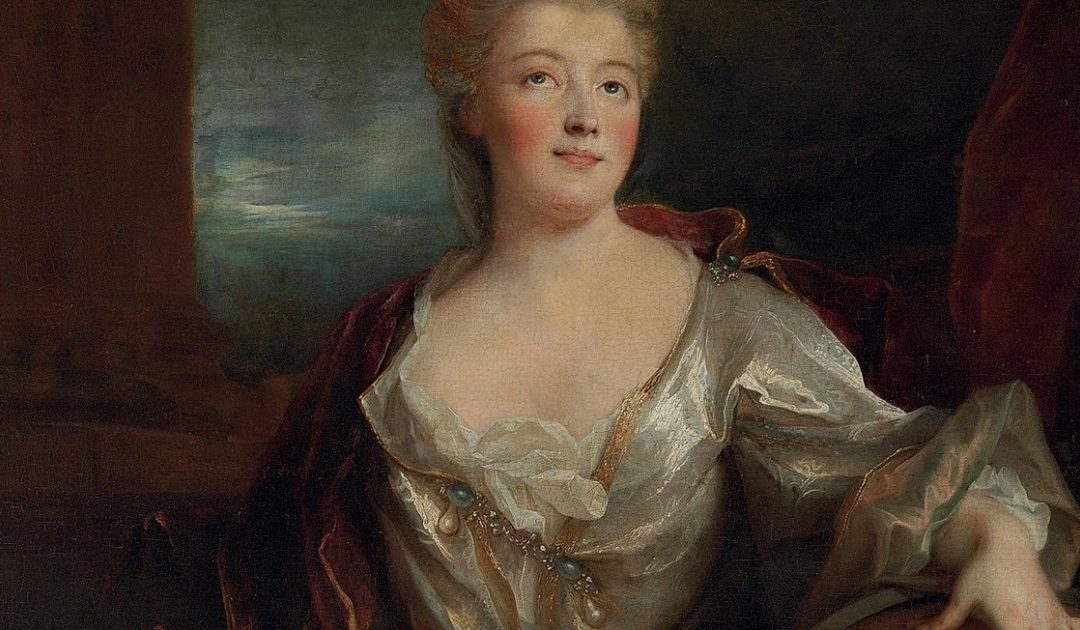
Twenty years later, in 1733, Voltaire would meet the love of his life, Émilie, Marquise du Châtelet. She was the wife of an aristocrat. He, by then was by then a successful writer. Having just returned from a period of enforced exile from France for his political views Voltaire was introduced to Émilie by friends.
The attraction was immediate, physical and cerebral. He wrote of her; “That lady whom I look upon as a great man… She understands Newton, she despises superstition and in short, she makes me happy.”
Soon the pair were living together in the Marquis du Châtelet’s chateau. The arrangement suited them all. Voltaire who was a rich man paid for the much-needed renovations to the chateau, Émilie’s husband the Marquis hunted all day and at night he lent Voltaire his willing wife.
Their love bore intellectual fruits; Émilie translated Newton’s Principia Mathematica and wrote her philosophical magnum opus, Institutions de Physique (Paris, 1740, first edition), or Foundations of Physics. Her own work circulated widely generated heated debates and was republished and translated into several other languages. During her time with Voltaire, she participated in the famous vis viva debate, concerning the best way to measure the force of a body and the best means of thinking about conservation principles. Posthumously, her ideas were heavily represented in the most famous text of the French Enlightenment, the Encyclopédie of Denis Diderot and Jean le Rond D’Alembert.
In 1737, Châtelet published a paper entitled Dissertation sur la nature et la propagation du feu, based upon her research into the science of fire, that predicted what is today known as infrared radiation and the nature of light.
In another publication, she debated the nature of happiness. During the Age of Enlightenment, personal happiness was one of the great philosophical themes. Many philosophers and writers studied it. There were many discourses on the subject but they were by men. Chatelet offers a new perspective on the philosophical question of happiness, a woman’s perspective. Her views on happiness were published posthumously long after she had ended her relationship with Voltaire.
Chatelet begins her work on happiness by recognising the difficulty of finding or achieving happiness due to the obstacles of circumstance such as age and other hindrances. She explains that fortune has placed individuals in specific states and that one of the most important elements in achieving happiness is not to try to change those circumstances. Chatelet’s way to happiness is to be satisfied with the condition we find ourselves in.
Happiness for Chatelet lies in satisfying personal tastes and passions and from “… having got rid of prejudices, being virtuous, getting well,….” In other words, she says it’s up to the individual to know and do what makes them happy.
I suppose that was alright for her she was a Marquise with a chateau, a husband, and rich lovers.
Her pet hate was religion which she saw as the ultimate prejudice. Prejudice she believed made people vicious and we cannot be both vicious and happy. Happiness, she believed came from virtue, inner satisfaction and the health of the soul. Finally, she concluded that happiness relied on illusion or the arts and that it was important to retain the illusions that produced pleasant feelings, such as laughter during a comedy.
Whilst I cannot argue with her view that pursuing interests, being free from prejudice and enjoying the arts all help us to achieve a state of happiness I cannot help being aghast at this very clever woman’s nativity. Perhaps she was so happy for most of her life, so happy with her studies and her lovers that she didn’t notice the people around her. Perhaps she didn’t notice the poor people who did her cooking and cleaning and grew everything she ate. Perhaps she lived life through such rose-tinted spectacles that she was blind to the routine injustice the state handed down to ordinary people and anyone who got in its way. Was Chatelet like so like so many aristocrats who met with Madame Guillotine a generation later - totally unaware of how they had created their own grisly fate? Did they not see that they had failed to ‘cultivate the garden’?
Julia Herdman writes historical fiction. Her books are available worldwide on Amazon.
myBook.to/TalesofTooleyStreet

by Julia Herdman | Jul 27, 2017 | Arts and Literature, Blog, Literature, Marriage, Romance
Jane Austen - Pride and Prejudice
Austen’s letter from Darcy is the watershed moment in Pride and Prejudice. From this moment on Elizabeth Bennet knows she has misread him. Oh, how her heart must have ached after reading it. It is an extraordinarily long letter for a novel these days. I wonder which of us who write would dare to put a letter this long into one of our books today.
Austen’s most usual plot devises are of course well known: Journeys, Revelations, Elopements, Illnesses, Alternative Suitors and the social position of her characters. Chance and coincidence play their parts, and Jane Austen does not try to disguise this. In Pride and Prejudice Jane Austen displays her ability to vary the devices she uses to bring Darcy and Elizabeth together, using holidays, illnesses and social gatherings. And of course, she writes this wonderful letter from Darcy. In it, Austen reveals all the heartache and frustration of this oh so proud man.
Austen is not the only writer to use the letter as a serious plot device. Thomas Hardy is another.
Thomas Hardy - The Mayor of Casterbridge
The private letter is the one space in a novel that provides lovers, or anyone else, to make contact without it being public. In Thomas Hardy’s the Mayor of Casterbridge for instance no fewer than sixteen notes or letters crisscross between the lovers. Though Hardy invariably reveals their contents to the reader, their privacy is respected within the fiction. Even when the sender remains anonymous, as Susan does when she brings Elizabeth-Jane and Farfrae together, the letters reach their intended readers. In the world of Casterbridge, letters function as specially protected spaces where secrets, plans, and requests can be communicated in true privacy.
Edith Wharton - Focus
Edith Wharton, who was a great letter writer herself, wrote of the need to focus the reader’s attention on the character’s point of view in an easy and compact way and advocated the use of the letter motif. Wharton resorts to this device in three stories—whose characters are all writers - and which connect the epistolary motif with a reflection on literature, a clear attempt on Wharton’s part to examine letter writing both as a narrative process and a literary topic.
Darcy’s Letter to Elizabeth Bennett
“Be not alarmed, madam, on receiving this letter, by the apprehension of its containing any repetition of those sentiments or renewal of those offers which were last night so disgusting to you. I write without any intention of paining you, or humbling myself, by dwelling on wishes which, for the happiness of both, cannot be too soon forgotten: and the effort which the formation and the perusal of this letter must occasion, should have been spared had not my character required it to be written and read. You must, therefore, pardon the freedom with which I demand your attention; your feelings, I know, will bestow it unwillingly, but I demand it of your justice.
Two offences of a very different nature, and by no means of equal magnitude, you last night laid to my charge. The first-mentioned was, that, regardless of the sentiments of either, I had detached Mr. Bingley from your sister,- and the other, that I had, in defiance of various claims, in defiance of honour and humanity, ruined the immediate prosperity and blasted the prospects of Mr. Wickham.- Willfully and wantonly to have thrown off the companion of my youth, the acknowledged favourite of my father, a young man who had scarcely any other dependence than on our patronage, and who had been brought up to expect its exertion, would be a depravity, to which the separation of two young persons, whose affection could be the growth of only a few weeks, could bear no comparison. But from the severity of that blame which was last night so liberally bestowed, respecting each circumstance, I shall hope to be in future secured, when the following account of my actions and their motives has been read. If, in the explanation of them, which is due to myself, I am under the necessity of relating feelings which may be offensive to yours, I can only say that I am sorry. The necessity must be obeyed, and further apology would be absurd.
I had not been long in Hertfordshire, before I saw, in common with others, that Bingley preferred your elder sister to any other young woman in the country. But it was not till the evening of the dance at Netherfield that I had any apprehension of his feeling a serious attachment. I had often seen him in love before. At that ball, while I had the honour of dancing with you, I was first made acquainted, by Sir William Lucas’s accidental information, that Bingley’s attentions to your sister had given rise to a general expectation of their marriage. He spoke of it as a certain event, of which the time alone could be undecided. From that moment I observed my friend’s behaviour attentively; and I could then perceive that his partiality for Miss Bennet was beyond what I had ever witnessed in him. Your sister I also watched. Her look and manners were open, cheerful, and engaging as ever, but without any symptom of peculiar regard, and I remained convinced from the evening’s scrutiny, that though she received his attentions with pleasure, she did not invite them by any participation of sentiment. If you have not been mistaken here, I must have been in an error. Your superior knowledge of your sister must make the latter probable.- If it be so, if I have been misled by such error to inflict pain on her, your resentment has not been unreasonable. But I shall not scruple to assert, that the serenity of your sister’s countenance and air was such as might have given the most acute observer a conviction that, however amiable her temper, her heart was not likely to be easily touched. That I was desirous of believing her indifferent is certain- but I will venture to say that my investigations and decisions are not usually influenced by my hopes or fears. I did not believe her to be indifferent because I wished it;- I believed it on impartial conviction, as truly as I wished it in reason. My objections to the marriage were not merely those which I last night acknowledged to have required the utmost force of passion to put aside, in my own case; the want of connection could not be so great an evil to my friend as to me. But there were other causes of repugnance;- causes which, though still existing, and existing to an equal degree in both instances, I had myself endeavoured to forget, because they were not immediately before me. These causes must be stated, though briefly. The situation of your mother’s family, though objectionable, was nothing in comparison of that total want of propriety so frequently, so almost uniformly betrayed by herself, by your three younger sisters, and occasionally even by your father. Pardon me. It pains me to offend you. But amidst your concern for the defects of your nearest relations, and your displeasure at this representation of them, let it give you consolation to consider that, to have conducted yourselves so as to avoid any share of the like censure, is praise no less generally bestowed on you and your eldest sister, that it is honourable to the sense and disposition of both. I will only say farther that from what passed that evening, my opinion of all parties was confirmed, and every inducement heightened which could have led me before to preserve my friend from what I esteemed a most unhappy connection. He left Netherfield for London, on the day following, as you, I am certain, remember, with the design of soon returning.
The part which I acted is now to be explained. His sisters’ uneasiness had been equally excited with my own; our coincidence of feeling was soon discovered, and, alike sensible that no time was to be lost in detaching their brother, we shortly resolved on joining him directly in London. We accordingly went- and there I readily engaged in the office of pointing out to my friend the certain evils of such a choice. I described, and enforced them earnestly. But, however this remonstrance might have staggered or delayed his determination, I do not suppose that it would ultimately have prevented the marriage, had it not been seconded by the assurance which I hesitated not in giving, of your sister’s indifference. He had before believed her to return his affection with sincere, if not with equal regard. But Bingley has great natural modesty, with a stronger dependence on my judgement than on his own. To convince him, therefore, that he had deceived himself, was no very difficult point. To persuade him against returning into Hertfordshire, when that conviction had been given, was scarcely the work of a moment. I cannot blame myself for having done thus much. There is but one part of my conduct in the whole affair on which I do not reflect with satisfaction; it is, that I condescended to adopt the measures of art so far as to conceal from him your sister’s being in town. I knew it myself, as it was known to Miss Bingley; but her brother is even yet ignorant of it. That they might have met without ill consequence is perhaps probable; but his regard did not appear to me enough extinguished for him to see her without some danger. Perhaps this concealment, this disguise was beneath me; it is done, however, and it was done for the best.- On this subject I have nothing more to say, no other apology to offer. If I have wounded your sister’s feelings, it was unknowingly done; and though the motives which governed me may to you very naturally appear insufficient, I have not yet learnt to condemn them.
With respect to that other, more weighty accusation, of having injured Mr. Wickham, I can only refute it by laying before you the whole of his connection with my family. Of what he has particularly accused me I am ignorant; but of the truth of what I shall relate, I can summon more than one witness of undoubted veracity.
Mr. Wickham is the son of a very respectable man, who had for many years the management of all the Pemberley estates, and whose good conduct in the discharge of his trust naturally inclined my father to be of service to him; and on George Wickham, who was his godson; his kindness was therefore liberally bestowed. My father supported him at school, and afterwards at Cambridge,- most important assistance, as his own father, always poor from the extravagance of his wife, would have been unable to give him a gentleman’s education. My father was not only fond of this young man’s society, whose manners were always engaging; he had also the highest opinion of him, and hoping the church would be his profession, intended to provide for him in it. As for myself, it is many, many years since I first began to think of him in a very different manner. The vicious propensities- the want of principle, which he was careful to guard from the knowledge of his best friend, could not escape the observation of a young man of nearly the same age with himself, and who had opportunities of seeing him in unguarded moments, which Mr. Darcy could not have. Here again I shall give you pain- to what degree you only can tell. But whatever may be the sentiments which Mr. Wickham has created, a suspicion of their nature shall not prevent me from unfolding his real character- it adds even another motive.
My excellent father died about five years ago; and his attachment to Mr. Wickham was to the last so steady, that in his will he particularly recommended it to me, to promote his advancement in the best manner that his profession might allow- and if he took orders, desired that a valuable family living might be his as soon as it became vacant. There was also a legacy of one thousand pounds. His own father did not long survive mine, and within half a year from these events Mr. Wickham wrote to inform me that having finally resolved against taking orders, he hoped I should not think it unreasonable for him to expect some more immediate pecuniary advantage, in lieu of the [preferment], by which he could not be benefited. He had some intention, he added, of studying the law, and I must be aware that the interest of one thousand pounds would be a very insufficient support therein. I rather wished, than believed him to be sincere- but, at any rate, was perfectly ready to accede to his proposal. I knew that Mr. Wickham ought not to be a clergyman; the business was therefore soon settled- he resigned all claim to assistance in the church, were it possible that he could ever be in a situation to receive it, and accepted in return three thousand pounds. All connection between us seemed now dissolved. I thought too ill of him to invite him to Pemberley, or admit his society in town. In town I believe he chiefly lived, but his studying the law was a mere pretence, and being now free from all restraint, his life was a life of idleness and dissipation. For about three years I heard little of him; but on the decease of the incumbent of the living which had been designed for him, he applied to me again by letter for the presentation. His circumstances, he assured me, and I had no difficulty in believing it, were exceedingly bad. He had found the law a most unprofitable study, and was now absolutely resolved on being ordained, if I would present him to the living in question- of which he trusted there could be little doubt, as he was well assured that I had no other person to provide for, and I could not have forgotten my revered father’s intentions. You will hardly blame me for refusing to comply with this entreaty, or for resisting every repetition of it. His resentment was in proportion to the distress of his circumstances- and he was doubtless as violent in his abuse of me to others as in his reproaches to myself. After this period every appearance of acquaintance was dropped. How he lived I know not. But last summer he was again most painfully obtruded on my notice.
I must now mention a circumstance which I would wish to forget myself, and which no obligation less than the present should induce me to unfold to any human being. Having said thus much, I feel no doubt of your secrecy. My sister, who is more than ten years my junior, was left to the guardianship of my mother’s nephew, Colonel Fitzwilliam, and myself. About a year ago, she was taken from school, and an establishment formed for her in London; and last summer she went with the lady who presided over it, to Ramsgate; and thither also went Mr. Wickham, undoubtedly by design; for there proved to have been a prior acquaintance between him and Mrs. Younge, in whose character we were most unhappily deceived; and by her connivance and aid, he so far recommended himself to Georgiana, whose affectionate heart retained a strong impression of his kindness to her as a child, that she was persuaded to believe herself in love, and to consent to an elopement. She was then but fifteen, which must be her excuse; and after stating her imprudence, I am happy to add, that I owed the knowledge of it to herself. I joined them unexpectedly a day or two before the intended elopement, and then Georgiana, unable to support the idea of grieving and offending a brother whom she almost looked up to as a father, acknowledged the whole to me. You may imagine what I felt and how I acted. Regard for my sister’s credit and feelings prevented any public exposure; but I wrote to Mr. Wickham, who left the place immediately, and Mrs. Younge was of course removed from her charge. Mr. Wickham’s chief object was unquestionably my sister’s fortune, which is thirty thousand pounds; but I cannot help supposing that the hope of revenging himself on me was a strong inducement. His revenge would have been complete indeed.
This, madam, is a faithful narrative of every event in which we have been concerned together; and if you do not absolutely reject it as false, you will, I hope, acquit me henceforth of cruelty towards Mr. Wickham. I know not in what manner, under what form of falsehood he has imposed on you; but his success is not perhaps to be wondered at, ignorant as you previously were of everything concerning either. Detection could not be in your power, and suspicion certainly not in your inclination.
You may possibly wonder why all this was not told you last night; but I was not then master enough of myself to know what could or ought to be revealed. For the truth of everything here related, I can appeal more particularly to the testimony of Colonel Fitzwilliam, who, from our near relationship and constant intimacy, and, still more, as one of the executors of my father’s will, has been unavoidably acquainted with every particular of these transactions. If your abhorrence of me should make my assertions valueless, you cannot be prevented by the same cause from confiding in my cousin; and that there may be the possibility of consulting him, I shall endeavour to find some opportunity of putting this letter in your hands in the course of the morning. I will only add, God bless you.”
Fitzwilliam Darcy
Source: Miss Austen of course and Suzanne Keen. Victorian Renovations of the Novel: Narrative Annexes and the Boundaries of Representation. Cambridge UP, 1998.
Julia Herdman writes historical fiction that puts women to the fore. Her latest book Sinclair, Tales of Tooley Street Vol. 1. is Available on Amazon – Paperback £10.99 Kindle £2.42 Also available on:
Amazon Australia
Amazon Canada
Amazon New Zealand
Amazon South Africa
Amazon USA
Also on Smashwords

by Julia Herdman | Jul 24, 2017 | Arts and Literature, Blog, Europe, European Royal Families, Literature, Marriage, Politics, Romance, Visual arts, Women and Children, Writing about history
This story is about an Empress with a taste for the common man. Just like Jarvis Cocker’s Greek girl in the Pulp classic, ‘She wanted to sleep with the common people’.
Daughter of a Housemaid and an Emperor
Elizabeth Petrovna was born at Kolomenskoye, near Moscow, on 18 December 1709. She was the daughter of Peter the Great, Tsar of Russia, by his second wife, Catherine, a maid in the household. Her parents were said to have married secretly at the Cathedral of the Holy Trinity in St. Petersburg at some point of time between 23 October and 1 December 1707 then they married officially 5 years later when Peter legitimised his daughters, Anna and Elizabeth.
Although Catherine bore five sons and seven daughters for Peter only two daughters, Anna (b. 1708) and Elizabeth (b. 1709) survived to adulthood. As a child, Elizabeth was the particular favourite of her father. She resembled him both physically and temperamentally. She was a bright girl, if not brilliant, but received only an imperfect and desultory formal education.
Even though he adored his daughter Peter did not devote time or attention to her education. He had a son and a grandson from his first marriage and did not anticipate that a daughter born to his second wife might one day inherit his throne. Indeed, no woman had ever sat upon the throne of Russia and there was no expectation one ever would.
Empress Elizabeth as a Child
As a child, the young Empress Elizabeth had a French governess and grew fluent in Italian, German and French. She was also an excellent dancer and rider. Like her father, Elizabeth was physically active and loved riding, hunting, sledding, skating, and gardening. The wife of the British ambassador described Elizabeth as “fair, with light brown hair, large sprightly blue eyes, fine teeth, and a pretty mouth. She is inclinable to be fat, but is very genteel and dances better than anyone I ever saw. She speaks German, French and Italian, is extremely gay and talks to everyone…”
In 1724 Peter betrothed his daughters to two young princes, first cousins to each other, from the tiny north German principality of Holstein-Gottorp. Anna Petrovna, aged 16, was to marry Charles Frederick, Duke of Holstein-Gottorp, who was then living in Russia as Peter’s guest after having failed in his attempt to succeed his maternal uncle as King of Sweden. Sometime later the young Empress Elizabeth was betrothed to Charles Frederick’s first cousin, Charles Augustus of Holstein-Gottorp, the eldest son of Christian Augustus, Prince of Eutin. Anna’s wedding took place in 1725 as planned, even though her father had died only a few weeks before the nuptials. In the future Empress Elizabeth’s case, however, the planned marriage never happened as her fiancé died on 31 May 1727 before the wedding could be held. Unfortunately Elizabeth’s mother Empress Catherine I (who had succeeded Peter the Great to the throne) also died on 17 May 1727 just two weeks before Elizabeth’s fiancé.
Empress Elizabeth as a Teenager
Thus, by the end of May 1727, Empress Elizabeth, aged 17, had lost both her parents and her fiancé, and her half-nephew Peter II was on the throne. Her marriage prospects immediately dried up. They did not improve when, three years later, Peter II died and was succeeded by the soon to be Empress Elizabeth’s first cousin, Anna wife of Peter the Great’s elder brother and her infant grandson Ivan. There was little love lost between the cousins and no prospect of either any Russian nobleman or any foreign prince seeking Elizabeth’s hand in marriage with her cousins on the throne. Nor could Elizabeth marry a commoner because it would cost her her title, claim to the throne and royal status.
Empress Elizabeth as a Woman

The Emperor of the Night
The woman who would one day be Empress Elizabeth’s solution was to take refuge in relationships with the lower classes. First, she took Alexis Shubin, a handsome sergeant in the Semyonovsky Guards regiment, as her lover. When Empress Anna found out she had Shubin’s tongue cut out and he was banished to Siberia. Elizabeth then threw herself into the arms of a handsome coachman and then to a footman. Eventually, she found her long-term companion in Alexis Razumovsky, a young and handsome Ukrainian peasant with a good bass voice. Razumovsky had been brought from his village to St. Petersburg by his master, a nobleman, to sing for a church choir. Elizabeth purchased the talented serf from the nobleman and put him in her own choir. Razumovsky, a good-hearted and simple-minded man, never showed any personal ambition or interest in affairs of state during all the years of his relationship with Elizabeth. In return, Elizabeth was devoted to Razumovsky, and there is reason to believe that she might even have married him in a secret. In 1756 Elizabeth would make him a Prince and a Field Marshal and in 1742 the Holy Roman Emperor made him a Count of the Holy Roman Empire but at court, he was always known as the “the Emperor of the Night.”
When Empress Anna died her daughter-in-law, another Anna, became regent to her young son Ivan. It was a period of poor government, taxes were high and Anna was unpopular at court. A circle of the disaffected began to gather around Elizabeth and plans for a coup began.
Empress Elizabeth Seizes Power
On 25 November 1741, Elizabeth seized power with the help of the Preobrazhensky Regiment. Arriving at the regimental headquarters wearing a warrior’s metal breastplate over her dress and grasping a silver cross she challenged them: “Whom do you want to serve: me, your natural sovereign, or those who have stolen my inheritance?” Won over, the regiment marched to the Winter Palace and arrested the infant Emperor, his parents, and their own lieutenant-colonel, Count von Munnich. It was a daring coup and, amazingly, succeeded without bloodshed. Elizabeth had vowed that if she became Empress she would not sign a single death sentence, an extraordinary promise for the time but one which she kept throughout her life.
The question of Razumovsky and Elizabeth’s children remains unresolved and subject to many legends. The best-known pretenders were Augusta who became a nun under the name Dosifeya. She died in 1810 and was buried in the Romanov family crypt; another Princess Elizabeth was arrested in Livorno, Tuscany by Aleksei Grigoryevich Orlov and returned to Russia in February 1775, presumably she was trying to escape. She was then imprisoned in the Peter and Paul Fortress, where she died from tuberculosis. The legend of her being drowned during the floods of 1777 was the subject of a painting by artist Konstantin Flavitsky, 1864, which now hangs in the Tretyakov Galler.
Unmarried and Childless

As a supposedly unmarried and childless empress, it was imperative for Elizabeth to find a legitimate heir to secure the Romanov dynasty. She chose her nephew, Peter of Holstein-Gottorp her sister’s son. Elizabeth was only too aware that the deposed Ivan VI, whom she had imprisoned in the Schlusselburg Fortress was a threat to her throne. Elizabeth feared a coup in his favour and set about obliterating him from history with orders that he should only be killed if he tried to escape, which of course he did when he tried to claim the throne after her death. The new queen Catherine gave the order and he was secretly executed and buried within the fortress.
Her nephew Peter was brought to Russia from Holstein and educated in Russian ways. He married Princess Sophie Friederike Auguste von Anhalt-Zerbst-Dornburg; she was nicknamed “Figchen” the daughter of Christian August, Prince of Anhalt-Zerbst of Anhalt. Her two of her first cousins became Kings of Sweden: Gustav III and Charles XIII and eventually, she would become Catherine the Great Empress of Russia.
The marriage took place on 21 August 1745. Nine years later, a son, the future Paul I, was finally born on 20 September 1754. There is considerable speculation as to the actual paternity of Paul I. It is suggested that he was not Peter’s son at all, but that his mother had engaged in an affair—to which Elizabeth had consented—with a young officer named Serge Saltykov, and that he was Paul’s real father. In any case, Peter never gave any indication that he believed Paul to have been fathered by anyone but himself. Elizabeth removed the young Paul and acted as if she were his mother and not Catherine. When the child was born the Empress had ordered the midwife to take the baby and to follow her. Catherine was not to see her child for another month and then on the second time briefly for the churching ceremony. Six months later Elizabeth let Catherine see the child again. The child had become a ward of the state to be brought up by Elizabeth as she believed he should be — as a true heir and great-grandson of her father, Peter the Great.
Empress Elizabeth’s Court
Under Elizabeth, the Russian court was one of the most splendid in all Europe. Foreigners were amazed at the sheer luxury of the sumptuous balls and masquerades and Elizabeth was said to be “the laziest, most extravagant and most amorous of sovereigns. Elizabeth created a world in which aesthetics reigned supreme. Historian Mikhail Shcherbatov wrote that her court was “arrayed in cloth of gold, her nobles satisfied with only the most luxurious garments, the most expensive foods, the rarest drinks, that largest number of servants and they applied this standard of lavishness to their dress as well.”
Clothing soon became the chosen means in Court by which to display wealth and social standing. Elizabeth is reported to have owned 15,000 dresses, several thousand pairs of shoes, and a seemingly unlimited number of stockings. She was known to never wear a dress twice and to change outfits anywhere from two to six times a day. Since the Empress did this her courtiers did as well. It is reported that to ensure no one wore a dress more than once to any ball or notably formal occasion, the Empress had her guards stamp each gown with special ink. Men at court were known to wear diamond buttons, own jewelled snuff boxes, and adorn their servants in uniforms made of gold.
Empress Elizabeth’s Decline and Death
In the late 1750s, Elizabeth’s health started to decline. She began to suffer a series of dizzy spells and refused to take the prescribed medicines. She forbade the word “death” in her presence. She died on 5 January 1762 and was buried in the Peter and Paul Cathedral in Saint Petersburg on 3 February 1762 after six weeks lying in state.
Not surprisingly her life has been dramatised in several films and novels. She appears in the 1934 film Catherine the Great (based on the play The Czarina by Lajos Bíró and Melchior Lengyel) which starred Flora Robson as Elizabeth. 1934 also saw the release of The Scarlet Empress, another filmed version of Catherine the Great’s story, this time with Louise Dresser in the role of Elizabeth. She was played by Olga Chekhova in the 1936 German film The Empress’s Favourite. The 1991 TV miniseries Young Catherine features Vanessa Redgrave in the role. Jeanne Moreau portrayed Elizabeth in the 1995 television movie Catherine the Great. She is also a major character in several episodes of the Japanese animated series, Le Chevalier D’Eon.
Elizabeth appears as a character in the historical fiction novel “The Winter Palace” by Eva Stachniak and as a character in the novel “The Mirrored World” by Debra Dean and in “A Princess at the Court of Russia” by Eva Martens.
Source: Wikipedia.
Julia Herdman writes historical fiction that puts women to the fore. Her latest book Sinclair, Tales of Tooley Street Vol. 1. is Available on Amazon – Paperback £10.99 Kindle £2.42 Also available on:
Amazon Australia
Amazon Canada
Amazon New Zealand
Amazon South Africa
Amazon USA
Also on Smashwords

Recent Comments