by Julia Herdman | Jul 21, 2017 | Arts and Literature, Blog, British History, Literature, Romance, Society, Women and Children, Writing about history
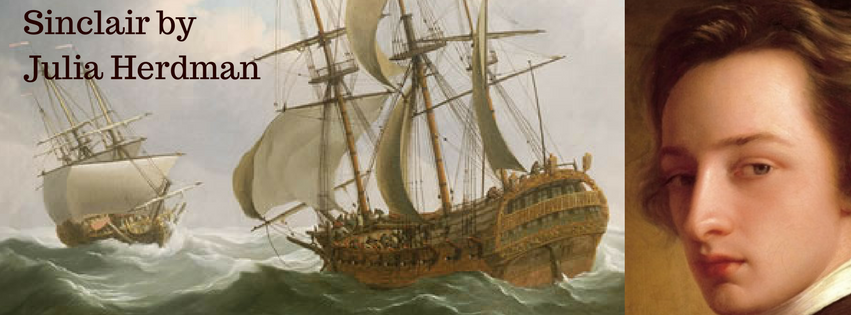
Sinclair By Julia Herdman
Sinclair is available on Amazon as an e-book and in paperback.
Sinclair is a story of love, loss and redemption. The story follows the lives of three people - James Sinclair a Scottish doctor working in London, Frank Greenwood a former Army Officer and Charlotte Leadam the widowed owner of an apothecary shop in Toooley Street.
Chapter 1 - Lies and Ambition
‘Gravesend, 1 January 1786’
It was dark when James Sinclair left the Anchor Inn and headed for the docks. As he walked across the cobbles towards the ‘Sherwell’, the bitter easterly wind flecked his coat with icy grains of snow. Moonlight broke intermittently through the clouds, illuminating the mighty ship standing before him. He paused at the foot of the gang plank and looked up. Yellow lantern lights dotted through the rigging punctured the blackness of the winter night, and the sails were reefed tight against the restless blustery squalls. His stomach tightened. He was glad to be on his way. He was sick of England; sick of money and connections being the chief means of advancement, and sick of never having enough of either.
He had spent his last day in England writing letters. One was to his sister Morag in Edinburgh, sending her a forwarding address in London; one was to his lawyer Henry Bowman in Cheapside, which he sent with a signed copy of his last will and testament; and one was to Iona McNeal, the woman he loved, telling her that he did not intend to return to Scotland, which was true, and indicating that she meant nothing to him, which was a lie. With these letters dispatched, and feeling confident that his affairs were in order, he pulled down his hat and boarded the ‘Sherwell’, a 758-ton East Indiaman bound for Madras.
Preparation for this journey had started earlier in the year when he attended a selection process at the London headquarters of the East India Company. It was a building he had passed many times: a neo-classical masterpiece, the mercantile heart of the City of London and the centre of the greatest enterprise on earth. Its wealth flowed through the banks and merchant houses of the City like the water of the Thames, washing them with silt of pure shining gold and, in the opinion of men of principle, corrupting everything it touched.
Although Sinclair was aware of the company’s less than wholesome reputation, he knew that for men of ability like him it was still the goose that laid the plumpest and the most golden of eggs and he, despite his political misgivings and the pricks from his Presbyterian conscience, was very much hoping to find himself in possession of one soon.
With five other hopefuls, he underwent two examinations. The first tested his knowledge of anatomy, physic, surgery and midwifery, the second his knowledge of botany, chemistry, materia medica and the creation of healing medicines and remedies. Then he was interviewed in the Directors’ Court, a room so vast in scale and decoration that if he had not been well prepared he might have been overwhelmed.
His interviewer, an elderly naval surgeon with a scrawny neck and trembling hands, fumbled through his papers looking for questions and then checking Sinclair’s answers against his handwritten script. As far as Sinclair was concerned, the questions were mundane and easily answered. When the old man had asked him why he had applied for the position, he had replied that he wanted to seek out new treatments for tropical diseases using the flora of the sub-continent. He knew the answer he gave so precisely chimed with the political requirements of the company, it was no surprise to him when a few weeks later he heard that the post was his.
At the end of November, he was called to Leadenhall Street to complete the formalities and to be briefed on the company’s new Indian Medical Service. There he was greeted by a keen, fresh-faced officer called Lovell, who looked no more than eighteen and was dressed in a uniform straight out of Hawkes. With a smile as bright as his brand new epaulettes, the young man said, “You will start your journey to India at the end of the year.” Sinclair thought the boy’s mother must be proud of her son’s new position, and was sad that his father would not feel the same about his.
“That’s the middle of winter,” he replied, unsure about starting a journey when the sea was at its most treacherous.
“Yes, sir;” the young man beamed. “It’s to catch the winds from the Cape in the spring. It’s the quickest way to India.”
“Aye, I see,” Sinclair mused, trying to disguise his unease.
Sensing the doctor’s reluctance, the young man set about reassuring him. “I can see you’re not completely comfortable with the idea, sir. Your ship is the newly refitted ‘Sherwell’, one of the company’s largest, under the captaincy of Mr Richards. Captain Richards is one of our most experienced men. He has already sailed the ‘Sherwell’ to Madras and China on several occasions, all without incident.”
Sinclair nodded, accepting the young man’s reassurance and allowing him to continue with the rest of his well-rehearsed lines.
“Your journey will start at Gravesend, and take you to Madeira, Gorée and the Cape of Good Hope. From there you’ll sail across the Indian Ocean, landing in Madras at the end of March. Then a local ship will take you to Calcutta.”
“Aye. That’s more or less what I expected.”
Lovell handed him a contract. Uninterested in the details, Sinclair scanned the contents, took a deep breath and wrote his name on the paper. He had learned his trade from the very best surgeons and anatomists in the world and now he was ready to take advantage of his investment.
Standing on the great ship, he felt his old and unhappy life was behind him, and the weight of years of disappointment and his father’s disapproval seemed to lift from his shoulders.
“You’ll find your accommodation on the lower deck, sir,” said the boatswain. “You’re with the ship’s senior officers: Lieutenants Merrick and Allsop; the ship’s surgeon, Mr Hodge; and a Captain Greenwood of the Bengal Army.”
“Aye, thank you,” Sinclair said, raising his hat to the short burly man and feeling the icy fingers of the wind running through his thick, sandy hair.
“Your accommodation is directly under that of the female passengers. The women are located on the first deck. There you’ll also find the ship’s saloon, the passengers’ dining and recreation room. To find your cabin, all you have to do is look for the captain’s quarters here,” the boatswain pointed to the door directly under the poop, “and go down a couple of flights of steps.”
Sinclair thanked the man again, and descended into the quiet golden belly of the ship.
When he had imagined himself on board, he had pictured himself in a cosy wooden cabin with a glass window and a comfortable cot. His cabin when he found it was a makeshift affair, constructed from canvas sheets stretched and nailed onto rough, wooden frames. His heart sank as he opened the door onto what was to be his world for the next three months. The cabin was dark and damp; there was a narrow wooden cot with a thin mean blanket. The belongings he had sent from London were there: a small writing desk, a basin and mirror for washing and shaving, a small armchair for reading, and his sea chest, containing everything he had accumulated in life so far including his medical books and equipment. Where the window should have been there was a leaky wooden hatch covering an unglazed porthole. It was battened shut, but the freezing wind was wheedling its way in with an icy chill.
He slumped into his armchair, feeling the fizz of his enthusiasm disappear. He had not expected to travel in luxury, but could not help registering the difference between his accommodation on the ship and the luxuries of the company offices in Leadenhall Street. Above, he could hear the giggles and shrieks of excited young girls, and he started to wonder if he had made a terrible mistake. Then his chair slipped backwards, and he realised the ship was being pulled away from the quay into the estuary. He was on his way, whether he liked it or not.
Knowing there was no going back, he made himself comfortable. He lit his lamp, took out a battered copy of ‘Candide’, his favourite book, and checked the hour with his treasured pocket watch. Like the book, it was French, and the most beautiful thing he had ever owned. He cradled it in his palm. The warmth of its golden body reminded him of the smoothness of a woman’s skin; its pearly white face was elegantly marked with Roman numerals; and the back, the part that he loved most of all, was made of cobalt blue enamel and shimmered like the silk of Iona McNeal’s ballgown the night they had danced at the Edinburgh Assembly Rooms. He turned it in his hand and kissed it then he put it back in his waistcoat pocket and started to read.
He chose the scene where Candide, the hero of the story, and his professor friend, Dr Pangloss, are nearly drowned in Lisbon harbour along with a sailor called Jacques. Candide and Pangloss survive, but Jacques dies attempting to save a fellow sailor. To explain how this is all part of God’s harmonious plan, Pangloss says that Lisbon harbour was created specifically so that Jacques could drown there and fulfil God’s divine plan for him. This was an idea so preposterous, like so many in the book, that it made Sinclair laugh out loud.
At eight, he joined the other passengers in the ship’s saloon. It was a simple, lime-washed room with a low ceiling and skylights onto the quarterdeck. In the centre, there was a long refectory table with space for sixteen people to dine comfortably. Sinclair pushed his way into the throng milling around in the space between the table and the low wall-mounted lockers that doubled as seats when the room was used for recreation.
Captain Richards greeted him with a firm handshake. He was a man Scots would describe as ‘braw’, and was in his late forties by Sinclair’s reckoning. “May I offer you a glass of Madeira, Dr Sinclair?”
“Aye, thank you,” the doctor replied with a nod, acknowledging the equality of their ranks.
“Between you and our surgeon Mr Hodge we shall be in good hands on this voyage,” Richards said.
“I pray my interventions will not be needed, Captain,” Sinclair replied, making the older man smile.
“Experience tells me that on voyages like this anything can happen, Dr Sinclair.”
“In which case, I am at your disposal.”
The captain put his hand on Sinclair’s shoulder. “I’m glad to hear it, sir.” Then he pushed past him, to speak to the scarlet-coated army captain.
One of the ship’s officers approached, introducing himself as Lieutenant Merrick. He explained that their purpose was to resupply Fort St George in Madras with fresh soldiers, their numbers having been much depleted during the last war. The lieutenant assured Sinclair that the men of the lower orders were to be confined to the ship’s hold, but their captain, Mr Greenwood, would join the passengers and fellow officers for meals and recreation. Merrick rested his hand on his sword. “You won’t be short of work in Madras, Dr Sinclair. It’s a regular bloodbath. If it’s not the natives, it’s the bloody French! My cousin was with Colonel Kelly in ‘83; thousands dead or wounded, supplies of everything scarce, it’s a miracle he survived. Who knows how long Prime Minister Pitt’s peace with France will last, or what this new-fangled India Act will turn up.”
“Indeed,” replied Sinclair, “but I’m bound for Calcutta and the company’s hospital there.”
Merrick slapped him on the back by way of a farewell and whispered, “Much the same there, but very rich pickings. A man can make a mint of money with the right connections. Plenty of ladies too,” he winked. “If you’re interested, Mr Allsop and I have some private trade there, despite what Mr Pitt and the new governor say.”
“Thank you. I’ll bear it in mind if I may; but in the meantime I’m not interested. I hope you’re not offended.”
“Not at all, Dr Sinclair. We all have to find our own way.” And with that Merrick was gone, leaving Mr Hodge, the barrel-chested ship’s surgeon, to introduce himself. Sinclair could see immediately that Hodge had an eye for the ladies. “Lovely, aren’t they?” the ship’s surgeon said, looking at the captain with his daughters and stroking the plume of thick, grey hair that crescendoed to a single curl on top of his head. “Completely mercenary though, all of them,” he continued, casting his lecherous eye around the room. “All they want is a rich husband, so watch yourself, laddie.”
“I will thank you; but I’m not rich so I’m in very little danger,” replied Sinclair, taking another glass of Madeira.
“Well, there’s nothing to say you can’t try your luck, it’s a long journey; but take my advice, if you’re not sincere in your intentions stay away from the captain’s daughters. I’d hate to see you keelhauled.”
“Oh aye; very funny, Mr Hodge. Trust me, I’m no imbecile,” said Sinclair.
“I’m sure you’re not, laddie,” the surgeon laughed loudly, shaking his vast barrel of a chest. “I’ve got my eye on that filly over there.” He pointed at a woman with dark hair. “She’s a recent widow, by all accounts. I shall enjoy offering her a bit of comfort.” Hodge licked his lips with bawdy anticipation. “Remember, I saw her first,” he smirked, and headed off in her direction.
With Hodge gone, Sinclair took a turn around the room, introducing himself to the captain’s young daughters, a middle-aged woman named Mrs Campbell and the elegant widow the ship’s surgeon had his eye on. Her daughters were a little younger than the captain’s.
As they sat down to eat, Sinclair found himself next to Miss Morris, the captain’s niece. His eyes were immediately drawn to her handsome bosom. He could see that Captain Greenwood, across the table, had noticed her too. She smiled at him, then pulled her shawl around her shoulders, obscuring his view.
“What are your plans when you get to India, Dr Sinclair?” she enquired without any of the usual formalities, a social transgression that unsettled him immediately. He looked at her, and felt the painful awkwardness he had felt all his adult life when encountering attractive women.
“Good evening, madam,” he replied, smoothing his napkin with fake assurance.
“That remains to be seen, doesn’t it?” she flirted, doing the same.
“Indeed it does. Let us hope that neither of us is disappointed,” he quipped in return. “To answer your question, madam, I shall work with the Surgeon General of the company’s new Indian Medical Service. I’ll be responsible for the organisation of the medical care for the company’s thousands of military and civilian servants on the sub-continent.”
“You’re Scottish, Dr Sinclair. I’ve never met anyone from Scotland before. Pray tell me, sir, what is Scotland like?”
Taken aback by her complete indifference to his position in the company, he replied, “Well, that’s a very difficult question because it’s a country of many parts, most of which I have never visited.”
She directed her gaze at him. “I am willing to be satisfied with the parts you know, Dr Sinclair.”
“Madam.” He paused to quell his consternation. How dare she show no appreciation of his rank, or his intellectual prowess? How dare she make him feel so uncomfortable with her beautiful breasts? He hated her already, and he had only just met her. “Well,” he said, “I hail from Sterling myself. Now, what can I tell you about Sterling? Aye, it’s a place with a big stone castle that has a little grey town attached to it.”
Miss Morris sipped her Madeira and cast her eyes across the table to the scarlet-coated Captain Greenwood. “So, you didn’t like living there, Dr Sinclair?” she smiled, but not at him.
Sinclair looked at Greenwood, who was returning his dining companion’s interest, and replied with rising pique. “Stirling was not my favourite abode.”
Unperturbed, or perhaps encouraged by her companion’s mounting discomfort, she continued, “I’m sure Sterling has something to recommend it, Dr Sinclair?”
He thought for a moment, then replied, “Unfortunately, I missed its most exciting episode.”
“What was that?” she said, taking one of the tureens and carefully dishing a portion of steaming hot broth into his bowl as if she were his servant.
“Well,” he declared with increasing irritation, “it was when that young scallywag Bonnie Prince Charlie tried to take the place.”
“Oh, it’s not good to make light of enemies of the Crown, Dr Sinclair,” she smiled, picking up her spoon.
“It was a jest, madam. I assure you I’m loyal to the Crown. I have no time for the Bonnie Prince and his Highland thugs. I am Scottish and I am British; my allegiance is to the King. If I may return to your question, the place I was happiest was Leiden. I studied at the University there. It’s a beautiful town with elegant buildings and a multitude of canals that freeze in the winter, when there is great entertainment to be had in skating.”
Hoping he had satisfied her curiosity, he started on his soup. As he ate, he saw the dashing Captain Greenwood calmly watching him from the corner of his eye. Why couldn’t he be more like him, he thought. Why did he always end up making a fool of himself as soon as he saw a pretty face?
With the first course finished, Sinclair took another glass of wine. “I’d like to know more about Scotland, sir. It sounds a fascinating place,” his torturer purred by his side.
He braced himself again. “Indeed it is. My father is a minister of the kirk there.”
“How interesting. My own dear father is dead, but when he was with us he was not of a religious persuasion.”
“Neither am I,” Sinclair replied with some relief, but then could not resist boasting. “My Father is a very popular preacher in Edinburgh.” Her shawl slipped from her shoulders, allowing him a view of her breasts again. “He has a very successful formula for filling his pews on Sundays,” he continued, distracted by the frisson of excitement in his groin.
“Pray tell me, sir, what is that?”
“Whatever the subject of his sermon he always ends it on the perils of licentiousness, madam.” As the words left his mouth, his heart began to sink.
“Licentiousness is a very dangerous thing, Dr Sinclair,” his companion smiled, turning his cheeks scarlet. “I am firmly of the opinion that men do not regulate their actions by anything the Church has to say. In my experience a man’s conscience is entirely determined by his class.”
He was astounded by the turn the conversation had taken. “Indeed, I believe that is an interesting and true observation, madam.”
“For my part I have only ever known Deptford,” she continued, “so I am in no position to contradict your opinion of Scotland or your father, but I suspect you are mocking a man who cares passionately about the welfare of his congregation.”
“Indeed he does, madam, but unlike my father my passion does not necessitate abhorring human nature and making people unhappy.”
“How interesting, Dr Sinclair. Pray, what is your passion?”
With great relief he proclaimed, “Medicine, Miss Morris; the curing of the sick.
”
“Then it is a passion every bit as worthy as your father’s,” she smiled. “You’re perhaps more alike than you care to admit.”
“I can assure you that my father and I have nothing in common, madam,” Sinclair retorted, taking the platter of beef and potatoes that had arrived in front of him and slapping a portion on his plate. Then, deliberately ignoring the rules of polite dining which seemed to no longer hold, he pushed it towards her. Unembarrassed, she took the platter and served herself saying, “Deptford is a very dreary place. Ordinarily, there are two choices for women like me there: the drudgery of being a poor man’s wife or the drudgery of being in the service of a rich one. That is why I am so grateful to my uncle for offering to take me to Bengal. You see, there are no castles or princes in Deptford, Dr Sinclair. Poor men work all the hours of the day and the rich drink and whore all the hours of the night. Tankards of ale and bottles of gin fuel passions there, not noble ideals and religious zeal. It’s a very different place to Scotland, sir.”
Chided and deflated, Sinclair bowed his head as he stabbed at the gristly pieces of meat on his plate, swallowing each in turn with a gulp of self-induced fury. When his plate was clean, he turned to Mr Hodge, who was sitting to his left, and introduced Miss Morris. Hodge, with instant and undisguised lechery in his eye, was delighted by the introduction. The ship’s surgeon quickly appraised himself of her finer assets, saying that he would be happy to assist her with any complaint and that she was welcome to come to his sick bay at any time, day or night. Recognising Hodge’s temperament immediately, Miss Morris thanked him for his concern, with the assurance that she was in robust good health and intended to remain so for the duration of the voyage – an assurance that disappointed him greatly.
At the first opportunity, Sinclair left the saloon for the rudimentary privacy of his canvas cabin. He was frustrated with himself. The evening that had started with so much promise had ended with him feeling deflated and humiliated. To console himself he smoked a pipe. As he sucked in the mellow tobacco he listened to the chatter of the other passengers making their way to bed. The rocking motion of the ship was vaguely soporific, but he could not settle; his mind was still in a state of agitation. He covered himself with his greatcoat and closed his eyes. Usually on New Year’s Day he would have no problem sleeping: he would still be drunk from the celebration the night before. Indeed, after dancing with Iona at the Assembly Rooms the previous year he had immersed himself in the demon for two days to assuage the feelings of desire she had aroused in him.
Drinking to excess was a habit he had acquired as a student; it was a habit his father and sister abhorred and one that had got him into trouble with his professors. But despite their disapproval, he often found himself craving the temporary oblivion that only its over-indulgence could supply. However, he thought tonight was not one of those occasions; and his mind turned to Iona again, wondering whom she had danced with and if by some chance she was lying in her bed thinking about him.
Despite their obvious delight in each other’s company, he knew Iona was out of his reach. Her father was Britain’s foremost medical educator, the son of the founder of Edinburgh’s medical school; a man of the kirk like his father and of the university’s governing body; a man with a reputation to foster and protect. His only daughter would marry a man of his choosing, a man whose work would advance the reputation of the great McNeal dynasty; not a man like James Sinclair, a man McNeal considered a godless, lazy drunk.
Then he thought about his encounter with Miss Morris. He was glad she was not interested in him; as it would save him the embarrassment of rejecting her. He concluded they were alike in many ways. They were clever, poor and gauche; she lacked the education and manners to make a good match in polite society, while he lacked the position and reputation to marry the woman of his choice. They were both unwilling to accept what fate had assigned them. Like him she was taking the journey hoping for fortune and success, and he had to admire her for that.
Chapter 2 - A Funeral in Yorkshire
As the Sherwell headed into the night, a long-cased pendulum clock struck midnight in a comfortable Yorkshire farmhouse. The house was a substantial brick-built property with an immense Dutch gable trimmed in whitewashed plaster that bore the initials R.R.L. and the year 1740.
The clock ticked on. Fourteen-year-old John poked at the yule log in the inglenook fireplace, making it splutter and spit. The glow of the fading fire radiated around the wood panelled room burnishing the rows of pewter plates and tankards on the dresser with its orange light. Apart from the fire, the only other light in the room was a candle in a pewter candlestick standing on his father’s coffin.
The mantelshelf was swathed in sprigs of red-berried holly and white-berried ivy, but Christmas seemed a lifetime away. Above the inglenook hung a pair of crossed claymores, looted by his grandfather from the Culloden battlefield in 1746. His grandfather had joined the Prince of Wales Regiment to fight the Scots because he was for Parliament and a protestant king. John knew the Leadams were brave and loyal Englishmen, and he knew that his father would expect him to uphold that tradition at his funeral in the morning.
In the space of a week, his world had turned upside down. Before Boxing Day, he had been a happy young man on the verge of a career in medicine, but now as he sat staring into the fire he had no idea what his future would be. He jabbed at it with the long iron poker, sending showers of red sparks up the chimney, and as he watched the little specks of light fade and die, he asked himself why God had taken his father.
His father was a good man, he reasoned: a surgeon at Guy’s Hospital; a man who helped the poor in their time of need but he was also a man who dissected their bodies to find out what had killed them and to understand better how the human body worked. Was that wicked? Was that why God had taken him? And what of his father’s soul and the day of judgement?
The clock struck one. John poked at the fire again and decided that his father would pass any test God could set for him. If death were truly an opening into another world, to a heaven without pain or suffering, what the ancients called the Elysian Fields, then his father’s soul would already be there. He stood and looked at his father’s coffin. In the morning he would bury his father’s body, a body his immortal soul no longer required because it had departed with his last breath on earth. He did not know where his father’s soul had gone, but he was sure that it had departed, and that there was nothing for him or his father to fear. He put the poker down and took himself off to bed.
Christopher Leadam’s coffin was lifted onto the hearse his brother had hired for the occasion from Beverley. Robert Leadam took his nephew’s hand and set off along the lane to All Hallows’ church in the village of Walkington, with John’s mother Charlotte, his aunt Mariah and his cousin Lucy following behind.
When they arrived at the small square-towered church, the grass was covered in thick white frost and the lichen-covered headstones sparkled with rime in the low winter sunshine. John had to admit that it was a more tranquil final resting place for his father than St Olave’s in Southwark, but the thought of going back to London without him stabbed at his raw and broken heart.
When the service was over, and John had shaken the hands of what seemed like a hundred strangers, his uncle led his father’s friends to the Fawsitt Arms, where he had purchased a cask of ale and meat pies by way of a wake. John and the women rode back to the farm on the back of the hearse.
The warmth of the farmhouse was welcome after they had been out in the cold for so long. Aunt Mariah poured sherry into small pewter cups and handed out sweet biscuits. “Hell fire, it’s freezing out there,” she muttered. “Now, Charlotte lass, get that down you, duck. It’ll do you good. It’s been right hard on you, lass.” She picked up the poker to jab at what was left of the fire. “Come on, you bugger, burn.”
“Mother, there’s no need to swear,” chided Lucy.
“I’ll swear if I want to, thank you very much. We’ve had the luck of Job round here these past years, and we sure as ‘ell don’t want no more. This yule log will burn until Twelfth Night if it kills me. Fetch some more wood and get some life into this fire, child.”
“I’ll go,” John volunteered. “You stay in the warm, Lucy.”
Mariah sank back in her chair and heaved a weary sigh. “You got the best of the two of them, you know. I have to admit I hankered after Christopher myself at one time.”
“Mother, for goodness’ sake,” Lucy squirmed. “Aunt Charlotte doesn’t want to hear all this.”
“Shush, child; I’m just saying what’s true,” retorted her mother. “Christopher turned the heads of lots of girls about these parts, but he were ambitious and he knew he could do better for himself in London. Besides, my father wouldn’t countenance a marriage without land, so I ended up with Robert and this damn place.”
“Mother, how can you say that? This is our home.”
“Well, just look at it. Nothing’s changed since the day it were built. We’ve no china to speak of, no wallpaper and no decent furniture. How can I invite the ladies of Walkington here, let alone anyone from Beverley, without being the object of sympathy or derision? You’re old enough to know that your father spends his money on horse racing and whores.”
“Mother, Aunt Charlotte doesn’t want to know our problems.”
“Shush, child, when I’m speaking,” Mariah scolded.
“I’m not a child; I’ll be twenty next year.”
“Two bastardy bonds he has to his name – two!” Mariah declared, spitting with anger. “It may be Christmas, but we’ve no need of mistletoe round here. Robert doesn’t need any encouragement to go kissing the maids, and more. You don’t get bairns by a bit of kissing, do you?” The women nodded their heads in agreement. “And if he sees a nag with long odds at Beverley or York you can be sure he’ll have money on it. It’s no wonder I’m ashamed to venture into the town. You may not have had him for long, Charlotte, but Christopher was a good husband to you, I know he was.” And she started to cry.
John returned with the logs and soon the fire was roaring again. They sat drinking sherry and talking until it was dark. His aunt was concerned about Lucy losing her bloom, but as far as he could see she was very pretty, and he could not understand what the women were worried about.
* * *
On the ‘Sherwell’ that evening Sinclair’s dining companion was the elegant widow from Maidstone. As they ate and chatted, he wondered whether she would succumb to the overtures of Mr Hodge. He knew that in the coming weeks he would pursue her not because he had feelings for her but because she was untainted by the horrors of venereal disease.
Across the table, Miss Morris was deep in conversation with Captain Greenwood. She was wearing the same sky-blue dress she had worn the night before. It suited her well, and in his opinion was a good investment for her cause. He had no doubt that some young buck with a bob or two would snap her up as soon as she got to one of the big garrison towns; if the handsome Captain Greenwood did not get there first. He seemed to have formed quite an attachment to her already. He retired early, slept soundly and woke the next morning to the sickening smell of bilge accompanied by the rhythmic sound of pumping from the hold. To his dismay the sunshine of the day before was gone, and the sky was a blanket of thick grey cloud. The sails were heavy with ice and salt, and the grey of the sea merged with the sky in all directions. They were stationary, snow fell all day, and the pumping continued.
At supper, Sinclair fell into conversation with Captain Greenwood, a young man like himself who was intent on forging a successful career in the East. He was a retired British Army officer who, like so many others, had been let go after the defeat in America. Sinclair could see that both the men and the women on board admired Greenwood, much to his chagrin. His good looks and easy temperament seemed to smooth all his social interactions: he was gracious, charming and good company. He spoke eloquently of his experience in the American War, saying that he had had a mainly diplomatic role and had not seen much in the way of fighting. Sinclair was jealous of this man of easy conversation and conscience. Greenwood seemed to have no moral quandaries to wrestle with and was content to accept the world as he found it.
The ship was moving at speed when Sinclair made his way on deck the next day. This was the first time he had really needed his sea legs.
“Bracing, isn’t it?” said Hodge, holding onto his hat.
“Aye, you could say that,” replied Sinclair. “It’s a wee bit rough for my liking.”
“Ah, this is nothing, laddie. Wait till we get to the Cape. You’ll know what a rough sea is then.”
By lunchtime, the wind had become a gale. Sitting in the saloon with the other passengers Sinclair felt a knot of fear tightening in his belly. Like the women, he was trying to distract himself with a book, but even Voltaire could not make him laugh in these circumstances.
Captain Greenwood was with his men. They were young and inexperienced, boys from farms and small towns unaccustomed to the confines of a ship and life at sea. The ship was pitching wildly as it rode the mountainous waves. Coupled with the disgusting odour of the bilge, the motion of the ship and the airlessness of the hold, the atmosphere was one of putrefaction and terror. The younger recruits were calling for their mothers and puking in their hammocks, while the more experienced cursed and fought. Anything not tied down slewed across the stinking slime of the deck, rattling backwards and forwards through the rolling puddles of vomit and piss. As the afternoon drifted into evening the atmosphere on board became as tight as a drum skin. Suddenly, the tension broke as the ship lurched to starboard with a mighty crack. In the saloon, the women screamed as the floor slipped away from them, and Sinclair was flung against the cabin wall with them. The table stayed in place but the chairs slewed across the room, ending up on top of them.
He pushed a chair away and watched as the women steadied themselves, their faces dazed and white. The chandelier was hanging at forty-five degrees and above them waves were crashing into the deck.
As they silently wondered what would happen next, the ship righted itself with an elastic thwack that sent them and all the furniture hurtling back to the other side of the room, and blowing out the candles in the chandelier. Sinclair found a candle on the floor and lit it on a red-hot coal. In the gloom he moved from passenger to passenger, attending to each in turn and asking them about their injuries. Much to his surprise, the women seemed to accept his ministrations and reassurances, and once he was sure they were calm he went to find out what had happened.
As he opened the door onto the deck, a blast of snow-laden wind smacked him in the face. Merrick saw him and commanded him to go back inside. Reluctantly he obeyed. In the saloon he took out his pocket watch, and turned it in his hand before flipping open its gold case. It was six o’clock. The wind was screaming like a demonic choir but the ship was steady again.
Mrs Campbell gathered the women around her and started to pray. Sinclair’s thoughts turned to Voltaire once more. He understood the women’s need for comfort, but to him the act of prayer was one of self-delusion. How could the words of man alter the course of nature? He felt alone. The wind picked up again and the ship pitched hypnotically, sending him into a trance-like state. He was not sure how much time had passed before the ship rolled again, sending him and the women and all the furniture flying like gaming counters against the cabin walls.
The saloon was as black as pitch once more. He fumbled around in the pile of furniture and frocks for a candle, eventually finding one and lighting it. The women were sprawled across the lockers with their petticoats and stockings on full display. Sinclair lit more candles while they waited for the ship to right itself, as it had before.
Suddenly there was an ear-splitting crack followed by a thunderous crash. Sinclair’s heart leapt and he let out a low groan. Surely this was it: the ship was breaking up and he would soon be on his way to a watery grave. The ship shuddered from bow to stern, then in one swift motion it righted itself, tossing him and the women back to where they had started.
Merrick opened the saloon door. “Dr Sinclair, come with me. Mr Hodge needs you.” As soon as the door closed behind them, Merrick said, “The mast’s gone; we have five men overboard and seven injured.” He led Sinclair through the forest of stinking hammocks in the hold, past Captain Greenwood towards the front of the ship, where they found Hodge stroking his plume of grey hair.
“Ah, Dr Sinclair, we’ll deal with this one first,” he said, pointing at an unconscious man on the floor. Sinclair held up a lantern to get a better look. The lower part of the man’s left leg was a bloody pulp of crushed skin and bone, oozing clouds of scarlet blood.
“Aye, Mr Hodge. I agree.”
“Right. You do the tourniquet and I’ll whip the leg off. It’ll give the poor sod a chance.”
In the lamplight the two men worked with speed and efficiency. Sinclair tightened the ligature around the man’s thigh to close the arteries that were spewing out blood, then Hodge cut away the man’s clothes and sliced cleanly through the flesh with a large, flat blade. Sinclair handed him the saw, and with a few short strokes the crushed and broken limb was on the floor. He poured vinegar over the wound and gathered the flap of skin together, securing it in place with five large stitches. Hodge finished by binding the stump with clean linen as Sinclair released the tourniquet, and the man was taken away.
Their next patient was conscious and terrified. Sinclair found a packet of opium and stirred it into a cup of brandy. He cradled the man’s head in his arms and pressed the cup to his quivering lips. “Drink this; it’ll settle your nerves,” he soothed, nodding to the orderlies that it was time to lash the man’s writhing body to the table. He slipped a cylinder of wood into the man’s mouth and cradled his head while Hodge completed the amputation, removing the mangled foot with speed and precision. He was astonished at Hodge’s skill, even thinking that he could give the great McNeal a run for his money. With his foot gone the man began to convulse, a symptom of major body trauma that Sinclair had seen many times before. The man was taken away, and two patients who had splinters the size of kindling embedded in their thighs were brought in. The two surgeons took it in turns to hold the lantern while the other gently eased the shards of wood away from the flesh, then doused the wounds with vinegar before stitching up the holes. Next they set a fractured radius, stitched a ripped ear back on and sewed up a wide gash across another man’s face.
When they were done, Hodge congratulated Sinclair. “You did a good job. I had my doubts about you with all that book learning, but we made a good team tonight.”
“Thank you,” Sinclair replied, offering Hodge a cup of brandy. “You’re a very accomplished surgeon yourself, sir. I know because I’ve seen the best. You were every bit as good as Alexander McNeal in Edinburgh and John Hunter in London.”
“Thank you,” Hodge chuckled, sipping his drink. “I’ll tell the Captain that when I ask him for a pay rise. So you know them, do you?”
“Aye, I do. McNeal better than Hunter, but I’ve had dealings with them both.”
“Well, what are you doing here? With connections like that you should be on the staff at one of those charity hospitals.”
“Aye, well, that’s a long story. Let’s just say that it’s my sister who has the family connections: she’s McNeal’s cousin by marriage, and McNeal and I, well, we don’t see eye to eye.”
“You mean you’re not a Tory?”
“ No, I’m a Whig if anything. McNeal was my professor in Edinburgh and he took against me then. He doesn’t like men who drink, Mr Hodge,” he said, taking a gulp of brandy from the bottle. But more importantly I can’t be doing with all that kowtowing to lay governors and their wretched God that you have to do in those hospitals. I’ve worked in a few of them, the Infirmary in Edinburgh and St George’s in London, and to be frank with you I’m glad to get away from them.”
“It’s just as well you’re off to India then, son; nobody gives a damn about that sort of thing there. A lot of men turn native, you know. They take up all manner of heathen ideas. It’s the women you see – they’re bloody stunning. A man would believe anything for one of them. There’s nothing duplicitous about them; no paint, no corsets, no wigs. What you see is what you get, and you get to see a whole lot more than you do in England. You’ll see what I mean when you get there. And when they dance, laddie, there’s so much silk and hair and skin on show you feel like King bloody Herod watching Salome.”
“That sounds very appealing. I’m glad there will be some compensation for the tribulations of this journey.”
“Oh, there’ll be plenty of compensations for the likes of you. The women, both English and the natives, will be throwing themselves at you. You’ll be spoilt for choice. I’d stick to the natives. They’ll do anything you want, you know, in the bedroom, and they keep the house nice. In fact I wouldn’t mind settling down with one myself.”
“Well, I wish you well with that, Mr Hodge,” Sinclair said, taking out his pocket watch to check the hour. The wind had died down and the ship was rolling less menacingly. “I think it’s time for me to try to get some sleep.”
“Of course, doctor. Thank you for your help this evening. It was much easier working with a man who knows what he’s doing than with a regular midshipman.”
Sinclair walked back the way he had come. With the storm abating the young soldiers were sleeping, and there was no sound from the women’s accommodation either, which was a good sign. The only light on was Greenwood’s, so he knocked on the door and waited to see if there was any reply.
“Come in,” said Greenwood, raising his head from the pillow. “I can’t sleep.”
Sinclair looked at the handsome young man lying in the cot with a bottle in his hand. He looked worn out and his face was wet with tears. “Well, that’s not surprising. It’s been a terrible night,” he said, leaning on the door frame to steady himself as the ship gently rolled.
“It was so dark when all the lights went out. I hate the dark, I always have. Those bloody ruffians gave me hell. I had to threaten to shoot two of them to keep them from killing each other. They went crazy, Sinclair. I don’t know how I kept the bastards in order. I thought I was going to cop it.”
“Would you like something to help you sleep?”
“If you have something that will work. I’ve nearly finished this bottle to no effect.”
Sinclair fetched a small paper packet from his sea chest and mixed it with a little claret, then gave it to Greenwood.
“What is it?”
“It’s a wee something to calm the nerves and help you sleep. Just get it down you and you’ll be asleep in no time.” That was all the assurance Greenwood needed. He drank the bitter, opium-laced wine in one gulp, and Sinclair closed the canvas door and headed for his own bed.
At midday, Sinclair stood silently on the blustery deck watching puffy white clouds skim across the blue of the sky with the assembled passengers and crew, as Captain Richards led a funeral service for the men who had lost their lives. Although he had no desire to confess the inadequacy of his soul or give thanks for deliverance from a god who dispensed random acts of destruction, he wanted to wish the injured men well and to offer his thanks to the brave and unlucky sailors who had died saving the ship. Despite his Presbyterian upbringing he did not believe that man was predestined in any way; Voltaire had shown him the insanity of that. He believed that all men were born equal and free to live according to their consciences. If there was a God, he believed he was the creator of the natural laws that governed the universe, and that he had given man a rational mind to understand them. Miss Morris had been right to say he was more like his father than he cared to accept. He had chosen to study natural philosophy and to practise medicine as his way of making the world a better place, and not religion as his father wished, and it had made them irreconcilable.
That afternoon Sinclair dozed peacefully in his cot for the first time since he had joined the ship. He had grown accustomed to the sound and smell of the bilge pumps. He woke in the dark to find the ship pitching and tossing in mountainous waves again; another storm had blown in as he slept. His stomach clenched and his mind was alive with fear again. He made for the saloon, where he found Mrs Campbell praying with the other women. He could taste the fear in the room, and not wishing to pray he took himself off to the sick bay to sit with Mr Hodge.
In the hold Greenwood felt lost in an eternity of darkness. Beneath him, he could hear the sound of water sloshing and barrels rolling, but the fetid stink of the bilges was gone. Now the cold sharp smell of the ocean was in his nostrils, and he knew that the ship was sinking.
When he had boarded the ‘Sherwell’ Frank Greenwood had considered himself a success, a gentleman and a competent officer, but now sitting in the darkness waiting to die he found himself questioning his abilities and his conduct. He longed to be home at Panton Hall again; he wanted to be clean, to lie in a bed that did not move, to sit by the window in the green drawing room with a cup of coffee in his hand. He thought about his mother, Lady Frances, and how she would weep when she heard the news of his death. He hated the idea of upsetting her. Then he thought about his father, Sir Bramwell, and how much he loved him and how he wanted him to be proud of his achievements. Finally he thought about Miss Morris, the most attractive woman he had ever met. She was lively and without the artificiality of so many women of his own class. He was not sure she was the sort of woman who would make a good wife for an ambitious officer, but he thought that if by some miracle they survived he would like to get to know her better.
His morbid contemplations were disturbed by the arrival of Lieutenant Allsop, who advised him of the ship’s perilous situation. “We cannot turn the ship; the wind is too strong,” he explained in a low voice, so that only Greenwood could hear. “We’re heading straight for the rocks, and will hit them some time after midnight.” Greenwood listened to the news of the impending disaster in silence. He did not know whether to be angry with God for the injustice of it all or simply to accept what had been decreed for him. “Wait below until the ship has grounded. Your men will be washed overboard if they venture onto the deck before that. When the ship has come to rest, it’s every man for himself. Do you understand, Captain?” Greenwood nodded numbly. “Hold these bastards with that pistol if you have to so you can get off yourself; that’s my advice. Good luck, Captain.”
News of the impending disaster arrived in the sick bay with Allsop. Sinclair said goodbye to Hodge as he took a lantern. He caught Greenwood’s eye as he passed through the hold, and although he waved he did not stop. Once inside his little canvas cabin he loosened his clothing so that he could dispose of it easily, then took his pocket watch and checked the hour; it was nearly midnight. He closed it and kissed the back, then took a clean neck-tie from his chest and secured three guineas in it in knots, and tied it around his waist. He reckoned that if he survived he would need money to get back to London. Then he lay in his cot and smoked a pipe. He was enjoying what he thought might be his last earthly pleasure when he became aware of Miss Morris standing by his door with an empty claret jug in her hand.
“Come in,” he said. “What can I do for you?”
“I found these in a locker,” she said, brandishing the jug in one hand and a bottle of brandy in the other. “Could you give me some of that power you gave to Frank the other night? I wouldn’t normally ask but Mrs Campbell’s praying is getting hysterical. We need something to calm us down.”
He rose from his cot and put down his pipe. “I assume you’re planning on staying on board when the ship grounds?” he said.
“None of us can swim so we have no choice.”
“In that case, I see no problem with satisfying your request, Miss Morris.” Sinclair lifted the lid of his sea chest and took out two packets of opium.
“Will you give it to us? I’m not sure Mrs Campbell will take it from me.”
“If you think it’ll help,” he smiled, warming to her at last. He followed her up to the saloon and pushed open the door. “Good evening,” he proclaimed, holding up the jug. “I’ve found us a little comfort on this tempestuous night.” The women looked to Captain Richards for his response. Sinclair steadied himself and continued. “Miss Morris, would you fetch some cups?”
Mrs Campbell was first to her feet, complaining that she had no intention of meeting the Lord in a state of intoxication. Sinclair touched her arm gently to reassure her. “The Lord is infinitely merciful, Mrs Campbell, and will not begrudge you or anyone here a wee dram to keep away the chill tonight.” Then he turned to Mrs Evans. “Would you like a wee dram of brandy to keep you warm?”
“Yes please, just a small one,” she whispered nervously, clutching her shawl. Then she turned her gaze to her daughters. “Could the girls have one too?”
“Of course; there’s plenty for everyone,” Sinclair said, pouring the brandy into the collection of chipped cups that Miss Morris was fishing out of the lockers. Captain Richards beckoned to his daughters to go forward for theirs, and soon Mrs Campbell was waiting in line for hers. Miss Morris took her own cup and gulped down the bitter liquid, feeling it burn all the way into her stomach. Within minutes, the opium began to work its magic. Sinclair could see that the women were less alarmed.
He thought about the possibility of his own death, realising it was an event that in all likelihood would come much sooner than he had anticipated. Looking at the women, his mind turned to his sister. Morag had looked after him after their mother had died. He remembered the comfort of her embrace and the warmth of her smile. The memory of her was so powerful that he almost cried. He was six when she married Andrew Rankin and left him alone with his father.
His pocket watch gave out a single chime and he knew it was time to go. He said his goodbyes and left for his cabin. There was a volley of cannon fire from the deck announcing their imminent impalement on the rocks. In the companionway Allsop and Merrick were both stripped down to their shirts and breeches. “We’ll make landfall at any moment. Keep your lantern with you; you’ll need it,” advised Allsop. There was a sickening jolt, and they all found themselves on the floor.
“That’s it. Every man for himself,” announced Merrick, scrambling to his feet and heading for the steps, with Allsop scrambling along behind him.
Sinclair followed them onto the deck, but instead of pushing forward he sheltered under the poop. Flashes of silver lightning turned the snow-filled sky from black to white. Through the blizzard and the spume, he saw a trail of yellow dots moving along the deck as the crew scrambled for the rocks. He was already soaked and freezing, his teeth were chattering and his chest was tight. He stepped forward, holding up his lantern in an effort to see what was happening, and immediately felt the full blast of the ocean’s fury. Retreating to the shelter of the poop again, he stood waiting for the right moment to make his move, not sure what that moment might be. Then an enormous wave lifted the ship out of the water and pounded her onto the rocks with an almighty thud, and he knew he had to leave. The line of lanterns that had been there only moments before had disappeared. He stepped out into the squalling wind and started to pick his way along the fractured deck. Out of nowhere a massive wave hit him broadside, knocking him off his feet. He landed on the deck with a heavy thud; he snatched a breath and blew out the pain. The next wave soaked him. His lantern was gone but he was still on the ship. In the darkness he wrestled off his wet coat and started to crawl along the broken deck. Another wave hit him and dumped him in the sea with the force of a prize fighter’s punch. Not knowing which way to swim, he stopped and allowed his body to float, hoping that he would go up and not down. He felt the pull of the current sucking him down and he was running out of breath. Just as he was thinking his lungs would explode, the current released him, his face broke the surface and he gulped in a breath of icy air. He was upright for a moment, then another wave thundered over his head and dragged him under again. The spiny rocks were slicing into his flesh as the foaming water raged over his head. The current held him in its vice-like grip, drawing him deeper into the watery blackness. His arms and legs became weaker and the pain in his chest more and more intense; death seemed only moments away. For the first time in his life he really wanted to live. Then he felt the current release its grip and his head popped out into the air. He snatched a breath, panting out the pain in his chest. The water was calm and there was no wind or snow. He could hear the strange echoey sound of men’s voices. I must be in a cave, he thought, and started to swim towards them. After a few strokes he bumped his head on a ledge, and as he grabbed it with both hands he called out to anyone who was there. To his great relief he heard Merrick telling him to get onto the ledge.
Exhausted, all he wanted was to lie down, to close his eyes and to sleep, but he knew that if he did he would most certainly die. Beyond the shelter of the cave, the storm crashed on. The wind roared, waves pounded the shore and lightning raked the sky. Through the din, Sinclair heard a familiar sound. His heart leapt: it was his pocket watch, and it was still working. The three small chimes told him it would be light in four hours’ time. With his hope rekindled, Sinclair determined to stay awake and to live.
To keep himself awake he started to recall everything he knew about human anatomy, the name of every organ, every bone and every blood vessel. He even started to recite the passages from the Bible he had learned as a child. He thought about Iona and of their trip to Arthur’s Seat. He pictured the wind in her hair; he recalled the smile on her face as he swung her around in the dance at the Assembly Rooms, their conversation about Voltaire and Defoe. Occasionally he heard the sound of one of his companions falling into the water and he redoubled his efforts to stay awake, but eventually exhaustion overtook him and he closed his eyes.
He woke to the freezing grey light of dawn. Now he could see that the ledge was some ten feet above a pebbly beach, and just inside a cave. He looked down to see the bodies of his shipmates dotted along the beach and drifting out to sea. The ship was gone, smashed to pieces, and as the light grew stronger he counted the prostrate bodies in red army coats splayed out like starfish on the shore. There were hundreds of them, and he was sure he could see a woman’s petticoat floating in the surf. He retched, and his mouth filled with hot, acidic vomit. He spat it out and wiped his lips. Looking around, Sinclair discovered he was alone. Where had everyone gone? His legs were cold and stiff, but he pushed himself to stand. As the blood started to flow back into his veins the pain was excruciating. He had no idea how long it took him to reach the open air, but when he finally raised his eyes to the sky he discovered he was at the bottom of a ninety foot cliff of jagged grey rock. Where were the men he had spent the night with? Where was Merrick? He was just about to panic when he saw a loop of thick rope moving in front of him. He reached out and grabbed it, and when he pulled on it he felt it jerk upwards. Hesitating briefly, the doctor placed it over his head so that it sat on his waist. He gave it a couple of jerks, and the rope tightened against his back, his body started to rise, and suddenly his world went black.
Sinclair is available to buy on Amazon and Smashwords. See reviews on this blog or on Amazon and Goodreads.
Julia Herdman writes historical fiction that puts women to the fore. Her latest book Sinclair, Tales of Tooley Street Vol. 1. is Available on Amazon – Paperback £10.99 Kindle £2.42 Also available on:
Amazon Australia
Amazon Canada
Amazon New Zealand
Amazon South Africa
Amazon USA
Sinclair, Tales of Tooley Street Vol. 1
Published by The Fontaine Press, 2017
ISBN 978 0952 817819
Copyright © Julia Herdman, 2017
The moral right of the author has been asserted. All rights reserved. Without limiting the rights under copyright reserved above, no part of this publication may be reproduced, stored in or introduced into a retrieval system, or transmitted in any form or by any means (electronic, mechanical, photocopying, recording or otherwise), without the prior written permission of both the copyright holder and the above publisher of this book. The cover image is Portrait of ‘Sir John Henderson of Fordell (1752–1817)’ by Gavin Hamilton, and is reproduced by kind permission of the Real Academia de Bellas Artes de San Fernado.



Recent Comments