by Julia Herdman | May 17, 2017 | Blog, British History, Fashion, France, Houses and Furniture
The colonisation of the Indian sub-continent from the mid sixteenth century onward had some unexpected results; one was the impact of Indian patterns and designs on European fashion. The demand for printed Indian calico grew so rapidly that the East India Company was unable to meet the European demand for it and the obvious solution to European entrepreneurs was to start producing it themselves but European manufacturers didn’t know how to.
In 1640, Armenian merchants, armed with the secrets of the Indian techniques, introduced textile printing to in Marseilles in southern France and the fashion industry never looked back. England followed with its own printing works in London around 1670 and the technique had made it to Holland by 1678.
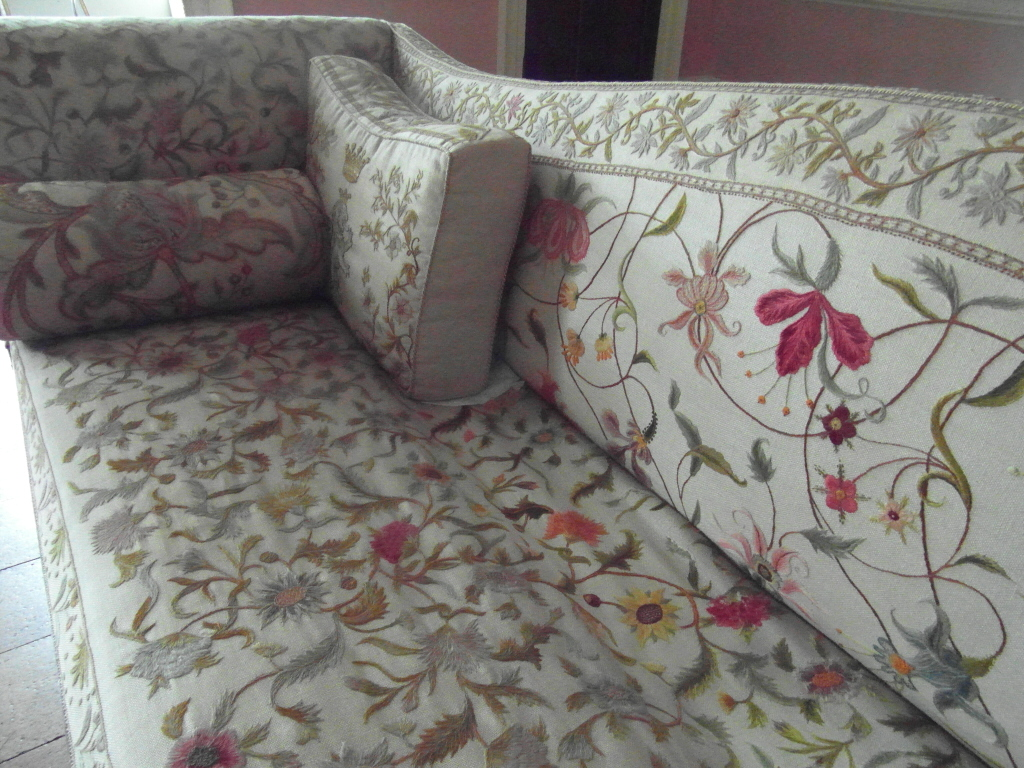
Example of ‘Indian Style’ floral design in Crewel Work on a restored sofa at Osterley House, National Trust
In France, the phenomenal success of the first textile print works was soon to be challenged. The well established wool and silk manufacturers objected strongly to this unexpected rivalry from the Indian imports and the Crown was against it too. Home manufacture meant no customs revenue for the king and in order to protect the status quo, the importation, manufacture, and usage of any Indian calico prints was forbidden by Royal Ordinance in 1686. England followed suit and from 1700 to 1774 there was a ban on imports. The lifting of the bans meant that from the 1780s onwards whilst most printed cottons continued to be manufactured in India the mills in England, France, Germany, the Netherlands, and Switzerland began to produce their own versions.
In Europe and in India printed cottons were created with vivid vegetable dyes using a variety of printing techniques. The designs were mainly floral, the Europeans favouring tulips, carnations, roses, and daises which they combined with traditional Indian motifs on a white background. In the 1780s, bolder designs with twisting stems became increasingly fashionable. In the 1790s, small floral “sprig” designs with tiny motifs on pastel backgrounds became cheap, and therefore became popular for working class clothing; also, some clothing fabrics veered away from the white backgrounds to include yellow, red, and brown.
In France, these printed fabrics were called indiennes and toiles peintes (“painted cloths”) and toiles imprimés (“printed cloths”). In England and the American colonies, there were similarly a number of terms used: calico, derived from the Indian port of Calicut, was a general name for Indian cotton fabric, including plain, printed, stained, dyed, woven with coloured stripes or checks. We got the word chintz, from the Hindi word chint (“variegated”), was a term for printed or painted calicoes. The English and American colonialists also used the term Indiennes to refer to French-made copies of Indian printed cottons.
These 18th century patterns have remained a firm favourite and are still a key feature of the English Country House Style. They are the mainstay of many interior design catalogues even today.
Illustration: Actress Kirsten Dunst in Marie-Antoinette
Julia Herdman writes historical fiction that puts women to the fore. Her latest book Sinclair, Tales of Tooley Street Vol. 1. is Available on Amazon – Paperback £10.99 Kindle £2.29 Also available on:
Amazon Australia
Amazon Canada
Amazon New Zealand
Amazon South Africa
Amazon USA

by Julia Herdman | May 16, 2017 | Blog, British History, Craft and manufacture, Fashion, Houses and Furniture, Society
I drive past the Spode Factory each time I pick up or drop off my daughter at university; so as I have always been a fan of nice bit of porcelain I decided to find out about it.
The factory was started by one Josiah Spode in 1761. The enterprising Josiah worked for Thomas Whieldon from the age of 16 until he was 21 then he went into business for himself, renting a small potworks in the town of Stoke-on-Trent.
Josiah Spode’s claim to pottery fame is the introduction of underglaze blue transfer printing on earthenware in 1783–84. The Worcester and Caughley factories were already doing this but on porcelain which was much more expensive. To adapt the process from the production of small porcelain tea wares to larger earthenware dinner wares required the creation of more flexible paper to transmit the designs from the engraved copper plate to the biscuit earthenware body, and the development of a glaze recipe that brought the colour of the black-blue cobalt print to a brilliant perfection. When Spode employed the skilled engraver Thomas Lucas and printer James Richard, both of the Caughley factory, in 1783 he was able to introduce high quality blue printed earthenware to the market and blue underglaze transfer became a standard feature of Staffordshire pottery.
Another innovation was the standardisation of the formula for fine English porcelain. Although the Bow porcelain factory, Chelsea porcelain factory, Royal Worcester and Royal Crown Derby factories had their own versions of the recipe Josiah Spode effectively finalised the formula between 1789 and 1793 however some credit must also be given to Alexandre Brongniart, director of the Sèvres manufactory who came up with much the same combination of ingredients.
After some early trials Spode perfected a ‘stoneware’ that came closer to porcelain than any previously, and introduced this as “Stone-China” in 1813. Spode pattern books record about 75000 patterns that survive from about 1800 for this product.
Messrs Spode were succeeded in the same business in c. 1833 by Copeland and Garrett, who often used the name Spode in their marks. After 1847 the business continued until 1970 as W.T. Copeland and sons, and again the term ‘Spode’ or ‘Late Spode’ continued in use alongside the name of Copeland. Under the name ‘Spode Ltd’ the same factories and business was continued after 1970. In 2006, the business merged with Royal Worcester but the company went into administration on 6 November 2008 and the brand names were acquired by Portmeirion Group on 23 April 2009. Many items in Spode’s Blue Italian and Woodland ranges are now made at Portmeirion Group’s factory in Stoke-on-Trent which is just around the corner from Staffordshire University.
Julia Herdman writes historical fiction that puts women to the fore. Her latest book Sinclair, Tales of Tooley Street Vol. 1. is Available on Amazon – Paperback £10.99 Kindle £2.29 Also available on:
Amazon Australia
Amazon Canada
Amazon New Zealand
Amazon South Africa
Amazon USA
by Julia Herdman | May 15, 2017 | Blog, British History, Marriage, Politics, Romance, Society, Women and Children, Writing about history
Today wanting marriage is considered a very female desire. From Rom-coms to slimming magazines the ideal is always to get the right man down the aisle. Bachelors are seen as reluctant, fun loving and free and it is hard to imagine a time when marriage represented the summit of a young man’s hopes.
Since the introduction of the contraceptive pill in the 1960s women have had control of their reproductive ability but until then sexual fulfilment for most women only came with marriage. The same was true for men although their options were wider; paying for sex was the norm for those who could afford it. For the middle class sexual indiscretion and becoming ill with the pox meant additional expense, disability and being unable to work.
For the professional middle class, who relied on their labour and not their estates for their income, sexual continence was the desired state and a good marriage to an attractive and capable woman offered the prospect of not only physical excitement, care and affection but good household management.
Until almost the end of the last century marriage was the only acceptable framework for children. In the 18th century children were a man’s property and it was through his sons that he laid claim on the future, but his ability to father children also confirmed his potency. Virility was one of the most celebrated masculine qualities in the 18th century. The father who led a handsome family into church radiated both an air of commanding respectability and a glow of unmistakable sexual success.
Historian Amanda Vickery says that, ” Two days before his marriage in January 1754, 33 year old Josiah Wedgwood positively frothed with anticipation of ‘the blissful day! When she will reward all my faithful services and take me to her arms! To her Nuptial bed! To - Pleasures which I am yet ignorant of’. He took the precaution of working over-time the week before his wedding to clear time to enjoy his bride uninterrupted.
In the 17th and 18th century, bachelorhood was a temporary and unprestigious state. The Bachelor’s Directory of 1694 was unequivocal - ‘Matrimony - what can better agree with man and more exactly relate to his necessities?’ Even men who felt no attraction to the opposite sex had to marry to gain the full benefits of adulthood.
Vickery says, “There were even proposals to levy a tax on mature bachelors as a deterrent and a punishment for their evasion of the burden of domestic government and social provision. Perpetual bachelors were the ‘vermin of the State’ pronounced the Women’s Advocate stonily. ‘They enjoy the benefit of society, but Contribute not to its Charge and Spunge upon the publick, without making the least return’.”
However, not all men were in a position to marry, even if they wanted a nice wife, because in Britain, marriage meant setting up your own home. Being a reader of English you might take this for granted, but it was highly unusual compared with the rest of world. In Southern Europe or China, a married couple was simply absorbed within the parental unit, and young brides were ruled by their mother-in-law. In Eastern Europe, multiple families tended to live together, but sharing a hearth was anathema to the British idea of marriage. No respectable Anglo-Saxon marriage could go forward without an independent establishment. As a result, there was always a sizeable majority of people who simply could not afford to wed; no home meant no wedding bells. So, British couples only married when they had saved sufficient capital or felt confident enough about cash flow to set up an independent home, and therefore the average bride and groom are much older than you might expect – over 27 for men, and 25 for women, before 1750.
We associate the history of home and private life with women, but what did house and domesticity mean to men? More than you might think argues Professor Amanda Vickery.
Julia Herdman writes historical fiction that puts women to the fore. Her latest book Sinclair, Tales of Tooley Street Vol. 1. is Available on Amazon – Paperback £10.99 Kindle £2.29 Also available on:
Amazon Australia
Amazon Canada
Amazon New Zealand
Amazon South Africa
Amazon USA
by Julia Herdman | May 13, 2017 | Arts and Literature, Blog, British History, Marriage, Performing Arts, Politics, Romance, Society, Theatre
English society expected, even encouraged, men to pay for sex in the 18th century. Prejudice and the law barred women from all but the most menial of jobs so prostitution with all its dangers was a career option worth exploring for some becasue a typical harlot could earn in a month what a tradesman or clerk earned in a year. For a few beautiful and savvy women, this gamble paid off. Some became successful matrons of ‘Disorderly Houses’ while the occasional woman came up trumps and married a duke.
One girl who got her man was Lavinia Fenton. Lavina was born in 1708; the illegitimate daughter of a naval lieutenant named Beswick, her mother’s name is not recorded. When her mother’s lover died at sea she married a Mr Fenton, a man who ran a coffee house near Charring Cross. Mr Fenton it seems was a good sort who sent his adopted daughter to boarding school. Therefore, Lavinia had the advantage of not only her beauty and wit but of education.
By 1725 she had attracted the attentions of a Portuguese nobleman who, having run up debts catering for her desires, ended up in the Fleet Prison. It was after this, in 1726, that another unnamed aristocrat used his influence to launch her career on the London stage. Her first appearance was as Monimia in Thomas Otway’s The Orphan: or The Unhappy Marriage, in March 1726.
Shortly after she appeared as Cherry Boniface in The Beaux Stratagem and went onto join the company of players at the theatre in Lincoln’s Inn Fields but it was as Polly Peacham in John Gay’s Beggar’s Opera, she found her greatest success. The play was a runaway success. Politicians smarted at being portrayed as highwaymen, fences, pickpockets and molls, but the public loved it and bought playing cards, fans and parlour screens imprinted with scenes or lyrics of the dashing MacHeath, or of Polly Peachum’s true-love.In her first season as Polly Peacham, Lavinia became the talk of the town and the object of Charles Powlett, 3rd Duke of Bolton’s desire.
Like many men of his rank he was locked in a loveless marriage to Lady Anne Vaughan, a daughter of the 3rd Earl of Carbery. Lady Anne, Lady Montague wrote, was “educated in solitude with some choice books, by a saint-like governess: crammed with virtue and good qualities, she thought it impossible not to find gratitude, though she failed to give passion; and upon this she threw away her estate, was despised by her husband and laughed at by the public.”
Contemporary accounts describe Bolton as “a handsome, agreeable libertine” and, “absolutely a fool” and a rogue. Memoirs of the Reign of George II records him as “being as proud as if he had been of any consequence besides what his emploments made him, as vain as if he had some merit, and as necessitous as if he had no estate, so he was troublesome at Court, hated in the country, and scandalous in his regiment. The dirty tricks he played to cheat the Government of men, or his men of half-a-crown, were things unknown to any Colonel but his Grace, no griping Scotsman excepted.” So, perhaps he wasn’t that much of a catch after all.
Lavinia became Bolton’s mistress during the first season of The Beggar’s Opera in 1728 and gave up the stage to become a ‘kept woman’ in 1729. William Hogarth used the scandal in his series pictures of the Beggar’s Opera showing Lavinia looking past Mackheath, to the Duke standing in his box.
The pair eloped to the continent in 1729. John Gay commented on the event in a letter to Jonathan Swift: “The Duke of Bolton, I hear, has run away with Polly Peachum, having settled £400 a year on her during pleasure, and upon disagreement £200 a year.”
Lavinia gave the Duke three illegitimate children. When his wife Anne died in 1751 Lavinia finally got her man and the pair were married in Aachen. By then the Duke had lost most of his income. He died three years later in 1754. Their sons Charles, Percy, and Horatio had no estate or wealth to inherit. Consequently, Charles went into the church, Percy the navy, and Horatio the army. Lavinia, now the duchess, died in 1760. She spent her last days at Westcombe House in Greenwich which she and Charles had shared since their marriage, and was buried in the nearly church of St Alfege. Peachum Road, close to the site of Westcombe House, was named in honour of her role as Polly Peachum.
Julia Herdman writes historical fiction that puts women to the fore. Her latest book Sinclair, Tales of Tooley Street Vol. 1. is Available on Amazon – Paperback £10.99 Kindle £2.29 Also available on:
Amazon Australia
Amazon Canada
Amazon New Zealand
Amazon South Africa
Amazon USA
Sources:
https://en.wikipedia.org/wiki/Lavinia_Fenton
https://en.wikipedia.org/wiki/Charles_Paulet,_1st_Duke_of_Bolton
Character’s Theater: Genre and Identity on the Eighteenth-Century English Stage, Lisa A. Freeman
http://thepeerage.com/ Cokayne, and others, The Complete Peerage, volume II, page 214.
https://en.wikipedia.org/wiki/Westcombe_Park
http://www.todayinliterature.com/stories.asp?Event_Date=1/29/1728
http://www.smk.dk/en/visit-the-museum/exhibitions/william-hogarth-a-harlots-progress-and-other-stories/
by Julia Herdman | May 12, 2017 | Blog, British History, British Royal Family, Marriage, Politics, Romance, Society, Visual arts, Women and Children
Marital ethics were the topic of much debate in 18th-century Britain. The many marriages of convenience and their attendant unhappiness came in for particular criticism, with a variety of authors taking the view that love was a much sounder basis for marriage than money. Hogarth for one felt the disquiet in British society sufficient to satirise it in a series of paintings called Marriage a la mode.
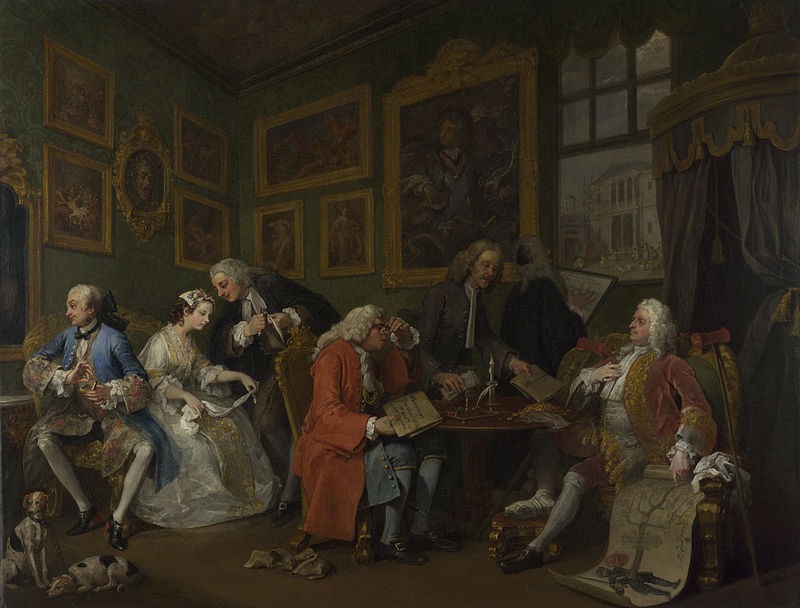
In the first of the series, The Marriage Settlement Hogarth shows an arranged marriage between the son of bankrupt Earl Squanderfield and the daughter of a wealthy but miserly city merchant. The construction on the Earl’s new mansion, visible through the window, has stopped as a usurer negotiates payment for further work at the centre table. The gouty Earl proudly points to a picture of his family tree. The son views himself in the mirror, showing where his interests in the matter lie. The distraught merchant’s daughter is consoled by the lawyer Silvertongue while polishing her wedding ring. Even the faces on the walls appear to have misgivings. Two dogs chained to each other in the corner mirror the situation of the young couple.
The pressure put on many young people to marry the ‘right’ person led to many secret marriages with the right people for them. This was possible because until the middle of the 18th century marriages could take place anywhere provided they were conducted before an ordained clergyman of the Church of England. Of course, this also left a lot of scope for bigamy and marriages to girls who were under age.
The trade in these irregular marriages had grown enormously in London by the 1740s and led to the introduction of the Marriage Act 1753, popularly known as Lord Hardwicke’s Marriage Act. This Act was the first statutory legislation in England and Wales to require a formal ceremony of marriage. The Act came into force on 25 March 1754 making the reading of banns, registration of a marriage and need for the marriage to be witnessed compulsory for the first time.
No marriage of a person under the age of 21 was valid without the consent of parents or guardians. Clergymen who disobeyed the law were liable for 14 years transportation. Jews and Quakers were exempted from the 1753 Act, but it required other religious non-conformists and Catholics to be married in Anglican churches.
The idea of secret marriage was taken up in the 1766 play, The Clandestine Marriage by George Colman the Elder and David Garrick. The play is a comedy and was first performed in 1766 at Drury Lane. The plot concerns a merchant, Mr Sterling, who wants to marry off his elder daughter to Sir John Melvil, who is in love with his younger daughter, Fanny. Fanny, however, is in love with a humble clerk, Lovewell, whom she has secretly married. Her attempts to extricate herself from the arrangement with Melvil lead to her being offered as a bride to Melvil’s elderly uncle, Lord Ogleby. But the truth comes out and she is saved from the awful fate of having to marry a man many years her senior whom she does not love and she and Lovewell are forgiven. In 1999, the play was made into a film directed by Christopher Miles and starring Nigel Hawthorne, Joan Collins, Timothy Spall, Emma Chambers and Tom Hollander.
Paul Nicholls and Natasha Little as the lovers in The Clandestine Marriage, 2000.
The Act did not change the position of a wife in law. On marriage, a woman became the property of her husband as soon as she said. “I do.” Clandestine and illegal marriages were not the exclusive domain of the wealthy. Many poor women where duped by unscrupulous, indecisive and inconstant men. Perhaps the most famous woman to be duped in this was Maria Fitzherbert (26 July 1756 - 27 March 1837) the secret wife of George, Prince of Wales, the future George IV.
In 1783 George, Prince of Wales became infatuated with her, wanting her to become his mistress but Maria’s devout Catholic beliefs would not allow it. So on 15 December 1785 they were married in a secret ceremony conducted by Robert Burt, an impoverished curate who set aside his scruples for the £500 fee. The marriage of course was not legal. It not only contravened the 1753 Marriage Act it was also in breach of the Act of Settlement of 1701, preventing a Roman Catholic from ascending the British throne and the Royal Marriage Act of 1772.
George and Maria spent much of their time in Brighton where Mrs Fitzherbert was treated as queen although George must have known that she never would be. Whether she was ignorant or deluded concerning her position is unknown. The couple separated when George’s affections turned to Frances, Countess of Jersey in 1794 and Maria’s position was finally put asunder when George married his cousin Caroline of Brunswick in 1795 with the benefit of law.
Illustration: Hogarth, Marriage a la mode - The marriage settlement.
Julia Herdman writes historical fiction that puts women to the fore. Her latest book Sinclair, Tales of Tooley Street Vol. 1. is Available on Amazon – Paperback £10.99 Kindle £2.29 Also available on:
Amazon Australia
Amazon Canada
Amazon New Zealand
Amazon South Africa
Amazon USA

Recent Comments