
by Julia Herdman | Sep 8, 2017 | Arts and Literature, Blog, British History, Literature, Writing about history
Six Rules for Writing Historical Fiction
Historical fiction is a literary genre in which the plot takes place in a setting located in the past. Historical fiction is an umbrella term; though it is commonly used as a synonym for describing the historical novel. Historical fiction also occurs in other narrative formats - the performing and visual arts like theatre, opera, cinema, and television, as well as video games and graphic novels.
An essential element of historical fiction is that it is set in the past and pays attention to the manners, social conditions and other details of the period depicted. Historical fiction writers frequently choose to explore notable historical figures in these settings, allowing readers to better understand how these individuals might have responded to their environments. Some subgenres such as alternate history and historical fantasy insert speculative or ahistorical elements into a novel.
Works of historical fiction are sometimes criticized for lack of authenticity because of readerly or genre expectations for accurate period details. This tension between historical authenticity, or historicity, and fiction frequently becomes a point of comment for readers and popular critics, while scholarly criticism frequently goes beyond this commentary, investigating the genre for its other thematic and critical interests.
When Wolf Hall won the Booker prize some commentators suggested that the term “historical fiction” was itself becoming a thing of the past. So many novels these days are set prior to the author’s lifetime that to label a novel “historical” is almost as meaningless as to call it “literary”.
1. Small details matter more than large ones.
The art of fiction is, in large part, the art of small-scale illusions. Focus on the things that set the period and the character - the snap of a fan, the recoil of a rifle, the sound of the hurdy-gurdy playing in the street. In this quote from The Mistletoe Bride by Kate Moss we are whisked immediately back to the 15th or 16th century with the mention of the lute, viol, and citole, the title of the story tells us it is set at Christmas and the drinking and goose fat glistening on merry faces lets us know everyone is feasting.
‘It is my wedding day. I should be happy, and I am.
I am happy, yet I confess I am anxious too. My father’s friends of wild. Their cups clashing against one another and goose fat glistening on their cheeks and their voices raised. There has been so much wine drunk they are no longer themselves. There is lawlessness in a glint of their eyes, but they are not so far gone us to forget their breeding and manners. Their good cheer echoes around the old oak hall, so loud I can no longer hear the lute or viol, or citole s set out for our entertainment.’
2. Period characters require more than period clothes.
Similarly, just as the exterior world requires research to establish believable, small details, the interior world of a character requires research as well. Good historical stories promise to not only transport readers to a historical setting but to reveal the interior life (the mind, heart and aspirations) of a character. For me, some of the large questions here had to do with interior perceptions: You need to find out how people viewed love and romance in your chosen period. What do your characters expect or want from life.
3. Use common names, not technical ones.
It’s all very well knowing the technical terms for the clothes and accoutrements of the past but if your reader is going to have to Google everything you mention it will spoil the story for them. Remember you’re writing a story to entertain not a history textbook. Let your characters engage with both historical details and their place in society. Not only have them interact with the politics or religion of the day – but allow them full use of their senses to recreate their environment, the smells, sounds and feel of their surroundings is just as important as having them know who was King at that time.
4. Immerse yourself in the culture.
To write historical fiction of any kind – short stories or not – you need to be able to close your eyes and have the past blaze up around you. Always remember research takes time. Research is an investment; you draw on it when you need to. Use it like capital and keep most of it in the bank. Historical accuracy is like quicksand. Stay too long in the same place and it will suck you down and there will be no movement, no dynamism to the story. Too much attention to factual detail is undoubtedly an impediment to literary art. Adam Foulds’s The Quickening Maze is described on the Booker prize website as “historically accurate but beautifully imagined”, as if “historically accurate” implied a literary problem. In some respects it does. Ask a historical author: how do you stop that facts getting in the way of the story? And the novelist, driven by his or her imagination, will offer a wealth of answers. The historian will assure you that the facts are the story.
5. Find experts.
Have fun with research, but do your homework. Use reference books, watch films, read novels of the period. Make sure you’re comfortable with all aspects of the time from politics to illnesses, from food to fashion, from local geography to language (even if you choose not to use it.) Hand in hand with double-checking comes evaluating your sources. If something seems a bit improbable or sketchy, it probably is. Look for another source to back it up. Use the internet wisely. We are so blessed nowadays with the amount of information at our fingertips, the access we have to old maps and stats is amazing. But ALWAYS triple check your facts, be aware of false information and never rely solely on Wikipedia! Use a good mix of primary and secondary sources for both perspective and immediacy and double-check everything. Bad mistakes will reflect on your work even if it is the fault of your source.
6. Historical facts are not the storyline.
Anyone who has tried to make a story out of historical narrative will know it’s impossible. History is the context out of which fiction grows. Fiction is the examination of the human heart as individual characters move through scenes that test – or perhaps change – their souls. History is just the backdrop. Of course, if you’re writing about a real historical person it is necessary to stick to the facts.

by Julia Herdman | Sep 1, 2017 | Arts and Literature, Blog, Literature, Society, Writing about history
5 Ways to improve your writing
So you’re thinking about writing - for your blog, for your company, for industry publications, or maybe just for fun. Maybe you’ve never considered writing but you’re quickly realising you’re going to have to do it and do it well, for your career.
If you’ve not done much writing before you may think you’ve just got to wait for the muse to strike you like the poets of old, or you may think you have to be born with some special, innate talent. You don’t have to be Shakespeare to write well. Of course, some great writers wait for the muse and some may have innate talent but most of us have to get by working at it. Learning to write is like anything else in life it is a process of trial and error. Anyway you know what they say about genius - it’s 1% inspiration and 99% perspiration. So, here are five tips that will help you develop your writing skills whatever or whoever you’re writing for.
1. Take advantage of the world around you, use it for inspiration—your walk to the subway, the stories in your Facebook newsfeed, your interaction with the cashier at Starbucks in the morning etc. As writer Henry Miller once said, “Develop interest in life as you see it; in people, things, literature, music—the world is so rich, simply throbbing with rich treasures, beautiful souls, and interesting people. Forget yourself.”
2. Take control of your own destiny. Know where you write best. For some people, it’s peace and quiet, while others need music or the chaotic hubbub of co-workers milling about. Different places suit different people and different types of writing. When you have to write for work, you may need to put in your headphones and listen to the crooning of Lana Del Rey, but when you’re blogging, you may prefer curling up on your couch with a glass of wine. Instead of trying to force yourself to write at a specific location, try out a variety of different spaces until you find what works for you. Then, recreate that cozy, creative environment every time you need to write.
3. Read it out loud. This tip is twofold. First, in most cases, you should write like you talk. Even if you, tend to use a casual tone, that’s OK—it will help you sound more realistic and understandable to your readers. Try recording yourself talking for two minutes then transcribing it. You can correct obvious mistakes later. Writing that reflects the way you speak often showcases the most authentic version of yourself. Secondly, once you’ve written something down, actually read it out loud. As silly as you may feel, it’s the best way to make sure what you’ve written makes sense. Anything that doesn’t flow is confusing, or is missing a word or two will quickly make itself apparent.
4. Take advantage of opportunities to develop your skills and knowledge. Most people baulk at the idea of standing in front of a room full of strangers and baring their soul to the world, but joining a writing workshop can be immensely beneficial – and a lot of fun. Meet up with a friend or colleague who wants to write and share your work. You don’t need to have an unfinished novel hidden away in your desk drawer to join a workshop. These days, content marketing meet-ups and professional development groups are popular. Join one of the many content marketing groups on LinkedIn to meet like-minded writers. Pick a topic, write something, listen to the feedback from the group, and then revise it.
5. Seek and respond to feedback from potential readers. Many times, you are your own worst critic. So, when you’re writing, it’s really important not to judge what you write, at least at first. Even experienced writers don’t often crank out a perfect first draft, so setting your expectations too high from the outset is unrealistic not to mention discouraging. A good exercise in nonjudgmental writing is to set a timer for 10 minutes and just write. Write down what you know, what you feel, or whatever’s on your mind. Don’t try to write too carefully or too intelligently or too accurately. Writing goes much better when you don’t work so hard at it or criticise your every word.
Julia Herdman writes historical fiction. Her debut novel is available on Amazon.

by Julia Herdman | Aug 27, 2017 | Arts and Literature, Blog, Literature, Writing about history
The profession or the jobs of your character does plays a major role in making your novel a hit.
That’s because a character’s profession affects the entire story.
A job or profession gives an indication of personality, class, wealth and motivation. You can use it as a stereotype or as a short-hand description or develop the character with it.
Just think for a moment. What character attributes would you give to a teacher?
Perhaps the teacher in your imagination is a dotty old professor. A man dressed in tweed with patches on his elbows, a mop of thick grey hair and horn-rimmed spectacles. He teaches classics and quotes passages from Cesar’s Gallic Wars.
Alternatively, the teacher of your imagination may be a young ambitious woman of Anglo-Caribbean descent who teaches physics. She wears a smart white lab coat and red, five-inch heel stilettos. She’s sassy. She drives a sports car and the boys in the class don’t know where to look when she comes into the lab.
Muriel Spark’s character Jean Brodie from the novel The Prime of Miss Jean Brodie is a highly idealistic character with an exaggerated romantic view of the world. The phrases Spark gives her character are now clichés in the English language. “Give me a girl at an impressionable age and she is mine for life.” “These years are still the years of my prime. It is important to recognise the years of one’s prime, always remember that.” ‘I am a teacher! First, last, always!’ Spark gives the character the name of the historical Jean Brodie the common law wife or mistress of Deacon Willie Brodie. Brodie was an Edinburgh cabinet maker and thief hanged from a gallows of his own design. The fictional Jean is doomed like her namesake whose husband was the was the inspiration for the gothic novel, The Strange Case of Dr. Jekyll and Mr. Hyde by Robert Louis Stevenson.
Now think about a taxidermist? Somehow there is always something a bit creepy about this job. Is it the association with dead things, the dismembering of bodies or the macabre nature of the results of their work - an animal that looks alive but is dead? The Taxidermist’s Daughter by Kate Moss is a story in which ghosts and ghoulish patriarchal secrets, estranged female psyches, and tumultuous bird-life. All these elements coexist in a compulsively readable yarn.The novel is a cabinet of curiosities, a tale of sexual predation and female revenge. The protagonist Connie is bright, beautiful, determined, and has a very strong stomach. She’s a victim of traumatic memory loss. The plot involves her mind’s recuperation from obscene events 10 years ago. A crime opens the story. A woman’s corpse is found outside Blackthorn House, where Connie is attempting to stuff a jackdaw. The woman has been garrotted with taxidermist’s wire.
These examples show that giving your character a profession enables you to start building that character and the character, in turn, helps you to build the story. In my novel Sinclair, which is set in the late 18th century, Sinclair is a man of the Enlightenment who has rejected religion. This leaves him isolated from his family and much of society. He is a dedicated doctor who wants to heal people.
Fantasy jobs
If the story is a realistic fiction, it’s best to avoid ridiculous characters and professions that don’t exist in the real world.On the other hand, if you are writing a general fiction story, an absurd and unrealistic profession is perfectly acceptable as long as you stick to the descriptions you have given about that character and his or her profession. For example, if you plan on writing a fantasy fiction, your character will probably include mythical creatures such as goblins, trolls, giants, or unicorns. The main character will possibly possess magical powers again consistency is the key here - what can your character do with magic and what are their limitations? Limitations are often the making of a character.
Sci-fi
Even in Sci-fi, the best characters have jobs: Ship’s captain, the General of an invading army, the pilot or navigator of a space of underwater cruiser. Phillip Dick’s Do Androids Dream of Electric Sheep? is a science fiction novel describing humanity’s struggle for survival in a post-apocalyptic world after a nuclear war has irradiated the Earth, forcing humans to create a separate colony on Mars. Character Rick Deckard is a bounty hunter who is about to have one bad day.
Unlike the bounty hunters of the Wild West, this space age cowboy will, within the space of twenty-four hours, have to kill six state-of-the-art androids, have an inter-galactic corporation mess with his mind, meet a metaphysical god twice, and discover an extinct animal.
Rick clearly lacks empathy for androids, his electric sheep, and for his wife which, in an ironic twist, is the very fault androids are accused of and as a result, they must be killed. Rick is a hypocrite, in a way he represents the hypocrisy of mankind. He punishes androids for lacking empathy when he’s the least empathetic person on the planet.
Ironic Jobs
Some authors and screenwriters choose to write an ironic character that doesn’t match their profession. Other times, a profession can be used to create a twist in the plot. This is usually true for novels with a dramatic theme. A character could be shown doing something they don’t enjoy at all. They are bored of their ordinary life and their ordinary profession.
Take “Fight Club”, a book by Chuck Palahniuk for example; in this novel, his protagonist who is never named is a man who works as a product recall specialist. Our protagonist hates his job and his lifestyle. In this anti-capitalist story, the narrator attempts to treat his depression and insomnia through obsessive consumerism and knowledge of brands.
On a flight home from a business trip, the Narrator meets Tyler Durden, a soap salesman with whom he begins to converse after noticing the two share the same kind of designer briefcase. After the flight, the Narrator returns home to find that his apartment has been destroyed by an explosion.
With no one else to contact, he calls Tyler and Tyler invite the Narrator to stay at his place but requests that the Narrator hit him first, which escalates into a minor fistfight. The Narrator then moves into Tyler’s home, a large dilapidated house in an industrial area of their city and begins assisting with Tyler’s handmade soap business. They have further fights outside the bar on subsequent nights, and these fights attract growing crowds of men.
The fighting eventually moves to the bar’s basement where the men form a structured club (“Fight Club”) which routinely meets to provide an opportunity for disaffected local men to fight safely for recreation. Ultimately, the story degenerates into a stop the bad guy destroying capitalism movie but the initial idea is interesting.
See also: 10 Things that can turn a character bad.
About the author: Julia Herdman writes historical fiction. Her debut novel Sinclair is available worldwide in print or as an Ebook. Go to Amazon to find out more.

by Julia Herdman | Aug 15, 2017 | Blog, Women in Ancient History, Writing about history

Princess Sophia, aged 5 in 1782 by Thomas Gainsborough. The Royal Collection.
This is the sad story of Princess Sophia. An unworldly and shy woman who was seduced by a man 33 years her senior, gave birth to his illegitimate child and was blackmailed by her son to pay his father’s debts.
According to biographer Christopher Hibbert, in her young adulthood Princess Sophia, the 5th daughter of King George III, was a “delightful though moody girl, pretty, delicate and passionate.” She was devoted to her father, though she occasionally found him exasperating. She wrote that “the dear King is all kindness to me, and I cannot say how grateful I feel for it.”
The King had told his daughters he would take them to Hanover and find them suitable husbands despite misgivings concerning marriage; he was well aware of his sisters’ experience. His eldest sister, Augusta had never fully adapted to life in Brunswick after her marriage to Charles William Ferdinand, Duke of Brunswick-Lüneburg, Prince of Brunswick-Wolfenbüttel. She did not like the German court and they did not like her. Her situation was made worse by the fact that her eldest sons were born with disabilities.
George’s sister Caroline had suffered a far worse fate; at the age of 15, she was married to her cousin, Christian VII of Denmark in 1766. A year later her husband abandoned her for his mistress Støvlet-Cathrine publicly declaring that he could not love Caroline because it was “unfashionable to love one’s wife”. Caroline was left neglected and unhappy as her young husband sank into a mental stupor of paranoia, self-mutilation, and hallucinations.

A Royal Affair is a 2012 historical drama film directed by Nikolaj Arcel, starring Mads Mikkelsen, Alicia Vikander, and Mikkel Følsgaard.
She took comfort with her husband’s doctor, Johann Friedrich Struensee, and Enlightenment man who ran Denmark with the half-crazed King introducing widespread reforms. The affair between Caroline and Struensee resulted in Caroline giving birth to his child, her divorce, and Struensee’s execution in 1772. Caroline, retaining her title but not her children, eventually left Denmark and passed her remaining days in exile at Celle Castle in Hanover. She died there of scarlet fever on 10 May 1775, at the age of 23.
George was unable to keep his promise due to his own ill health but when Sophia was born the King went to Parliament to negotiate allowances for his daughter and his younger sons. Like her siblings, Sophia was to receive an allowance of £6,000 a year either upon her marriages or the king’s death. This would have made her an attractive marriage prospect but Sophia ruined what prospects she had when she met and fell in love with one of her father’s equerries, Colonel, Thomas Garth, a man thirty-three years her senior.
Garth had a large purple birthmark on his face, causing Sophia’s sister Mary to refer to him as “the purple light of love.” Courtier and diarist Charles Greville, on the other hand, described him as a “hideous old devil,” and one of her ladies-in-waiting wrote, “the princess was so violently in love with him that everyone saw it. She could not contain herself in his presence.”

Princess Sophia, 1792 by Sir William Beechey. The Royal Collection.
Sophia’s downfall came when she found herself pregnant with Garth’s child. Although there has been much debate amongst historians as to whether the child was Garth’s or her uncle’s, the Duke of Cumberland’s, Thomas Garth adopted the child, educated him and brought him into his regiment calling him his nephew.
Sophia never married and remained at court until her mother Queen Charlotte died. After the queen’s death, Sophia lived in Kensington Palace next to her niece Princess Victoria of Kent, the future Queen Victoria. Like her sister-in-law the Duchess of Kent, Sophia fell under the spell of Victoria’s comptroller Sir John Conroy and let him manage her money. The lonely and unworldly Sophia fell under Conroy’s spell and he used her affection to rob her.
Her son, Tommy Garth of the 15th Hussars (1800-1873), learned of his true heritage when his father thought he was on his deathbed in 1828. With the family deep in debt, he tried to blackmail the royal family with evidence of his mother’s true identity. As historian Flora Fraser writes, all parties played unfairly. The royal family offered young Garth £3,000 for his box of evidence; they took the box but did not pay him so he went to the papers. The press dug up the gossip concerning the possibility of the Duke of Cumberland being his true father making the latter part of Sophia’s life very difficult.

Princess Sophia, 1825 by Thomas Lawrence in The Royal Collection.
Charles Greville summed Sophia up with he wrote in his diary in May 1848, shortly after she died: “Princess Sophia died a few days ago, while the Queen [Victoria] was holding the Drawing-room for her Birthday. She [Sophia] was blind, helpless, and suffered martyrdom; a very clever, well-informed woman, but who never lived in the world.”
Sources:
Fraser, Flora (2004). Princesses: The Six Daughters of George III. London: John Murray. ISBN 0-7195-6109-4.
Hibbert, Christopher (2000). George III: A Personal History. Basic Books. ISBN 0-465-02724-5.
Hibbert, Christopher (2001). Queen Victoria: A Personal History. De Capo Press. ISBN 0-306-81085-9.

by Julia Herdman | Aug 8, 2017 | Arts and Literature, Blog, British History, Literature, Medicine, Politics, Romance, Society, Writing about history
The dead are always present, says Hilary Mantel, they live with us in our memory, in our genes and in the legacy of their decisions and actions that shaped the world we live in today. In the words of St Augustine, she says, they are ‘invisible, they are not absent’. My inspiration for it Sinclair was family history. Whoever we are we all have some sort of family and some sort of history, we could not have got here without it even if we do not know that history.
There is a poem by WH Auden, called “As I Walked Out One Evening”:
‘The glacier knocks in the cupboard,
The desert sighs in the bed,
And the crack in the tea-cup opens
A lane to the land of the dead’
Like most people I come from a long line of very ordinary people; people who struggled most of their lives to make ends meet them to keep a roof over their head. These are not the people we think of when we think of history. History was, until the last century, very much the domain of great men and great events. When we imagine the past in drama, in books, and, in films, the characters are always the movers and shakers of history; their decisions and actions change the world. Rarely do we think of the ordinary run of the mill people in the background who were most likely our ancestors.
My grandparents were born at the turn of the 19th century, they were Victorians. They lived through great events, the Great War, the economic depression of the 1930s, the Second World War, and the post-war boom but they did not shape them. They were lucky, they survived these huge historic events and so did their children; all of them living to ripe old age thanks to the introduction of the National Health Service in 1947. They were the first generation to live in Council Houses, proud tenants who always paid the rent on time. They worked hard and life was not easy but it was certainly better than it had been for their parents who had lived in overcrowded city-centre tenements with no interior sanitation. My Victorian ancestors worked hard, feared the workhouse, died young and were buried unceremoniously and as cheaply as possible.
My novel, Sinclair, is inspired by my husband’s family, the Leadams, who came from Walkington near the market town of Beverley and city of Hull. Christopher Leadam trained as a surgeon in York then moved to London sometime in the 1770s. I recently visited Walkington to look at the place he left to work at Guy’s Hospital. The contrast between this rural idle of the East Riding and the busy streets of Southwark could not be greater. Walkington is a beautiful place but as the 10th child in a family of farmers Christopher, who was clearly bright and adventurous, knew that if he was going to make a life for himself he had to leave the place of his birth.
Christopher died when he was relatively young, probably around 40. We know from the historical record that when he died he was the owner of an apothecary shop in Tooley Street and that he had a 14-year-old son and a wife. Christopher was not a great man of medicine but he was one of the cast of players who helped to heave medicine out of its medieval roots into the modern scientific age.
The Leadams of Tooley Street has led me on a journey into the 18th century and early 19th century. My novel begins in the aftermath of the disastrous American War and ends as France is about to throw the shackles of the ancient regime. Most historical romance is about aristocratic families, families with connections and status. My fiction is about a family too but this family has to make their own way in the world. They have no estate or inheritance to come into; they have to use their hands and their brains to make their way in the world. Men like the Leadams and the fictional Sinclair were men of the professions, industry, ideas, and commerce; they were the men for a new and enlightened age, the men who shaped the world we know today.
As a novelist, I want to tell the story of that change, of the development of the middle class if you like. The middle class is much maligned and forgotten in the pages of history and novels. Today middle-class values are under attack from libertarian capitalists who view government as a barrier to the unfettered accumulation of personal wealth, they do not believe in society or collective endeavour. In the historical novel, the middle class gets lost between the aristocratic splendour of the ballroom and the rags to riches stories of the poor.
‘The pursuit of the past makes you aware, whether you are novelist or historian, of the dangers of your own fallibility and inbuilt bias’ says Mantel. I agree I am the product of my own history. I am not the past I am now writing about the past in a language that is understood today. I am a writer of fiction but I am a historian too; an anachronism an oxymoron. The 19th-century historian Lord Macaulay said, “History has to be burned into the imagination before it can be received by the reason.” I burn with a passion for the past, but I also burn with a passion for the future, for a better future for my children and mankind. I’m biased and I don’t feel guilty about it; all history is biased, I am not perturbed about my desire to tell stories about people who live in townhouses and not country estates, people who value education for its own sake, people who want to engage in the political life of the nation because they want to improve the lives of others and build a better future.
Mantel says, “The historian and the biographer follow a trail of evidence, usually a paper trail. The novelist does that too, and then performs another act, puts the past back into the process, into action, frees the people from the archive and lets them run about, ignorant of their fates, with all their mistakes unmade.” Sinclair makes plenty of mistakes.
Julia Herdman writes historical fiction that puts women to the fore. Her latest book Sinclair, Tales of Tooley Street Vol. 1. is Available on Amazon – Paperback £10.99 Kindle £2.42 Also available on:
Amazon Australia
Amazon Canada
Amazon New Zealand
Amazon South Africa
Amazon USA
by Julia Herdman | Jul 31, 2017 | Arts and Literature, Blog, Europe, France, Literature, Marriage, Politics, Romance, Science, Women in Science, Writing about history
The pursuit of love and happiness was an 18th-century ideal.
Voltaire (1694-1778), the French philosopher and author was one of its chief exponents and is one of the heroes of my character Sinclair. Sinclair takes his copy of Candide, Voltaire’s satirical novel to India with him but he loses it when the ship goes down. Once he’s established himself in Tooley Street he’s quick to buy himself another copy.
Candide was an 18th century best seller. The story is about a young man who is the illegitimate nephew of a German baron. He grows up in the baron’s castle under the tutelage of the scholar Dr. Pangloss, who teaches him that this world is “the best of all possible worlds.” Candide falls in love with the baron’s young daughter, Cunégonde which does not please the baron at all and so the young man and his teacher are thrown out of the castle and their adventure begins.
The work describes the abrupt end of their idyllic lifestyle and Candide’s slow, painful disillusionment with the world as he witnesses and experiences its hardships.
The book ends with Candide, not rejecting Dr. Pangloss’s optimism outright but advocating that “we must cultivate our garden”, rather than rely on optimism alone to make it flourish. Thus, Candide rejects the Leibnizian mantra of Pangloss, “all is for the best” in the “best of all possible worlds” for the act of making the world we desire by cultivating it like a garden.
Voltaire was a man of passion and emotion as well as ideas. At the age of nineteen Voltaire was sent as an attache to the French Ambassador to the Netherlands. It was there that he fell in love with Olympe Dunover, the poor daughter of lower-class women. Their relationship was not approved of by either the ambassador of Olympe’s mother and Voltaire was soon imprisoned to keep them apart.
Writing from his prison cell in The Hague in 1713 he poured out his love for Olympe.
“I am a prisoner here in the name of the King; they can take my life, but not the love that I feel for you. Yes, my adorable mistress, to-night I shall see you, and if I had to put my head on the block to do it.
“For heaven’s sake, do not speak to me in such disastrous terms as you write; you must live and be cautious; beware of madame your mother as of your worst enemy. What do I say? Beware of everybody; trust no one; keep yourself in readiness, as soon as the moon is visible; I shall leave the hotel incognito, take a carriage or a chaise, we shall drive like the wind to Scheveningen; I shall take paper and ink with me; we shall write our letters.”
“If you love me, reassure yourself; and call all your strength and presence of mind to your aid; do not let your mother notice anything, try to have your pictures, and be assured that the menace of the greatest tortures will not prevent me to serve you. No, nothing has the power to part me from you; our love is based upon virtue and will last as long as our lives. Adieu, there is nothing that I will not brave for your sake; you deserve much more than that. Adieu, my dear heart!”
Arout (Voltaire)
His time in prison was brief. Being young and fit and the prison not so secure, he jumped out a window and got away.
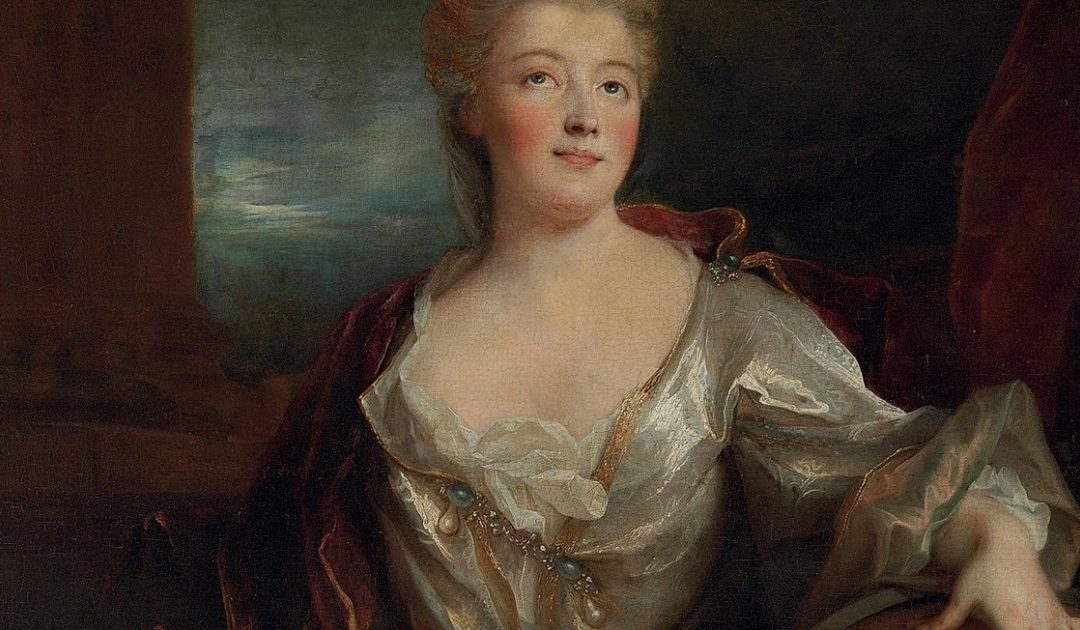
Twenty years later, in 1733, Voltaire would meet the love of his life, Émilie, Marquise du Châtelet. She was the wife of an aristocrat. He, by then was by then a successful writer. Having just returned from a period of enforced exile from France for his political views Voltaire was introduced to Émilie by friends.
The attraction was immediate, physical and cerebral. He wrote of her; “That lady whom I look upon as a great man… She understands Newton, she despises superstition and in short, she makes me happy.”
Soon the pair were living together in the Marquis du Châtelet’s chateau. The arrangement suited them all. Voltaire who was a rich man paid for the much-needed renovations to the chateau, Émilie’s husband the Marquis hunted all day and at night he lent Voltaire his willing wife.
Their love bore intellectual fruits; Émilie translated Newton’s Principia Mathematica and wrote her philosophical magnum opus, Institutions de Physique (Paris, 1740, first edition), or Foundations of Physics. Her own work circulated widely generated heated debates and was republished and translated into several other languages. During her time with Voltaire, she participated in the famous vis viva debate, concerning the best way to measure the force of a body and the best means of thinking about conservation principles. Posthumously, her ideas were heavily represented in the most famous text of the French Enlightenment, the Encyclopédie of Denis Diderot and Jean le Rond D’Alembert.
In 1737, Châtelet published a paper entitled Dissertation sur la nature et la propagation du feu, based upon her research into the science of fire, that predicted what is today known as infrared radiation and the nature of light.
In another publication, she debated the nature of happiness. During the Age of Enlightenment, personal happiness was one of the great philosophical themes. Many philosophers and writers studied it. There were many discourses on the subject but they were by men. Chatelet offers a new perspective on the philosophical question of happiness, a woman’s perspective. Her views on happiness were published posthumously long after she had ended her relationship with Voltaire.
Chatelet begins her work on happiness by recognising the difficulty of finding or achieving happiness due to the obstacles of circumstance such as age and other hindrances. She explains that fortune has placed individuals in specific states and that one of the most important elements in achieving happiness is not to try to change those circumstances. Chatelet’s way to happiness is to be satisfied with the condition we find ourselves in.
Happiness for Chatelet lies in satisfying personal tastes and passions and from “… having got rid of prejudices, being virtuous, getting well,….” In other words, she says it’s up to the individual to know and do what makes them happy.
I suppose that was alright for her she was a Marquise with a chateau, a husband, and rich lovers.
Her pet hate was religion which she saw as the ultimate prejudice. Prejudice she believed made people vicious and we cannot be both vicious and happy. Happiness, she believed came from virtue, inner satisfaction and the health of the soul. Finally, she concluded that happiness relied on illusion or the arts and that it was important to retain the illusions that produced pleasant feelings, such as laughter during a comedy.
Whilst I cannot argue with her view that pursuing interests, being free from prejudice and enjoying the arts all help us to achieve a state of happiness I cannot help being aghast at this very clever woman’s nativity. Perhaps she was so happy for most of her life, so happy with her studies and her lovers that she didn’t notice the people around her. Perhaps she didn’t notice the poor people who did her cooking and cleaning and grew everything she ate. Perhaps she lived life through such rose-tinted spectacles that she was blind to the routine injustice the state handed down to ordinary people and anyone who got in its way. Was Chatelet like so like so many aristocrats who met with Madame Guillotine a generation later - totally unaware of how they had created their own grisly fate? Did they not see that they had failed to ‘cultivate the garden’?
Julia Herdman writes historical fiction. Her books are available worldwide on Amazon.
myBook.to/TalesofTooleyStreet

Recent Comments