The annual RHS Chelsea Flower Show opened today - 22nd May 2017 with a visit from HM Queen Elizabeth and in the evening with its traditional charity preview. The RHS patron, HM the Queen, is the guest of honour at each show. The show is so popular tickets are restricted to four per person and are already sold out. Tickets for the Gala dinner start at £700 per head for; champagne, canapés and live music followed by a three-course meal.
Chelsea is probably the world’s most famous horticultural shows and is the place to see cutting-edge garden design, find new plants and new ideas to enhance your garden. The show is held in the grounds of Royal Hospital Chelsea which was once the site of the famous 18th century Ranelagh Gardens.
Ranelagh was one of the great melting pots of 18th century society. Entry cost two shillings and sixpence, compared to a shilling at Vauxhall and Horace Walpole wrote soon after the gardens opened, “It has totally beat Vauxhall… You can’t set your foot without treading on a Prince, or Duke of Cumberland.” Novelist Fanny Burney described how the nightly illuminations and magic lanterns ‘made me almost think I was in some enchanted castle or fairy palace’. Originally designed to appeal to wealthier tastes, pleasure gardens soon became the haunt of the rich and poor alike.
When it first opened in 1746, Ranelagh boasted acres of formal gardens with long sweeping avenues, down which pedestrians strolled together on balmy summer evenings. Other visitors came to admire the Chinese Pavillion or watch the fountain of mirrors and attend musical concerts held in the great 200-foot wide Rotunda, the gardens’ main attraction where Mozart performed as a child. Yet the novelty soon waned. In June of that year Catherine Talbot wrote to a friend that “…it is quite vexatious at present to see all the pomp and splendour of a Roman amphitheatre devoted to no better use than a twelvepenny entertainment of cold ham and chicken.” And Ranelagh soon lost out to the cheaper and more exciting Vauxhall Gardens. It probably didn’t help that the Rotunda proved to have dreadful acoustics, there was no drinking or gambling allowed and the grounds were too well lit for assignations. However, Ranelagh remained open for sixty years weathering the storms and frosts of the 1780s, London riots and the French wars until 1803.
The RHS Chelsea Flower Show is organised by the Royal Horticultural Society which was founded in 1804. The Chelsea Flower Show started over 100 years ago it was just a few tents and was nothing like the spectacle it is today. The Royal Hospital is proud of its links with the Royal Horticultural Society. Today the show is a highlight of the social calendar for the English elites and the Great Pavilion is one of main attractions covering roughly 11,775 square metres or 2.90 acres, enough room to park 500 London buses.
One of the RHS’s campaigns they will be promoting at the show this year is ‘Greening Grey Britain.’ Watch this wonderful transformation.
Julia Herdman writes historical fiction that puts women to the fore. Her latest book Sinclair, Tales of Tooley Street Vol. 1. is Available on Amazon – Paperback and Kindle. Also available on:
The 18th century saw an explosion of opera across Europe. Opera houses were built in all the major European cities and new operas were commissioned for each season. The King’s Theatre in London became the home of opera in the 18th and 19th centuries where operas were the main offering in the evening’s entertainment, usually interspersed with dances and sometimes a short play or farce as an afterpiece.
It was the music of Frederick Handel that really established the popularity of opera in London. Operas were composed for individual singers who were the great stars. The composer’s job was to produce music to show off the star’s voice and many composers could write an opera in just two or three weeks. These star singers had considerable freedom to improvise within the music. Indeed certain passages of ornamentation were left to the singer’s own inclination and would change from night to night.
Going to the opera was a social occasion in the 18th and 19th centuries. The rise in the popularity of theatre and opera reflected the growing leisure time and wealth of the upper middle classes. Theatres were noisy, chaotic places and the aim was to see and be seen. The stage and the auditorium were lit from great chandeliers that hung from the ceiling and the audience was as visible as the performers. Audiences would chat, walk around and play games. It wasn’t unknown for ladies to have a card table in the box for a game of cards during the performance.
The aisles in the pit were known as ‘Fops Alley’ and young men would cruise up and down flirting with the ladies. In addition there was standing room on stage for audience members which provided another distraction from the focus of the performance. Audiences stopped talking to listen to the aria which was the great show piece that everyone recognised. Then they would resume their conversation, card game or perusal of other members of the audience.
Here is a scene from my novel Sinclair which is based on the programme of an actual show in 1787.
“Frank Greenwood joined Sinclair and Bowman at the Sadler’s Wells theatre, buoyed up by the eight guineas in his pocket he had earned from Lord Wroxeter. The atmosphere was vibrant and expectant as the fashionably dressed audience took their seats. A pair of red velvet curtains hung across the gilded proscenium, hiding the delights to come, and in the pit there were two enormous A frames supporting a slack line that ran front to back, high above the audience’s heads, ready for a display of rope-walking.
“Goodness, I haven’t been to the theatre for years,” Greenwood gushed, taking his seat. “I’ve spent far too long in barracks or in the country chasing foxes. This is wonderful,” he rejoiced, gazing at the tiers of ornately gilded boxes opposite and admiring the young women playing coyly with their fans.
“As a married man I have no interest in the ladies,” said Bowman with happy resignation. “One woman is more than enough for me.”
“But looking is permitted,” said Sinclair, “and from what I can see is positively encouraged. I prefer it that way if I’m honest. I find that admiration from afar is often preferable to an actual encounter with the female of the species.”
“In your situation, Sinclair, it would be wise to stay well out of Cupid’s range. Wives have many delights and great benefits, but they’re fearfully expensive creatures to keep and you, my dear friend, are broke.” Bowman turned to Greenwood. “I blame Sinclair for my addiction to the theatre; he drags me out whenever he’s in town.”
“Aye,” Sinclair chuckled. “I’m making up for all those years of misery in Scotland.”
The drums rolled, and the Master of Ceremonies stepped in front of the curtain. “Tonight for your delight and delectation, ladies and gentlemen, we have a show featuring breathtaking rope-walking from Naples; death-defying tumbling, acrobats from China and the music of an angel, the virtuoso Madame de Chanson with her timeless songs of amour.” The three men roared their approval with the rest of the audience, the red curtains opened and the show began.
The friends watched open mouthed as Signor Romeo and Adriani walked the rope at the same time as they juggled with batons and hoops. The act finished with Signor Romeo performing the splits above the heads of the audience, who thundered their applause. The Joseph Brothers somersaulted and rotated across the stage at amazing heights in their yellow and red costumes, and the Chinese acrobats made a tower of human flesh ten men high. Finally, Madam de Chanson, a buxom woman dressed in white with flowers in her hair, played a golden harp and sang French songs with an exquisite and lilting voice that moved the audience so much that even the hardest hearted of them were forced to wipe a tear from their eyes.
When the performances were over, the friends made their way to the lobby feeling happy and relaxed, enjoying the jostling crowd with its smell of perfume and powder and the opportunities for surreptitious bodily contact with the ladies and girls as they made their way out onto the crowded street. Bowman managed to attract the attention of a driver with an empty cab, and soon they were on their way to Bread Street. “I’m sorry I can’t ask you in at the moment,” he apologised. “It’s just that Emma has banned Sinclair from the house for stealing one of her father’s patients.”
Julia Herdman writes historical fiction that puts women to the fore. Her latest book Sinclair, Tales of Tooley Street Vol. 1. is Available on Amazon – Paperback £10.99 Kindle £2.29 Also available on:
The colonisation of the Indian sub-continent from the mid sixteenth century onward had some unexpected results; one was the impact of Indian patterns and designs on European fashion. The demand for printed Indian calico grew so rapidly that the East India Company was unable to meet the European demand for it and the obvious solution to European entrepreneurs was to start producing it themselves but European manufacturers didn’t know how to.
In 1640, Armenian merchants, armed with the secrets of the Indian techniques, introduced textile printing to in Marseilles in southern France and the fashion industry never looked back. England followed with its own printing works in London around 1670 and the technique had made it to Holland by 1678.
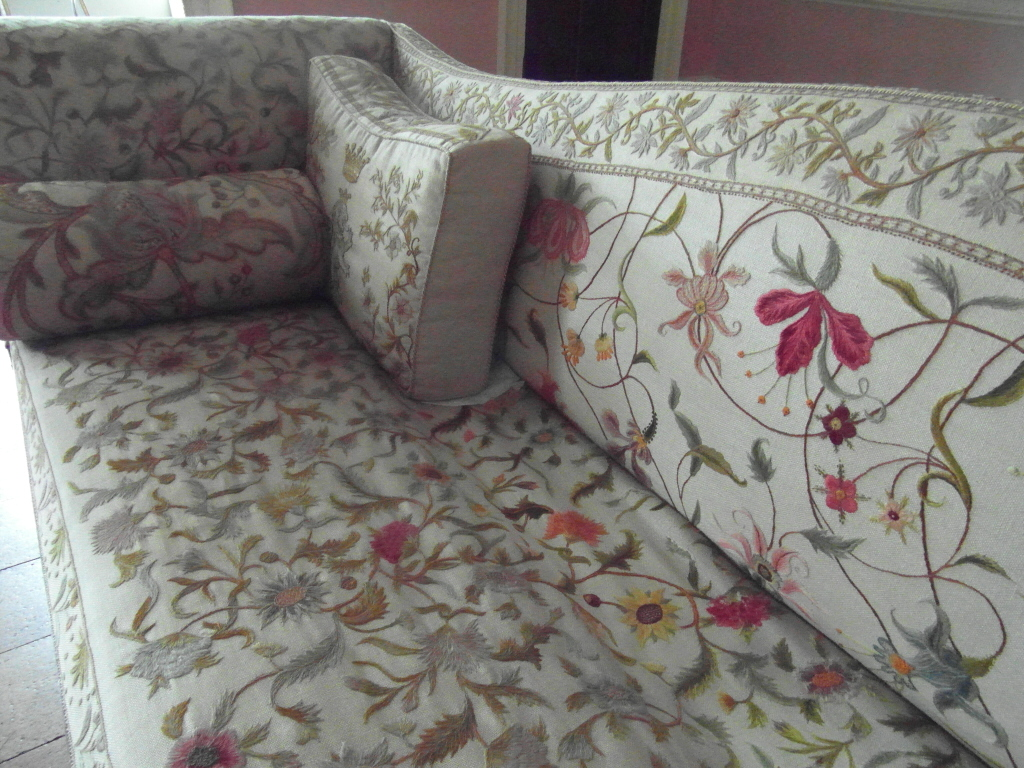
Example of ‘Indian Style’ floral design in Crewel Work on a restored sofa at Osterley House, National Trust
In France, the phenomenal success of the first textile print works was soon to be challenged. The well established wool and silk manufacturers objected strongly to this unexpected rivalry from the Indian imports and the Crown was against it too. Home manufacture meant no customs revenue for the king and in order to protect the status quo, the importation, manufacture, and usage of any Indian calico prints was forbidden by Royal Ordinance in 1686. England followed suit and from 1700 to 1774 there was a ban on imports. The lifting of the bans meant that from the 1780s onwards whilst most printed cottons continued to be manufactured in India the mills in England, France, Germany, the Netherlands, and Switzerland began to produce their own versions.
In Europe and in India printed cottons were created with vivid vegetable dyes using a variety of printing techniques. The designs were mainly floral, the Europeans favouring tulips, carnations, roses, and daises which they combined with traditional Indian motifs on a white background. In the 1780s, bolder designs with twisting stems became increasingly fashionable. In the 1790s, small floral “sprig” designs with tiny motifs on pastel backgrounds became cheap, and therefore became popular for working class clothing; also, some clothing fabrics veered away from the white backgrounds to include yellow, red, and brown.
In France, these printed fabrics were called indiennes and toiles peintes (“painted cloths”) and toiles imprimés (“printed cloths”). In England and the American colonies, there were similarly a number of terms used: calico, derived from the Indian port of Calicut, was a general name for Indian cotton fabric, including plain, printed, stained, dyed, woven with coloured stripes or checks. We got the word chintz, from the Hindi word chint (“variegated”), was a term for printed or painted calicoes. The English and American colonialists also used the term Indiennes to refer to French-made copies of Indian printed cottons.
These 18th century patterns have remained a firm favourite and are still a key feature of the English Country House Style. They are the mainstay of many interior design catalogues even today.
Illustration: Actress Kirsten Dunst in Marie-Antoinette
Julia Herdman writes historical fiction that puts women to the fore. Her latest book Sinclair, Tales of Tooley Street Vol. 1. is Available on Amazon – Paperback £10.99 Kindle £2.29 Also available on:
I drive past the Spode Factory each time I pick up or drop off my daughter at university; so as I have always been a fan of nice bit of porcelain I decided to find out about it.
The factory was started by one Josiah Spode in 1761. The enterprising Josiah worked for Thomas Whieldon from the age of 16 until he was 21 then he went into business for himself, renting a small potworks in the town of Stoke-on-Trent.
Josiah Spode’s claim to pottery fame is the introduction of underglaze blue transfer printing on earthenware in 1783–84. The Worcester and Caughley factories were already doing this but on porcelain which was much more expensive. To adapt the process from the production of small porcelain tea wares to larger earthenware dinner wares required the creation of more flexible paper to transmit the designs from the engraved copper plate to the biscuit earthenware body, and the development of a glaze recipe that brought the colour of the black-blue cobalt print to a brilliant perfection. When Spode employed the skilled engraver Thomas Lucas and printer James Richard, both of the Caughley factory, in 1783 he was able to introduce high quality blue printed earthenware to the market and blue underglaze transfer became a standard feature of Staffordshire pottery.
Another innovation was the standardisation of the formula for fine English porcelain. Although the Bow porcelain factory, Chelsea porcelain factory, Royal Worcester and Royal Crown Derby factories had their own versions of the recipe Josiah Spode effectively finalised the formula between 1789 and 1793 however some credit must also be given to Alexandre Brongniart, director of the Sèvres manufactory who came up with much the same combination of ingredients.
After some early trials Spode perfected a ‘stoneware’ that came closer to porcelain than any previously, and introduced this as “Stone-China” in 1813. Spode pattern books record about 75000 patterns that survive from about 1800 for this product.
Messrs Spode were succeeded in the same business in c. 1833 by Copeland and Garrett, who often used the name Spode in their marks. After 1847 the business continued until 1970 as W.T. Copeland and sons, and again the term ‘Spode’ or ‘Late Spode’ continued in use alongside the name of Copeland. Under the name ‘Spode Ltd’ the same factories and business was continued after 1970. In 2006, the business merged with Royal Worcester but the company went into administration on 6 November 2008 and the brand names were acquired by Portmeirion Group on 23 April 2009. Many items in Spode’s Blue Italian and Woodland ranges are now made at Portmeirion Group’s factory in Stoke-on-Trent which is just around the corner from Staffordshire University.
Julia Herdman writes historical fiction that puts women to the fore. Her latest book Sinclair, Tales of Tooley Street Vol. 1. is Available on Amazon – Paperback £10.99 Kindle £2.29 Also available on:
The emergence of the modern-day hipster is the antithesis of the 18th-century Macaroni, but they have some things in common.
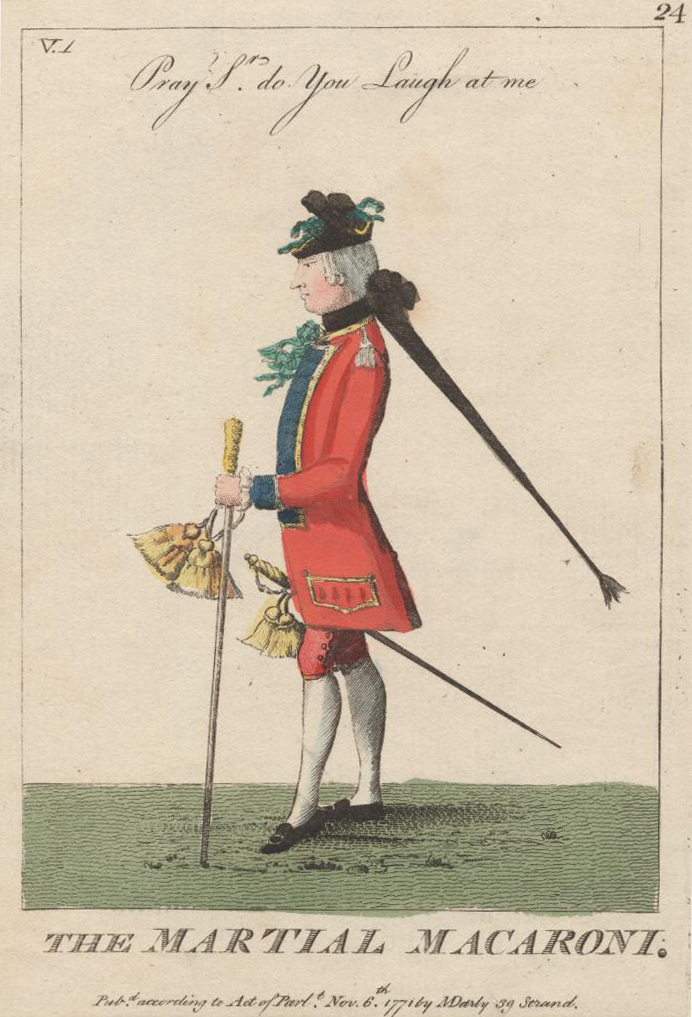
Macaronis were fashionable fellows who dressed and even spoke in an outlandishly affected manner. The macaroni only wanted was new and expensive. They thrived on spending money on the most outlandish costumes and hair.
The term macaroni is a pejorative one and referred to a man who “exceeded the ordinary bounds of fashion” in terms of clothes, fastidious eating and gambling. It was used to describe young men who had been to Italy on the Grand Tour and developed a taste for maccaroni, a type of pasta little known in England then, and so they were said to belong to the Macaroni Club.
Macaronis were the object of some savage British satire. In the Middlesex Journal for November 7th, 1772 Juventis commented on the use of the term macaroni: “If I consult the prints, ’tis a figure with something uncommon in its dress or appearance; if the ladies, an effeminate fop; but if the’ prentice-boys, a queer fellow with a great large tail.” Basically, this meant that the author thought if a woman looked at an illustration of a Macaroni, she would think she was looking at an effeminate dandy, while a working-class boy would say the man was a homosexual.
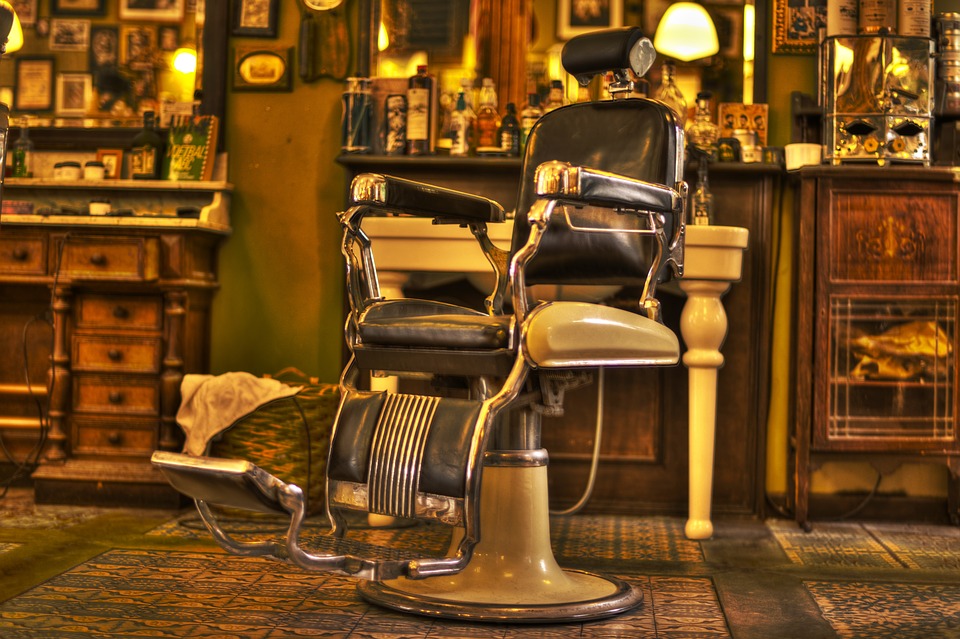
Hipster men, gay and straight, have made Retro their cool. The environment they say is precious to them, so they have turned their backs on the ‘the new’. The purloin their style from the racks of the Vintage shops choosing tweeds, corduroy and shirts made of cotton. Hipsters want to wear Sylvia Plath’s cardigans and Buddy Holly’s glasses because to be cool isn’t to look like a television star. They have beards and wear their hair in ponytails and buns revelling in the irony of making what was once nerdy cool. The only new thing Hipsters want is technology and coffee. These latter-day dandies wish to live hi-tech and sustainably; eat organic, gluten-free grains and preen their whiskers in the Edwardian style barbers shops.
Dandies appeared in the late 18th-century. Of course, both the dandy and the macaroni appear in the popular American Revolution song ‘Yanki-doodle-dandy’ the song that describes how an American colonist stuck a feather in his cap and called it Macaroni.
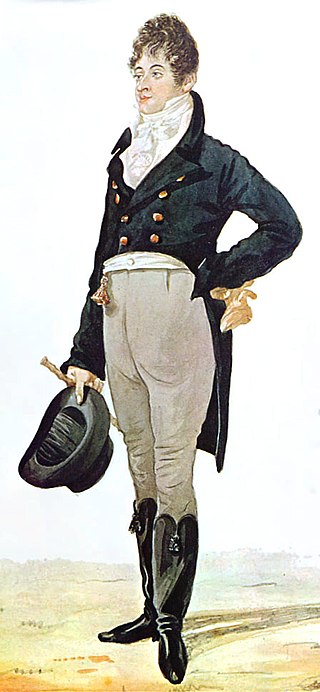
Napoleon and soldiering made ‘dandy’ a vogue word in the late 18th-century. Military men did not see themselves as men about town. Distinguishing a “dandy” from a “fop” was not difficult. The dandy was a rich, fashionable man about town, a man who could afford to copy the style of George Bryan “Beau” Brummell (1778–1840), in his early days, an undergraduate student at Oriel College, Oxford and later, an associate of the Prince Regent. The dandy’s dress was more refined and sober than the fop’s. The fop was a man of more modest means who made foolish and unfashionable choices about his wardrobe. The fop was a object of fun and was variously known as a coxcomb, a fribble, a popinjay (meaning ‘parrot’), a fashion-monger, or a ninny. He was the 18th-century equivalent of medallion man.
A 21st-century fop would be the hair-obsessed character Ulysses Everett McGill (played by George Clooney) in the Coen brothers film O Brother Where Art Thou (2001) and the character of Jack Sparrow (played by Johnny Depp) in the Pirates of the Caribbean film series. Depp’s style has been termed “grunge fop” because he has dreadlocks. The actor’s mannerisms caused concerns among executives at the Walt Disney Company Depp’s characterisation of Sparrow prevailed, thereby creating a new generation of fans of the fop.
Hipsters, dandies and fops are extremes in men’s fashion. It is often said that women do not dress for men but for other women. When we look at the history of men’s fashion, the hipster, the dandy and the fop seem to have no interest in the opposite sex, they like women are dressing to impress each other.
Julia Herdman writes historical fiction. Her latest book Sinclair, Tales of Tooley Street Vol. 1. is Available on Amazon – Paperback £10.99 and on Kindle.
Sinclair is set in the London Borough of Southward, the Yorkshire town of Beverley and in Paris and Edinburgh in the late 1780s. Strong female leads include the widow Charlotte Leadam and the farmer’s daughter Lucy Leadam. Sinclair is a story of love, loss and redemption. Prodigal son James Sinclair is transformed by his experience of being shipwrecked on the way to India to make his fortune. Obstacles to love and happiness include ambition, conflict with a God, temptation and betrayal. Remorse brings restitution and recovery. Sinclair is an extraordinary book. It will immerse you in the world of 18th century London where the rich and the poor are treated with kindness and compassion by this passionate Scottish doctor and his widowed landlady, the owner of the apothecary shop in Tooley Street. Sinclair is filled with twists and tragedies, but it will leave you feeling good.
Think of the words ‘white’ and ‘chocolate’ and the images that come to mind are those of the ‘The Milky Bar Kid’ or that luxury white chocolate flecked with fine black vanilla seeds but White’s and chocolate in the 18th century meant something entirely different; gambling.
The impetus for London’s chocolate craze came from France, introduced as an ‘excellent west indian drink’ in the mid 17th century. A decade later pamphlets proclaimed the miraculous, panacean qualities of the new drink, saying that it would boost fertility, cure consumption, alleviate indigestion and reverse ageing: with a mere lick, it was said, it would ‘make old women young and fresh and create new motions of the flesh’.
Unlike in Paris and Madrid, chocolate drinking was not confined to the social elite in London however it was never as popular as coffee with its enlivening caffeine boost.. It was only around St James’s Square that a cluster of super-elite self-styled ‘chocolate houses’ flourished. The principal chocolate houses were Ozinda’s and White’s, both on St James’s Street, and the Cocoa Tree on Pall Mall.As befitted their location their interiors were a cut above the wooden, workmanlike interiors of the City coffeehouses, boasting sofas, polished tables, dandyish waiters and, at least in Ozinda’s case, a collection of valuable paintings for the customers to admire. In fact Ozinda’s comfortable surroundings became a hot bed of Jacobite intrigue. On one occasion in 1715, Jacobite supporters were arrested there and taken off to Newgate prison.
White’s started life at 4 Chesterfield Street, off Curzon Street in Mayfair, in 1693; owned by an Italian immigrant named Francesco Bianco. It was later re-named Mrs. White’s Chocolate House with a side line in tickets for the King’s Theatre and Royal Drury Lane Theatre White’s quickly made the transition from cafe into an exclusive club. It was notorious as a gambling house; those who frequented it were known as “the gamesters of White’s.” The club gained a reputation for both its exclusivity and the often raffish behaviour of its members. Jonathan Swift referred to White’s as the “bane of half the English nobility.” In 1778 it moved to 37–38 St James’s Street and was from 1783 the unofficial headquarters of the Tory party, while the Whigs’ club Brooks’s was just down the road.
White’s had such a terrible reputation Hogarth depicted its inner gambling room as ‘Hell’, in the sixth episode of Hogarth’s Rake’s Progress. The place is on fire but no one seems to notice. It is a picture of greed and despair so far removed from the images of chocolate we have today.
Illustration: Meissen Chocolate Cup and Saucer.
Julia Herdman is a novelist. Her latest book Sinclair, Tales of Tooley Street Vol. 1 is Available on Amazon – Paperback £10.99 Kindle £2.29






Recent Comments