

Juan Luna de San Pedro y Novicio Ancheta Public Domain.
- Did Cleopatra wish to be noble in death, or did she fear public humiliation at the hands of Octavius Augustus?
- Historical accounts of the deaths of Cleopatra and Antony raise many questions. Questions such as:
- Did Cleopatra betray Antony?
- What did Cleopatra do to protect her children and Egypt?
Who Was Cleopatra VII?
Cleopatra VII Philopator, or “Cleopatra the father-beloved”, was born in 69 BC. She was the last Queen of the Ptolemaic Kingdom of Egypt from 51 to 30 BC.
Although almost 50 ancient works of Roman historiography mention Cleopatra, we know little about her except accounts of her suicide and Augustan propaganda about her personal deficiencies. Cleopatra is barely mentioned in De Bello Alexandrino, the memoirs of an unknown staff officer who served under Caesar. The writings of Cicero, who knew her personally, provide an unflattering portrait. The Augustan-period authors Virgil, Horace, Propertius, and Ovid perpetuated the negative opinion of Cleopatra, one approved by the ruling Roman regime at the time.
A member of the Ptolemaic dynasty, she was a descendant of its founder Ptolemy I Soter, a Macedonian Greek general and companion of Alexander the Great.
Her native language was Koine Greek, and she was the only Ptolemaic ruler to learn the Egyptian language.
Cleopatra died on the 10th or 12th of August, 30 BC. Cleopatra was just 39 years old. The Greek and Roman historians Strabo, Horace, Plutarch, Livy and Cassius Dio give the closest contemporary accounts of her mysterious death.
Cleopatra’s death ended the final war of the Roman Republic between the remaining triumvirs Octavian, later Emperor Augustus and Mark Antony.
Cleopatra aligned herself with Antony, the father to three of her children. When Antony lost the battle of Actium in 31 BC, Octavian invaded Egypt.
Octavian had Cleopatra’s son Caesarion (also known as Ptolemy XV), his rival to become heir to Julius Caesar’s heir killed. But he spared her children by Antony and took them to Rome.
Cleopatra’s death marked the end of the Hellenistic period and Ptolemaic rule of Egypt, and Egypt became a province of the Roman Empire.

Cleopatra’s Suicide
The Death of Cleopatra, Guido Cagnacci, Met Museum, Public Domain.
How Did Cleopatra Die?
What really happened when Cleopatra barricaded herself in her mausoleum and sent word to Antony that she was dead?
Plutarch’s Account of Cleopatra’s Death
Plutarch c. AD 46 – after AD 119, was a Greek Middle Platonist philosopher, historian, biographer, essayist, and priest at the Temple of Apollo in Delphi. He is known primarily for his Parallel Lives, a series of biographies of illustrious Greeks and Romans, and Moralia, a collection of essays and speeches. Adapted from Parallel Lives.
On hearing of Antony’s defeat at Alexandria, Cleopatra took off to her tomb. ‘It is said that the asp (that killed her) was brought to her with figs and leaves and lay hidden beneath them. Cleopatra had given orders that the reptile might fasten itself upon her body without her being aware.
But when she took away some of the figs and saw it, she said: ‘There it is, you see,’ and baring her arm, she held it out for the bite. But others say the asp was shut up in a water jar and that while Cleopatra was stirring it with a golden distaff, it sprang out and fastened itself upon her arm.
But the truth of the matter no one knows; for it was also said that she carried about poison in a hollow comb and kept the comb hidden in her hair. But neither spot nor other sign of poison broke out upon her body.’
When they opened the tomb doors, they found Cleopatra lying dead on a golden couch, arrayed in a royal state. Her woman, Iras, was dying at her feet, and her lady Charmion, tottered trying to arrange the diadem which encircled the Queen’s brow. Then somebody said in anger: ‘A fine deed, this, Charmion!’ ‘It is indeed most fine,’ she said, ‘and befitting the descendant of many kings.’ Then she died.
No reptile was found in the chamber, though people said they saw some traces of it near the sea. And some also say that Cleopatra’s arm was seen to have two slight and indistinct punctures. Plutarch tells us Caesar seems to have believed this version of the story as during his triumph in Rome, an image of Cleopatra with the asp clinging to her was carried in the procession.
Plutarch also tells us that although Caesar was vexed at the woman’s death, he admired her lofty spirit. He ordered that her body be buried with that of Antony in a splendid and regal fashion. Her women also received honourable interment by his orders.
When Cleopatra died, she was forty years of age save one, had been Queen for two and twenty of these, and had shared her power with Antony more than fourteen. Antony was fifty-six years of age, according to some, and according to others, fifty-three. Now, the statues of Antony were torn down. But those of Cleopatra were left standing because Archibius, one of her friends, gave Caesar two thousand talents so that they might not suffer the same fate as Antony.
Despite not being a biography of Cleopatra, the Life of Antonius, written by Plutarch in the 1st century AD, provides the most thorough surviving account of Cleopatra’s life. Plutarch lived a century after Cleopatra but relied on primary sources, such as Philotas of Amphissa, who had access to the Ptolemaic royal palace, Cleopatra’s personal physician named Olympos, and Quintus Dellius, a close confidant of Mark Antony and Cleopatra. Plutarch’s work included both the Augustan view of Cleopatra—which became canonical for his period—as well as sources outside of this tradition, such as eyewitness reports.
Livy’s Account
Titus Livius, 59 BC-AD 17, known in English as Livy, was a Roman historian. He wrote a monumental history of Rome and the Roman people, titled Ab Urbe Condita, ”From the Founding of the City,” covering the earliest legends of Rome to the reign of Augustus. He was on familiar terms with members of the Julio-Claudian dynasty and a friend of Augustus.
Adapted from Book 133
After Caesar had reduced Alexandria to rubble, he discovered Cleopatra, to avoid falling into the victor’s hands, had died by her own hand. Caesar returned to the city of Rome and celebrated three triumphs: one for victory over Illyricum, a second for success at Actium, and a third one for victory over Cleopatra. This was the end of the civil wars in their twenty-second year.
Livy wrote that when Octavian met Cleopatra, she told him frankly, “I will not be taken as an achievement.” Octavian refused to say what would happen to her if she and Anthony lost the Battle at Actium. He gave only the cryptic answer that her life would be spared. He did not offer specific details about his plans for Egypt or its royal family.
Livy wrote that when a spy informed Cleopatra that Octavian intended to take her to Rome to be presented as a prisoner in his triumph, she decided to avoid this humiliation by taking her own life at age 39; on August 30.
Horace’s Ode - “Nunc est bibendum” or “Now is the time for drinking.”
“Nunc est bibendum”, or “Now is the time for drinking”, sometimes known as the “Cleopatra Ode”, is one of the most famous of the odes of the Roman lyric poet Horace. Published in 23 BC, it appeared as Poem 37 in the first book of Horace’s collected “Odes” or “Carmina.”
The poem tells the story of Octavian’s defeat of Mark Antony and Cleopatra at the Battle of Actium. Neither Cleopatra nor Mark Anthony is named in the poem. Some commentators say this is because loyal Horace preferred to describe the war as between Egypt and Rome and not between two of Rome’s most prestigious families or as a Roman civil war. Horace repeats the notion that Antony and Cleopatra killed themselves.
Horace concurs with Plutarch and Livy that Cleopatra died by her own hand, as does Strabo.
Cassius Dio’s Account
Lucius Cassius Dio (c. 155 – c. 235), also known as Dio Cassius, was a Roman historian and senator who published 80 volumes of Roman history covering approximately 1,000 years. Many of his books have survived intact or as fragments, providing modern scholars with a detailed perspective on Roman history.
Cleopatra, unknown to Antony, sent Octavian a golden sceptre and a golden crown together with the royal throne showing that she was offering him her kingdom. Caesar accepted her gifts as a good omen. Publicly he sent her threatening messages, but in secret, Caesar extolled her to kill Antony. In return for Antony’s death, Caesar offered Cleopatra a pardon.
Meanwhile, Antony wrote to Caesar, reminding Caesar of their friendship and kinship. Antony recounted all the amorous adventures and youthful pranks they had shared together and offered him Publius Turullius, one of the assassins of Julius Caesar, to save Cleopatra.
Caesar accepted the gift of Turullius and put him to death. But he offered Antony no guarantees in return. So, Antony despatched the third embassy, sending him his son Antyllus with much gold. Caesar accepted the money but sent the boy back. Indicating he was not in the mood for a deal.
Octavian sent threats and promises of love and loyalty to Cleopatra while his army marched towards Alexandria. Believing Octavian’s protestations of affection, Cleopatra forbade the Alexandrians to rise against him, and so he took Alexandria.
Antony, we are told, took refuge with the Egyptian fleet and prepared to sail to Spain. When Cleopatra heard he was taking her ships, she ordered her sailors to desert Antony. Then she moved to her tomb. With no navy to command, Cassius tells us Antony went to Cleopatra’s tomb, dripping with blood and dying from a self-inflicted stab in the stomach. She embalmed Antony’s body and buried him. Cassius describes how Cleopatra redecorated her apartment, added a golden couch and draped herself upon it invitingly for Caesar. She convinced Octavius she would travel to Rome with him but planned her own demise behind his back. Her plan was to die as painlessly as possible. After putting on her best clothes and draping herself in symbols of royalty, she lay on her golden coach and killed herself.
Cassius Dio thus portrays Cleopatra as the worst sort of woman, as a woman happy to ignore her sacred duty of mourning her dead husband, Antony. And as a woman without morals ready to offer herself to the next man who came along. In Cassius’ eyes, Cleopatra was a fully paid-up scheming slut and a coward.

Cleopatra on her couch of gold.
John Collier, Prado, Madrid. Public Domain.
Suicide in Ancient Egypt and Rome
According to American art historian Robert Bianchi, conflicting accounts of Cleopatra’s suicide were circulated almost immediately after her death. He also claims Octavian would have savoured the thought of parading the defeated Cleopatra through the streets of Rome. [1]
Suicide, i.e., deliberately killing oneself, was practically unheard of in ancient Egypt. This makes the story told about the end of Cleopatra’s life all the more intriguing. Egyptians generally did not see suicide as a violation of their religious or legal codes, and there is no archaeological evidence of suicides in the ancient Egyptian civilization. However, texts such as ‘Desperate from Life’, an intellectual dialogue on despair, injustice, and corruption, suggest that some desperate people thought about ending their own lives. [2]
The famous judicial papyrus of Turin records the so-called Harem Conspiracy, a plot to murder Ramses III. The conspirators were given punishments ranging from execution, suicide, flogging, imprisonment, and severing of the nose, for their respective roles in the crime. Although we do not know precisely how each individual conspirator was punished, it is likely members of the royal family were offered the dignity of suicide as an alternative to execution.
Suicide was, however, a regular feature of elite Roman life. Romans promoted the idea of “patriotic suicide.” Suicide was a way out of dishonourable situations for the elite. Thus, it was illegal for ordinary soldiers, slaves, and people accused of capital crimes. In other words, death was preferable to dishonour.
Was Cleopatra An Honourable Woman?
In the eyes of Cleopatra’s Egyptian subjects, her relationship with Antony was the equivalent of a dynastic marriage, as was her relationship with Julius Caesar. Caesar and Antony were the two most prominent Romans of the time. They were the men who were most likely to ensure the survival of her dynasty.
Cleopatra was not the greedy two-faced slut the Romans made her out to be. Her children by both of her husbands were legitimate. They had a part to play in the royal succession plan and the destiny of Egypt and the Eastern Mediterranean.
Cleopatra carefully selected their names – Caesarean, Alexander Helios and Cleopatra Selene. Cleopatra had Macedonian, Seleucid and Ptolemaic antecedents that linked her twins with Alexander the Great and Ptolemy the Great. Their second names, Helios (Sun) and Selene (Moon) marked the twins as a celestial and godly pair linked to the beliefs and prophecies circulating around the Roman Empire regarding a forthcoming ‘golden age’.
Medieval Arabic historians who worked from translated Egyptian sources portray Cleopatra as a strong and able queen. In Cleopatra: Last Queen of Egypt, Egyptologist Dr Joyce Tyldesley states that Ptolemaic women were responsible for participating in state affairs and would have been taught the basics of reading, writing, and arithmetic, plus studies on Greek and Egyptian laws, history, and traditions. Dr Tyldesley considers Cleopatra’s role in Egyptian history and culture a vital subject to study since her rule nearly returned Egypt to world superpower status.
The balance of evidence from the texts suggests Cleopatra died by her own hand. Such a death would have been perfectly acceptable and even honourable for a defeated queen in Egypt and Rome.
Did Cleopatra Betray Antony and Her Children?
Octavian celebrated his military triumph by parading the three orphans in heavy golden chains in the streets of Rome. The chains were so heavy that they could not walk, prompting reactions of sympathy from the Romans.
Caesarion, who was said to be Cleopatra’s son by Julius Caesar, was sent by his mother, with much treasure, into India, by way of Ethiopia, according to Plutarch. However, it is more likely Octavian had his rival executed in Alexandria soon after his victory there, following the advice of Arius Didymus, who said, “Too many Caesars is not good”.
Cleopatra’s three surviving children, Cleopatra Selene II, Alexander Helios, and Ptolemy Philadelphos, were sent to Rome with Octavian’s sister Octavia the Younger, a former wife of their father, as their guardian.
Cleopatra Selene II and Alexander Helios were present in the Roman triumph of Octavian in 29 BC. The fates of Alexander Helios and Ptolemy Philadelphus are unknown after this point. Octavia arranged the betrothal of Cleopatra Selene II to Juba II of Numidia in North Africa. The emperor Augustus made Juba II and Cleopatra Selene II, Mauretania’s new rulers, formerly Cartage.
Historian Arthur Weigall says there is no reason to believe Cleopatra betrayed Antony even though he had accused her of doing so. Weigall attributes Antony’s accusations as “erratic behaviour” during the last years of his life.
Duane Roller adds that Cleopatra was stronger than Antony following the Battle of Actium since Antony was often “suicidal and withdrawn” after his defeat.
Plutarch and Cassius Dio have similar accounts, which imply Octavian offered Cleopatra the opportunity to save herself and her throne if she agreed to kill Antony.
Stacy Schiff points out that Cleopatra was still in a position to negotiate with Octavian, whereas Antony was not.
So, it seems Antony was as good as dead after the Battle of Actium. Octavian would not allow his rival for control of Egypt and what was to become the Roman Empire to fall into his hands or the hands of his offspring. Suicide for Antony was the only honourable way out of his situation. As for Cleopatra, she likely did her best to secure the future of her children by taking her own life and by sending Caesarean away. Unfortunately, she was not wholly successful.
Why was Cleopatra so Vilified?
In Doi’s version of her death, which is the most detailed, all the men are portrayed more honourably than this great Queen of Egypt.
This was because a respectable woman in ancient Rome was required to keep a low profile. Women were supposed to be defined by their husbands, fathers, and sons. They were required to live faithful uncomplaining lives. Modesty and fidelity were the foremost virtues of a Roman woman – virtues Cleopatra clearly did not believe in. This was either because she was not Roman or because she was a queen in her own right and not a consort.
Whenever a Roman woman went out, assuming she was of noble birth, she would be chaperoned by slaves or a relative. She had to cover her body in a long gown called a stola, including her face in public. Over it, she wore a ‘palla’ or cloak. Women were supposed to be invisible in the Roman world.
Indeed, until the reign of Octavius Augustus, there were no statues of women at all. A noblewoman’s body was no business of anyone else except her husband. And, no respectable Roman woman would dare to be found lying around half-dress on a golden couch, especially when she was supposed to be mourning the loss of her husband!
Women who were considered to have transgressed sexually and betrayed their Imperial husbands, Empress Messalina. It was straightforward misogyny.
Valerius Maximus, writing in the century after Cleopatra’s death, gives several examples of errant women being ‘punished’ by their husbands. Ignatius Metellus, he tells us, bludgeoned his wife to death merely for drinking wine. Valerius tells his readers that far from being charged with murder, he received no public censure. According to Valerius, women needed to be kept under male control to stop them from scheming, as did Marcus Porcius Cato, otherwise known as Cato the Censor.
It is possible Octavius might have paraded her at his triumph, but unlikely. Working on the basis Cleopatra was not a ‘savage’ Gaul like Vertingeterex; and that she was the vanquished Queen of the most culturally advanced nation on earth when she died, it is unlikely Augustus would have humiliated her. However, she was not a good example, so it was open season on her reputation for authors like Dio, whether she had died at her own hand or from a gnat bite.
Bibliography
- El-Daly, Okasha. Egyptology: The Missing Millennium: Ancient Egypt in Medieval Arabic Writings. Portland: Cavendish Publishing, 2005.
- Fletcher, Dr Joann. Cleopatra the Great: The Woman Behind the Legend. New York: Harper Perennial, 2011.
- Jameson, Anna Brownwell. Memoirs of Celebrated Female Sovereigns. London: George Routledge & Sons, 1880.
- Elibron Classics series: Adamant Media Corporation, 2005. Reprint.Jones, Prudence J. Cleopatra: A Sourcebook.
- Norman: University of Oklahoma Press, 2006. Print.Lange, Carsten Hjort. “The Battle of Actium: A Reconsideration.” The Classical Quarterly 61.2 (2011) doi:10.1017/S0009838811000139. Web. February 9, 2013.
- Roller, Duane. Cleopatra: A Biography. New York: Oxford University Press, 2010. Print.Schiff, Stacy. Cleopatra: A Life. New York: Little, Brown and Company, 2010.
- Sergeant, Philip W. Cleopatra of Egypt: Antiquity’s Queen of Romance. London: Hutchinson & Co., 1909.
- Tyldesley, Joyce. Cleopatra: The Last Queen of Egypt. New York: Basic Books, 2008. Print.Weigall,
- Weigall, A The Life and Times of Cleopatra, Queen of Egypt. New York & London: G. P. Putnam’s Sons, 1924.

The Death of Cleopatra, Arthur Reginald Smith, Public Domain.
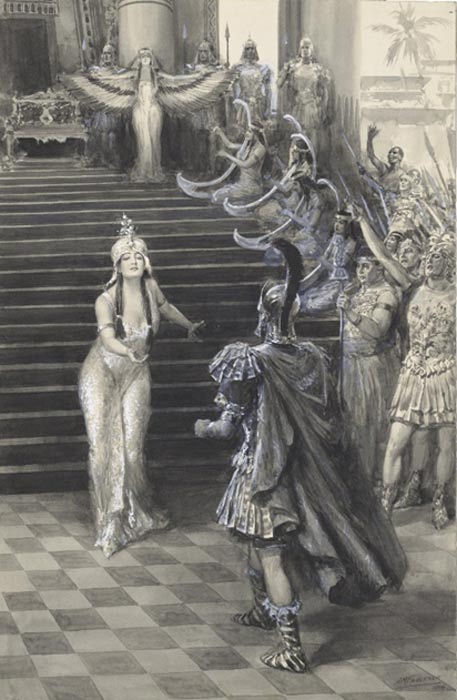
Cleopatra Meet Julius Caesar, Falkner: Public Domain

Cleopatra - Waterhouse, Public Domain.
Sources
LA Times, MIMI MANN, MARCH 15, 1992, 12 AM PT
Attitudes Toward Death and Suicide, HANKOFF L D, 1975, Pharos of Alpha Omega Alpha, v.38, no.2, (April 1975), p.60-64,75, SIEC No: 19840001
Plutarch’s Lives, Tufts University.
Livy, Periochae Book 133
DIO’S ROMAN HISTORY, Book 51, THE LOEB CLASSICAL LIBRARY VI.
Robert Garland, PhD, Colgate University, The Other Side of History: The Ideal Roman Woman, Great Courses Daily, 2021.
See Julia’s new book: Bedroom Diplomacy

Questions in Egyptology:
Recent Comments