by Julia Herdman | Jul 28, 2017 | Blog, British History, British Royal Family, Europe
Rebellion
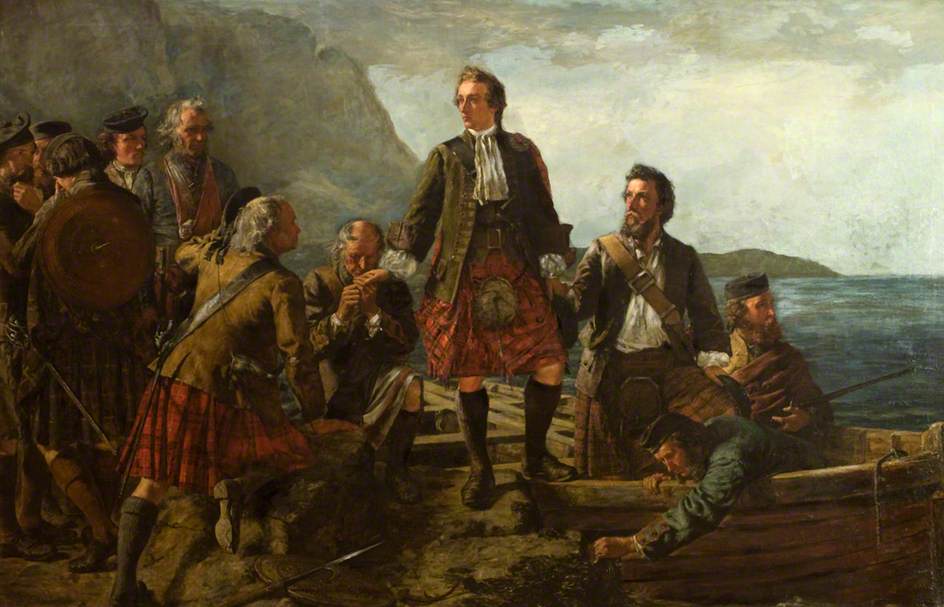
The Jacobite movement started when the Stuart King, James II was deposed in 1688.
Parliament, not wanting a Roman Catholic king gave the throne of Great Britain and Ireland to his daughter Mary II and her husband and first cousin William of Orange.
King James and his family left England and went into exile. The Stuarts were not without their supporters, however. There were people who thought that Parliament had no business interfering with the natural line of succession. These people became known as Jacobites - the supporters of James.
Jacobite support was strongest in parts of the Scottish Highlands, lowland northeast Scotland, Ireland, and parts of northern England. In England, support for James came mostly from Northumberland and Lancashire. James also had some supporters in Wales and southwest England.
To be a Jacobite supporter was a very dangerous game. The stakes were high. If you were discovered you would be guilty of treason, and the death penalty would undoubtedly await you. Expressing allegiance, therefore, had to be done covertly through secret rituals, secret symbols, and secret messages.
The Jacobites had many secret symbols, including the sunflower to symbolise loyalty, as a sunflower always follows the sun and moths or butterflies whose emergence from a chrysalis symbolised the hope for the return to power of the Stuart family. The Merovingian bee was adopted by the exiled Stuarts in Europe, and engraved bees are still to be seen on some Jacobite glassware.
The Jacobite White Cockade
In the years leading up to the Jacobite Rebellion of 1745 Jacobites were forced to meet and plot in secret, and the white rose or white cockade (a flower made from ribbon, often worn on a hat) was a way of identifying those who supported the cause.The emblem of the Jacobites was the White Cockade.
All 69 Scottish Nationalist Party members of parliament wore white roses in their lapels at the swearing-in ceremony of the Scottish parliament a few years back. When asked about the significance of the Nationalists wearing of the white rose Scotland’s First Minister at the time, Alex Salmond, denied that the flower was a reference to the Jacobites. Instead, he cited the poem “The Little White Rose”, written by the Scottish poet Hugh MacDiarmid, and claimed the rose stood for “all of Scotland”. MacDiarmid (1892-1978) was a committed Nationalist. In 1928 he helped found the National Party of Scotland, the forerunner of today’s Scottish National Party.
Rosa x alba grows all over Scotland. It is a bushy shrub-like rose with dark, grey-green foliage and a small five-petalled flower, similar to a dog rose, which can be white or pale pink. They only flower in spring and have a beautiful scent with notes of citrus. The plants are hardy, thrive in poor soil, can tolerate shade and drought and are for the most part resistant to disease.
The origins of the rose as a symbol are somewhat lost in myth and legend. It is said that one of the earliest references refers to the birth of James Francis Edward Stuart, son of the deposed King James II, who was born on 10th June in 1688, said to be “the longest day of the year in which the white rose flowers”. Another legend tells how Bonnie Prince Charlie plucked a white rose from the roadside and stuck it in his hat as he made his way south from Glenfinnan to start the Jacobite Rebellion of 1745.
English, Irish and Welsh Jacobites
Jacobitism was attractive to members of the English aristocracy who had chosen to remain Catholic after the Reformation.
About 2-3% of the English population remained Catholics at the time of the Glorious Revolution in 1688. The highest concentration of Catholics was in the north of England.
The movement also found support in the Catholic populations of Ireland and rural Wales because they hoped the return of a Stuart king would end their exclusion from many aspects of civic and political life under the Recusancy Acts.
In Ireland, James was supported for his 1687 Declaration of Indulgence or, as it is also known, The Declaration for the Liberty of Conscience. This declaration promised an Irish Parliament.
Scottish Jacobites
Catholic country gentry tended were James most ideologically committed supporters. Drawing on almost two centuries of suffering as a religious minority persecuted by the state they rallied enthusiastically to the Jacobite cause.
Highland clans such as the MacDonnels and MacDonalds of Clanranald, Keppoch, Glengarry and Glencoe; the Clan Chisolm, and the clan Ogilvy were largely still Catholic. Other clans, such as the powerful Camerons, were Episcopalian, and as staunch in their Jacobitism as their allies the Catholic MacDonalds.
Scottish Episcopalians provided over half of the Jacobite forces in Britain. As Protestants, they could take part in Scottish politics, but as a religious minority, they were repeatedly discriminated against in legislation which favoured the established Presbyterian Church of Scotland. About half the Episcopalians supporting the Jacobite cause came from the Lowlands, but this was obscured in the risings by their tendency to wear the Highland dress.
In the Gaelic-speaking Scottish Highland clans, Jacobites were known as Seumasaich. The clan chiefs ran their own private armies and there was often conflict between them. This conflict was more about political power and money than religion as most were Catholic.
A significant source of friction was the territorial ambitions of the Presbyterian Campbells of Argyll. Another was James VII’s sympathetic treatment of the Highland clans. Monarchs since the late 16th century had been antagonistic to the Gaelic-Highland way of life but James had worked sympathetically with the clan chieftains. He had put in place the Commission for Pacifying the Highlands but that had now been abandoned. Some Highland chieftains, therefore, viewed Jacobitism as a means of resisting hostile government interference in their territories. These private armies would go onto provide the bulk of Jacobite manpower in both the 1715 and 1745 rebellions.
Although most support for the Stuart cause came from Tories there were some notable Whig exceptions most notably the Earl of Mar. Most sympathetic Whigs were merely keeping their options open in case the Stuarts returned.
Jacobite Romance
Jacobites were definitively romantic. They were the underdogs in the battle with the British state. They fought heroically for their rights and their country. They were brave and dashing in their Highland garb but they weren’t what would pass as the good guys today. They were distinctly unenlightened and un-democratic.
They believed in:
• the divine right of kings and the accountability of Kings to God alone;
• inalienable hereditary right; and the unequivocal scriptural injunction of non-resistance and passive obedience to the crown.
Sources:
Scotland, A Concise History, Fitzroy Maclean, Thames and Hudson
Bonnie Prince Charlie, Fitzroy Maclean, Canongate Books Ltd.
The Jacobites, Britain and Europe 1688–1788, Daniel Szechi, Manchester University
The Myths of the Jacobite Clans, Murray G. H. Pittock, Edinburgh University Press
Julia Herdman writes historical fiction that puts women to the fore. Her latest book Sinclair, Tales of Tooley Street Vol. 1. is Available on Amazon – Paperback £10.99 Kindle £2.42 Also available on:
Amazon Australia
Amazon Canada
Amazon New Zealand
Amazon South Africa
Amazon USA
Also on Smashwords

by Julia Herdman | Jul 26, 2017 | Blog, British History, Craft and manufacture, Europe, Fashion, Houses and Furniture, Society
We take clear glass or Cristallo for granted today but this fragile material was once so prized men were condemned to death for revealing its secrets.
Sparklingly clear glass is the stuff of romance. Without it there would be no coup de champagne or glittering chandeliers to dance under and no cheap sparkles for a girl to wear.
The Venetians had been making glass since Roman times but by the late 1200s, the production of glass objects of the finest quality was the city’s major industry. The Glassmakers Guild laid out rules and regulations to safeguard their secrets and in 1271 a law prohibited the importation of foreign glass or the employment of foreign glass workers. An even more radical law was passed in 1291 that laid the ground for the establishment of Murano as a premier glass-manufacturing centre. This law required that all furnaces used for glass making be moved from Venice to the island of Murano to avoid the risk of in the overpopulated city. Many historians agree that the real motive was to isolate the glassmakers to a place on where they wouldn’t be able to disclose trade secrets. A subsequent law passed in 1295 forbidding the glassmakers from leaving the city on pain of death confirms this theory.
Venetian glass reached the peak of its popularity in the 15th and 16th centuries. In the 15th century, master Angelo Barovier discovered the process for producing clear glass - (Cristallo) - that allowed Murano glass makers to become the only producers of mirrors in Europe. In addition, the popularity of Chinese porcelain among European nobility fuelled the discovery and production of the white glass mimicking porcelain (lattimo). Other types of glass making techniques became popular such as enameling and gilding glass, which originated in the Middle East, filigrana glass which is made using glass rods with inner threads of white, golden or coloured glass that are twisted or intersecting, and ice glass which appears finely crackled. Variety of shapes and colours increased, and glassware became more sophisticated though the beauty was still viewed as the simplicity of shapes and ornaments.
By the end of the 16th-century glasshouses in Bohemia, Germany, the Low Countries, and even England were employing Italian glassmakers to produce a colourless glass, an imitation of Venetian Cristallo, often called façon de Venise. However, a century later things were beginning to change. Coal was a major factor. Coal fired furnaces were developed in England and towards the end of the 17th century, the first colourless lead glass (variously called ‘flint glass’ and ‘lead crystal’) was produced. These new technologies allowed Britain to become one of the leading glass producers and the balance of power in the world of glass began to shift northwards.
This shift from Venetian Cristallo glass to northern European imitations (façon de Venise) was noted by Girolamo Alberti, the Doge of Venice’s Secretary in London in October 1672 when he complained that “With regard to Venetian trade, I find that of glass is utterly ruined since the introduction here of the manufacture of mirrors and drinking glasses, by a privilege granted to the Duke of Buckingham.”
The origin of colourless lead glass is traditionally traced back to George Ravenscroft and his 1674 patent. However, the details of what Ravenscroft actually invented are obscure. Recent research points to an Italian connection. Ravenscroft, set up a furnace in Savoy. The Savoy glasshouse was visited 29 July 1673 by Robert Hooke and Christopher Wren. Hooke records that they visited, the new glasshouse at the Savoy and “saw calcind flints as white as flower, Borax, Niter and tarter, with which he made his glasse he denyd to use arsenick he shewd pretty representations of Agates by glass &c.”
It is more likely that Ravenscroft was a financial backer and that an Italian glassmaker called Da Costa was the actual inventor of the glass that was patented. John Baptista Da Costa was one of two glassmakers from Altare, the other was John Odaccio Formica, who worked together in Nijmegen between 1665 and c.1672. Both were later associated with lead glass industries: Da Costa in London and Odaccio in Dublin.
On the 8th March of 1674, George Ravenscroft petitioned the crown for a patent to produce glass as it was still legally in the hands of the Duke of Buckingham. Ravenscroft claimed to have ‘attained to the art and manufacture of a particular sort of Cristaline Glasses resembling Rock Cristall, not formerly exercised or put into use’. The patent was for drinking glasses and specifically excludes mirrors as well as, other sorts of glasse of ancient fabrick, at present and for many years practiced or any other sort of glasse that shall be made by others. The King approved the application on the 19th March and the patent was formally issued on the 16th May 1674 for a period of seven years. That year Ravenscroft entered into an exclusive agreement with the Company of London Glass Sellers to provide them with his new glassware.
The new process had its teething problems, namely crizzling, where the glass became flaky and lost transparency. The problem it seems was solved by adding more lead to the mixture. By the 1680s glass, manufacture had spread outside London to Bristol and Newcastle-upon-Tyne. Archaeological evidence from the glasshouse at Silkstone, South Yorkshire shows the production of lead glass during the 1680s using coal.
The Glass Sellers sought to ban imports of so-called ‘country’ glasses into London during the 1680s. They argued that the ‘country’ glasses were of inferior quality and that the London consumer needed to be protected. It is perhaps more likely that those most in need of protection were the members of the Company of Glass Sellers!
Sources:
Investigation of Late 17th Century Crystal Glass, D Dungworth and C Brain, Centre for Archaeology Report 21/2005
https://www.glassofvenice.com/murano_glass_history.php
Julia Herdman writes historical fiction that puts women to the fore. Her latest book Sinclair, Tales of Tooley Street Vol. 1. is Available on Amazon – Paperback £10.99 Kindle £2.42 Also available on:
Amazon Australia
Amazon Canada
Amazon New Zealand
Amazon South Africa
Amazon USA
Also on Smashwords
by Julia Herdman | Jul 25, 2017 | Blog, British History, Europe, European Royal Families, France, Marriage, Politics, Romance
Klemens Wenzel Nepomuk Lothar, Fürst von Metternich-Winneburg zu Beilstein otherwise known simply as Metternich was probably the greatest diplomat of the nineteenth century. As well as being a towering intellectual he seems to have been a very physical man, if not on the field of battle then in the bedchamber. In her book, Dorothea Lieven: A Russian Princess in London and Paris, 1785-1857, Judith Lissauer Cromwell describes him as, “witty and charming, above average height, slim and graceful, “the Adonis of the Drawing Room.” A man with, “fair hair, an aquiline nose, a well-shaped mouth, a high forehead, and piercing blue eyes.”
He served as the Austrian Empire’s Foreign Minister from 1809 and Chancellor from 1821 and was responsible for what historians call ‘The Concert of Europe.” This was not a forerunner of the Eurovision Song contest but a concert in the sense of an arrangement of something by mutual agreement or coordination and the thing he was in charge of arranging was the restoration of Europe to its state before the French Revolution after the defeat of Napoleon. He managed what is called ‘The Congress System’ from 1814 until the liberal revolutions of 1848 finally forced his resignation. But it is not his achievements as a statesman or his politics I am interested in today, it is achievements as a husband, lover, and as one of the most prolific love letter writers in history.
Metternich had three wives, obviously not all at the same time although one suspects he might have managed that if he had had the opportunity he rarely had only one bed to go to at a time. With his first wife, Princess Eleonore von Kaunitz (m. 1795–1825) he had 10 children, with his second wife, Baroness Antoinette Leykam (m. 1827–29) he had one child; and with his third wife, Countess Melanie Zichy-Ferraris (m. 1831–54) he had another five. You would think that was more than enough for any man but Metternich did not stop there. He managed to squeeze in another child with his mistress Katharina Bagration. Princess Marie-Clementine, was born on 29 September 1810 in Vienna and to save face was promptly adopted into the Bagration family in Russia.
At the Congress of Vienna in 1815 Metternich had two mistresses in tow. His long-standing mistress the widow Katharina Bagration and his new love interest the Duchess of Sagan.
Both women ran pro-Russian, anti-Napoleonic salons in the city mainly financed by the Tsar and in the case of Bagration by her besotted but estranged husband until he died from his wounds at the battle of Borodino in 1812. Bagration was known as le bel ange nu “the beautiful nude angel” because she wore low cut dresses with bare shoulders, and la chatte blanche “the white cat” for her white Indian muslin dresses that clung seductively to her body and her wily intelligence. Her influence on the politicians and statesmen who frequented her salon was significant and Napoleon is said to have considered her a formidable opponent.
But by 1815 Bagration’s charms were becoming less beguiling to Metternich. The new woman in his life, Katharina Friederike Wilhelmine Benigna, Princess of Courland, Duchess of Sagan (1781-1839) a German noblewoman from what is today part of Latvia was taking over his affections and attention.
There was intense rivalry between the women who were living in separate wings of the Palm Palace in Vienna in 1815, both the paid guests and informers of Tsar Alexander. This state of affairs was a complication even the greatest diplomat in Europe found hard to manage. “What a detestable complication your residence is in Vienna,” he wrote Sagan but he was not going to give up Sagan. He had been infatuated with her since 1813 and besides she was useful. Over the years he had built up a network of female informants or ‘spies’ who had been his lovers like Caroline Bonaparte, now Queen of Naples and Laure Junot the wife of the French General and Bagration and Sagan would be no different in the end.
Sagan had been perusing Metternich since 1804 when the ambitious young widow’s family moved to Berlin so that she inveigle herself into his affections but he did not fall under her spell then so she remarried only to divorce her new husband a year later saying, “I am ruining myself with husbands.” When their affair began it was intense and Sagan demanded that Metternich divorce his wife and marry her if he wanted to continue. Her demands were brushed aside but the affair continued. While he was in her thrall he wrote Sagan over 600 letters. The letters which were read by the Austrian Secret Police who rightly suspected Sagan of being a Russian spy at the time were lost and remained hidden until 1949. Reading the letters more than 100 years later it is easy to see that Sagan mimicked her lover’s prose, they reflected his opinions back to him, confirmed his conceits and his image as peacemaker and conqueror. In short, she pandered to his enormous ego and he loved it and her much to the Tsar’s delight. In the summer of 1814, the pair fell out. She wrote, “Everything has so completely changed between us that it is not at all astonishing that our thoughts and our sentiments agree on anything. I am beginning to believe that we never really known each other. We were both perusing a phantom.” The break up was acrimonious with Metternich saying as he took to the baths at Baden that they were, ” to arm his skin,” against her.”
Three years later, Metternich began another affair with Princess Dorothea von Lieven (1785 – 1857). Dorothea was a Baltic German noblewoman and wife of Prince Khristofor Andreyevich Lieven, Russian ambassador to London from 1812 to 1834. It seems Metternich had a penchant for aristocratic women from the Baltic, she was the third in succession of Baltic lovers. Cromwell describes Dorothea as a “tall and slender woman, distinguished rather than beautiful, with a strikingly proud bearing.
Dorothea was not an instant success in London and was considered cold and snobbish by London Society. She had a long and elegant neck that earned her the nickname, “the swan” and by those who disliked her, “the giraffe. But her reputation did not bother her she was not after friendship she was after power much like her predecessors Sagan and Bagration and she used her intelligence, charisma, and social skills to make herself a leader of London’s politically infused society. She cultivated friendships with the foremost diplomats of the day. Not only did she become Metternich’s lover she was also reputed to have had an affair with Lord Palmerston, although there is no firm proof of this and she was a close friend of Foreign Secretary, Lord Castlereagh, and Lord Grey.
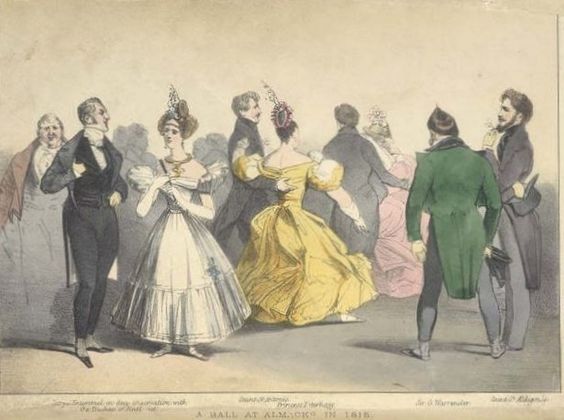
Her hard work paid off and she became a leader of London society; invitations to her home were the most sought after. She was the first foreigner to be elected a patroness of Almack’s, London’s most exclusive social club, where she introduced the scandalous dance, the waltz to England when Tsar Alexander came to London in 1818. It was during that visit the two great lovers first met. They took an instant dislike to one another. She thought he was cold and intimidating and far too self- important. He dismissed her as just a pretty woman travelling in the Tsar’s wake and treated her with complete indifference.
However, at a party hosted by the Dutch Ambassador on 22nd October at Aix-La-Chappelle that year, they found themselves sitting next to each other and she played him for all he was worth drawing him out with questions on his favourite subject; Napoleon; and by indulging his ego and listening to his every word she won him over. The next day she found herself alone in a carriage with the Prince and as they chatted, they found that they had much in common. They were both disappointed in the people they were married to, they hated getting up early in the morning, they liked the same paintings, the same novels, and literature, the same style of furniture – in fact, they were kindred spirits. A few days later, their notorious liaison began with Dorothea concealing her identity by wearing a long cloak and veil in order to enter the Prince’s apartment incognito.
In Metternich Dorothea had found her equal, he was a man she could love wholeheartedly, who could satisfy her physically, emotionally and intellectually. She wrote, “Good God! My love, I know how to rejoice in so few things, do you understand what makes me feel true happiness, it is you, only you! My Clement, if you cease to love me what will become of me? … My dear friend promise to love me as much as I love you; our lives are pledged in this promise.”
In Dorothea Metternich had met the woman of his dreams, she could match his intellect and his passion. She could speak and write in four languages and her wit and intelligence were as sharp as his. He wrote, “My happiness today is you. Your soul is full of common sense your heart is full of warmth … You are as a woman what I am as a man.” “Why are your letters so like mine? Why do you write to me almost the same words I have written to you, and you have the air of knowing them whilst my letter is still in my room? Will such perfect identity of our beings be so complete that the same thought only finds the same expression in each of us, when a word, a single phrase will succeed in expressing what we feel? …. I could write volumes, I could repeat to you a hundred times in one page that I love you.”
Their heated, clandestine, affair soon succumbed to the requirements state. They continued their liaison mainly in letters continuing their physical relationship whenever their paths crossed. Metternich described writing to Dorothea as like speaking to her, or chatting to her as if she were in the room with him because she was ‘in him.’ “You are my last thought before I go to sleep at night and first thought when I awaken,” he wrote.
The pair were tortured by their affair not only because of their separation but also because they both knew that they were married to others and that they could never be together. Dorothea was well aware of Metternich’s reputation with women and called his fidelity to her into question on occasion. In the early years of the affair he chastised her for such thoughts but of course the inevitable happened and she broke off their relationship in 1826 when she found out that he traded her in for a younger woman.
Towards the end of her life, Dorothea burned Metternich’s letters afraid that their intimacy would shock her family and ruin their reputations but she copied sections of his letters into her notebook. In one letter, that survived because it was copied by the French Secret Service, Dorothea writes about a dream she had when she was staying at Lord and Lady Jersey’s house one summer evening. She wrote; “We spoke a great deal, and for fear we would be heard, you took me on your lap so that you could speak to me more quietly; my dear Clement, I heard your heart beating, I felt it under my hand so strongly that I woke up, and it was my own heart reacting to yours. Mr. God, my love, how it still beats at this moment …. will my dream ever become a reality?”
Metternich occupied her imagination from 1818 to the beginning of 1826. By the end she was disillusioned; references to him in letters written after that date, are cold and spiteful and it seems that time did not heal her broken heart. She had nothing good to say about him or his third wife when she saw him in Brighton in 1849 describing him as “slow and tedious” and his wife as “stout and well-mannered.” By then she was the wife in all but name of the French politician Guizot and living in Paris. It was said that even though she was a widow by then she refused to marry Guizot as she would have to give up her title of ‘Serene Highness’ something the proud and regal woman was never going to do. Like her former lover, she was ancien regime through and through.
Dorothea Lieven died peacefully at her home, 2 rue Saint-Florentin, Paris, aged 71, on 27 January 1857, with Guizot and Paul Lieven, one of her two surviving sons, beside her. She was buried, according to her wish, at the Lieven family estate, Mežotne (near Jelgava) next to her two young sons who had died in St. Petersburg. She is a recurring minor figure in many historical novels about the period, notably those of Georgette Heyer. Heyer generally portrays her as a haughty, formidable, and unapproachable leader of society, but in The Grand Sophy she is described as “clever and amusing”, and there is a passing reference in that book to her role in political intrigues.
Metternich died in Vienna two years later on 11 June 1859, aged 86. He was the last great figure of his generation; almost everyone of note in Vienna came to pay tribute at his funeral but in the foreign press his death went virtually unnoticed. Of course ‘the coachman of Europe’ is the topic of much historical discourse. His reactionary political views held sway in Europe for the best part of 35 years and his love affairs were a source of fascination and intrigue throughout the courts of Europe.
Sources:
Dorothea Lieven: A Russian Princess in London and Paris, 1785-1857 By Judith Lissauer Cromwell
The Congress of Vienna: Power and Politics After Napoleon By Brian E. Vick
1815: The Roads to Waterloo By Gregor Dallas
https://en.wikipedia.org/wiki/Klemens_von_Metternich
http://www.eurozine.com/articles/2015-01-28-sluga-en.html
Julia Herdman writes historical fiction that puts women to the fore. Her latest book Sinclair, Tales of Tooley Street Vol. 1. is Available on Amazon – Paperback £10.99 Kindle £2.42 Also available on:
Amazon Australia
Amazon Canada
Amazon New Zealand
Amazon South Africa
Amazon USA
Also on Smashwords

by Julia Herdman | Jul 24, 2017 | Arts and Literature, Blog, Europe, European Royal Families, Literature, Marriage, Politics, Romance, Visual arts, Women and Children, Writing about history
This story is about an Empress with a taste for the common man. Just like Jarvis Cocker’s Greek girl in the Pulp classic, ‘She wanted to sleep with the common people’.
Daughter of a Housemaid and an Emperor
Elizabeth Petrovna was born at Kolomenskoye, near Moscow, on 18 December 1709. She was the daughter of Peter the Great, Tsar of Russia, by his second wife, Catherine, a maid in the household. Her parents were said to have married secretly at the Cathedral of the Holy Trinity in St. Petersburg at some point of time between 23 October and 1 December 1707 then they married officially 5 years later when Peter legitimised his daughters, Anna and Elizabeth.
Although Catherine bore five sons and seven daughters for Peter only two daughters, Anna (b. 1708) and Elizabeth (b. 1709) survived to adulthood. As a child, Elizabeth was the particular favourite of her father. She resembled him both physically and temperamentally. She was a bright girl, if not brilliant, but received only an imperfect and desultory formal education.
Even though he adored his daughter Peter did not devote time or attention to her education. He had a son and a grandson from his first marriage and did not anticipate that a daughter born to his second wife might one day inherit his throne. Indeed, no woman had ever sat upon the throne of Russia and there was no expectation one ever would.
Empress Elizabeth as a Child
As a child, the young Empress Elizabeth had a French governess and grew fluent in Italian, German and French. She was also an excellent dancer and rider. Like her father, Elizabeth was physically active and loved riding, hunting, sledding, skating, and gardening. The wife of the British ambassador described Elizabeth as “fair, with light brown hair, large sprightly blue eyes, fine teeth, and a pretty mouth. She is inclinable to be fat, but is very genteel and dances better than anyone I ever saw. She speaks German, French and Italian, is extremely gay and talks to everyone…”
In 1724 Peter betrothed his daughters to two young princes, first cousins to each other, from the tiny north German principality of Holstein-Gottorp. Anna Petrovna, aged 16, was to marry Charles Frederick, Duke of Holstein-Gottorp, who was then living in Russia as Peter’s guest after having failed in his attempt to succeed his maternal uncle as King of Sweden. Sometime later the young Empress Elizabeth was betrothed to Charles Frederick’s first cousin, Charles Augustus of Holstein-Gottorp, the eldest son of Christian Augustus, Prince of Eutin. Anna’s wedding took place in 1725 as planned, even though her father had died only a few weeks before the nuptials. In the future Empress Elizabeth’s case, however, the planned marriage never happened as her fiancé died on 31 May 1727 before the wedding could be held. Unfortunately Elizabeth’s mother Empress Catherine I (who had succeeded Peter the Great to the throne) also died on 17 May 1727 just two weeks before Elizabeth’s fiancé.
Empress Elizabeth as a Teenager
Thus, by the end of May 1727, Empress Elizabeth, aged 17, had lost both her parents and her fiancé, and her half-nephew Peter II was on the throne. Her marriage prospects immediately dried up. They did not improve when, three years later, Peter II died and was succeeded by the soon to be Empress Elizabeth’s first cousin, Anna wife of Peter the Great’s elder brother and her infant grandson Ivan. There was little love lost between the cousins and no prospect of either any Russian nobleman or any foreign prince seeking Elizabeth’s hand in marriage with her cousins on the throne. Nor could Elizabeth marry a commoner because it would cost her her title, claim to the throne and royal status.
Empress Elizabeth as a Woman

The Emperor of the Night
The woman who would one day be Empress Elizabeth’s solution was to take refuge in relationships with the lower classes. First, she took Alexis Shubin, a handsome sergeant in the Semyonovsky Guards regiment, as her lover. When Empress Anna found out she had Shubin’s tongue cut out and he was banished to Siberia. Elizabeth then threw herself into the arms of a handsome coachman and then to a footman. Eventually, she found her long-term companion in Alexis Razumovsky, a young and handsome Ukrainian peasant with a good bass voice. Razumovsky had been brought from his village to St. Petersburg by his master, a nobleman, to sing for a church choir. Elizabeth purchased the talented serf from the nobleman and put him in her own choir. Razumovsky, a good-hearted and simple-minded man, never showed any personal ambition or interest in affairs of state during all the years of his relationship with Elizabeth. In return, Elizabeth was devoted to Razumovsky, and there is reason to believe that she might even have married him in a secret. In 1756 Elizabeth would make him a Prince and a Field Marshal and in 1742 the Holy Roman Emperor made him a Count of the Holy Roman Empire but at court, he was always known as the “the Emperor of the Night.”
When Empress Anna died her daughter-in-law, another Anna, became regent to her young son Ivan. It was a period of poor government, taxes were high and Anna was unpopular at court. A circle of the disaffected began to gather around Elizabeth and plans for a coup began.
Empress Elizabeth Seizes Power
On 25 November 1741, Elizabeth seized power with the help of the Preobrazhensky Regiment. Arriving at the regimental headquarters wearing a warrior’s metal breastplate over her dress and grasping a silver cross she challenged them: “Whom do you want to serve: me, your natural sovereign, or those who have stolen my inheritance?” Won over, the regiment marched to the Winter Palace and arrested the infant Emperor, his parents, and their own lieutenant-colonel, Count von Munnich. It was a daring coup and, amazingly, succeeded without bloodshed. Elizabeth had vowed that if she became Empress she would not sign a single death sentence, an extraordinary promise for the time but one which she kept throughout her life.
The question of Razumovsky and Elizabeth’s children remains unresolved and subject to many legends. The best-known pretenders were Augusta who became a nun under the name Dosifeya. She died in 1810 and was buried in the Romanov family crypt; another Princess Elizabeth was arrested in Livorno, Tuscany by Aleksei Grigoryevich Orlov and returned to Russia in February 1775, presumably she was trying to escape. She was then imprisoned in the Peter and Paul Fortress, where she died from tuberculosis. The legend of her being drowned during the floods of 1777 was the subject of a painting by artist Konstantin Flavitsky, 1864, which now hangs in the Tretyakov Galler.
Unmarried and Childless

As a supposedly unmarried and childless empress, it was imperative for Elizabeth to find a legitimate heir to secure the Romanov dynasty. She chose her nephew, Peter of Holstein-Gottorp her sister’s son. Elizabeth was only too aware that the deposed Ivan VI, whom she had imprisoned in the Schlusselburg Fortress was a threat to her throne. Elizabeth feared a coup in his favour and set about obliterating him from history with orders that he should only be killed if he tried to escape, which of course he did when he tried to claim the throne after her death. The new queen Catherine gave the order and he was secretly executed and buried within the fortress.
Her nephew Peter was brought to Russia from Holstein and educated in Russian ways. He married Princess Sophie Friederike Auguste von Anhalt-Zerbst-Dornburg; she was nicknamed “Figchen” the daughter of Christian August, Prince of Anhalt-Zerbst of Anhalt. Her two of her first cousins became Kings of Sweden: Gustav III and Charles XIII and eventually, she would become Catherine the Great Empress of Russia.
The marriage took place on 21 August 1745. Nine years later, a son, the future Paul I, was finally born on 20 September 1754. There is considerable speculation as to the actual paternity of Paul I. It is suggested that he was not Peter’s son at all, but that his mother had engaged in an affair—to which Elizabeth had consented—with a young officer named Serge Saltykov, and that he was Paul’s real father. In any case, Peter never gave any indication that he believed Paul to have been fathered by anyone but himself. Elizabeth removed the young Paul and acted as if she were his mother and not Catherine. When the child was born the Empress had ordered the midwife to take the baby and to follow her. Catherine was not to see her child for another month and then on the second time briefly for the churching ceremony. Six months later Elizabeth let Catherine see the child again. The child had become a ward of the state to be brought up by Elizabeth as she believed he should be — as a true heir and great-grandson of her father, Peter the Great.
Empress Elizabeth’s Court
Under Elizabeth, the Russian court was one of the most splendid in all Europe. Foreigners were amazed at the sheer luxury of the sumptuous balls and masquerades and Elizabeth was said to be “the laziest, most extravagant and most amorous of sovereigns. Elizabeth created a world in which aesthetics reigned supreme. Historian Mikhail Shcherbatov wrote that her court was “arrayed in cloth of gold, her nobles satisfied with only the most luxurious garments, the most expensive foods, the rarest drinks, that largest number of servants and they applied this standard of lavishness to their dress as well.”
Clothing soon became the chosen means in Court by which to display wealth and social standing. Elizabeth is reported to have owned 15,000 dresses, several thousand pairs of shoes, and a seemingly unlimited number of stockings. She was known to never wear a dress twice and to change outfits anywhere from two to six times a day. Since the Empress did this her courtiers did as well. It is reported that to ensure no one wore a dress more than once to any ball or notably formal occasion, the Empress had her guards stamp each gown with special ink. Men at court were known to wear diamond buttons, own jewelled snuff boxes, and adorn their servants in uniforms made of gold.
Empress Elizabeth’s Decline and Death
In the late 1750s, Elizabeth’s health started to decline. She began to suffer a series of dizzy spells and refused to take the prescribed medicines. She forbade the word “death” in her presence. She died on 5 January 1762 and was buried in the Peter and Paul Cathedral in Saint Petersburg on 3 February 1762 after six weeks lying in state.
Not surprisingly her life has been dramatised in several films and novels. She appears in the 1934 film Catherine the Great (based on the play The Czarina by Lajos Bíró and Melchior Lengyel) which starred Flora Robson as Elizabeth. 1934 also saw the release of The Scarlet Empress, another filmed version of Catherine the Great’s story, this time with Louise Dresser in the role of Elizabeth. She was played by Olga Chekhova in the 1936 German film The Empress’s Favourite. The 1991 TV miniseries Young Catherine features Vanessa Redgrave in the role. Jeanne Moreau portrayed Elizabeth in the 1995 television movie Catherine the Great. She is also a major character in several episodes of the Japanese animated series, Le Chevalier D’Eon.
Elizabeth appears as a character in the historical fiction novel “The Winter Palace” by Eva Stachniak and as a character in the novel “The Mirrored World” by Debra Dean and in “A Princess at the Court of Russia” by Eva Martens.
Source: Wikipedia.
Julia Herdman writes historical fiction that puts women to the fore. Her latest book Sinclair, Tales of Tooley Street Vol. 1. is Available on Amazon – Paperback £10.99 Kindle £2.42 Also available on:
Amazon Australia
Amazon Canada
Amazon New Zealand
Amazon South Africa
Amazon USA
Also on Smashwords
by Julia Herdman | Jul 18, 2017 | Arts and Literature, Blog, Europe, European Royal Families, Marriage, Romance, Visual arts, Women and Children

Maria Christina or Mimi
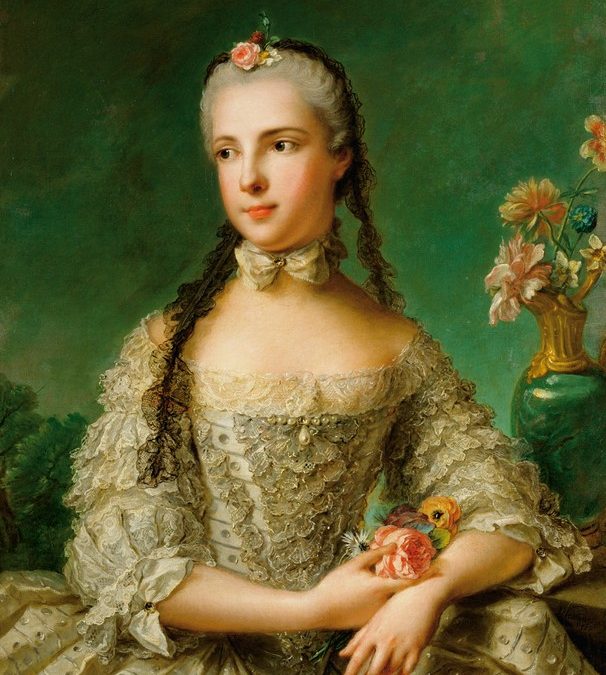
Archduchess Maria Christina was born on her mother’s 25th birthday at the Imperial Palace in Vienna, she was her fifth child and fourth daughter of Maria Theresa of Austria and Francis I, Holy Roman Emperor.
Maria Christina Johanna Josepha Antonia was born on 13 May 1742 at Vienna, Austria. The next day she was baptised in the Hofburg under the watchful gaze of her grandmother Elisabeth Christine, the dowager Holy Roman Empress.
Known simply as Mimi she was a capricious and spirited and her mother’s favourite child. Beautiful, highly intelligent and artistically gifted, Mimi mastered Italian and French and spoke good English. She was also talented with the paintbrush; she painted the Imperial family at work and play and copied the paintings of Dutch and French masters.
Mimi was in love with life and in love with love. At 17-years-old she had a romance with Duke Louis Eugene of Württemberg, but a marriage between them was dismissed. The third son of the Duke of Württemberg wasn’t good enough for an Archduchess. Mimi’s broken heart was soon mended with the arrival of the Princes Albert and Clemens of Saxony in at the Imperial Palace in 1760.
Mimi first met Albert at a concert during the Christmas celebrations and the attraction it seems was instant and mutual. However, at the end of January Albert and his brother returned to Saxony.
In the same year Mimi’s brother Archduke Joseph of Austria, heir to the Habsburg Monarchy was married to Isabella of Parma. The marriage took place by proxy and then Isabella was escorted from Italy to Austria. The formal wedding celebrations began on 6 October 1760 and lasted several days. Isabella was 18 homesick and still mourning the death of her mother. Joseph was thrilled with his new bride but Isabella did not feel the same.
Instead, she formed an almost immediate and strong attachment to Mimi which Mimi reciprocated. The pair became very close, some say they were lovers. The played music together and enjoyed each other’s company. Isabella was beautiful, educated, and very sensitive. She detested court ceremonial and her position as the wife of the Habsburg heir. While her husband loved her very deeply, she was cold towards him and focussed her attention on Mimi. The pair wrote over 200 letters to each other.
In one such letter, Isabella wrote:
“I am writing to you again, cruel sister, though I have only just left you. I cannot bear waiting to know my fate, and to learn whether you consider me a person worthy of your love, or whether you would like to throw me into the river…. I can think of nothing but that I am deeply in love. If I only knew why this is so, for you are so without mercy that one should not love you, but I cannot help myself.“.
In a different letter, she wrote: “I am told that the day begins with God. I, however, begin the day by thinking of the object of my love, for I think of her incessantly.“.
Only the letters of Isabella have been preserved; those of Maria Christina were destroyed after her death.
Isabella despite her coolness towards her husband eventually became pregnant. On March 20, 1762, after nine months of mental and physical strain, Isabella gave birth to a daughter they named Maria Theresia. Isabella remained bedridden for 6 weeks after giving birth. In August 1762 and January 1763 Isabella suffered two separate miscarriages then she fell pregnant again that year with a baby girl. Six months pregnant she contracted smallpox. On 22 November 1763 premature labour began. The child survived less than a day and was named after Mimi. Isabella followed her daughter to the grave five days later. Mimi was devastated.
Less than a month later in December 1763, Prince Albert of Saxony returned to Vienna. He comforted Mimi in her desolation. He too had liked Isabella and shared Mimi’s sadness in her passing. The pair met at court through 1764 and gradually Mimi’s affection for Albert grew. Albert was not sure he would be able to marry her as although he was prince he was only a minor one. Nevertheless the pair took their chances especially when Albert was invited to join the Imperial family whilst stationed in Vienna in the Imperial Cavalry. Her mother liked Albert but her father had greater ambitions for Mimi he wanted her to marry her first-cousin Prince Benedetto of Savoy, Duke of Chablais. The Empress advised her impatient daughter to appear calm and cautious with regard to her liaison with Albert; however Maria Christina found it extremely difficult to conceal her feelings for her Saxon prince.
In July 1765 the Imperial family travelled to Innsbruck for the wedding of Archduke Leopold, Grand Prince of Tuscany to the Infanta Maria Luisa of Spain. Albert was also invited to the wedding and the lovers had to play it cool. Mimi returned home to Vienna without her love wondering what would happen to her next. She could not have imaged that her path to happiness would be paved with her own father’s sudden death on 18 August.
After a suitable period of mourning, Mimi was married to Albert. She was the only child of Francis I to marry for love. To aid the couple’s happiness Albert was appointed Field Marshal and Statthalter of Hungary; these posts forced him and his future wife to live in Pressburg but provide them with a healthy income. The castle was renovated at a cost of 1.3 million guldens, and the Dowager Empress even personally took care of the furniture and tableware. Finally, Maria Christina received from her mother a rich dowry: the Silesian Duchy of Teschen –whereupon Albert became entitled as Duke of Saxe-Teschen–, the towns of Mannersdorf, Ungarisch Altenburg and other lordships, and the amount of 100,000 guldens. The household of the couple included about 120 people making her brothers and sisters pea-green with envy.
Maria Christina gave birth to a daughter named Maria Christina Theresa on 16 May 1767, but the child lived one day. She survived the puerperal fever that followed the birth but it left her barren. Unable to have any more children she persuaded her brother Leopold, Grand Duke of Tuscany to let her and her husband adopt one of his youngest sons, Archduke Charles, as their heir.

Prince Albert of Saxony
Sources: Wikipedia.
Julia Herdman writes historical fiction that puts women to the fore. Her latest book Sinclair, Tales of Tooley Street Vol. 1. is Available on Amazon – Paperback £10.99 Kindle £2.42 Also available on:
Amazon Australia
Amazon Canada
Amazon New Zealand
Amazon South Africa
Amazon USA
Also on Smashwords
by Julia Herdman | Jul 17, 2017 | Blog, Europe, Science, Women in Science, Writing about history
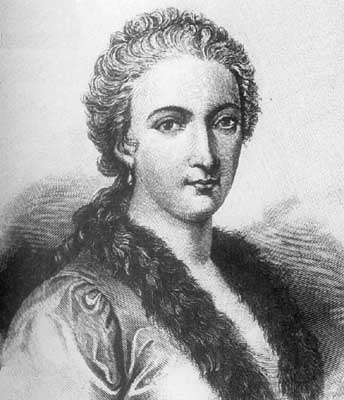
Maria Gaetana Agnesi 16 May 1718 – 9 January 1799 was an Italian mathematician, philosopher, theologian and humanitarian.
Maria Gaetana Agnesi was born in Milan, to a wealthy and literate family the third of 21 children. Her father Pietro Agnesi, a University of Bologna mathematics professor, her mother was the daughter of a prosperous silk manufacturer. Maria’s father supported her learning but gave priority to his sons. She soon outstripped her brothers and she was recognised as a child prodigy before she was 10 years old. She could speak both Italian and French at five years of age and by her eleventh birthday, she had added Greek, Hebrew, Spanish, German, and Latin to her arsenal of knowledge. She was often referred to as the “Seven-Tongued Orator”.
When she was nine years old, she composed and delivered an hour-long speech in Latin to some of the most distinguished intellectuals of the day; and the subject was, of course, a women’s right to be educated.
At the age of 12, she was found to be suffering from some undefined malaise. Her ill health was automatically attributed to her excessive studying and her doctors prescribed vigorous dancing and horseback riding as a remedy. This treatment did not work; she began to experience extreme convulsions, after which she was encouraged to be moderate in all her pursuits.
But there was no stopping Gaetana, by the age of fourteen she was studying ballistics and geometry and a year later her father began to regularly include her in his gatherings which included some of the most learned men in Bologna. Here she would read papers on the most abstruse philosophical questions of the day. Records of these meetings are given in Charles de Brosses’ Lettres sur l’Italie and in the Propositiones Philosophicae, which her father published in 1738.
In 1739 two Burgundian gentlemen were passing through Milan on their ‘Grand Tour’. They were Charles De Brosses, conseiller, at the parliament of Dijon and its future president Germain Ann Loppin de Montmort, conseiller at the parliament of Bourgogne, and a mathematician. While touring the churches and libraries of Milan in July 1739 they met Count Belloni and were invited to attend a salon or conversazione at the Agnesi Palazzo. The evening was that of the 16th of July, tired and thirsty the two men arrived at the main gate of the Palazzo Agnesi. The Palazzo’s exterior was elegant but plain. They were greeted by footmen dress in grey livery and taken to the first-floor apartment via a small drawing room adorned with vivid landscape paintings. They were then led through a larger room decorated with tapestries of gold and silver where a portrait of Holy Roman Emperor Charles VI and his consort for Elizabeth Christine gazed down on them. Finally, they arrived at a room with a harpsichord and decorated in crimson damask, where they were invited to sit in an audience of about 20 notable guests and served with glasses of iced water. Gaetana was there with her sister, the composer, and musician, Maria Theresa, and the conversation began when Count Belloni rose and asked Gaetana a question in Latin concerning the nature of tides. Gaetana began the discourse in the form an academic disputation putting forward ideas then dismissing them. An hour later Brosses was invited to ask a question, he decided to question her on the subject of the nature of the soul and the body and on the nature of light and colours. Then Loppin asked a question about the nature of circles and curves. When the discussion was over they were served fruit flavoured ices and Theresa played the harpsichord to entertain the guests.
In 1740, aged twenty-two, Gaetana began a period of studies with Father Ramiro Rampinelli, professor of physics and mathematics in Milan in the monastery of Olivetani of San Vittore. Rampinelli was an Olivetan monk and chair of mathematics and physics at ‘ University of Pavia. With Rampinelli Maria started to study other notable mathematicians and both differential and integral calculus.
Gaetana’s main contribution to the world of mathematics was the formula for a curve called ‘versiera’ a term derived from Latin vertere, to turn, but is also an abbreviation of Italian avversiera, female devil. Some wit in England once translated it as ‘witch’, and the silly pun is still preserved in most English textbooks. This curve appeared in the writings of Fermat (Oeuvres, I, 279–280; III, 233–234) and in the work of other prominent mathematicians. The name ‘versiera’ is from Guido Grandi (Quadratura circuli et hyperbolae, Pisa, 1703) and is a type 63 in Newton’s classification. Its principal use today is in astronomy and to show the distribution of energy in objects such as ocean waves.
With the help of fellow mathematician and astronomer Jacopo Riccati, she drafted her first book, Institutions Analytical for use by the Italian Youth which was published in Italian in 1748 and dedicated to Empress Maria Teresa. The book was well received and was translated into French in 1755 and English in 1801. In 1750, she replaced her father in teaching mathematics at ‘ University of Bologna and when he died in 1752, Pope Benedict XIV gave her a special dispensation to hold the rank of Professor but she did not take it up. Instead, she dedicated herself to charitable works; she opened a small hospital and worked there herself nursing the poor at the end of their lives.
Her religious inclinations led her to study theology in the second half of her life. She was a devout Catholic and wrote extensively on the marriage between intellectual pursuit and mystical contemplation, most notably in her essay Il Cielo Mistico (The Mystic Heaven). She saw the rational contemplation of God as a complement to prayer and contemplation.
Gaetana was the first woman to write a book on mathematics and the first to teach mathematics at a university. She was the first female professor of mathematics too although she never took up the post. Her lasting legacy is her wave, known as The Witch of Agnesi. Other honours included the dedication of one of the largest craters on the planet Venus; a metal model of a versiera is embedded in the square outside the town hall of the city of Varedo as a tribute to their most famous inhabitant and the house she lived in until she died in 1799 is now a music academy there. As a tribute to her genius several Italian cities have dedicated a street in her honour and in Merate ( LC ) there is a high school specialising in science and languages named after her.
Sources: Wikipedia and The World of Maria Gaetana Agnesi, Mathematician of God By Massimo Mazzotti, JHU Press, 2012
Julia Herdman writes historical fiction that puts women to the fore. Her latest book Sinclair, Tales of Tooley Street Vol. 1. is Available on Amazon
Amazon Australia
Amazon Canada
Amazon New Zealand
Amazon South Africa
Amazon USA

Recent Comments