
by Julia Herdman | Jun 24, 2017 | Blog, Marriage, Politics, Women in Ancient History
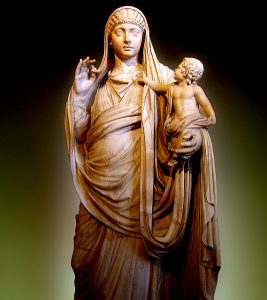
The Real Messalina wearing the clothes of a Roman matron holding her son Britannicus.
Messalina was born around 20 AD. She was a cousin of Nero and Caligula and became Empress when she married Claudius.
Little is known for certain about the life of Messalina, other than her descent through both parents from Octavia, Augustus’ sister and her claim to be the mother of Claudius’ children Britannicus and Claudia Octavia.
Along with Augustus’ daughter Julia (who he had banished for sleeping with so many different men), Messalina is probably one of the most notoriously promiscuous women of Rome. But, does she deserve her reputation?
In 37 AD, Messalina married Claudius, who was at least 30 years older than her. At this time Caligula was still Emperor. Claudius we are told by Roman historian Suetonius doted on Messalina, and after he became Emperor, Messalina used his affection for her to get whatever she wanted from him. Suetonius tells us that Messalina used her sexual allure to get her way with her aging husband too. Tacitus tells us she ordered that Claudius exile or execute anyone who displeased her or who she felt threatened by. Unfortunately, according to her detractors, this was a good number of people.
Suetonius paints a picture of a weak Emperor, Claudius, a man who was easily manipulated by his wife. The account of Messalina competing with a prostitute to see who could have sex with the most people in one night was first recorded by Pliny the Elder. Pliny says that, with 25 partners, Messalina won. The poet Juvenal tells in his sixth satire that the Empress used to work clandestinely all night in a brothel under the name of the She-Wolf
Messalina’s most famous affair is the one she had with the senator Gaius Silius. It is said she told Silius to divorce his wife, which he did and that they planned to kill Claudius and make Silius Emperor. When Claudius found out about his wife’s behaviour and plots Suetonius is of the opinion that he should have ordered her death, but instead the stupid doting old man gave her another chance. Too weak and feeble to kill Messilina himself Suetonius as Claudius’ chief of the Imperial Guard do it instead. Suetonius says that when Claudius heard what had happened he simply asked for another chalice of wine. The Roman Senate then ordered a damnatio memoriae so that Messalina’s name would be removed from all public and private places and all statues of her would be taken down.
The problem for Messalina is that the Roman historians who relayed these stories about her, principally Tacitus and Suetonius, wrote them some 70 years after the events in a hugely hostile political environment where everything related to the imperial line to which Messalina had belonged was being trashed. Suetonius’ history is a great read but it is largely anti-Julio-Claudian scandal-mongering - they all get a bad press from him. Tacitus claims to be transmitting ‘what was heard and written by my elders’ without naming sources other than the memoirs of Agrippina the Younger, who had arranged to displace Messalina’s children in the imperial succession and was therefore particularly interested in blackening her predecessor’s name.
Messalina is portrayed by Tacitus as a scheming, manipulative and greedy liar who has no compunction in bringing down innocent people who she dislikes or who get in her way. Suetonius paints her as a whore and a woman who sleeps with lower class men - either way, she likes her sex rough and dirty which is not the hallmark of a respectable Roman matron let alone an Empress. What passes for history when it comes to Messalina is political and social annihilation. Accusations of sexual excess were and still are a tried and tested smear tactic against women. In this case, they were the result of politically motivated hostility. We know that when her affair with Gaius Silius was uncovered she did the very Roman thing of committing suicide in the company of her estranged mother; she was not killed by Claudius’ guards.
Her notorious story has had several outings on the silver screen - 1951, 1960, 1981
Julia Herdman writes historical fiction that puts women to the fore. Her latest book Sinclair, Tales of Tooley Street Vol. 1. is Available on Amazon – Paperback £10.99 Kindle £0.99 Also available on:
Amazon Australia
Amazon Canada
Amazon New Zealand
Amazon South Africa
Amazon USA

by Julia Herdman | Jun 23, 2017 | Blog, British History, Women in Asian History
Ching Shih, the world’s most successful pirate was born in 1775.
Although not much is known about her she was a known prostitute who worked in a floating brothel in the city of Canton. She caught the eye of the renowned pirate Zheng Yi while she was working there.
Some stories say that Zheng Yo took her by force, others that she struck a bargain with him. It is said that she agreed to marry him for half his Pirate Empire. Whatever happened the two worked together to run the most successful pirate operation ever seen in the South China Sea.
In the six years, they were married their fleet grew from about 200 ships to more than 400.
They grew their business by forming alliances with other pirate leaders creating the Cantonese Pirate Coalition. This gave them effective control over much of the merchant traffic in the area. By 1807 they were collecting a mountain of protection money from traders for safe passage.
Zheng Yi’s ship was caught in a storm in 1807 and he lost his life. His ferocious widow took up the reins of their criminal enterprise and continued to run the empire they had created together.
With her newly appointed military commander, Chang Pao leading her loyal band of 400 pirates Ching Shih focused on the “business” side of things.
With her pirate army and navy she had effective control of Guangdong province, a vast spy network within the Qing Dynasty; and domination of the South Chinese Sea. Needless to say, this was not a situation the authorities in China liked.
Before long the Emperor raised a fleet against her. Unfortunately for the Emperor, Ching Shih was a brilliant military strategist and rather than running from her assailants she met them head on taking 63 of the Emperor’s ships and terrifying their crews.
Ching Shih forced those who she captured to join her pirate gang by threatening to have them nailed to the deck by their feet then beaten to death. Needless to say, there was a high rate of take up.
The Admiral in command of the debacle, Kwo Lang committed suicide rather than suffer further humiliation of being beaten and captured by a woman.
The Qing Dynasty government then enlisted the aid of the super-power British and Portuguese navies, as well as many Dutch ships, paying them large sums of money to drive Ching Shih into submission.
The international task force waged war on Ching Shih’s organisation for two years but met with little success. She won battle after battle until finally, the Emperor decided to take a different tack. Instead of trying to defeat her, he offered her and most of her organisation an amnesty.
Ching Shih initially rejected the Emperor’s offer but she wisely changed her mind and signed in 1810.
The deal she struck disbanded her fleet and granted amnesty to most of her followers. In the deal, she was allowed to keep all her loot. She sacrificed 126 members of her 376 crew who were executed. 250 others received some punishment for their crimes. Her commander and new husband ChangPao was given command of 20 ships in the Qing Dynasty navy.
As for Ching Shih herself, not only did she negotiate the rights to keep the fortune she acquired she got a noble title, “Lady by Imperial Decree”, which entitled her to various legal protections as a member of the aristocracy.
Ching Shih retired at the age of 35. She did not give up her life of vice thought. She opened a gambling house cum brothel in Guangzhou, Canton, which she ran until she died aged 69.
Ching Shih died in her bed as an aristocrat, a successful businesswoman, a mother, and a grandmother.
Since her death, her infamy has led to the creation of several fictional and semi-fictionalised accounts of her pirate years. She first appeared in the 1932 book ‘The History of Piracy’, by Philip Gosse then in Jorge Luis Borges’s short story ‘The Widow Ching, Lady Pirate’ in 1954.
Nikita star Maggie Q played Ching Shih in TV series titled Red Flag. Jun Ichikawa played Ching Shih in the film Singing Behind Screens, 2003. In the 2007 film Pirates of the Caribbean: At World’s End, Ching Shih (played by Takayo Fischer) is portrayed as the powerful Mistress Ching, one of the nine Pirate Lords.
Julia Herdman writes historical fiction that puts women to the fore. Her latest book Sinclair, Tales of Tooley Street Vol. 1. is Available on Amazon – Paperback £10.99 Kindle £0.99 Also available on:
Amazon Australia
Amazon Canada
Amazon New Zealand
Amazon South Africa
Amazon USA

by Julia Herdman | Jun 22, 2017 | American History, Blog, France, Politics, Romance, Society
 Benjamin Franklin was a lover of knowledge; after all, he was the quintessential Renaissance man. He gave us the lightning rod, the Franklin stove, bifocals, and Poor Richard’s Almanack. He was also an indispensable politician and civic activist who not only helped lay the groundwork for the Declaration of Independence and the United States Constitution but was also the country’s first ambassador to France where in 1779 he fell in love with Anne Catherine Helvétius, the widow of the Swiss-French philosopher, Claude-Adrien Helvétius.
Nicknamed “Minette”, she maintained a renowned salon in Paris using her dead husband’s accumulated wealth and among its habitués were France’s leading politicians, philosophers, writers, and artists. In courting her attention, he sent her many letters expressing his love, admiration, and passion. In one, he claimed that he had a dream that their dead spouses had married in heaven and that they should avenge their union by doing the same on earth! In another passionate plea, he wrote: “If that Lady likes to pass her Days with him, he, in turn, would like to pass his Nights with her; and as he has already given her many of his days…she appears ungrateful never to have given him a single one of her nights.”
Franklin’s libido was apparently so strong, he himself was scared of it. In his autobiography, he confessed: “the hard-to-be-governed passion of my youth had hurried me frequently into intrigues with low women that fell in my way.”
One of the more revealing documents on his views on women, which had been known in certain circles but kept under wraps for almost 200 years, was a letter he wrote in 1745, offering advice to a young man who was having trouble with his own insatiable libido. In the letter, which was entitled “Advice to a Young Man on the Choice of a Mistress,” Franklin advised: “In all your Amours, you should prefer old Women to young ones.” He goes on to explain that with older women they tend to have more discretion, will take care of you when you’re sick, are cleaner than prostitutes, and that “there is no hazard of children.” He also offered that you can’t really tell who’s old or young when you’re in the dark. What a romantic!!!
Julia Herdman writes historical fiction that puts women to the fore. Her latest book Sinclair, Tales of Tooley Street Vol. 1. is Available on Amazon – Paperback £10.99 Kindle £4.99 Also available on:
Amazon Australia
Amazon Canada
Amazon New Zealand
Amazon South Africa
Amazon USA

by Julia Herdman | Jun 20, 2017 | Blog, British History, British Royal Family, Fashion, Society
Ascot Racecourse pronounced /ˈæskət/, by those in the know is close to Windsor Castle and is the Queen of England’s favourite racecourse. The most famous and prestigious race is The Gold Cup.
Ascot Racecourse was founded in 1711 by Queen Anne. The first race, “Her Majesty’s Plate”, had a purse of 100 guineas, was held on 11 August 1711. Seven horses competed, each carrying a weight of 12 stones (76 kg). This first race comprised three separate four-mile (6437 m) heats. It’s changed a lot since then.
Every year Royal Ascot is attended by Elizabeth II and other members of the British Royal Family such as The Prince of Wales, arriving each day in a horse-drawn carriage with the Royal procession taking place at the start of each race day and the raising of the Queen’s Royal Standard. It is a major event in the British social calendar, and press coverage of the attendees and what they are wearing often exceeds coverage of the actual racing. There are three enclosures attended by guests on Royal Ascot week.
The Royal Enclosure is the most prestigious of the three enclosures, with recent visits from the Queen and Royal Family members. Access to the Royal Enclosure is restricted, with high security on the day. First-time applicants must apply to the Royal Enclosure Office and gain membership from someone who has attended the enclosure for at least four years. Those in the Royal Enclosure have the options of fine dining and hospitality, and a selection of bars. The dress code is strictly enforced. For women, only a day dress with a hat is acceptable, with rules applying to the length and style of the dress. In addition, women must not show bare midriffs or shoulders. For men, black or grey morning dress with top hat is required.
Over 300,000 people make the annual visit to Berkshire during Royal Ascot week, making this Europe’s best-attended race meeting. There are eighteen group races on offer, with at least one Group One event on each of the five days. The Gold Cup is on Ladies’ Day on the Thursday of the meet, hats are the order of the day - the more outrageous the better.
In 2012, the Golden Jubilee Stakes was renamed the Diamond Jubilee Stakes, to commemorate Queen Elizabeth II’s Diamond Jubilee. In 2013, the Windsor Forest Stakes was renamed the Duke of Cambridge Stakes, with the Queen’s consent, recognising the new title given to Prince William; in 2015, the newly created Commonwealth Cup became the eighth Group One race at Royal Ascot, replacing the Buckingham Palace Stakes. In 2016, total prize money across the five days of Royal Ascot was £6,580,000. This year the prize money is expected to be higher. Races with notable prize money increases for 2016 included the Prince of Wales’s Stakes (£750,000 from £525,000), the Queen Anne Stakes (£600,000 from £375,000) and the Diamond Jubilee Stakes (£600,000 from £525,000), while the other Group One races all had their prize money increased to £400,000. The Gold Cup in 2016 was run as “The Gold Cup in Honour of The Queen’s 90th Birthday”.
Ascot racecourse closed for a period of twenty months on 26 September 2004, for a £185 million redevelopment funded by Allied Irish Bank and designed by Populous and Buro Happold. As the owner of the Ascot estate, Her Majesty Queen Elizabeth reopened the racecourse on Tuesday 20 June 2006. Upon re-opening the new grandstand attracted criticism for failing to provide sufficiently raised viewing for patrons to watch the racing, and devoting too much space to restaurants, bars, and corporate hospitality facilities. At the end of 2006, a £10 million programme of further alterations was announced to improve the viewing from lower levels of the grandstand.
Julia Herdman writes historical fiction. Sinclair is a second chance romance set in Georgian London and Yorkshire with horse racing and doctors that puts women to the fore. Available on Amazon – in Paperback and o Kindle. Also available on:
Amazon Australia
Amazon Canada
Amazon New Zealand
Amazon South Africa
Amazon USA
by Julia Herdman | Jun 19, 2017 | Blog, European Royal Families, Marriage, Politics, Society
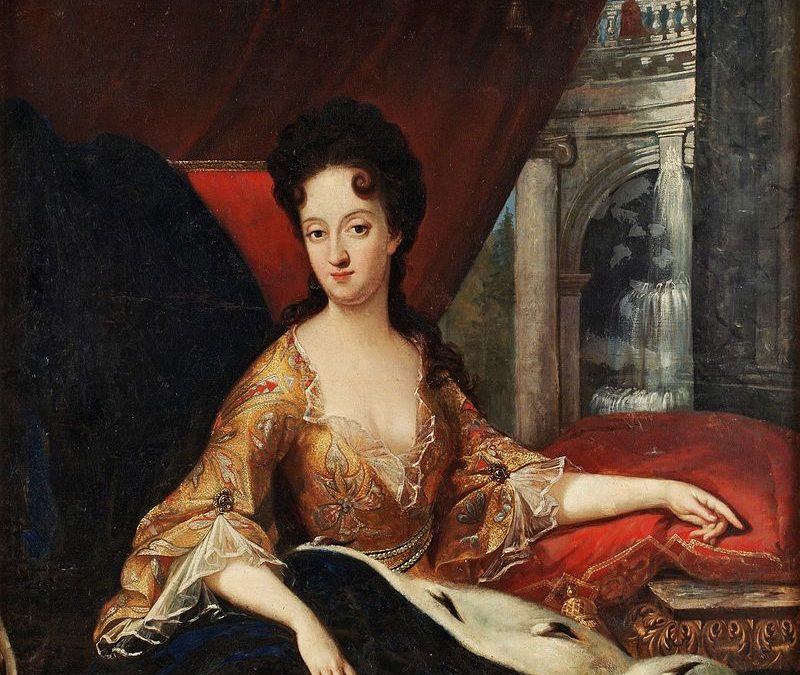
Queen Ulrika Eleonora the Younger (1688 – 1741), was Queen regnant of Sweden from 5 December 1718 to 29 February 1720, and then Queen consort until her death in 1741. She was the youngest child of King Charles XI and Ulrika Eleonora of Denmark. She had an elder brother and sister so never expected to be queen.
Her mother died in 1693 when she was five and little Ulrika and her elder sister, Princess Hedvig Sophia, were set off to be brought up by their grandmother, Hedwig Eleonora at Karlberg Palace. Grandmother was a consummate operator, she was the guiding light in her husband’s administration and she dominated her son so much that he referred to her as the Queen ignoring his wife. Her grandmother described Ulrika as a stubborn little girl who would pretend to be ill when it came to doing things she didn’t like riding and dancing. It seems little Ulrika was not the physical type but she was a talented musician, and when performing with her sister at court concerts, she would play the clavier while her sister sang. Although she was friendly, modest and dignified, with good posture and beautiful hands she was regarded as neither intelligent nor attractive and no match for her older sister.
Her father died in 1697 when Ulrika was 9 years old and the crown passed to her brother Charles XII (1682 –1718). Grandmother was sure he was too young to take on full royal responsibilities, he was only 15, and petitioned to act has his regent; a caretaker government was put in place which lasted for seven months then Charles took full command. Charles was an absolutist monarch; he believed he had been put in charge by God, an idea that was already encountering quite a bit of resistance in Europe at the time. He was, however, a successful war leader and achieve considerable success in defending Sweden in the Great Northern War.
On 12 May 1698, Princess Hedwig Sophia married her cousin, Frederick IV, Duke of Holstein-Gottorp. Her marriage was arranged as a part of the traditional Swedish policy of alliance with Holstein-Gottorp against Denmark. The marriage took place against her consent and she was not happy; Frederick IV had a string of mistresses and whores he preferred over his reluctant wife. Hedwig Sophia was a widow with a young son by 1702 but Ulrika was still unmarried. Hedwig Sophia returned to the Swedish court where she was the centre of attention, partying with her brother the king and lauded for her beauty and fashion sense. She was known as the “The Happy Princess” unlike her stubborn little mouse of a sister. Unfortunately, Hedwig Sophia caught smallpox in 1708 nursing her son who also had the disease. Hedwig Sophia died but her son survived.
With no marriage in prospect for her brother the king in sight Ulrika’s position suddenly changed with her sister’s death. In 1710, she received a marriage proposal from Prince Frederick of Hesse, he was a widower with an eye on her crown. The marriage was supported by her grandmother because it would force Ulrika to leave Sweden and so increased the chance of her favourite granddaughter’s son becoming king when Charles died. Although her prospective husband liked the idea of inheriting her crown his advisers were telling him that Ulrika was no great catch describing her as imperious, haughty, and suffering from bad breath and a weak bladder. Their engagement was announced four years later on 23 January 1714, and the wedding took place on 24 March 1715. During the wedding, her brother Charles XII remarked: “Tonight my sister is dancing away the crown”. But it turned out she wasn’t. When a musket ball went clean through her brother’s head in 1718 the Swedish nobles opposed to the war which had been waging for nearly two decades seized their chance and offered Ulrika the throne on the condition that she accepted a modern constitution for the country. She accepted but years of living as an autocrat made accepting what was required of her very difficult so she abdicated giving her crown to her husband who did the deed for her and Sweden took its first steps into the modern age. All of which goes to show that you don’t have to be clever, or beautiful to make history you just have to seize the opportunities life throws at you and do the right thing.
Julia Herdman writes historical fiction that puts women to the fore. Her latest book Sinclair, Tales of Tooley Street Vol. 1. is Available on Amazon – Paperback and on Kindle. Also available on:
Amazon Australia
Amazon Canada
Amazon New Zealand
Amazon South Africa
Amazon USA


Recent Comments