by Julia Herdman | Jun 8, 2017 | Blog
Through most of history, men were thought of as the stronger sex. Men were and in many cases still are considered to be the more violent, more intelligent, more courageous, and the more determined sex.
Women were considered more placid and at worst governed by their unpredictable emotions. The ideal woman was expected to be passive, chaste, modest, compassionate, and pious.
Historians claim that the late eighteenth and early nineteenth centuries witnessed a significant separation of the sexes in society. For example, at that time women and men to started to develop separate social lives. Women took tea at home, while men frequented the coffee shops in town. Women started to withdraw from the dining table after a meal to let the men smoke and talk politics while they concerned themselves with more domestic topics of conversation, played cards and drank tea. These social changes were in part due to increased wealth and to some extent, the growing influence of evangelical Christianity, which placed a high moral value on female domesticity, virtue, and religiosity. The women of the comfortably off were not expected to want for anything and if they did they were expected to keep their desires to themselves.
 Those girls and women of the lower classes who broke society’s rules were treated with a mixture of cruelty and disdain. When it came to crime, women were accused of fewer, and different, crimes to men. At the Old Bailey women accounted for only 21% of the defendants tried between 1674 and 1913. This figure masks a significant chronological change, however. While women accounted for around 40% of the defendants from the 1690s to the 1740s (and, highly unusually, over half the defendants in the first decade of the eighteenth century), over the course of the period this proportion declined significantly.
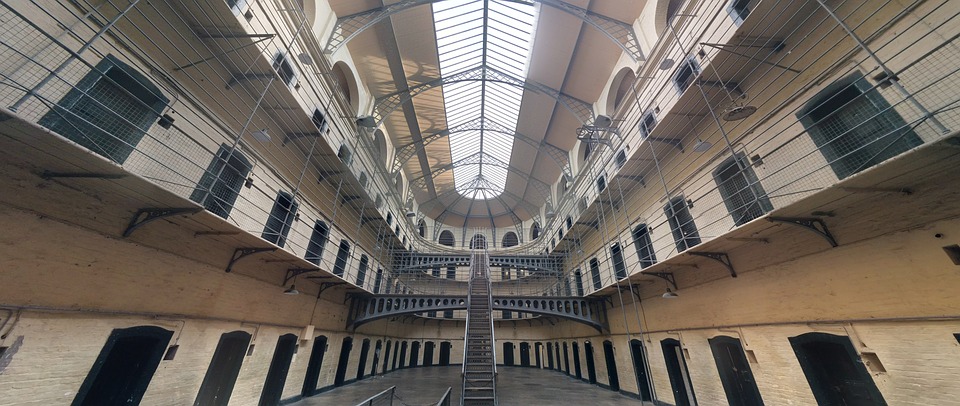
The shadow of Newgate Prison looms over the book Moll Flanders by Daniel Defoe just as the real building must have loomed over surrounding London. Moll starts her life in that cold place, and she comes pretty close to ending it there, too. The prison is mentioned nearly forty times over the course of the book, more than any other place or even any other character’s name. Moll enters the prison as a thief and says looked around upon all the horrors of that dismal place.
‘I looked on myself as lost, and that I had nothing to think of but of going out of the world, and that with the utmost infamy: the hellish noise, the roaring, swearing, and clamour, the stench and nastiness, and all the dreadful crowd of afflicting things that I saw there, joined together to make the place seem an emblem of hell itself, and a kind of an entrance into it.'(Moll Flanders, Daniel Defoe.)
By the early nineteenth century only 22% of defendants were women, and as the twentieth century dawned that percentage had dropped to 9%. By the early twentieth century serious crime had become a mainly male problem and female deviance was viewed as a consequence of sexual immorality and mental defectiveness and was addressed through other agencies such as the asylum. Reasons for admission were various and included Egotism, Fever and Jealousy, Immoral Life, Novel Reading, Nymphomania, Shooting a daughter, Greediness and Self Abuse between 1864 and 1889 according to a poster from the Trans-Allegheny Lunatic Asylum in the US.Similar practices occurred in the UK.
During the 18th century women tended to be accused of certain kinds of theft - pickpocketing, shoplifting, theft from lodging houses, theft from their masters stores, and for receiving stolen goods. The more serious crimes that women were involved in included coining, kidnapping, keeping a brothel, and offences surrounding childbirth such as infanticide, concealing a birth or illegal abortions. Young women who fell prey to their employers and their employer’s sons often found themselves with an unwanted child and no job.Although prostitution itself was not tried at the Old Bailey, keeping a brothel was, and women account for about a third of those prosecuted for brothel keeping.
Of the 47 infanticide cases Naomi Clifford read researching her book, It is Women and the Gallows: Unfortunate Wretches, 13 ended in the acquittal of the manslaughter or murder charge but the conviction rate for the lesser crime of concealing a birth, for which the defendants were given prison sentences ranging from 14 days to 2 years more commonly brought in a guilty verdict. When convicted of infanticide a woman was usually hanged.
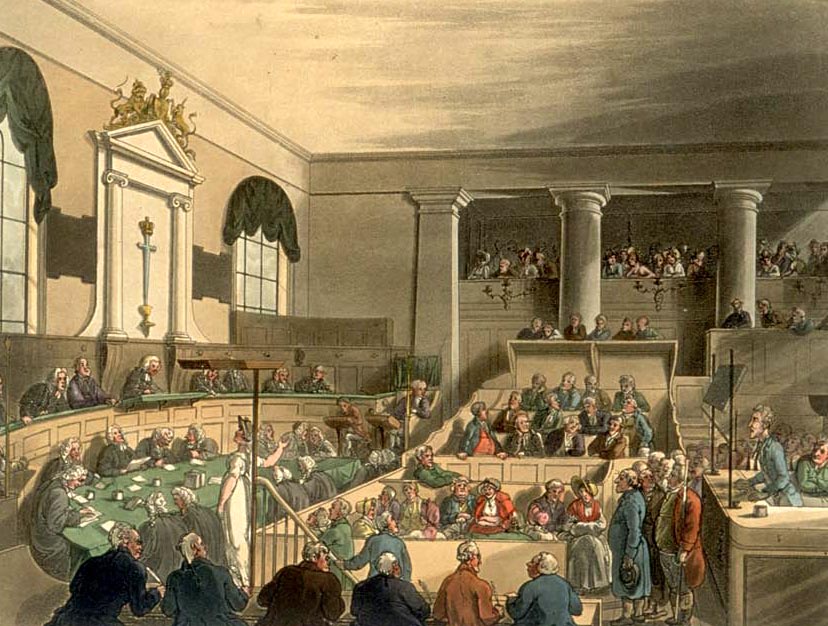
Appearing as a defendant at the Old Bailey must have been a significantly more intimidating experience for women than it was for men. All court personnel, from the judges and jury to lawyers and court officials were men except when a panel of all women was convened. These all female juries were known as a ‘jury of matrons’ and were called to determine the validity of a convicted woman’s plea that she was pregnant. Pregnant women could not be hanged until they had delivered their unborn child.
There is some evidence that juries treated evidence presented by female witnesses more sceptically than that delivered by men. The testimony of women was more likely to be omitted from court proceedings. At the same time, other evidence suggests that juries may have been more reluctant to convict women because women were perceived to be less of a threat to society. The legal principle of the feme covert, which made women responsible for crimes committed in the presence of their husbands (they were presumed to be following their husbands’ commands) was not often applied. A married man was legally responsible for any debts his wife ran up with or without his knowledge.
The pattern of punishments for convicted women was significantly different from that of men, though when sentences for the same offence are compared, the differences are not so significant.
Before 1691, women convicted of the theft of goods worth more than 10 shillings could not receive the benefit of clergy unlike men and were sentenced to death. In practice, they were often acquitted, convicted on a reduced charge, or pardoned. Juries are usually reluctant to convict when they feel the punishment does not fit the crime.
Women convicted of treason or petty treason were sentenced to death by being burned at the stake until 1790 while men convicted of the same offences were hanged, drawn and quartered. It seems the authorities did not want to expose women to this humiliating fate of being undressed in public when they were being executed. Women sentenced to death who successfully pleaded that they were pregnant had their punishments respited and often remitted entirely. From 1848, reprieves granted to pregnant women were always permanent.
Following the suspension of transportation to America in 1776, a statute authorised judges to sentence male offenders otherwise liable to transportation to hard labour improving the navigation of the Thames (they were incarcerated on the hulks), while women, and those men unfit for working on the river, were to be imprisoned and put to hard labour. Only men could be sentenced to military or naval duty, and fewer women were selected for transportation when transportation to Australia began in 1787. The public whipping of women was abolished in 1817 (having been in decline since the 1770s), while the public flogging of men continued into the 1830s (and was not abolished until 1862).
The perception of women as passive and weak and the types of misdemeanours most frequently committed by them made them seem far less of a threat to society than the crimes committed by men. However, when a woman transgressed into the world of ‘male crime’, her punishment was likely to be more severe because as a woman she had not only committed a crime against society she had transgressed the ideal of womanhood and stepped outside her expected gender role.
Source: https://www.oldbaileyonline.org/static/Gender.jsp
Julia Herdman writes historical fiction.
Sinclair is available of Amazon. Click here to get your copy.
Sinclair is set in the London Borough of Southward, the Yorkshire town of Beverley and in Paris and Edinburgh in the late 1780s. Strong female leads include the widow Charlotte Leadam and the farmer’s daughter Lucy Leadam. Sinclair is a story of love, loss and redemption. Prodigal son James Sinclair is transformed by his experience of being shipwrecked on the way to India to make his fortune. Obstacles to love and happiness include ambition, conflict with a God, temptation and betrayal. Remorse brings restitution and recovery. Sinclair is an extraordinary book. It will immerse you in the world of 18th century London where the rich and the poor are treated with kindness and compassion by this passionate Scottish doctor and his widowed landlady, the owner of the apothecary shop in Tooley Street. Sinclair is filled with twists and tragedies, but it will leave you feeling good.
Suffer Little Children to Come Unto Me
London’s Mad House
Women’s Boxing - A Georgian Novelty Act

by Julia Herdman | Jun 7, 2017 | Blog
Did Queen Marie Antoinette ever say ‘Let them eat cake’?
‘Let them eat cake.’ is one of the most famous quotes in history, but did the queen ever say it and what was going on in France for such a quote to become so popular?
Love her or hate her Marie Antoinette is one of the most famous women in French history but was she blamed for things she never said or had any control over?
The Weather in 1788

Historians and archaeologists are becoming increasingly aware of the influence of weather on the world’s significant events and as someone who has been researching life in the 18th century Britain and France I was amazed to find that the weather could be said to one of the causes of the French Revolution.
In the spring and summer of the year before the Revolution France suffered a drought. Although there was no drought in England the summer of 1788 was an unusually warm one in London. As temperatures soared in the capital, the incidence of Scarlet fever and Typhus spread through the city. In August over 1000 deaths were attributed to fever alone.
As Londoners sweltered the French baked. The French were not particularly competent farmers at the time, the aristocracy and major landowners were not interested in developing and improving their land for agriculture and food production, unlike their British counterparts. Consequently, food production was already pretty miserable when the drought struck.
The drought of 1788 ended when the skies opened and hail the size of fists fell from the sky bashing the fruit from the trees and the smashing the crops in the fields to smithereens so when the French entered the winter of 1788-9 food stocks were at an all-time low. The storms of July caused damage in parts of the country. To make matters worse, the disastrous harvest was followed by months of freezing weather. The temperature barely rose above freezing for three months through November, December and January. In London, the river Thames froze.
The bad weather was most likely caused by the eruption of the Laki volcanic fissure in southern Iceland which spewed out ash for eight months from 8 June 1783 to February 1784 killing much of the livestock and perhaps a quarter of the Icelandic population at the time. The British naturalist Gilbert White described that summer in his classic Natural History of Selborne as “an amazing and portentous one … the peculiar haze, or smokey fog that prevailed for many weeks in this island, and in every part of Europe, and even beyond its limits was a most extraordinary appearance, unlike anything known within the memory of man.”
The State of French Agriculture

Tobias Smollett wrote about Boulogne near Calais in 1763. As much as he hates France he can see that the peasants and landowners around the town have adopted some English farming improvements unlike in the rest of France. ” I am certain that a man may keep house in Boulogne for about one half of what it will cost him in London; and this is said to be one of the dearest places in France. The adjacent country is very agreeable, diversified with hill and dale, corn-fields, woods, and meadows. There is a forest of a considerable extent, that begins about a short league from the Upper Town: it belongs to the king, and the wood is farmed to different individuals. In point of agriculture, the people in this neighbourhood seem to have profited by the example of the English. Since I was last in France, fifteen years ago, a good number of inclosures and plantations have been made in the English fashion. There is a good many tolerable country-houses, within a few miles of Boulogne; but mostly empty. I was offered a compleat house, with a garden of four acres well laid out, and two fields for grass or hay, about a mile from the town, for four hundred livres, about seventeen pounds a year: it is partly furnished, stands in an agreeable situation, with a fine prospect of the sea, and was lately occupied by a Scotch nobleman, who is in the service of France.” ( Project Gutenberg’s Travels Through France and Italy, by Tobias Smollett.)
High Prices and High Taxes
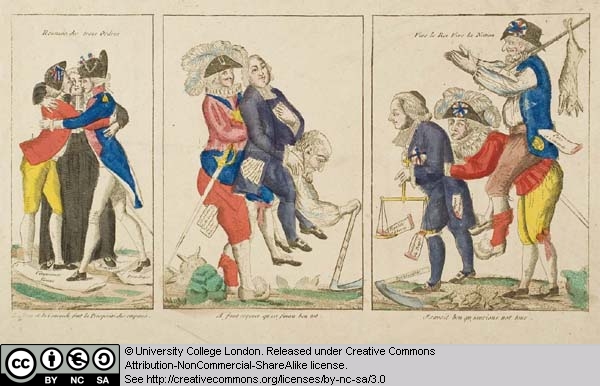
The poorer classes, 95% of whose diet consisted of bread and cereals and which before the drought had to spend about 55% of their earnings on bread, were forced by the famine conditions of the first half of 1789 to spend now 85% and over of their income on this staple food. In France rural taxes called “privilege seigneriaux” or seigniorial privileges, severely burdened farmers.The clergy and nobility exercised a preeminent right over all land property but evaded most of the taxes and financial burdens of managing it. By 1789, some 90% of the population were hungry by the beginning of 1789. The famine added to the woes of the French people who was also suffering from a 10 year economic slump with its attendant unemployment.
The Riots and the Queen’s Response
When the riots did come, they were triggered by a chance remark by a wallpaper manufacturer named Reveillon, who said in a public meeting that the government should lower grain prices so that wages could be limited to 15 sous. Rumours of impending wage reductions swept the restless capital and set off the train of events we call The French Revolution.
Queen Marie-Antoinette never said, “Let them eat cake,” on hearing there was no bread to be had in Paris but it was just the sort of thing the crowd thought her capable of saying. As was expected of a woman of her class and position she was remote but she was also totally unaware and untroubled by the plight of her people. She was, as all 18th century monarchs in Europe were, living a life of secluded luxury in their palaces. Marie Antoinette was of course living at one of Europe’s most opulent homes, the Palace at Versailles.
The phrase,’Let them eat cake’ first appeared in a slightly different form about Marie-Thérèse, the Spanish princess who married King Louis XIV in 1660. Marie-Thérèse allegedly suggested that the French people eat “la croûte de pâté” (or the crust of the pastry or the top of the pie - this was usually discarded as pastry was designed to protect the meat while it cooked). Over the next century, several other royals had the phrase attributed to them including two aunts of Louis XVI as it was a phrase that spoke of the royal family’s callousness to their people.
Land Reform

The Revolution brought the repealed feudal tenures, freed all those bound into serfdom, abolished feudal courts, and cancelled all payments not based on real property, including tithes. Once the reforms were in place; however, the peasants seized the land and refused to pay rent to the government, and in 1792, all payments were finally cancelled. Property of the clergy and political emigrants was confiscated and sold at auction, together with common land. The terms of sale, however, often favoured the wealthy, which may explain the rise of a new class of large landowners among the supporters of Napoleon I. The redistribution of land became the basis of French democracy and the small family farm has been the main feature of French agriculture ever since. Having secured their piece of land, there was little incentive or money to improve it for the peasant owners and so the economic benefits of the reforms were limited, France still struggled to feed itself and agricultural improvements that were being introduced in England were slow to be adopted.
France was a rural nation as late as 1940. After the creation of the land owning peasant class after the Revolution a next major change came in with the railways in the 1850s according to Peasants Into Frenchmen (1976), by historian Eugen Weber. Weber traced the modernisation of French villages and argued that rural France went from backward and isolated to modern and possessing a sense of French nationhood during the late 19th and early 20th centuries. He emphasised the roles of railways, republican schools, and universal military conscription. He based his findings on school records, migration patterns, military service documents and economic trends. Weber argued that until 1900 or so a sense of French nationhood was weak in the provinces, a view that has been called into question by several writers. Nevertheless, he gives a good account of the development of rural France in the 19th century. Reforms brought in after World War II and France’s engagement in the European Union has transformed agricultural production again.
Sources:
https://www.britannica.com/topic/land-reform/History-of-land-reform
https://en.wikipedia.org/wiki/French_peasants
Great Historical Events That Were Significantly Affected by the Weather: The Year Leading to the Revolution of 1789 in France, J. Neumann, Department of Atmospheric Sciences, The Hebrew University, Jerusalem, Israel
Drought and the French Revolution:The effects of adverse weather conditions on peasant revolts in 1789, Maria Waldinger (London School of Economics)
Julia Herdman writes historical fiction. Her latest book Sinclair, Tales of Tooley Street Vol. 1. is Available on Amazon – Paperback £10.99 Kindle
Sinclair is available of Amazon. Click here to get your copy.
Sinclair is set in the London Borough of Southward, the Yorkshire town of Beverley and in Paris and Edinburgh in the late 1780s. Strong female leads include the widow Charlotte Leadam and the farmer’s daughter Lucy Leadam. Sinclair is a story of love, loss and redemption. Prodigal son James Sinclair is transformed by his experience of being shipwrecked on the way to India to make his fortune. Obstacles to love and happiness include ambition, conflict with a God, temptation and betrayal. Remorse brings restitution and recovery. Sinclair is an extraordinary book. It will immerse you in the world of 18th century London where the rich and the poor are treated with kindness and compassion by this passionate Scottish doctor and his widowed landlady, the owner of the apothecary shop in Tooley Street. Sinclair is filled with twists and tragedies, but it will leave you feeling good.
Also available on:
Amazon Australia
Amazon Canada
Amazon New Zealand
Amazon South Africa
Amazon USA
18th Century Smuggling Fact and Fiction

by Julia Herdman | May 30, 2017 | Blog
Secret and Clandestine Marriage
A clandestine or illicit marriage is a plot device in many 18th and 19th-century stories, think of Jayne Eyre and Mr Rochester, but what seems like the work of fiction was a fact of life for women from all social classes in 18th Century Britain. No one knew who was married to whom until the law of marriage was changed. Even the Prince Regent tried to marry a woman clandestinely and illegally.
On May 11, 1786, the Coachmakers’ Hall, Debating Society debated the following proposition: “Are not the Restraints contained in the Marriage Act, and every other Restriction on the Matrimonial Contract, contrary to the natural Rights of Mankind, and injurious to Conjugal Felicity?” Someone at the Coachmakers’ Hall was clearly stirring the pot of civil discord that evening as the formalities prescribed by the Act were hardly novel, and had been observed even when they were not essential to the validity of a marriage, and the protection afforded by the previous law was not as generous as many who wished to deviate from the new law claimed.
The Marriage Act
The Marriage Act 1753, popularly known as Lord Hardwicke’s Marriage Act, was the first statutory legislation in England and Wales to require a formal ceremony of marriage. The Act came into force on March 25, 1754, making compulsory the reading of the banns, and the registration of a marriage and its witnesses for the first time.
Before the Act, the legal requirements for a valid marriage in England and Wales had been governed by the canon law of the Church of England. This had stipulated that banns should be called or a marriage licence should be obtained before marriage and that the marriage should be celebrated in the parish where at least one of the parties was resident. However, these requirements were not mandatory and the absence of banns or a licence – or even the fact that the marriage was not celebrated in a church – did not render the marriage void. The only essential requirement was that the union be celebrated by an Anglican clergyman. So this left a lot of scope for clandestine marriages and for the wedding of those who were technically under the age of legal consent which was 21 at the time.
The King’s Secret Marriage
Maria Fitzherbert (July 26 1756 - March 27 1837) became the wife of George, Prince of Wales, the future George IV in extraordinary circumstances. Maria came from a respectable Roman Catholic family and was educated in France. She had been married twice before when she met Prince George. Maria married Edward Weld, who was sixteen years her senior, and the wealthy Catholic owner of Lulworth Castle in July 1775. Weld died just three months later after falling from his horse leaving Maria penniless. Her new husband had failed to sign his Will, so his estate went to his younger brother.
Maria, now a widow was left effectively destitute. She received little or no financial support from the Weld family and was obliged to remarry as soon as she could. Three years later, she married again. Her second husband was Thomas Fitzherbert of Swynnerton, Staffordshire who was ten years her senior. They had a son but he died young and then she was widowed again in 1781, but this time she got an annuity of £1000 and a townhouse in Park Street, Mayfair.
In 1783 George, Prince of Wales became infatuated with her after meeting her at the opera. The licentious Prince, he wanted her to become his mistress, but Maria’s devout Catholic beliefs would not allow it. So on December 15, 1785, they were married in a secret ceremony conducted by Robert Burt, an impoverished curate who set aside his scruples for the £500 fee.
The marriage was not legal. It not only contravened the 1753 Marriage Act it was also in breach of the Act of Settlement of 1701, preventing a Roman Catholic from ascending the British throne and the Royal Marriage Act of 1772. How George thought he was going to get away with is a mystery and how Maria could believe she was being married to a Prince of the realm legitimately in such circumstances is beyond belief.
The Illegally Married Couple
George and Maria spent much of their newly married life in Brighton where Mrs Fitzherbert was treated like a queen. Whether she was ignorant or deluded concerning her position is unknown, she never spoke of it. George’s intentions were never earnest, he always had an eye for the ladies.
The couple finally separated when George’s affections turned to Frances, Countess of Jersey in 1794. Their illegal marriage was finally put asunder when George married his cousin Caroline of Brunswick in 1795.
Five years later, in 1800, Maria and George were reunited as George could not stand the sight of his legal wife, Caroline.
By 1807, the Prince’s affections were wandering again, this time towards Lady Hertford. Unable to bear any further humiliation, on December 18 1809, Maria sent George a farewell letter and departed from Brighton where she and the Prince were living.
Following the death of George IV on June 26 1830, it was discovered that he had kept all of Fitzherbert’s letters, and steps were taken to destroy them. Fitzherbert told George IV’s brother, King William IV, about their marriage and showed him the documents in her possession. He asked Fitzherbert to accept a dukedom, but she refused, asking only for permission to wear widow’s weeds and to dress her servants in royal livery. The architect William Porden created Steine House for her, on the west side of Old Steine in Brighton where she lived from 1804 until her death in 1837. The king’s unofficial wife was buried at St John the Baptist’s Church in the Kemp Town area of Brighton.
Julia Herdman writes historical fiction. Her latest book Sinclair, Tales of Tooley Street Vol. 1. is Available on Amazon – Paperback £10.99 and on Kindle.
Also available on:
Amazon Australia
Amazon Canada
Amazon New Zealand
Amazon South Africa
Amazon USA
Princess Sophia Dorothea the Uncrowned Queen of Britain
Dress to Impress Princess
by Julia Herdman | May 26, 2017 | Blog
Voltaire, the great rationalist, was always falling in love and had numerous love affairs. His love life began with great passion when he was just seventeen years old.
‘Voltaire in Love‘ is perhaps the best known work about his love life. It is a popular history of the sixteen-year relationship between Voltaire and the Émilie, the Marquise du Châtelet. I wrote about Emilie last month, she was a great physicist who died tragically young giving birth to her lover’s child (not Voltaire’s their affair was long since over). The book was written by Nancy Mitford and first published in 1957. As well as telling the story of Voltaire’s love for Emilie it explores the French Enlightenment.
A musical featuring the music of Leonard Bernstein with contributions from the greatest lyricists of the 20th century, Stephen Sondheim to Dorothy Parker, is an outrageous musical satire that tells the story of Voltaire’s character, the naïve Candide, who is banished for romancing the Baron’s daughter only to be plagued by a series of absurd hardships that challenge his optimistic outlook of life and love. Candide will leave you enchanted. As you will see from the letter below the story is somewhat based on his own experience.
In my novel Sinclair, Voltaire (1694-1778), the French philosopher is one of my eponymous hero’s favourite authors. He takes a copy of Candide to India with him and loses it when the ship goes down but once he’s established himself in Tooley Street he’s quick to buy himself another copy.
“Knowing there was no going back, he made himself comfortable. He lit his lamp, took out a battered copy of ‘Candide’, his favourite book, and checked the hour with his treasured pocket watch. Like the book, it was French, and the most beautiful thing he had ever owned. He cradled it in his palm. The warmth of its golden body reminded him of the smoothness of a woman’s skin; its pearly white face was elegantly marked with Roman numerals; and the back, the part that he loved most of all, was made of cobalt blue enamel and shimmered like the silk of Iona McNeal’s ballgown the night they had danced at the Edinburgh Assembly Rooms. He turned it in his hand and kissed it then he put it back in his waistcoat pocket and started to read.
He chose the scene where Candide, the hero of the story, and his professor friend, Dr Pangloss, are nearly drowned in Lisbon harbour along with a sailor called Jacques. Candide and Pangloss survive, but Jacques dies attempting to save a fellow sailor. To explain how this is all part of God’s harmonious plan, Pangloss says that Lisbon harbour was created specifically so that Jacques could drown there and fulfil God’s divine plan for him. This was an idea so preposterous, like so many in the book, that it made Sinclair laugh out loud.”
Voltaire was incarcerated in the local prison for his own good to keep him away from the girl he had fallen in love with,Olympe Dunove. Olympe’s mother and the French ambassador disapproved of their relationship. Such was the power of French aristocrats before the Revolution. Shortly after he wrote the letter below, he managed to escape by climbing out of the window.
Voltaire to Olympe Dunover, written in 1713 while in prison in the Hague.
“I am a prisoner here in the name of the King; they can take my life, but not the love that I feel for you. Yes, my adorable mistress, to-night I shall see you, and if I had to put my head on the block to do it.
For heaven’s sake, do not speak to me in such disastrous terms as you write; you must live and be cautious; beware of madame your mother as of your worst enemy. What do I say? Beware of everybody; trust no one; keep yourself in readiness, as soon as the moon is visible; I shall leave the hotel incognito, take a carriage or a chaise, we shall drive like the wind to Sheveningen; I shall take paper and ink with me; we shall write our letters.
If you love me, reassure yourself; and call all your strength and presence of mind to your aid; do not let your mother notice anything, try to have your pictures, and be assured that the menace of the greatest tortures will not prevent me to serve you. No, nothing has the power to part me from you; our love is based upon virtue, and will last as long as our lives. Adieu, there is nothing that I will not brave for your sake; you deserve much more than that. Adieu, my dear heart!”
Arout, (Voltaire)
According to Victor Hugo: “To name Voltaire is to characterize the entire eighteenth century.” Goethe regarded Voltaire to be the greatest literary figure in modern times, and possibly of all times. According to Diderot, Voltaire’s influence on posterity would extend far into the future.
Napoleon commented that till he was sixteen he “would have fought for Rousseau against the friends of Voltaire, today it is the opposite…The more I read Voltaire the more I love him. He is a man always reasonable, never a charlatan, never a fanatic.”
Frederick the Great commented on his good fortune for having lived in the age of Voltaire.
Catherine the Great had been reading Voltaire for sixteen years prior to becoming Empress of Russia in 1762. In October 1763, she began a correspondence with the philosopher that continued till his death. The content of these letters has been described as being akin to a student writing to a teacher.Upon Voltaire’s death, the Empress purchased his library, which was then transported and placed in The Hermitage.
In England, Voltaire’s views influenced Godwin, Paine, Mary Wollstonecraft, Bentham, Byron, and Shelley.[195] Macaulay made note of the fear that Voltaire’s very name incited in tyrants and fanatics. Voltaire was a man of reason and passion just like my character Sinclair. You can read about his escapades in my novel - see below.
Julia Herdman writes historical fiction that puts women to the fore. Her latest book Sinclair, Tales of Tooley Street Vol. 1. is Available on Amazon – Paperback £10.99 Kindle £2.42 Also available on:
Amazon Australia
Amazon Canada
Amazon New Zealand
Amazon South Africa
Amazon USA

by Julia Herdman | May 24, 2017 | Blog
The landscaped park was a British style which would influence gardens throughout Europe from the 18th century onwards.
The style at a glance:
- Informal layout designed as a classical Arcadia
- Lakes created to reflect the landscape as well as for recreation
- Cascades add drama and animation to the scene
- Temples, grottoes and follies doubled up as tea rooms, and viewing towers
- Clumps and shelter belts to provide shelter and privacy to the park
- Shrubberies planted with the newly introduced exotics from abroad
- The Ha-ha, an invisible boundary to keep livestock away from the house
- Circuit walks taking you on a tour around the park
It drew inspiration from paintings of landscapes by Claude Lorrain and Nicolas Poussin. The new style that became known as the English garden was invented by landscape designers William Kent and Charles Bridgeman, working for wealthy patrons, including Richard Temple, 1st Viscount Cobham, Richard Boyle, 3rd Earl of Burlington, and banker Henry Hoare; men who had large country estates, were members of the anti-royalist Whig Party, had classical educations, were patrons of the arts, and had taken the Grand Tour to Italy, where they had seen the Roman ruins and Italian landscapes they reproduced in their gardens.
William Kent (1685–1748) was an architect, painter and furniture designer who introduced Palladian style architecture to England. Kent’s inspiration came from Palladio’s buildings in the Veneto and the landscapes and ruins around Rome—he lived in Italy from 1709 to 1719, and brought back many drawings of antique architecture and landscapes. His gardens were designed to complement the Palladian architecture of the houses he built. Charles Bridgeman (1690–1738) was the son of a gardener and an experienced horticulturist, who became the Royal Gardener for Queen Anne and Prince George of Denmark, responsible for tending and redesigning the royal gardens at Windsor, Kensington Palace, Hampton Court, St. James’s Park and Hyde Park. He collaborated with Kent on several major gardens, providing the botanical expertise which allowed Kent to realise his architectural visions.
Kent created one of the first true English landscape gardens at Chiswick House for Richard Boyle, 3rd Earl of Burlington. The first gardens that he laid out between 1724 and 1733 had many formal elements of a Garden à la française, including alleys forming a trident and canals, but they also featured something novel: a picturesque recreation of an Ionic temple set in a theatre of trees. Between 1733 and 1736, he redesigned the garden, adding lawns sloping down to the edge of the river and a small cascade. For the first time the form of a garden was inspired not by architecture, but by an idealised version of nature.
Stowe, in Buckinghamshire, (1730–1738), was an even more radical departure from the formal French garden. In the early 18th century, Richard Temple, 1st Viscount Cobham, had commissioned Charles Bridgeman to design a formal garden, with architectural decorations by John Vanbrugh. Bridgeman’s design included an octagonal lake and a Rotunda (1720–21) designed by Vanbrugh Stowe is frequently used as a setting for TV dramas and films. Here are just a few scenes filmed at Stowe Park:
Illustrations: Ryan O’Neal in Barry Lyndon (1975), Keira Knightly in Pride and Prejudice (2005),
Film director, Amma-Asante and Star Gugu Mbatha-Raw filming Belle (2013).
Julia Herdman writes historical fiction that puts women to the fore. Her latest book Sinclair, Tales of Tooley Street Vol. 1. is Available on Amazon – Paperback £10.99 Kindle £2.29 Also available on:
Amazon Australia
Amazon Canada
Amazon New Zealand
Amazon South Africa
Amazon USA

Recent Comments