
by Julia Herdman | Jun 27, 2017 | Blog, Fashion, France, Politics, Writing about history
The origins of Haute Couture are English! Charles Frederick Worth established the first haute couture house in Paris in 1858, championing exclusive luxury fashion for the upper-class woman and coining the term ‘fashion designer’ and upgrading himself from a basic dressmaker. Ten years later Le Chambre Syndicale de la Haute Couture was first established as the safeguard of high-fashion. Designers were required to earn the right to label themselves a couture house according to certain specifications although at the time the requirements were rather vague but being male was certainly an essential part of the package
The phrase “haute couture” was used for the first time in 1908 and shortly afterward, in 1910, Gabrielle Chanel set up her milliner’s studio at 21 rue Cambon in Paris, and in 1913 she opened a boutique in Deauville devoted to hats and a small range of clothes, made predominantly from jersey. In 1915 she reached new heights when she opened her Maison de Couture in Biarritz, in the Villa Larralde just opposite the Casino.
From the gamine fashions of the 1920s, Coco Chanel progressed to the womanly fashions in the 1930s: evening-dress designs were characterised by an elongated feminine style, and summer dresses featured contrasts such as silver eyelets, and shoulder straps decorated with rhinestones - drawing from Renaissance style. In 1932, Chanel presented an exhibition of jewellery dedicated to the diamond as a fashion accessory; it featured the Comet and Fountain necklaces of diamonds, which were of such original design, that Chanel S.A. re-presented them in 1993. Moreover, by 1937, the House of Chanel had expanded the range of its clothes to more women and presented prêt-à-porter clothes designed and cut for the petite woman. Among fashion designers, only the clothes created by Elsa Schiaparelli could compete with the clothes of Chanel. Schiaparelli’s designs were heavily influenced by Surrealists like her collaborators Salvador Dalí and Jean Cocteau. Her clients included the heiress Daisy Fellowes and actress Mae West. Schiaparelli did not adapt to the changes in fashion following World War II and her couture house closed in 1954. Her brand has recently been revived led by designer Bertrand Guyon.
It is now over a hundred years since Coco Channel challenged convention, the key feature of today’s fashion is gender neutrality but there is nothing neutral about who’s in charge in these bastions of fashion and wealth. “Who’s Who in Fashion,” a directory published by Fairchild Publications, is split 60-40 in favor of men, and “The Encyclopaedia of Clothing and Fashion,” published last year by Charles Scribner’s Sons, included entries on 36 female and 69 male designers. There is still a glass ceiling for women when it comes to the fashion industry.
With two films and several books about her life and legacy, Coco Chanel has become a style icon. In the 1920’s and 30’s, there were many female designers — Alix Grès, Elsa Schiaparelli and Chanel — but after World War II, the big names were male — Bill Blass, Yves Saint Laurent and Pierre Cardin even though the number of women entering the profession is more than ten to one in favour of the girls they are not making the progress they should.
Karl Lagerfeld has been the artistic director of the House of Chanel since 1983. He said of the brand founder,” Coco did a lot, but not as much as people think - or as much she herself taught at the end of her career. She wasn’t only a designer - she was a woman of her time.’ He said didn’t like women and that she made two great mistakes towards the end of her long career; that she believed men did not like to see women in miniskirts and she took against blue jeans.
Coco Chanel was certainly a talented and controversial character, she spent the Second World War in bed with Baron Hans Günther von Dincklagea at the Hotel Ritz. In 1939, she took revenge on her staff who had struck for fairer wages in 1936 by closing her shops making 4000 of her mainly female staff redundant and she was well known for her dislike of Jews believing them to be a threat to Europe because of the Bolshevik government in the Soviet Union. I would say that not taking the blue jeans was the least of her mistakes.
Julia Herdman writes historical fiction that puts women to the fore. Her latest book Sinclair, Tales of Tooley Street Vol. 1. is Available on Amazon – Paperback £10.99 Kindle £2.42 Also available on:
Amazon Australia
Amazon Canada
Amazon New Zealand
Amazon South Africa
Amazon USA

by Julia Herdman | Jun 26, 2017 | Blog, History of India, Marriage, Politics
Lakshmi bai, the Rani or Queen of Jhansi (1828-1858) was a remarkable woman and one of the leaders of the Indian Rebellion of 1857. She has since become emblematic of Indian rebellion against the encroachment of British imperialism and is celebrated by her country and people as a woman who lived contrary to the perceived notions of nineteenth-century Indian feminine decorum.
Many contradictory stories have been written about Bai that depict her as either an honorable head of state or as a ruthless, deceitful, and cunning warrior. Likewise, physical descriptions of Bai vary; some describing her as possessing beautiful facial features, and others describing her as badly scarred by smallpox. Nevertheless, she is considered an Indian national hero for leading the Jahnsi army against the British and is sometimes referred to as “the Indian Joan of Arc.”
Lakshmi bai was born in Poona into a Marathi Brahmin family. Her birth name was Maninkarnika and the date of her birth is believed to be November 19, 1835. Nicknamed Manu she moved to the holy town of Varanasi in the northern portion of India. Her mother died when she was four. her mother died when she was of four years. She was brought up in the family of her father’s employer the Peshwa of Bithoor who treated her like his own daughter.
Lakshmi bai had an unusual upbringing for a Brahman girl. Growing up with the boys in the Peshwa’s court, she was trained in martial arts and became proficient in sword fighting and riding elephants and horses. Two of her childhood friends were Nana Sahib and Tatya Tope, both of whom were active participants in the Great Rebellion.
Lakshmi bai married the Maharaja of Jhansi, Gangadhar Rao who was more than twice her age. She was soon widowed. The pair had no children so following established Hindu tradition, just before his death, the maharaja adopted a boy as his heir.
Lord Dalhousie, the British governor-general of India, refused to recognize their adopted heir and annexed Jhansi in accordance with the doctrine of lapse and an agent of the East India Company was posted in the small kingdom to look after administrative matters.
Lakshmi bai decided to go against the British. She was just 22-year-old when she refused to cede Jhansi to the British. This was shortly after the beginning of the mutiny in 1857, which broke out in Meerut. With rebellion already taking place in India, Lakshmi bai was proclaimed the regent of Jhansi and joined the uprising. She rapidly organised her troops and assumed charge of the rebels in the Bundelkhand region. She was so successful that mutineers in the neighbouring areas headed toward Jhansi to offer her support.
Lakshmibal ‘s opponents were fierce. General Hugh Rose, of the East India Company’s forces, began the counteroffensive in Bundelkhand in January 1858. Advancing from Mhow, Rose captured Saugor (now Sagar) in February and then turned toward Jhansi in March.
East India company forces surrounded the fort of Jhansi, and the battle ensued. Offering stiff resistance to the invading forces, Lakshmi bai did not surrender even after her troops were overwhelmed and the army of her childhood friend Tantia Tope was defeated at the Battle of Betwa.
Despite the defeat of her forces Lakshmi bai managed to escape from the fort with a small band of palace guards. She headed eastward, where other rebels joined her. Together Tantia Tope and Lakshmi Bai then mounted a successful assault on the city-fortress of Gwalior. The treasury and the arsenal were seized, and Nana Sahib, the local leader, was proclaimed as the Peshwa. After taking Gwalior, Lakshmi bai marched east with her troops to Morar to confront Rose again. This time Lakshmi bai dressed as a man; she fought a fierce battle but was killed in combat.
According to a memoir purported to have been written by her husband’s adopted son Damodar Rao; he was among his mother’s troops and household at the battle of Gwalior; he says there were 60 men riding camels and horses. After the battle he fled and lived in the forest for two years. In that two years, Damodar and his retinue were whittled down by starvation and encounters British forces. Finally, Damodar Rao surrendered himself to a British official. His memoir ends in May 1860 when he was retired with a pension of Rs. 10,000 and seven retainers and put under the guardianship of Munshi Dharmanarayan, a loyal British subject.
Illustration: Portrait of Lakshmibai, the Ranee of Jhansi, (the 1850s or 1860s). Probably done after her death (June 1858): she wears a valuable pearl necklace and a cavalrywoman’s uniform.
Sources: Wikipedia, Encyclopedia Britannica.
Julia Herdman writes historical fiction that puts women to the fore. Her latest book Sinclair, Tales of Tooley Street Vol. 1. is Available on Amazon – Paperback £10.99 Kindle £0.99 Also available on:
Amazon Australia
Amazon Canada
Amazon New Zealand
Amazon South Africa
Amazon USA

by Julia Herdman | Jun 24, 2017 | Blog, Marriage, Politics, Women in Ancient History
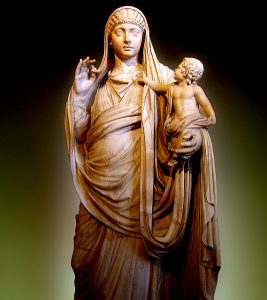
The Real Messalina wearing the clothes of a Roman matron holding her son Britannicus.
Messalina was born around 20 AD. She was a cousin of Nero and Caligula and became Empress when she married Claudius.
Little is known for certain about the life of Messalina, other than her descent through both parents from Octavia, Augustus’ sister and her claim to be the mother of Claudius’ children Britannicus and Claudia Octavia.
Along with Augustus’ daughter Julia (who he had banished for sleeping with so many different men), Messalina is probably one of the most notoriously promiscuous women of Rome. But, does she deserve her reputation?
In 37 AD, Messalina married Claudius, who was at least 30 years older than her. At this time Caligula was still Emperor. Claudius we are told by Roman historian Suetonius doted on Messalina, and after he became Emperor, Messalina used his affection for her to get whatever she wanted from him. Suetonius tells us that Messalina used her sexual allure to get her way with her aging husband too. Tacitus tells us she ordered that Claudius exile or execute anyone who displeased her or who she felt threatened by. Unfortunately, according to her detractors, this was a good number of people.
Suetonius paints a picture of a weak Emperor, Claudius, a man who was easily manipulated by his wife. The account of Messalina competing with a prostitute to see who could have sex with the most people in one night was first recorded by Pliny the Elder. Pliny says that, with 25 partners, Messalina won. The poet Juvenal tells in his sixth satire that the Empress used to work clandestinely all night in a brothel under the name of the She-Wolf
Messalina’s most famous affair is the one she had with the senator Gaius Silius. It is said she told Silius to divorce his wife, which he did and that they planned to kill Claudius and make Silius Emperor. When Claudius found out about his wife’s behaviour and plots Suetonius is of the opinion that he should have ordered her death, but instead the stupid doting old man gave her another chance. Too weak and feeble to kill Messilina himself Suetonius as Claudius’ chief of the Imperial Guard do it instead. Suetonius says that when Claudius heard what had happened he simply asked for another chalice of wine. The Roman Senate then ordered a damnatio memoriae so that Messalina’s name would be removed from all public and private places and all statues of her would be taken down.
The problem for Messalina is that the Roman historians who relayed these stories about her, principally Tacitus and Suetonius, wrote them some 70 years after the events in a hugely hostile political environment where everything related to the imperial line to which Messalina had belonged was being trashed. Suetonius’ history is a great read but it is largely anti-Julio-Claudian scandal-mongering - they all get a bad press from him. Tacitus claims to be transmitting ‘what was heard and written by my elders’ without naming sources other than the memoirs of Agrippina the Younger, who had arranged to displace Messalina’s children in the imperial succession and was therefore particularly interested in blackening her predecessor’s name.
Messalina is portrayed by Tacitus as a scheming, manipulative and greedy liar who has no compunction in bringing down innocent people who she dislikes or who get in her way. Suetonius paints her as a whore and a woman who sleeps with lower class men - either way, she likes her sex rough and dirty which is not the hallmark of a respectable Roman matron let alone an Empress. What passes for history when it comes to Messalina is political and social annihilation. Accusations of sexual excess were and still are a tried and tested smear tactic against women. In this case, they were the result of politically motivated hostility. We know that when her affair with Gaius Silius was uncovered she did the very Roman thing of committing suicide in the company of her estranged mother; she was not killed by Claudius’ guards.
Her notorious story has had several outings on the silver screen - 1951, 1960, 1981
Julia Herdman writes historical fiction that puts women to the fore. Her latest book Sinclair, Tales of Tooley Street Vol. 1. is Available on Amazon – Paperback £10.99 Kindle £0.99 Also available on:
Amazon Australia
Amazon Canada
Amazon New Zealand
Amazon South Africa
Amazon USA

by Julia Herdman | Jun 22, 2017 | American History, Blog, France, Politics, Romance, Society
 Benjamin Franklin was a lover of knowledge; after all, he was the quintessential Renaissance man. He gave us the lightning rod, the Franklin stove, bifocals, and Poor Richard’s Almanack. He was also an indispensable politician and civic activist who not only helped lay the groundwork for the Declaration of Independence and the United States Constitution but was also the country’s first ambassador to France where in 1779 he fell in love with Anne Catherine Helvétius, the widow of the Swiss-French philosopher, Claude-Adrien Helvétius.
Nicknamed “Minette”, she maintained a renowned salon in Paris using her dead husband’s accumulated wealth and among its habitués were France’s leading politicians, philosophers, writers, and artists. In courting her attention, he sent her many letters expressing his love, admiration, and passion. In one, he claimed that he had a dream that their dead spouses had married in heaven and that they should avenge their union by doing the same on earth! In another passionate plea, he wrote: “If that Lady likes to pass her Days with him, he, in turn, would like to pass his Nights with her; and as he has already given her many of his days…she appears ungrateful never to have given him a single one of her nights.”
Franklin’s libido was apparently so strong, he himself was scared of it. In his autobiography, he confessed: “the hard-to-be-governed passion of my youth had hurried me frequently into intrigues with low women that fell in my way.”
One of the more revealing documents on his views on women, which had been known in certain circles but kept under wraps for almost 200 years, was a letter he wrote in 1745, offering advice to a young man who was having trouble with his own insatiable libido. In the letter, which was entitled “Advice to a Young Man on the Choice of a Mistress,” Franklin advised: “In all your Amours, you should prefer old Women to young ones.” He goes on to explain that with older women they tend to have more discretion, will take care of you when you’re sick, are cleaner than prostitutes, and that “there is no hazard of children.” He also offered that you can’t really tell who’s old or young when you’re in the dark. What a romantic!!!
Julia Herdman writes historical fiction that puts women to the fore. Her latest book Sinclair, Tales of Tooley Street Vol. 1. is Available on Amazon – Paperback £10.99 Kindle £4.99 Also available on:
Amazon Australia
Amazon Canada
Amazon New Zealand
Amazon South Africa
Amazon USA
by Julia Herdman | Jun 19, 2017 | Blog, European Royal Families, Marriage, Politics, Society
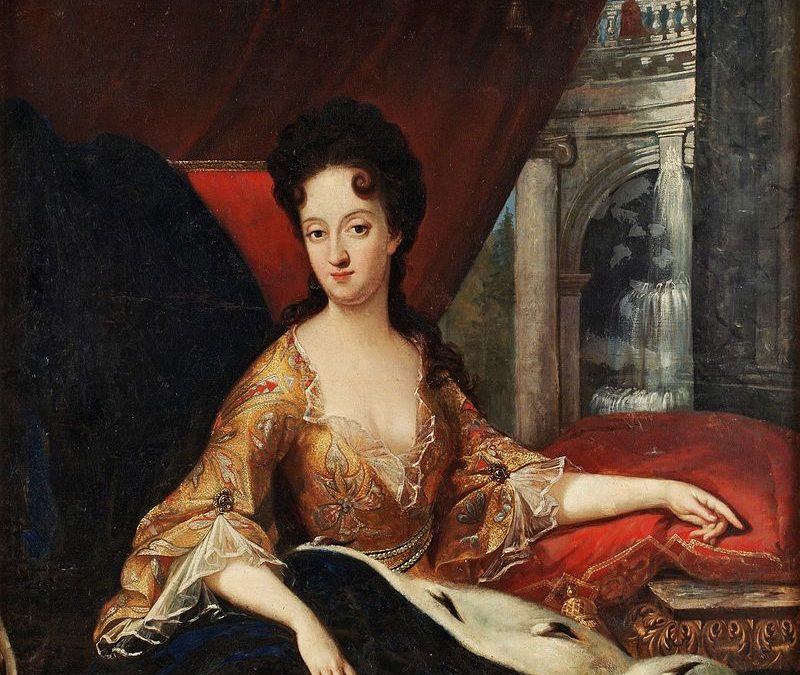
Queen Ulrika Eleonora the Younger (1688 – 1741), was Queen regnant of Sweden from 5 December 1718 to 29 February 1720, and then Queen consort until her death in 1741. She was the youngest child of King Charles XI and Ulrika Eleonora of Denmark. She had an elder brother and sister so never expected to be queen.
Her mother died in 1693 when she was five and little Ulrika and her elder sister, Princess Hedvig Sophia, were set off to be brought up by their grandmother, Hedwig Eleonora at Karlberg Palace. Grandmother was a consummate operator, she was the guiding light in her husband’s administration and she dominated her son so much that he referred to her as the Queen ignoring his wife. Her grandmother described Ulrika as a stubborn little girl who would pretend to be ill when it came to doing things she didn’t like riding and dancing. It seems little Ulrika was not the physical type but she was a talented musician, and when performing with her sister at court concerts, she would play the clavier while her sister sang. Although she was friendly, modest and dignified, with good posture and beautiful hands she was regarded as neither intelligent nor attractive and no match for her older sister.
Her father died in 1697 when Ulrika was 9 years old and the crown passed to her brother Charles XII (1682 –1718). Grandmother was sure he was too young to take on full royal responsibilities, he was only 15, and petitioned to act has his regent; a caretaker government was put in place which lasted for seven months then Charles took full command. Charles was an absolutist monarch; he believed he had been put in charge by God, an idea that was already encountering quite a bit of resistance in Europe at the time. He was, however, a successful war leader and achieve considerable success in defending Sweden in the Great Northern War.
On 12 May 1698, Princess Hedwig Sophia married her cousin, Frederick IV, Duke of Holstein-Gottorp. Her marriage was arranged as a part of the traditional Swedish policy of alliance with Holstein-Gottorp against Denmark. The marriage took place against her consent and she was not happy; Frederick IV had a string of mistresses and whores he preferred over his reluctant wife. Hedwig Sophia was a widow with a young son by 1702 but Ulrika was still unmarried. Hedwig Sophia returned to the Swedish court where she was the centre of attention, partying with her brother the king and lauded for her beauty and fashion sense. She was known as the “The Happy Princess” unlike her stubborn little mouse of a sister. Unfortunately, Hedwig Sophia caught smallpox in 1708 nursing her son who also had the disease. Hedwig Sophia died but her son survived.
With no marriage in prospect for her brother the king in sight Ulrika’s position suddenly changed with her sister’s death. In 1710, she received a marriage proposal from Prince Frederick of Hesse, he was a widower with an eye on her crown. The marriage was supported by her grandmother because it would force Ulrika to leave Sweden and so increased the chance of her favourite granddaughter’s son becoming king when Charles died. Although her prospective husband liked the idea of inheriting her crown his advisers were telling him that Ulrika was no great catch describing her as imperious, haughty, and suffering from bad breath and a weak bladder. Their engagement was announced four years later on 23 January 1714, and the wedding took place on 24 March 1715. During the wedding, her brother Charles XII remarked: “Tonight my sister is dancing away the crown”. But it turned out she wasn’t. When a musket ball went clean through her brother’s head in 1718 the Swedish nobles opposed to the war which had been waging for nearly two decades seized their chance and offered Ulrika the throne on the condition that she accepted a modern constitution for the country. She accepted but years of living as an autocrat made accepting what was required of her very difficult so she abdicated giving her crown to her husband who did the deed for her and Sweden took its first steps into the modern age. All of which goes to show that you don’t have to be clever, or beautiful to make history you just have to seize the opportunities life throws at you and do the right thing.
Julia Herdman writes historical fiction that puts women to the fore. Her latest book Sinclair, Tales of Tooley Street Vol. 1. is Available on Amazon – Paperback and on Kindle. Also available on:
Amazon Australia
Amazon Canada
Amazon New Zealand
Amazon South Africa
Amazon USA
by Julia Herdman | Jun 15, 2017 | Blog, Europe, Politics, Society, Writing about history
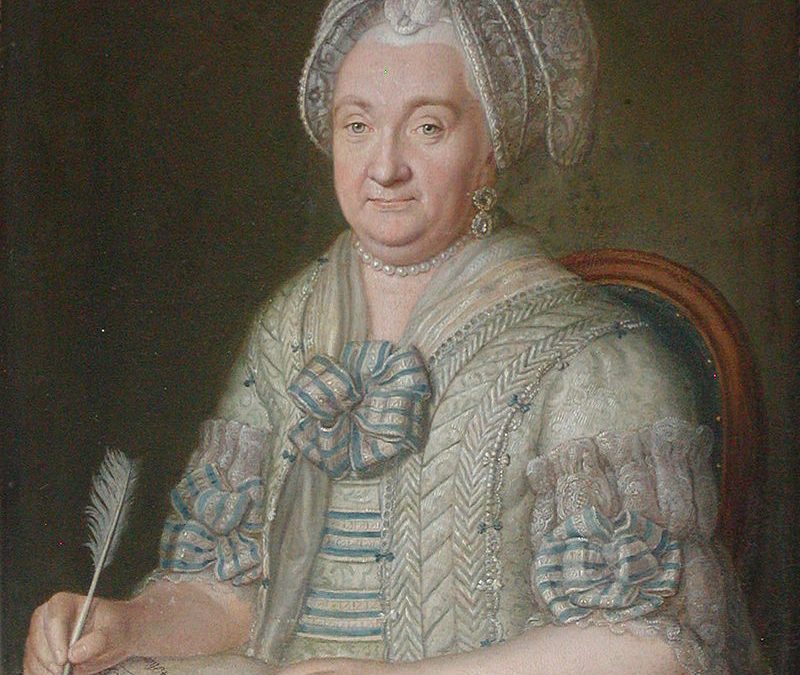
Anna Magdalena Godiche née Høpfner (January 11, 1721 - February 22, 1781) was a Danish book printer and publisher. She managed the biggest printing company in Denmark as the Danish political scene combusted. Born to judge Høpfner in Haderslev Anna married Andreas Hartvig Godiche (1714-1769) of Copenhagen in 1736. Godiche owned one of the biggest printing companies in Denmark and was one of those contributing to the expansion of book printing in the mid 18th century. She took over the company which held the monopoly on printing and publishing the work of Johann Friedrich Struensee and Enevold Brandt, when her husband died in 1769.

Portrait of Johann Friedrich Struensee (1737-1772), Cornelius Høyer (1741-1804) - Frederiksborg Museum
Struensee took over the Danish government in 1770 and held absolute sway for almost thirteen months, between 18 December 1770 and 16 January 1772. With Brandt’s assistance he set about reforming Denmark. Reforms initiated by Struensee included:
- abolition of torture
- abolition of unfree labour (corvée)
- abolition of the censorship of the press
- abolition of the practice of preferring nobles for state offices
- abolition of noble privileges
- abolition of “undeserved” revenues for nobles
- abolition of the etiquette rules at the Royal Court
- abolition of state funding of unproductive manufacturers
- introduction of a tax on gambling and luxury horses to fund nursing of foundlings
- ban of slave trade in the Danish colonies
- rewarding only actual achievements with feudal titles and decorations
- criminalisation and punishment of bribery
- re-organisation of the judicial institutions to minimise corruption
- introduction of state-owned grain storage to balance out the grain price
- assignment of farmland to peasants
- re-organisation and reduction of the army
- university reforms
- reform of the state-owned medical institutions
His reforms were popular at first but Struensee had overstepped the mark with his royal masters, he did not speak Danish, conducting his business in German, his affair with the queen and the birth of their illegitimate child scandalised Danish society and gradually his enemies moved in for the kill.
A palace coup took place in the early morning of 17 January 1772, Struensee, Brandt and Queen Caroline Matilda were arrested in their respective bedrooms, and the perceived liberation of the king, who was driven round Copenhagen by his deliverers in a gold carriage, was received with universal rejoicing. The chief charge against Struensee was that he had usurped the royal authority in contravention of the Royal Law (Kongelov). He defended himself with considerable ability and, at first, confident that the prosecution would not dare to lay hands on the queen, he denied that their liaison had ever been criminal. The queen was taken as prisoner of state to Kronborg Castle.

Enevold Brandt
On 27 April/28 April Struensee and Brandt were condemned first to lose their right hands and then to be beheaded; their bodies were afterwards to be drawn and quartered. The Kongelov had no provisions for a mentally ill ruler who was unfit to govern. However, as a commoner who had imposed himself in the circles of nobility, Struensee was condemned as being guilty of lèse majesté and usurpation of the royal authority, both capital offences according to paragraphs 2 and 26 of the Kongelov.
Struensee awaited his execution at Kastellet, Copenhagen. The sentences were carried out on 28 April 1772 with Brandt being executed first. First, Struensee’s right hand was cut off; next, after two failed attempts his head was severed, stuck on a pole and presented to 30,000 bystanders; then, after disembowelment, his remains were quartered.
The King himself considered Struensee a great man, even after his death. Written in German on a drawing the king made in 1775, three years after Struensee’s execution, was the following: “Ich hätte gern beide gerettet” (“I would have liked to have saved them both”), referring to Struensee and Brandt.
Anna Magdalena Godiche survived the scandal and lived for another 10 years.
Julia Herdman writes historical fiction that puts women to the fore. Her latest book Sinclair, Tales of Tooley Street Vol. 1. is Available on Amazon – Paperback £10.99 Kindle £2.42 Also available on:
Amazon Australia
Amazon Canada
Amazon New Zealand
Amazon South Africa
Amazon USA


Recent Comments