How did the royal priests convince the king he had the golden ticket that would take him to the afterlife?
Getting The Pharaoh to the Afterlife
Every ancient Egyptian king required a ticket to the afterlife. To understand how these tickets were made we need to understand the king’s sacred monuments, their design, materials, and decoration, but more importantly, we need to understand the religious ideas that inspired them.
The Old Way of Understanding Heka
The Pyramid Texts tell us that Heka was believed to have existed before the creation of the world and was, therefore, part of the divine energy of the creator. However, the first studies of Egyptian magic were influenced by the idea that magic was split into good magic and bad magic. Good magic was beneficent and bad magic negative or hostile. Good magic was practised by the pious and bad by the evil and blasphemous. Magic and knowledge were separated into that knowledge that could be acquired from nature and observation and that which was part of heka or supernatural. Magic was defined as a private religion whose purpose was defensive.
Today, Egyptologists use the anthropological definition of magic and religion, which represents social practices with a set of accompanying beliefs regarding the nature of reality. According to anthropologists, magic lies beyond nature and is, therefore, a figment of the human imagination. Its practitioners employ rituals, charms, spells, prayers, and incantations to influence the world’s natural forces to prevent the loss of something deemed essential or to obtain something desired.
Anthropologically, magic is said to come in two forms: 1] sympathetic magic and 2] contagious magic.
Sympathetic or homoeopathic magic is defined as like being effective against like. Something astringent would be used to treat a sting or insect bite when using a sympathetic magical cure. Magically, a statue or image of a person or a god could be used similarly to using the classic voodoo doll. That is as a representation of the person or God the magic was intended to act upon.
Contagious magic is the type that flows from one object or person to another by touch, typically in the form of an amulet of charm. The abundance of charms and amulets found in the archaeological record and the survival of texts containing a wide range of spells shows that this sort of magic was highly prevalent from top to bottom in ancient Egyptian society.
Although most religions treat magic and religion as diametrically opposite, religion and magic are treated the same in anthropology because all religions include magical or supernatural beliefs. Here the ancient Egyptians would agree with the anthropologists because magic was an integral part of their world. Magic, ritual and religion were inseparable and were fundamental to all aspects of daily life and necessary for the correct operating of the cosmos.
Sex and Magic
The traditional view of heka also includes sex. Sex was viewed as the second most potent creative force in the cosmos. Evidence of phallic cults and the reviving efficacy of sex is found across archaeological records and ancient Egypt’s myths. The most prominent example being the annual raising of the Djed Pillar, a festival similar to raising the Maypole at the beginning of the growing season in Europe. Erecting the Djet Pillar was designed to celebrate the resurrection of Osiris and to celebrate the power of life over death. To the ancient Egyptians, nature’s power of begetting contained the secret spring of life.
Towards a New Understanding of Heka
Vignette illustrating part of the spell 23 and the power of heka from the Book of the Dead, papyrus of Hunefer, 19th dynasty (c. 1310 BCE). BM 9901/5 (R. O. Faulkner, The Ancient Egyptian Book of the Dead, London 1985, 54).
The ancient Egyptians believed heka operated in this world and the next; it was neither good nor bad; it was simply the invisible energy or force that powered everything in the world. The royal priests believed they knew how it worked, how to connect with it, and, how to control it. It was their special knowledge, and it helped to maintain their position at the top of ancient Egyptian society for over three thousand years, and it was this sacred knowledge, the knowledge of the god Thoth that convinced the king his priests could get him to the afterlife.
A lot has been written about heka or hike; it was the tool of the gods; the Heliopolitian creator god Atum used it with Sai (perception) and Hu (speech) to make the world. Today we might call heka something like gestalt because it was the thing that provided the structure that made the world manifest in all its beauty and all its horror. Heka was also how the deceased passed from this transitory world to the life eternal beyond the grave. Beliefs surrounding heka were the fountainhead and the origin of every sacred building constructed in ancient Egypt. Egyptologists believe words contained the power of heka but not numbers, although they never speak of this omission.
Thoth and Isis were the two great magicians of the cosmos and were said to be great in heka. Like Sai and Hu, Heka was depicted as a god in his own right from the Old Kingdom and sometimes appeared in illustrations of the funeral boat on tomb walls. The gods Sai, Hu and Heka, were the physical manifestations of the invisible powers that created the universe, understanding heka was the key to comprehending the world.
The priests could invoke the gods’ power through speech, by saying the right spells or prayers but understanding heka was problematic; where was it and how could it be manipulated? We believe it was by using sacred materials, sacred images and by using both words and numbers. The priest’s special knowledge of all of the things to ensure the king’s transformation from man to god.
How Heka was Used to Re-birth the King in the Afterlife
A succession of high-ranking priests were inolved in getting the Pharaoh to the afterlife. They listened to and understood each ruler’s requirements; then facilitated projects that provided the monarch with their personal edifices of glory and their individual road-maps to the afterlife.
The ancient Egyptian priesthood were the architects of each pharaoh’s greatest projects; their temples and their tombs using sacred materials, sacred images and by using sacred words and sacred numbers. They supplied the spiritual structure, the technically outstanding design work, and the organisational framework that underpinned and made possible all the monumental creations ever built in ancient Egypt.
A scene from the Book of Caverns in the tomb of Ramses V./VI. (KV9, chamber E, right wall) Wikipedia
Using a common language of shared intellectual and spiritual beliefs the priests and their kings created some of the greatest religious monuments on earth. These were pyramids and tombs with special sarcophaguses, decorated coffins, books of spells and sacred amulets. This special combination of design, decoration, furniture, spells and rituals created the pharaoh’s pathway to the afterlife.
The Royal cult sat at the centre of all religious and cultural innovation for 3000 years. Its ideas and practices were taken up by the wealthy and privileged in ancient Egyptian society after they had first been employed by the king. This is how royal practices trickled down to those at the bottom of the social pile. What the king did first was sure to be followed by others.
The two short videos below show some of these practices and motifs.
Nobody knows its original name or its age. The Great Sphinx of Egypt remains a mystery.
The name Sphinx is not even Egyptian; it’s Greek.
Sphinx means a human-headed animal with a lion’s body in ancient Greek mythology.
The word Sphinx came into use some 2,000 years after the Great Sphinx of Egypt was built.
There are hundreds of tombs at Giza with hieroglyphic inscriptions dating back some 4,500 years, but not one mentions the monument.
The trouble is the Egyptians didn’t write history as we do; they were not interested in precise dates or explanations.
Although we don’t fully understand the Great Sphinx of Giza, it was undoubtedly part of their sacred landscape of death and resurrection.
You can find out more about the Great Sphinx of Egypt at https://www.arce.org/sphinx-map where Mark Lehner and James Allen reveal the results of their forty-year study of the monument.
The Dream Stele
The Dream Stele is a rectangular piece of red granite, 3.6 meters (12 ft) tall. It originally formed the back wall of a small open-air chapel built by Thutmose IV and sits between the paws of the Great Sphinx. The Stele itself is a reused door lintel from the entry to the mortuary temple of the Pharaoh Khafre, the owner of the second-largest pyramid at Giza. The scene in its lunette, the semi-circular window-like space at the top of the stone, shows the Pharaoh Thutmose IV on the left and the right making offerings and libations to the Sphinx.
The Stele records how Thutmose slept under the protection of the Great Sphinx one afternoon when he was tired from hunting. While he slept, he dreamt he struck a bargain with the mighty Sphinx. In return for refurbishing the monument, the Sphinx promised to make him king.
The Stele gives rise to the Great Sphinx being named Harmachis-Chepre-Re-Atum because that is the name the god of the Great Sphinx goes by when speaking to Thutmose IV in his sleep.
‘Look at me, look at me, my son Thutmose. I am your father Harmachis-Chepre-Re-Atum, who gives you the kingdom on earth at the head of the living. ” Sphinx stele (Urk IV, 1539a-1544)
The Greek Myth: Oedipus and the Riddle of the Sphinx
During his great journey, Oedipus came upon the town of Thebes; he found the great Sphinx there. The Sphinx sat in front of Thebes and asked a riddle of everyone who tried to enter the city. If you could answer the riddle, the Sphinx let you go, but if you could not answer the riddle, then the Sphinx ate you! Nobody ever knew the answer.
This was the Sphinx’s riddle:
What goes on four feet in the morning, two feet at noon and three feet in the evening?
Answer:
A man: As a baby in the morning of their life a man crawls on fours.
As an adult in the noon of their life, a man walks upright on two feet.
But when he is old, in the twilight of life, he walks with a cane or on three legs.
When Oedipus answered the riddle correctly, the Sphinx was so upset that she fainted, and Oedipus went on into Thebes. When he got there, the Thebans were very upset because somebody had killed their king, Laius. But they were happy to hear that Oedipus had figured out the riddle of the Sphinx. So, they made Oedipus their new king.
Forty years of documenting the Great Sphinx of Giza
In 1979, Mark Lehner and James Allen started work on the first comprehensive mapping of the Sphinx.
They studied its structure and geology
They documented every detail
Their goal was to determine how and when this iconic monument was built
Recorded its current state of preservation
Their data is now available thanks to a grant from ARCE’s Antiquities Endowment Fund
If you’d like to search the data yourself, good starting points are the project homepage or try browsing some of the over 5500 photographs and 364 maps and drawings and see what you find!
https://www.arce.org/sphinx-map
The Great Sphinx
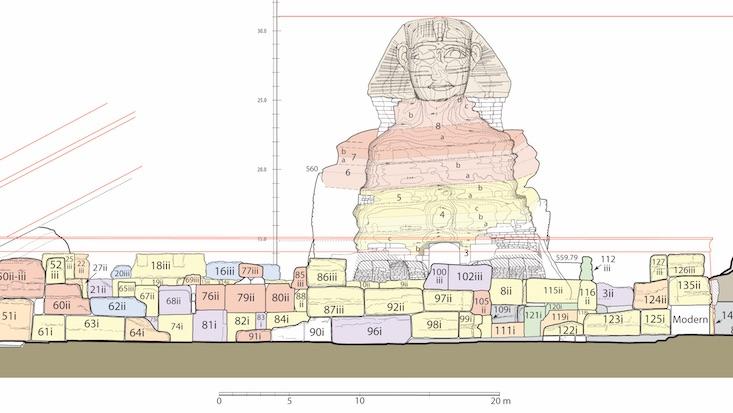
Elevation of the Sphinx Temple, showing east and west walls and the Sphinx from Ulrich Kapp’s 1979 photogrammetric elevation and profiles with core blocks numbered and color-coded for type.
Photo: Mark Lehner.
About 3,000 years ago, a man named Nespawershefyt, a priest at the temple of Amun at Karnak (in modern Luxor), commissioned a set of coffins for himself.
He wanted an outer coffin and an inner coffin – the smaller of the two to be placed in the larger, much like Russian dolls – and a mummy board that would be placed on top of his embalmed and wrapped body.
Unbeknown to Nespawershefyt, the artisans he had chosen to make his coffins were cheapskates.
The wood they chose for the inner coffin was poor and needed lots of patching.
They were good at painting though. All the patches were expertly covered with bright yellow paint and text.
The coffins were delivered but not needed for years.
Sometime before his death Nespawershefyt decided to update his funerary inscriptions: he had received a promotion at the temple and wanted to mention his new higher-level position on his coffins.
You cannot leave your CV out-of-date for eternity, so the artisans set to work once again.
Princess Charlotte August was in labour for more than two days before she died on 6th November 1817.
Princess Charlotte Augusta of Wales (1796 – 1817) was the only child of George, Prince of Wales (later King George IV) and Caroline of Brunswick. If she had lived Charlotte would have become Queen of the United Kingdom.
Before her marriage, Charlotte was what we might call a ‘wild child’. She was a good horsewoman and a bit of a ‘tomboy.’
Charlotte’s parents loathed the sight of each other and separated soon after she was born. Her father debauched himself with every form of excess except fatherly love and attention. Her mother lived the lonely life of an abandoned woman. As an only child, Charlotte’s welfare was left in the hands of palace staff and her estranged mother whom she visited regularly at her house in Blackheath.
As Charlotte entered her teenage years, members of the Court considered her behaviour undignified. Lady de Clifford complained about her ankle-length underdrawers that showed. Lady Charlotte Bury, a lady-in-waiting to her mother Caroline described the Princess as a “fine piece of flesh and blood” who had a candid manner and rarely chose to “put on dignity”. Her father, however, was proud of her horsemanship and her tolerably good piano playing.
By the time she was age 15, the curvey Charlotte looked and dressed like a woman; she developed a liking for opera and men and soon became infatuated with her first cousin, George FitzClarence, the illegitimate son of the Duke of Clarence.
To put an end to the budding romance FitzClarence was called to Brighton to join his regiment, and Charlotte’s gaze fell on Lieutenant Charles Hesse of the Light Dragoons, reputedly the illegitimate son of Charlotte’s uncle, Prince Frederick, Duke of York and Albany.
Her mother colluded with Charlotte as far as Hesse was concerned not because she approved of the romance but to peeve her husband who did not. Caroline allowed the pair to meet in her apartments but the liaison was shortlived. Britain was at war with France and Hesse was called to duty in Spain.
Her father’s plan was to marry Charlotte to William Prince of Orange, the Dutch king. Neither her mother nor the British public wanted Charlotte to leave the country to pursue such a match. Charlotte, therefore, informed the Prince of Orange that if they wed, her mother would have to live with them at their home in the Netherlands. This was a condition sure to be unacceptable to the Prince of Orange and their engagement was broken before it was started.
Charlotte finally settled on the dashing young Prince Leopold of Saxe-Coburg-Saalfeld, Leopold had a commission in the Imperial Russian Army and fought against Napoleon after French troops overran Saxe-Coburg until Napoleon’s defeat at Waterloo.
The Marriage
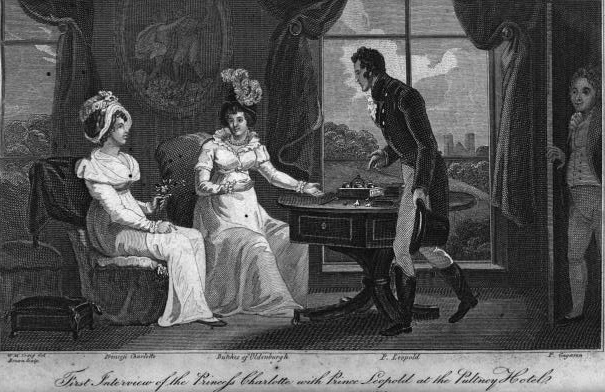
The marriage ceremony was set for 2 May 1816. The war with France was over and the people of London were in the mood to celebrate. On the wedding day, huge crowds filled the streets and at nine o’clock in the evening in the Crimson Drawing Room at Carlton House, with Leopold dressing for the first time as a British General (the Prince Regent wore the uniform of a Field Marshal), the couple were married. Charlotte’s wedding dress cost over ₤10,000, an enormous sum of money - the average doctor earned less than £300 per year. The only mishap was during the ceremony happened when Charlotte was heard to giggle when the impoverished Leopold promised to endow her with all his worldly goods.
At the end of April 1817, Leopold informed the Prince Regent that Charlotte was pregnant and that there was every prospect of the Princess carrying the baby to term.
Charlotte’s pregnancy was the subject of the most intense public interest. Betting shops quickly set up a book on what sex the child would be. Economists calculated that the birth of a princess would raise the stock market by 2.5%; the birth of a prince would raise it 6%.
The mum to be Charlotte spent her time quietly, however, spending much time sitting for a portrait by Sir Thomas Lawrence. She ate heavily and got little exercise; when her medical team began prenatal care in August 1817, they put her on a strict diet, hoping to reduce the size of the child she was carrying. The diet and occasional bleeding they subjected her to seemed to weaken Charlotte and did little to reduce her weight.
The Pregnancy
Much of Charlotte’s day to daycare was undertaken by Sir Richard Croft. Croft was not a physician, but an accoucheur, or male midwife. Male midwives were much in fashion among the well-to-do. In, ‘The Princess Charlotte of Wales: A triple obstetric tragedy’ Sir Edward Holland (J Obst & Gynaec Brit Emp 58:905-919, 1951) describes Sir Richard Croft as a diffident, sensitive man without much self-confidence despite his skill and experience. “He was not the sort of man to deviate from the rules of practice by doing something unconventional or risky. He played it by the book, but his library was small.”
Charlotte was believed to be due to deliver on 19 October, but as October ended, she had shown no signs of giving birth and drove out as usual with Leopold on Sunday 2 November. On the evening of 3 November, her contractions began. Sir Richard encouraged her to exercise, but would not let her eat: late that evening, he sent for the officials who were to witness the birth of the third in line to the throne.
A Labour in Vain
The first stage of labour lasted 26 hours, which is not uncommon for a first child. With the cervix fully dilated, Croft sent for Dr. Sims, perhaps because the uterus was acting inertly and irregularly, and also because, should a forceps delivery be necessary, Sims had been chosen consultant on that point. Sims was the “odd man out” among the four doctors; his principal work was as a botanist and editor, but he was also physician to the Surrey Dispensary and Charity for Delivering Poor Women in their Homes.
Almost certainly the outcome would have been better had the second stage of labour not lasted as long as the first. The optimal time the second stage is around two hours. Dr. Sims arrived at 2:00 am on November 5 after the second stage had been in progress for about seven hours.
Thirty-three hours after Charlotte’s labour had began Dr. Sims was ready with the forceps, but his assistance was not called for. Croft continued to let nature take its course. After 15 hours of second-stage labour, about noon on November 5, meconium-stained amniotic fluid appeared. Three hours after that, the baby’s head appeared. At nine o’clock in the evening of 5 November, Charlotte finally gave birth to a stillborn boy weighing nine pounds. Efforts to resuscitate the child proved fruitless. Onlookers commented that the dead child was a handsome boy, resembling the Royal Family.
The third stage of labour was no less distressing. Croft informed Sims that he suspected an hourglass contraction of the uterus. This happens when the placenta gets trapped in the upper part of the womb as it contracts Croft removed the placenta manually with some difficulty, and it seemed to do the trick. Soon after midnight, Charlotte began vomiting violently and complaining of pains in her stomach. Croft returned to Charlotte’s bedside to find her cold to the touch, breathing with difficulty, and bleeding profusely. He placed hot compresses on her, the accepted treatment at the time for postpartum bleeding, but the bleeding did not stop. Charlotte died an hour and a half later.
The Aftermath
Charlotte had been Britain’s hope: George III and Queen Charlotte, had had thirteen children but only Charlotte survived. She was the sole legitimate heir to the throne of Great Britain and Ireland. Her father, with his spendthrift behaviour and penchant for womanising, was already unpopular with the public and his brothers were viewed in much the same light. The Prince of Wales’s girth and reputation for gluttony prompted his critics to dub him the “Prince of Whales.” The people were devasted by Charlotte’s tragic death.
Post-mortems on Charlotte and her stillborn son exonerated the Croft from any wrong-doing. The postmortem results showed Charlotte died because she lost too much blood, her baby because of lack of oxygen. In 1817 there were no blood transfusions for Croft to call on when Charlotte began to lose blood but he could have done things differently and she may not have died. Croft decided not to use forceps, had he Charlotte and her baby might have been saved. Croft was following fashion and the dictum of Dr. Denman an authority of midwifery and childbirth at the time. Since the death of the hugely influential Scottish obstetrician William Smellie’s in 1760, the use of forceps had fallen into disfavour because of the injuries that could be caused by the instrument when used by unskilled accoucheurs. Hundreds of unskilled or partially trained doctors were operating in Britain’s unregulated medical market at the time. The late Dr. Denman had overreacted to these injuries and had advocated a policy of “Let nature do the work. …The use of forceps ought not to be allowed from any motives of eligibility (i.e. of choice, election, or expediency). Consider the possible mistakes and lack of skill in younger practitioners.”
Denman had however hedged his position with a qualification: “Care is also to be taken that we do not, through an aversion to the use of instruments, too long delay that assistance we have the power of affording. In the last edition of his book (1816, posthumously) he wrote: “But if we compare the general good done with instruments, however cautiously used, with the evils arising from the unnecessary and improper use, we might doubt whether it would not have been happier for the world if no instrument of any kind had ever been contrived for, or recommended in the practice of midwifery.”
Croft had relied on Denman’s ultraconservative precepts, his passive obstetrics was just as dangerous as meddlesome obstetrics. The adroit accoucheur steered a middle course, but Croft was not adroit. Three months later, Croft was involved in a similar case, and, when the patient died, he shot himself with a pistol he found in the house. What happened in the wake of Princess Charlotte’s death was too much for Croft to bear.
By today’s standards, the first and second stages of Charlotte’s labour were far too long. Modern obstetricians would use forceps to extract the baby and drugs would be given to speed-up and strengthen the contractions.The most recent CEMD report indicates that in 2009-12, 357 women died during or within 6 weeks of the end of their pregnancy. This represents a decrease in the maternal mortality ratio (MMR) from 11 (2006-8) to 10.12 per 100,000 live births (2010-12), mainly due to a decrease in deaths due to direct obstetric causes. However, there has been no change in the MMR for indirect maternal deaths in the last 10 years; the current ratio (6.87 per 100,000 live births) is almost twice that of direct deaths (3.25 per 100,000 live births).
Sources:
THE YALE JOURNAL OF BIOLOGY AND MEDICINE 65 (1992), 201-210
Obstetrical Events That Shaped Western European History
WILLIAM B. OBER, M.D.
Bergen County Medical Examiners Office, Paramus, New Jersey
Received March 26, 1991
Julia Herdman is fascinated by 18th-century cabinets of curiosities because they show a love of learning and the natural world. The 18th century saw a huge growth in the public interest in science and medicine. Cabinets of curiosities were a feature of many large houses because they were a way to show that their owners were taking an intellectual interest in the world. The 18th century was a time when it was cool to show off one’s intellectual prowess. Most of the collections consisted of rocks and minerals, shells, feathers and small animal skeletons. Cabinets of curiosities were works of art and a popular way to establish and uphold the owner’s rank in society. Because of the wonderful things they had in them these collections were sometimes called ‘wonder rooms.’ They were collections of the most extraordinary objects.
Peter The Great’s Cabinets of Curiosities
Russian Emperor, Peter the Great created his Kunstkamera in Saint Petersburg in 1714. It was a haphazard collection rarities with an emphasis on natural specimens.”, rather than the man-made objects called “artificialia”.
Frederik Ruysch (1638 - 1731)
Peter was interested in anatomy because he wanted to improve Russian medicine. He encouraged research into human deformities by issuing a royal edict requiring examples of malformed and still-born infants to be sent to the imperial collection where he put them on display as examples of accidents of nature. This collection of human specimens became the core of the Russian Academy of Sciences.
In 1716, he added a mineral cabinet to the Kunstkamera, with the purchase of a collection of 1195 minerals. Russian minerals were added to the collection that eventually became the core of the Fersman Mineralogical Museum in Moscow.
Peter the Great also bought many specimens from Holland particularly from the pharmacologist, Albertus Seba, and the anatomist, Frederik Ruysch (1638 - 1731).
The illustration shows one of the scenes created by Ruysch and displayed in his museum in Amsterdam. Ruysch’s creations were so intricate and detailed they were known as 8th wonders of the world. Ruysch’s daughter prepared the delicate cuffs and collars that were slipped on to arms and necks of the skeletons which were positioned to show them crying into handkerchiefs. To add to the bizarre scene the skeletons were wearing strings of pearls and playing the violin. Ruysch was an expert showman and a scientist. His dissections were public spectacles held by candlelight and accompanied by music and refreshments. A major new voice in historical fiction.
John and William Hunter’s Cabinets of Curiosities
In Britain, the anatomists, John and William Hunter were renowned collectors of curiosities. The brothers collected what is called the Hunterian Collection which is split between London and Glasgow.
William Hunter played a prominent role in the most prestigious cultural and scientific institutions of the 18th century, both in Britain and abroad. He appears in Zoffany’s painting, Life Class at the Royal Academy (1771-1772). He also appears in James Barry’s Distribution of the Premiums by the Royal Society of Arts and Manufactures (1777-1783).
The curiosities he collected are now on display at the University of Glasgow. The exhibition explores Hunter’s personal and professional life and highlights both his passion for collecting and his hugely successful career as a royal physician, outstanding teacher of anatomy and surgery and pioneering scientific researcher. It is one of the best-known collections in the country and contains 650 manuscripts,10,000 printed books, 30,000 coins.r new voice in historical fiction
John Hunter
William Hunter teaching anatomy
John Hunter FRS (1728 – 1793) was one of the most distinguished scientists and surgeons of his day. He came to London in 1748 at the age of 20 and worked as an assistant in the anatomy school of his elder brother William (1718-83), who was already an established physician and obstetrician. He was an early advocate of careful observation and scientific method in medicine. John Hunter was a great showman and entrepreneur as well as one of London’s most famous surgeons.
Hunter devoted all his resources to his museum. It included nearly 14,000 preparations of more than 500 different species of plants and animals. As his reputation grew, he was supplied with rare specimens such as kangaroos brought back by Sir Joseph Banks from James Cook’s voyage of 1768-71.
In his lifetime, John Hunter collected and prepared thousands of natural specimens, which he displayed in his museum including the skeleton of the Irish Giant Charles Byrne. In 1799, the British government purchased the collection and presented to the Royal College of Surgeons.
A La Ronde is an 18th-century 16-sided house located near Lympstone, Exmouth, Devon, England, and in the ownership of the National Trust.
Jane and Mary Parminter - La Ronde
Cabinets of Curiosities
Collecting was not just the rage for anatomists and princes. Curious Parsons and Lords of the manor had their own cabinets of curiosities. It was part of what has been called the 18th century’s elite ‘learned entertainment.’
Many houses had cabinets of curiosities; one of the most beautiful collections of seashells was gathered by two spinster cousins, Jane and Mary Parminter. The two cousins became greatly attached to each other and in 1795 decided to set up home together in Devon.
The sisters created a magical world in their sixteen-sided house with diamond-shaped windows. The spinster cousins went on a tour around Europe and were avid collectors. They decorated the walls of their quirky house lovingly with hundreds of feathers and shells. They crafted pictures using sand, seaweed, and card and hung them on the walls. The cabinet of curiosities in the library is jam-packed with a jumble of Parminter family souvenirs such as shells, beadwork, semi-precious stones and votive statues. This is a real treasure house with every nook and cranny crammed with bizarre items collected over the years. It is a treasure trove overflowing with everything from ancient Egyptian artifacts and precious rocks to prints from Switzerland. The cousins lived secluded and somewhat eccentric lives for many years. Their happy lives together came to an end in 1811 when Miss Jane died. A major new voice in historical fiction.
In 2013 novelist Hilary Mantel wrote in an article in the London Review of Books. The subject of the article was giving a book to someone. The book she chose was published in 2006 and was by the cultural historian Caroline Weber. The book was called Queen of Fashion: What Marie Antoinette Wore to the Revolution and she chose to give it to Catherine Duchess of Cambridge.
“It’s not that I think we’re heading for a revolution,” said Mantel. She was concerned that Kate was becoming a jointed doll on which certain rags were hung. “Marie Antoinette was a woman eaten alive by her frocks,” says Mantel. “She was transfixed by appearances and stigmatised by her fashion choices.
Politics were made personal in the tragic French Queen. Her greed for dresses and self-gratification, her half-educated dabbling in public affairs, were adduced as a reason the French were bankrupt and miserable. It was ridiculous, of course. She was one individual with limited power and influence, who focused the rays of misogyny.
Marie-Antoinette was a woman liked to dress to impress but she couldn’t win. If she wore fine fabrics she was said to be extravagant. If she wore simple fabrics, she was accused of plotting to ruin the Lyon silk trade. But in truth, she was all body and no soul: no sense, and no sensitivity.
The Queen was so wedded to her appearance. As the royal family tried to escape Paris she did not leave her wardrobe behind instead she had several trunk loads of new clothes sent on in advance and took her hairdresser along for the trip. Despite the weight of her mountainous hairdos, she didn’t feel her head wobbling on her shoulders. When she found herself back in prison it is said her hair went grey overnight.
Of course, the Duchess of Cambridge is no Marie-Antoinette. She is a modern, educated woman who has married for love but Mantel is right about royal women of the past and strangely prophetic in describing what has happened to Kate in the press recently. Duchess of Drab! wrote Sarah Vine in the Daily Mail on 8th April 2016, “It’s the mystery of the cosmos… How DOES a beautiful woman make designer outfits look so frumpy?”
Unlike her late mother-in-law, Diana Princess of Wales, Kate has not courted fashion or the press a crime she will pay heavily for I suspect but as a woman with a mind, she probably knows she’s damned if she does and damned if she doesn’t. If she courts fashion and sex appeal, she will be lambasted and lauded like tragic Diana, if she doesn’t she’ll remain a dowdy, uptight mouse.
In this respect, Kate is like so many royal women in the past who receive only a passing reference in mainstream history books. When Kate ventures out to visit some charity or other on her own she is lauded patronizingly by the newscasters as if they were talking about a child. Surely, it’s not hard for a woman in possession of one of the country’s most expensive educations and a good university degree to talk to children or politicians for a half an hour after a briefing by Palace aids!
The Duchess of Cambridge is just the most recent in a line of royal women living out their lives in gilded cages. The difference between Kate and her Georgian forbears is that she has chosen her life and consciously sacrificed her private life and career for love. This was not a luxury afforded to princesses in the past.
This summer Meghan Markle was criticised for a pale pink off the shoulder dress she wore to her first Trooping the Colour ceremony. The sleeveless dress caused a Twitter storm with Tweeters slamming the look as “inappropriate” for Queen Elizabeth’s annual birthday parade.
Disney may believe every girl wants to be a pastel packaged franchise of a slender-waisted fairy-tale princess but if they knew what most princesses went through in the past and even today they would not be so keen to join their ranks. It’s not all about the dress. The truth is many of these women were child brides, exchanged by their families to secure some dynastic advantage or to settle political deals; personal happiness and fulfilment were never part of the transaction.


_fifth_division.jpg)





Recent Comments