by Julia Herdman | Jun 12, 2017 | Blog
Giulio Strozzi was the poet and librettist who recognised Barbara as his adopted daughter on 6 August 1619.
She was baptised in the church of Santa Sofia in the Cannaregio district (sestiere) of Venice and officially welcomed into to Strozzi family. Barbara had probably always been part of the Strozzi family as she was his illegitimate daughter by Isabella Garzoni, a long-time servant.
Barbara was lucky. Unlike most women, she was encouraged to develop her musical talents.
Her father introduced her to Venice’s intellectual elite and showcased her talents to advance her career.
Giulio was a member of the Venetian circle of intellectuals known as the Accademia degli Incogniti (“Academy of the Unknowns”), which met to discuss and debate questions of literature, ethics, aesthetics, religion, and the arts. In 1637 Giulio formed a musical subset of the Incogniti, known as the Accademia degli Unisoni (“Academy of the Like-Minded,”) for Barbara where she performed as a singer and suggested topics for discussion.
The Incogniti were early proponents of Venetian opera and Barbara was their leading light, singing for them and writing music for herself and others to perform. Click on the link to hear her haunting cantata - My Mourning sung by Pamela Lucciarini.
 Barbara thrived in the society her father created for her. But her role as hostess of the Unisoni and her very public involvement in music were satirized in an anonymous manuscript that may have been penned by a member of the Incogniti; the author equated her status as a musician with the licentious behaviour of a courtesan.
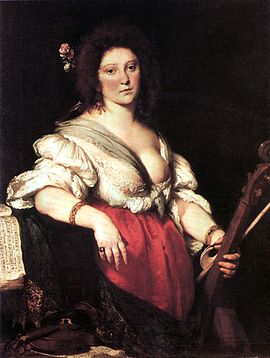
A portrait of her by Bernardo Strozzi (not of the same family) has been interpreted as one implying she was indeed a woman of less than prefect morals and the fact that she never married but had four children rather suggests she was not considered good marriage material by the men she consorted with. Her two daughters became nuns and one of her sons became a monk.
Giulio Strozzi’s proto-feminist sensibilities garnered Barbara an opportunity that would be closed to most women composers for centuries. Barbara published eight collections of her vocal works between 1644 and 1664, seven of which survive.
Barbara Strozzi was a woman ahead of her time — far ahead of her time, as it would still be several centuries before most women could have serious careers as composers. Strozzi published many volumes of music, which in itself indicates that her music was well received. Her compositional output following her first volume of madrigals consisted mostly of arias, cantatas, and ariettas. The arias are generally short strophic pieces (every stanza is sung to the same music), while the cantatas are mostly longer sectional works in which the music changes to suit the meaning of the text. For example, impassioned or pathos-ridden poetry might be set as recitative, whereas music with dance rhythms might be used for poetry with a lighter character. Most of the poetry centres on the theme of love, in a manner consistent with the Marinist aesthetic of the mid-17th century, which valued wit, linguistic virtuosity, and erotic imagery. Her one collection of sacred motets, the Sacri musicali affetti (1655), was linked to the notion of Christian caritas, which represents the church as a benevolent mother; the volume was also connected to the devotional practices of its dedicatee, Anna de’ Medici, archduchess of Innsbruck.
Although she never married, Strozzi had four children; her two daughters joined a convent, and one of her sons became a monk. Barbara died in 1677 leaving behind a body of work praised for its wit, linguistic virtuosity, and erotic imagery.
Sources : Rebecca Cypess Encyclopedia Britannica
Barbara Strozzi
QUICK FACTS
BORN 1619
Venice, Italy
DIED November 11, 1677 (aged 58)
Padua, Italy

RELATED BIOGRAPHIES
Francesca Caccini
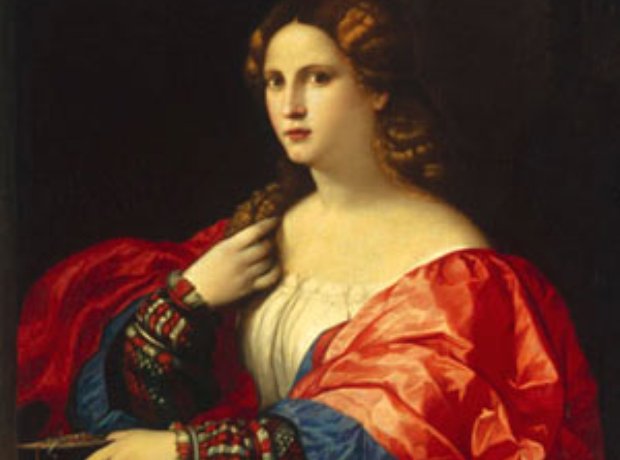
Francesca Caccini was born 18 September 1587 and was an Italian composer, singer, lutenist, poet, and music teacher of the early Baroque era. She was also known by the nickname “La Cecchina”, given to her by the Florentines and probably a diminutive of “Francesca”. She was the daughter of Giulio Caccini. Her only surviving stage work, La liberazione di Ruggiero, is widely considered the oldest opera by a woman composer.
Settimia Caccini
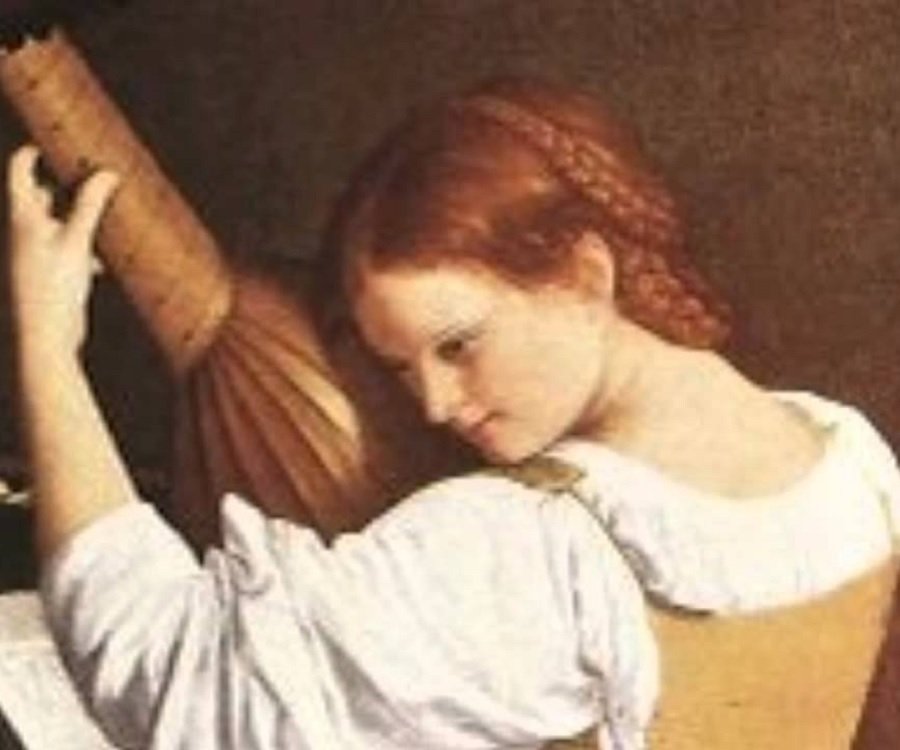
Born 6 October 1591 – ca. 1638, Italy, Settima was a well-known Italian singer and composer during the 1600s being one of the first women to have a successful career in music. Caccini was highly regarded for her artistic and technical work with music. She came from a family of well-known composers and singers, with her father being Giulio Caccini and her sister Francesca Caccini. Steam Caccini was less well-known as a composer because she never published her own collection of works. Instead, nine works are attributed to her in two manuscripts of secular songs. Settimia was known much more for her talent as a singer, and she performed for nobility with the Caccini family consort and as a soloist. Coming from a musical family, she was able to lead herself to her own fame and success.
See Also:
Giovanna Bassi - Ballet Dancer, Mother and Spy
Flowers, Theatre and Fashion - Fanny Abington
Julia Herdman writes historical fiction that puts women to the fore. Her latest book Sinclair, Tales of Tooley Street Vol. 1. is Available on Amazon – Paperback £10.99 and on Kindle Also available on:
Amazon Australia
Amazon Canada
Amazon New Zealand
Amazon South Africa
Amazon USA

by Julia Herdman | May 19, 2017 | Blog
Throughout her life, Florence Nightingale’s gift for mathematics was often to be a source of frustration for her. This was because many of those she sought to influence simple did not understand numbers. In 1891 she wrote that: “Though the great majority of cabinet ministers, of the army, of the executive, of both Houses of Parliament, have received a university education, what has that university education taught them of the practical application of statistics?”
Nightingale came to prominence while training and managing nurses during the Crimean War, where she organised the tending to wounded soldiers. She gave nursing a highly favourable reputation and became an icon of Victorian culture, especially in the persona of “The Lady with the Lamp” making rounds of wounded soldiers at night. She was revered more as a representative of the female carer than the promoter of scientific medicine.
Florence Nightingale was born on 12 May 1820 into a rich, upper-class, well-connected British family at the Villa Colombaia,in Florence, Italy, and was named after the city of her birth. Florence’s older sister Frances Parthenope had similarly been named after her place of birth, Parthenope, a Greek settlement now part of the city of Naples. The family moved back to England in 1821, with Nightingale being brought up in the family’s homes at Embley, Hampshire and Lea Hurst, Derbyshire.
As a young woman, Nightingale was described as attractive, slender and graceful. While her demeanour was often severe, she was said to be very charming and possess a radiant smile. Her most persistent suitor was the politician and poet Richard Monckton Milnes, but after a nine-year courtship she rejected him, convinced that marriage would interfere with her ability to follow her calling to nursing.
In 1853, Nightingale took the post of superintendent at the Institute for the Care of Sick Gentlewomen in Upper Harley Street, London, a position she held until October 1854. Her father had given her an annual income of £500 (roughly £40,000/US$65,000 in present terms), which allowed her to live comfortably and to pursue her career. A year later, on 21 October 1854, Nightingale and a staff of 38 women volunteer nurses that she trained arrived in Scutari, the base for casualties from the war being waged in Crimea between the British, France, The Ottoman Empire and Sardinia on one side and the Russian Empire on the other.
Immediately, Florence calculated that deaths from disease were seven times those arising in battle and used the information to campaign for better food, hygiene, and clothing for the troops. She persuaded the government to commission Isambard Kingdom Brunel to design a prefabricated hospital to be shipped out to Scutari, though it arrived after hostilities had ceased.
Upon returning to England, Florence continued her work and calculated that, even in times of peace, mortality among supposedly healthy soldiers, aged 25–35 and living in barracks, was double that of the civilian population. She wrote to Sir John McNeill (who was conducting the inquiry into the mismanagement of the Crimean campaign): “It is as criminal to have a mortality of 17, 19 and 20 per thousand in the line, artillery and guards, when that in civil life is only 11 per thousand, as it would be to take 1,100 men out upon Salisbury Plain and shoot them.”
She bombarded the commissioners with questions about the relationship between the death rates in barracks and such factors as the provision of water, sewerage, ventilation, accommodation, and food, using a ‘coxcomb’ chart (a sort of pie chart) to press home her points. She used her contacts to ensure that her views received publicity in newspapers. The commission reported in 1863, accepting most of her recommendations and Florence then used her royal connections to ensure that they were put into effect. Death rates fell by 75 percent.
Florence’s campaigns continued to the end of her life,1891. She didn’t get everything right. Her analysis of the 19th‑century cholera epidemics convinced her that they were caused by foul air, not polluted water and her influence was such that she probably hampered the fight against the disease. But, despite such miscalculations, she was certainly a passionate statistician and reformer.
Sources: Wikipedia, http://www.historyextra.com/article/people-history/florence-nightingale-nursing-numbers
Illustration: A portrait of Florence aged about 20 by August Egg.c. 1840.
Julia Herdman writes historical fiction that puts women to the fore. Her latest book Sinclair, Tales of Tooley Street Vol. 1. is Available on Amazon – Paperback and Kindle. Also available on:
Amazon Australia
Amazon Canada
Amazon New Zealand
Amazon South Africa
Amazon USA

by Julia Herdman | May 6, 2017 | Blog
Throughout her career as a writer, her wit and talent for satirical caricature were widely acknowledged: literary figures such as Dr Samuel Johnson, Edmund Burke, Hester Thrale and David Garrick were among her admirers. Her early novels were read and enjoyed by Jane Austen, whose own title Pride and Prejudice derives from the final pages of her novel Cecilia. William Makepeace Thackeray is reported to have drawn on the first-person account of the Battle of Waterloo, recorded in her diaries, while writing Vanity Fair.
Fanny’s first novel, Evelina or the History of a Young Lady’s Entrance into the World, was published anonymously in 1778, without her father’s knowledge or permission. It was unthinkable at the time that a young woman would deliberately put herself into the public eye by writing, and Burney had to commandeer the assistance of her eldest brother, who posed as its author to her publisher, Lowndes. Inexperienced in negotiating, Burney only received twenty guineas as payment for the manuscript.
I had great fun reading this book when I first started my researches into the lives of 18th century women.
 The novel was a critical success; admired for its comic view of wealthy English society, and for its realistic portrayal of working-class London dialects. It was even discussed by some characters in another epistolary novel of the period: Elizabeth Blower’s The Parsonage House published in 1780.
Evelina Book Review by Kate Howe The Book Nomad
The novel brought Fanny to the attention of patron of the arts Hester Thrale, who invited the young author to visit her home in Streatham. Though shy by nature, Fanny impressed those she met, including Dr Johnson, who would remain her friend and correspondent throughout the period of her visits, from 1779 to 1783. Mrs Thrale wrote to Dr Burney on 22 July, stating that: “Mr. Johnson returned home full of the Prayes of the Book I had lent him, and protesting that there were passages in it which might do honour to Richardson: we talk of it for ever, and he feels ardent after the dénouement; he could not get rid of the Rogue, he said.” Dr Johnson’s best compliments were eagerly transcribed in Fanny’s diary.
Burney went on to write three more best sellers: Cecilia: Or, Memoirs of an Heiress, 1782; Camilla: Or, A Picture of Youth, 1796; and The Wanderer: Or, Female Difficulties, 1814. Although her novels were hugely popular during her lifetime, Burney’s reputation as a writer of fiction suffered after her death at the hands of biographers and critics who felt that the extensive diaries, published posthumously in 1841, offered a more interesting and accurate portrait of 18th-century life. Today critics are returning to her novels and plays with renewed interest in her outlook on the social lives and struggles of women in a predominantly male-oriented culture. Scholars continue to value Burney’s diaries as well for their candid depictions of English society in her time.
Sources: Wikipedia

by Julia Herdman | May 4, 2017 | Blog
Anna Laetitia Barbauld, née Aikin; 20 June 1743 – 9 March 1825 was a prominent English poet, essayist, literary critic, editor, and children’s author. Anna was a “woman of letters” who published in multiple genres. Anna had a successful writing career at a time when female professional writers were rare. She was a noted teacher at the Palgrave Academy a school by English Dissenters run by Anna and her husband, Rochemont, 1774 to 1785 in Suffolk. The academy attracted parents who wished an alternative to traditional education for their sons.
Anna was born into the tradition of the so-called dissenting academies, as her father John Aikin taught first at Kibworth Academy, where she received a better education than most girls and women of the day, and then at the renowned Warrington Academy, known as “the Athens of the North” for its stimulating intellectual atmosphere. Rochemont Barbauld, the grandson of a Huguenot (French Dissenter), had been a pupil there.
Her marriage to Rochemont was viewed as an act of sacrifice by her friends and family. Prone to bouts of ‘insanity’ she did not want to make him more melancholic by refusing his offer. The couple spent eleven years teaching at Palgrave where Anna was not only responsible for running her own household but also the school’s; she was accountant, maid, and housekeeper. There she started to write ‘primers’ early text books. Her teaching materials remained popular for more than a century. She also engaged herself in politics through essays encouraging authors such as the abolitionist, poet and translator Elizabeth Benger to emulate her.
It seems that Barbaulds were concerned that they would never have a child of their own and in 1775, after only a year of marriage, they suggested that they should adopt one of Anna’s brother’s children. She wrote:
“I am sensible it is not a small thing we ask; nor can it be easy for a parent to part with a child. This I would say, from a number, one may more easily be spared. Though it makes a very material difference in happiness whether a person has children or no children, it makes, I apprehend, little or none whether he has three, or four; five, or six; because four or five are enow [sic] to exercise all his whole stock of care and affection. We should gain, but you would not lose.”
Eventually her brother conceded and the couple adopted Charles; it was for him that Anna wrote her most famous books: Lessons for Children (1778–79) and Hymns in Prose for Children (1781).
In September 1785, the Barbaulds left Palgrave for a tour of France; Rochemont’s mental health had been deteriorating and he was no longer able to carry out his teaching duties. In 1787, they moved to Hampstead where Rochemont was asked to serve as the minister at what later became Rosslyn Hill Unitarian Chapel. It was here that Anna became close friends with Joanna Baillie, the playwright. It was during this time, the heyday of the French Revolution, that Anna published her most radical political pieces. From 1787 to 1790, Charles James Fox attempted to convince the House of Commons to pass a law granting Dissenters full citizenship rights. When this bill was defeated for the third time, Anna wrote one of her most passionate pamphlets, An Address to the Opposers of the Repeal of the Corporation and Test Acts. Readers were shocked to discover that such a well-reasoned argument should come from a woman. In 1791, after William Wilberforce’s attempt to outlaw the slave trade failed, Anna published her Epistle to William Wilberforce Esq. On the Rejection of the Bill for Abolishing the Slave Trade, which not only lamented the fate of the slaves but also warned of the cultural and social degeneration the British could expect if they did not abandon slavery. In 1792, she continued this theme of national responsibility in an anti-war sermon entitled Sins of Government, Sins of the Nation.
Anna’s career ended abruptly in 1812 with the publication of Eighteen Hundred and Eleven, which criticised Britain’s participation in the Napoleonic Wars. The work received vicious reviews and she published nothing else during her lifetime. Her reputation was further damaged when many of the Romantic poets she had inspired in the heyday of the French Revolution turned against her.
Anna died in 1825, a renowned writer, and was buried in the family vault in St Mary’s, Stoke Newington. Afterwards, a marble tablet was erected in the Newington Green Chapel with the following inscription:
In Memory of ANNA LETITIA BARBAULD, Daughter of John Aikin, D.D.
And Wife of The Rev. Rochemont Barbauld, Formerly the Respected Minister of this Congregation.
She was born at Kibworth in Leicestershire, 20 June 1743, and died at Stoke Newington, 9 March 1825.
Endowed by the Giver of all Good With Wit, Genius, Poetic Talent, and a Vigorous Understanding
She Employed these High Gifts in Promoting the Cause of Humanity, Peace, and Justice,
of Civil and Religious Liberty,of Pure, Ardent, and Affectionate Devotion.
Let the Young, Nurtured by her Writings in the Pure Spirit of Christian Morality;
Let those of Maturer Years, Capable of Appreciating the Acuteness, the Brilliant Fancy, and Sound Reasoning of her Literary Compositions; Let the Surviving few who shared her Delightful and Instructive Conversation, Bear Witness That this Monument Records No Exaggerated Praise.
Source: Wikipedia
Illustration: Detail from Nine Living Muses of Great Britain by Richard Samuel (1779). From left: Elizabeth Carter, Barbauld gesturing, Angelica Kauffmann, Elizabeth Linley
Julia Herdman writes historical fiction that puts women to the fore. Her latest book Sinclair, Tales of Tooley Street Vol. 1. is Available on Amazon – Paperback £10.99 Kindle £2.29 Also available on:
Amazon Australia
Amazon Canada
Amazon New Zealand
Amazon South Africa
Amazon USA

by Julia Herdman | May 3, 2017 | Blog
Frances Barton or Frances “Fanny” Barton was the daughter of a private soldier and started her working life as a flower girl and a street singer. She performed in taverns and resorted to selling herself as many hard up women did in those days before she made it onto the stage. Her first step to success came when she got a job as a servant to a French milliner, there she learned about costume and acquired some French which afterwards stood her in good stead as she mingled in London’s high society.
Her first appearance on the stage was at Haymarket in 1755 as Miranda in Mrs Centlivre’s play, Busybody. Following that she became a member of the Drury Lane Company, where she was overshadowed by its more established actresses Hannah Pritchard and Kitty Clive. However she was ambitious and travelled to Ireland where she had her first major success Lady Townley in The Provok’d Husband by Vanbrugh and Cibber. She worked at her trade and five years late received an invitation from David Garrick to return to Drury Lane.
Fanny married her music teacher, James Abington, a royal trumpeter, in 1759. It was not a happy and the pair separated but she retained his name calling herself Mrs Abington. She remained at Drury Lane for eighteen years.

Mrs Abington as Miss Prue, Joshua Reynolds
Fanny played Mrs Teasel in Sheridan’s School for Scandal making the role her own. She also played Shakespearean heroines – Beatrice, Portia, Desdemona and Ophelia and the comic characters Miss Hoyden, Biddy Tipkin, Lucy Lockit and Miss Prue. Mrs. Abington’s Kitty in “High Life Below Stairs” put her in the foremost rank of comic actresses, making the mop cap she wore in the role the reigning fashion“. This cap was soon referred to as the “Abington Cap” and frequently seen on stage as well as in hat shops across Ireland and England. Adoring fans donned copies of this cap and it became an essential part of the well-appointed woman’s wardrobe. The actress soon became known for her avant-garde fashion and she even came up with a way of making the female figure appear taller. She began to wear a tall-hat called a ziggurat adorned with long flowing feathers and began to follow the French custom of putting red powder on her hair.

An example of Fanny’s influence on fashion - the high ziggurat style hat.
Sir Joshua Reynolds painted her as Miss Prue a character from Congreve’s Love for Love. The portrait is the the best-known of his half-dozen or more portraits of her. In 1782 she left Drury Lane for Covent Garden. After an absence from the stage from 1790 until 1797, she reappeared, quitting it finally in 1799. Her ambition, personal wit and cleverness won her a distinguished position in society, in spite of her humble origin.
Source; Wikipedia
Illustrations: Fanny Abington, Joshua Reynolds, Portrait of Marie-Dauncey,1789, James-Northcote, Fanny as Miss Prue, Joshua Reynolds.
Julia Herdman writes historical fiction that puts women to the fore. Her latest book Sinclair, Tales of Tooley Street Vol. 1. is Available on Amazon – Paperback £10.99 Kindle £2.29 Also available on:
Amazon Australia
Amazon Canada
Amazon New Zealand
Amazon South Africa
Amazon USA

Recent Comments