
by Julia Herdman | May 6, 2021 | Ancient Rome, Blog, Egypt, History & People
Why Did Cleopatra Kill Herself?

Juan Luna de San Pedro y Novicio Ancheta Public Domain.
Did Cleopatra wish to be noble in death, or did she fear public humiliation at the hands of Octavius Augustus?
The Death of Cleopatra VII, the last ruler of Ptolemaic Egypt, took place on the 10th or 12th August, 30 BC, in Alexandria. Cleopatra was just 39 years old. The closest contemporary accounts of her death are given by theGreek and Roman historians Strabo, Horace, Plutarch, Livy and Cassius Dio.
According to American art historian Robert Bianchi, conflicting accounts of Cleopatra’s suicide were in circulation almost immediately after her death. He also claims Octavian would have savoured the thought of parading the defeated Cleopatra through the streets of Rome. [1]
Suicide, i.e. deliberately killing one’s self, was practically unheard of in ancient Egypt. This makes the story told about the end of Cleopatra’s life all the more intriguing. Egyptians generally did not see suicide as a violation of their religious or legal codes, and there is no archaeological evidence of suicides in the ancient Egyptian civilization. However, literary texts such as ‘Desperate from Life’, an intellectual dialogue on despair, injustice, and corruption in the world, suggest some people certainly thought about ending their own lives. [2]

The Death of Cleopatra, Guido Cagnacci, Met Museum, Public Domain.
The famous judicial papyrus of Turin records the so-called Harem Conspiracy, a plot to murder Ramses III. The conspirators were given punishments ranging from execution, suicide, flogging, imprisonment, and severing of the nose, for their respective roles in the crime. Although we do not know precisely how individual conspirators were punished, it is likely members of the royal family were offered the dignity of suicide as an alternative to execution.
Suicide was, however, a regular feature of elite Roman life. Romans promoted the idea of”patriotic suicide.” In other words, death was preferable to dishonour. Suicide was explicitly illegal for soldiers, slaves, and people accused of capital crimes.
Plutarch’s account of Cleopatra’s Death [3]
 John Collier, Prado, Madrid. Public Domain.
On hearing of Antony’s defeat at Alexandria, Cleopatra took off to her tomb. ‘It is said that the asp was brought with those figs and leaves and lay hidden beneath them, for thus Cleopatra had given orders, that the reptile might fasten itself upon her body without her being aware of it. But when she took away some of the figs and saw it, she said: ‘There it is, you see,’ and baring her arm she held it out for the bite. But others say that the asp was kept carefully shut up in a water jar and that while Cleopatra was stirring it up and irritating it with a golden distaff it sprang and fastened itself upon her arm. But the truth of the matter no one knows; for it was also said that she carried about poison in a hollow comb and kept the comb hidden in her hair, and yet neither spot nor other sign of poison broke out upon her body.’
‘When they opened the doors of the tomb they found Cleopatra lying dead upon a golden couch, arrayed in royal state. And of her two women, the one called Iras was dying at her feet, while Charmion, already tottering and heavy-headed, was trying to arrange the diadem which encircled the queen’s brow. Then somebody said in anger: ‘A fine deed, this, Charmion!’ ‘It is indeed most fine,’ she said, ‘and befitting the descendant of so many kings.’ Not a word more did she speak, but fell there by the side of the couch.’
‘Moreover, not even was the reptile seen within the chamber, though people said they saw some traces of it near the sea, where the chamber looked out upon it with its windows. And some also say that Cleopatra’s arm was seen to have two slight and indistinct punctures; and this Caesar also seems to have believed. For in his triumph an image of Cleopatra herself with the asp clinging to her was carried in the procession. These, then, are the various accounts of what happened.’
‘But Caesar, although vexed at the death of the woman, admired her lofty spirit; and he gave orders that her body should be buried with that of Antony in splendid and regal fashion. Her women also received honourable interment by his orders. When Cleopatra died she was forty years of age save one, had been queen for two and twenty of these, and had shared her power with Antony more than fourteen. Antony was fifty-six years of age, according to some, according to others, fifty-three. Now, the statues of Antony were torn down, but those of Cleopatra were left standing, because Archibius, one of her friends, gave Caesar two thousand talents, in order that they might not suffer the same fate as Antony’s.’
Livy’s Account [4]

The Death of Cleopatra, Arthur Reginald Smith, Public Domain.
‘After Caesar had reduced Alexandria, and Cleopatra, to avoid falling in the victor’s hands, had died by her own hand, he returned to the city to celebrate three triumphs: one over Illyricum, a second for the victory at Actium, and a third one over Cleopatra; this was the end of the civil wars, in their twenty-second year.’
Livy wrote that when Octavian met Cleopatra, she told him frankly that “I will not be taken as an achievement.’ Octavian only gave the cryptic answer that her life would be spared. He did not offer specific details about his plans for Egypt or his royal family. When a spy informed Cleopatra that Octavian intended to take her to Rome to be presented as a prisoner in her Roman triumph, she decided to avoid this humiliation and took her own life at the age of 39; on August 30. Plutarch elaborates how Cleopatra approached his suicide in an almost ritual process that involved bathing and then a good meal that included figs brought in a basket. [ Book 133].
Strabo’s Account and Horace’s Ode [5]
“Nunc est bibendum” or “Now is the time for drinking”, sometimes known as the “Cleopatra Ode”, is one of the most famous of the odes of the Roman lyric poet Horace. Published in 23 BCE, it appeared as Poem 37 in the first book of Horace’s collected “Odes” or “Carmina.”
The poem tells to story of Octavian’s defeat of Mark Antony and Cleopatra at the Battle of Actium. Neither Cleopatra nor Mark Anthony is named in the poem. Some commentators say this is because loyal Horace prefers to describe the war as one between Egypt and Rome and not between two Roman families or civil war. Horace repeats the notion that Antony and Cleopatra killed themselves.
Horace concurs with Plutarch and Livy that Cleopatra died by her own hand as does Strabo.
Cassius Dio Account[6]
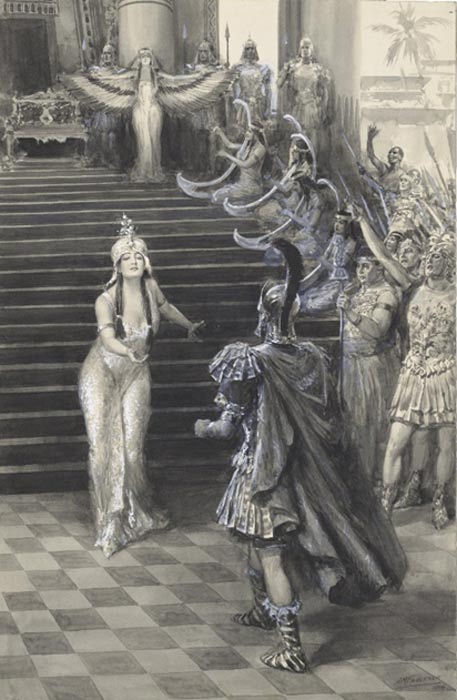
Cleopatra Meet Julius Caesar, Falkner: Public Domain
Cleopatra, on her part, unknown to Antony, sent to him (Octavian) a golden sceptre and a golden crown together with the royal throne, signifying that through them she offered him the kingdom as well; for she hoped that even if he did hate Antony, he would yet take pity on her at least. Caesar accepted her gifts as a good omen, but made no answer to Antony; to Cleopatra, however, although he publicly sent threatening messages, including the announcement that, if she would give up her armed forces and renounce her sovereignty, he would consider what ought to be done in her case, he secretly sent word that, if she would kill Antony, he would grant her pardon and leave her realm inviolate.
‘Upon hearing from the envoys the demands which Caesar made of them, sent to him again. Cleopatra promised to give him large amounts of money. Antony reminded him of their friendship and kinship, made a defence also of his connexion with the Egyptian woman, and recounted all the amorous adventures and youthful pranks which they had shared together. Finally, he surrendered to him Publius Turullius, who was a senator and one of the assassins of Caesar and was then living with Antony as a friend; and he offered to take his own life if in that way Cleopatra might be saved.
Caesar put Turullius to death, but this time also he gave no answer to Antony. So Antony despatched the third embassy, sending him his son Antyllus with much gold. Caesar accepted the money but sent the boy back empty-handed, giving him no answer. To Cleopatra, Octavian sent many threats and promises of love and loyalty alike, hoping to prevent her from destroying or absconding with the mountain of money she had stacked up in her tomb.
In the meantime, Octavian’s army proceeded to take the city of Pelusium in the delta. But believing Octavian’s protestations of affection, Cleopatra forbade the Alexandrians to rise against him, and so he took Alexandria as well. She clearly expected forgiveness, according to Cassius.
Antony, we are told, took refuge in his fleet and was preparing to give battle on the sea or, at any rate, to sail to Spain. When Cleopatra heard he was taking her ships, she ordered her sailors to desert and moved into her tomb, saying she feared Caesar and would thus take her own life. Cassius interprets this move as an act of betrayal to Antony. According to Cassius, Cleopatra’s cry for help would either make Antony rush to her side where she would kill him, or he would kill himself if he heard she had taken her own life. Either way, the wicked Cleopatra would ensure the end of the once noble Antony.
Cassius tells us that Antony went to the tomb dripping with blood because he had stabbed himself in the stomach when a friend refused to kill him. An implausible scenario, if you ask me. Why stab yourself before you go to rescue your wife and the mother of your children? Nevertheless, Cassius asks us to believe this and also that Antony died in Cleopatra’s arms in her tomb while she waited for Octavius to forgive her.
She embalmed Antony’s body and buried him. Then we are told Octavius removed anything she could use to kill herself from her apartment because he wanted her alive. A couple of sentences later, Cassius describes how Cleopatra redecorated the apartment, added a golden couch and draped herself upon it invitingly, thus ignoring her duty of mourning her dead husband, Antony. In Cassius’ eyes, Cleopatra was a fully paid up scheming slut.
Cleopatra, we are told, convinced Octavius she would travel to Rome with him while she planned her own demise. Her plan was to die as painlessly as possible. Cassius clearly thought she was a coward too. After putting on her best clothes and draping herself in symbols of royalty, she lay on her golden coach and killed herself.
Conclusions
The balance of evidence from the texts suggests Cleopatra died by her own hand. Such as death would have been perfectly acceptable and even honourable for a defeated queen in Egypt and in Rome.
In Doi’s version of her death, which is the most detailed, all the men are portrayed more honourably than her. This is the same Roman attitude to women who were considered to have transgressed sexually and betrayed their Imperial husbands as we see applied to Empress Messalina. It is straight forward misogyny.
A respectable woman in ancient Rome was required to keep a low profile. Women were supposed to be defined by their husbands, fathers, and sons. They were required to live faithful uncomplaining lives. Modesty and fidelity were the foremost virtues of a Roman woman – virtues Cleopatra clearly did not believe in either because she was not Roman or most probably because she was a queen in her own right and not a consort.
Whenever a Roman woman went out, assuming she was of noble birth, she would be chaperoned by slaves. She had to cover her body in a long gown called a stola, including her face. Over it, she wore a ‘palla’ or cloak. Indeed until the reign of Octavius Augustus, there were no statues of women at all. A noblewoman’s body was no business of anyone else except her husband. And, no respectable Roman woman would dare to be found lying around half-dress on a golden couch, especially when she was supposed to be mourning for her dead husband!
Valerius Maximus, writing in the century after Cleopatra’s death, gives several examples of errant women being ‘punished’ by their husbands. Egnatius Metellus, he tells us, bludgeoned his wife to death merely for drinking wine. Valerius tells his readers that far from being charged with murder, he received no public censure. According to Valerius, women needed to be kept under male control to stop them from scheming, as did Marcus Porcius Cato, otherwise known as Cato the Censor. [7]
It is possible Octavius might have paraded her at his triumph but unlikely. Working on the basis Cleopatra was not a ‘savage’ Gaul like Vertingeterex; and that she was the vanquished queen of the most culturally advanced nation on earth when she died, it is unlikely Augustus would have humiliated her. However, she was not a good example, so it was open season on her reputation for authors like Dio, whether she had died at her own hand or from a gnat bite.
Cleopatra - Waterhouse, Public Domain.
Sources
[1] LA Times, MIMI MANN, MARCH 15, 1992 12 AM PT
[2] Attitudes Toward Death and Suicide, HANKOFF L D, 1975, Pharos of Alpha Omega Alpha, v.38, no.2, (April 1975), p.60-64,75, SIEC No: 19840001
[3] Plutarch’s Lives, Tufts University.
[4] Livy, Periochae Book 133
[5] https://www.ancient-literature.com/rome_horace_odes_1_37.html#:~:text=%E2%80%9CNunc%20est%20bibendum%E2%80%9D%20(%E2%80%9C,Odes%E2%80%9D%20or%20%E2%80%9CCarmina%E2%80%9D.
[6] DIO’S ROMAN HISTORY, Book 51, THE LOEB CLASSICAL LIBRARY VI.
[7] Robert Garland, PhD, Colgate University, The Other Side of History: The Ideal Roman Woman, Great Courses Daily, 2021.
Academia.com Go to Bookshop Find me on Facebook Find me on Quora Find me on Linkedin
See Julia’s new book: Bedroom Diplomacy
Questions in Egyptology:
Questions in Egyptology 5: What was the punishment for Ancient Egyptians if caught tomb-robbing?
Questions in Egyptology No. 4: Did the Ancient Egyptians Have a Religion?
Questions in Egyptology No 3. Did the Egyptians Influence the Greeks?
Questions in Egyptology No. 2: How Long Did it Take to Mummify a Pharaoh?
Ancient Egypt - Cheapskate Coffin Makers

by Julia Herdman | May 2, 2021 | Blog
Did Anubis have a magic eye?
In popular and media culture, Anubis is often falsely portrayed as the sinister god of the dead. This version of Anubis gained popularity during the 20th and 21st centuries through books, video games, and movies. Artists gave him evil powers, including an evil eye, and a dangerous army. Despite his nefarious reputation, his image is still the most recognizable of the Egyptian gods, and replicas of his statues and paintings remain popular, somehow people are attracted to what they believe to be this ancient Egyptian god’s power over life and death. These factors are probably the origin of the ‘Eye of Anubis stories.’ There are plenty of examples of Eye of Anubis tattoo designs online.
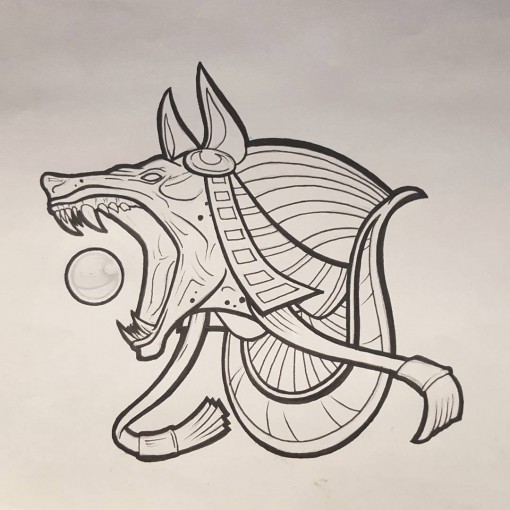
A popular website for tattooists explains the symbolism of the Anubis Eye. As a Jackal-headed figure, Anubis was the god of the dead and Afterlife. He symbolized the optimistic side of death, focusing on the peace, protection, and respect that come with it. Whereas the Eye of Horus: in ancient Egypt, Horus was the Sky God. As a tattoo design, Horus’ left eye symbolizes ‘the gift of life.’ The Eye of Ra, Horus’ right eye, symbolized the ultimate protection of the ‘eternal watcher.’ The god Anubis was the preeminent God of cemeteries and embalming, and hence an agent of resurrection – and so Anubis became connected with the good side of death in the Tattooist’s Dictionary.
The real Egyptian god Anubis is depicted in the form of a black canine of uncertain species with a collar and sash around his neck, or as a man with the head of such a canine. He was initially independent in his responsibility for the care of the corpse and the deceased’s transition to a new life in the other world; and was only gradually incorporated in the Osirian myth. Anubis became the protector of graves as early as the First Dynasty (c. 3100 – c. 2890 BC), and is shown performing the Opening of the Mouth ceremony in tomb art and papyri. He was also described as one of the guides of souls in the Afterlife along with Thoth and Hathor.
In the Middle Kingdom Coffin Texts, for example, Anubis is said to have been “caused to descend from the sky to put Osiris in order, because he [Osiris] was so highly regarded by Re and the Gods” I CT Spell 908. Anubis is at times affirmed to be the son of Re and can be given Hesat or Bast as his mother. However, Plutarch has him as the illegitimate son of Osiris and Nephthys.
So, Anubis is an old god but his origins are unclear. However, there are no references in the texts to him having a special or magical eye.
The Eye motif was however a powerful one in ancient Egypt.
Osiris’s name is written the hieroglyph of an eye. His name may have originally meant ‘He with many eyes.’
_jpg/111px-Egyptian_-_Pectoral_with_Scarab_-_Walters_4291_-_View_A_(2).jpg)
The Magic Eye of Re
 The sun god Re was described as having two eyes. His left eye was the moon in the shape of Shu, who is more usually described as the god of air or space; his right eye was the sun in the form of the lion-headed goddess Tefnut who is most often but erroneously described as a god of moisture. Shu was Re’s cool eye of reason, while Tefnut was his hot eye of vengeance together, they were ma’at. The cool eye of Shu is also known as the Eye of Horus or Wadjet (or Ujat, meaning “Whole One”) is a powerful symbol of protection in ancient Egypt, also known as the “all seeing eye“.
Shu is life and death; Shu was breath, the moon and yesterday, Re, was conceived of as today and as the sun he was born between the thighs of Nut, Tefnut was thought of as tomorrow, she is the god who smites Re’s enemies and scorches the land when she is unpacified.
The Magic Eye in the tomb of Pashedu (TT3)
Pashedu is believed to be a New Kingdom craftsman and the first member of his family to work in the artistic community at Deir el-Medina. His father, Menna, worked at the Temple of Amun. Pashedu began his career as a stonemason and was later promoted to foreman. He and his wife, Nedjembehdet had several children. In death he was honoured with the title, “Servant in the Place of Truth on the West of Thebes”. We know this because he decorated his tomb in the same way as that of his royal masters.
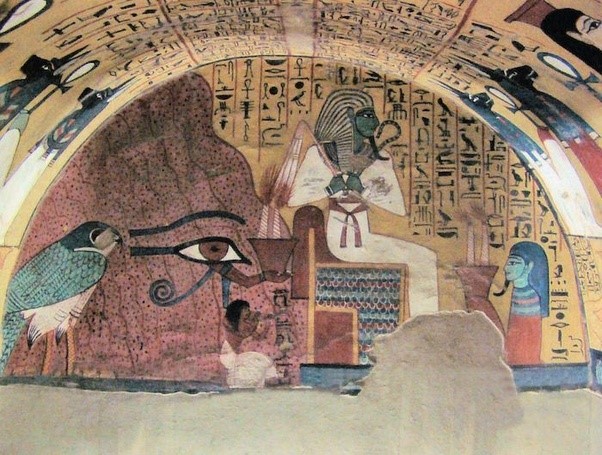
In the picture of his tomb above, we can see the libation bowl held by the Eye of Horus being filled with a strange substance emanating from Pashedu’s flail (Pashedu had represented himself as Osiris in the same way the king did in his tomb). The magical Eye is being filled. How this related to the Afterlife is revealed in my upcoming book.
Follow my posts to find out more.
Find me on Facebook
Find me on Quora
Find me on Linkedin
Go to Bookshop
Academia.com
See Also:
Questions in Egyptology 6: Did Anubis Have a Magic Eye?
Questions in Egyptology 5: What was the punishment for Ancient Egyptians if caught tomb-robbing?
Questions in Egyptology No. 4: Did the Ancient Egyptians Have a Religion?
Questions in Egyptology No 3. Did the Egyptians Influence the Greeks?
Questions in Egyptology No. 1 - The Cartouche - what did it protect?
Questions in Egyptology No. 2: How Long Did it Take to Mummify a Pharaoh?

by Julia Herdman | Apr 29, 2021 | Blog
New Book by Julia Herdman - Champollion - The Rosetta Stone
 What was the punishment for Ancient Egyptians if they were caught robbing tombs?
Well, it rather depended on who was doing the robbing.
Pharaohs robbed the graves of their long-dead ancestors for treasure in much the same way the Vikings robbed the Bronze Age barrows of the Boyne in Ireland. Caches of sarcophagi and mummies desecrated by Pharaohs of the New Kingdom were found in the late 19th century.
The burial of the Old Kingdom builder of the Great Pyramid of Giza, Khufu’s mother’s tomb was robbed just years after she was interred. Her son reburied her sarcophagus not knowing her body was missing. It had probably been removed so that the jewellery she was buried with could be removed.
No doubt there was a thriving black market for trinkets flitched from unguarded graves. Every self-respecting Egyptian wanted a good burial and a charm or two to help them reach the Afterlife. The tomb-robbery papyri suggest that most of the thieves were petty criminals, individuals of low or modest status as, for example, stonemasons, coppersmiths, and doorkeepers, lured by the prospect of instant riches. The audacity of the thieves of Thebes suggests that they had inside help in robbing tombs and funerary temples. Poorly paid officials and guards could be easily bribed. Most thieves were tradesmen who could melt down gold and silver or refashion an item to make it ‘new’ again. In an economy that ran on metal by weight and barter, it was easy to cut jewellry up and redeem its value for something else.
The sage Ipu-wer reflected upon the national distress which Egypt endured for nearly two centuries following the collapse of the Old Kingdom in these words:
Behold, the land turns round as does a potter’s wheel. The robber is a possessor of riches. [The wealthy man?] has become a plunderer. (2.8-9)
In acknowledgment of the evil done in those days by kings and princes who took advantage of the turmoil to pillage the tombs of their ancestors, a subdued king in that troubled time advised his son, Do not despoil the monument of another, but quarry stone in Tura. Do not build your tomb out of the ruins, (using) what had been made for what is to be made. As tombs were plundered and pillaged, mortuary cults and the endowments designed to perpetuate them were discontinued as the mortuary priests who administered them and made the funerary offerings abandoned their offices. It is at this time that the pyramid of Khufu was likely first violated when thieves found a way through the outer limestone casing and located the entrance. The entrance may have been sealed a number of times before rulers of the seventh-sixth century BCE fitted it with a door.
The scale of robbery suggests that the chances of being caught were pretty low. However, if caught the robber would be ‘taught a lesson.’
The Nauri Decree of Seti I specifies many punishments for various forms of theft, such as beating, the opening of wounds, forced labour, and amputation of the nose and ears. Take, for instance, the punishment for taking an animal belonging to the god’s estate, “punishment shall be done to him by cutting off his nose (and) his ears, he being put as a cultivator in the Foundation, *…+ and putting his wife (and) his children as serfs of (the) steward of this estate.” So, the whole family got punished. Officials caught cheating could get a beating of 200 lashes and 5 piercings.
The only crimes which we know for certain to have been punishable by death are high treason and stealing from the royal tombs, presumably because these were crimes against the pharaoh himself. Murderers would, most likely, also be executed, although there are no extant legal texts which involve murder. Death sentences are also mentioned occasionally in crimes that were committed against temples. It is, however, quite unsure whether capital punishments were consistently imposed in these cases. Other potential capital offenses are often listed in the literary sources, such as adultery within the Westcar Papyrus.
Go to Bookshop
Find me on Facebook
Find me on Quora
Find me on Linkedin
Academia.com
Sources:
Law and Order in Ancient Egypt, J.A Van Loon, Leiden University.
Robbing Pharaoh: Royal Tombs and the Underground Economy, Special Lecture to accompany exhibit of artifacts from Tutankhamun’s tomb at Dynamic Earth,. Sudbury, Ontario. August 2015; SSEA Symposium on Crime and Punishment in Ancient Egypt, Toronto, Nov. 1998 Sally Katary
See Also:
Questions in Egyptology No. 1 - The Cartouche - what did it protect?
Questions in Egyptology No. 2: How Long Did it Take to Mummify a Pharaoh?
Questions in Egyptology No 3. Did the Egyptians Influence the Greeks?

by Julia Herdman | Jul 28, 2019 | Blog
Did the ancient Egyptians have a religion, or did they worship cults?
Whether the ancient Egyptians had what we would call religion is a topic Egyptologists struggle with and disagree about.
What is Religion?
The word religion has a Latin origin. The ancient Egyptians had no word for religion and so the argument goes, therefore, they had no concept of religion. They also had no word of cosmos or art but they believed they lived in a god-made cosmos and they practiced all manner of arts. So, the absence of a word for something does not mean it did not exist.
Egyptologists take their lead on religion from anthropologists. This makes religion into the study of people, not the study of belief or spiritual beings and relationships with them. (Tylor, 1871). Tylor’s definition is not the most up-to-date. But it works. It provides a good definition of what most of us think of when we think about religion.
The anthropologist Edward Burnett Tylor (1832–1917) defined religion as belief in spiritual beings and stated that this belief originated as explanations of natural phenomena. … They used this by extension to explain life and death, and belief in the afterlife.
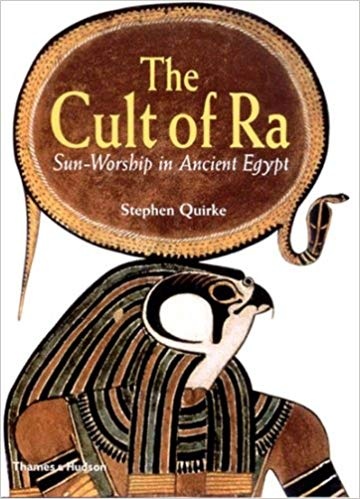
Book by Stephen Quirke https://www.amazon.co.uk/Cult-Ra-Sun-worship-Ancient-Egypt/dp/0500051070
What is a cult?
In Egyptology, the term cult means the daily tending and worship of an image of a deity. In ancient Egypt, the temples were the houses of the gods. The gods were thought to descend from the sky temporarily to live in their cult statues which were located in the temple’s inner sanctuaries.
The temples were also the stage for daily rituals that were ideally performed by the pharaoh, but in practice were performed by the resident priests. During religious festivals, cult statues could be brought out of the temple. For example at Dendera statues were brought out onto the cult terrace so that people could see them.
The Daily Cult Routine and Ceremonies
The shrine containing the god’s cult image was:
- opened at dawn,
- greeted and praised with prayers and hymns,
- purified with libations and the burning of incense,
- clothed in fresh linen, and
- fed with bread, cakes and water.
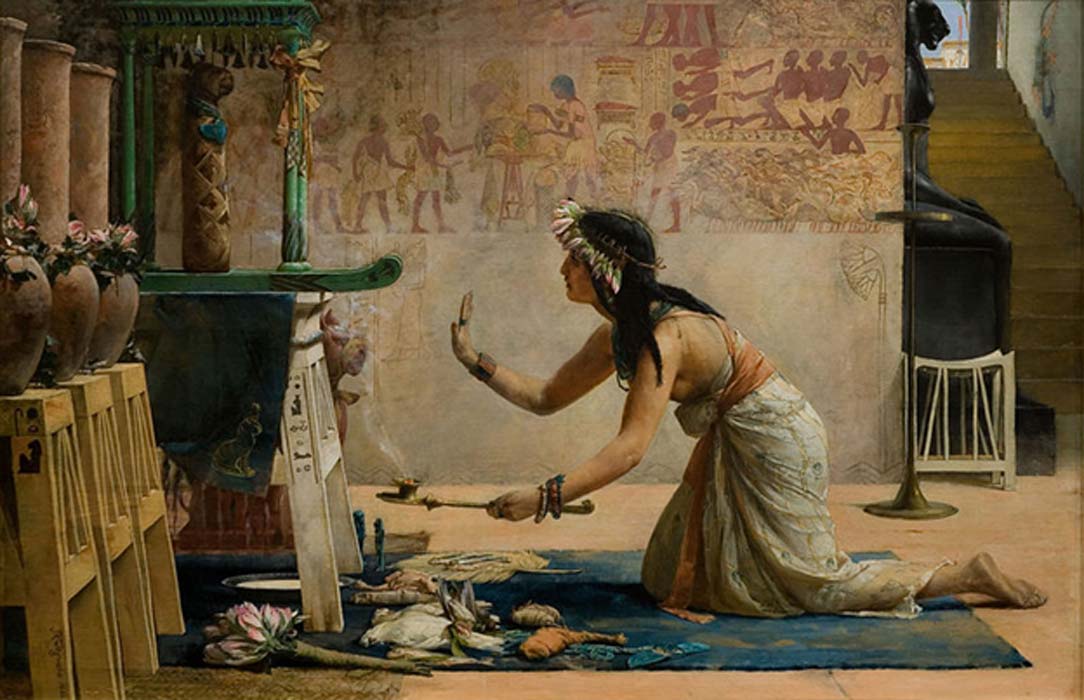
The Obsequies of an Egyptian Cat, John Reinhard Weguelin, 1886.
Every day at dawn the priests performed the ceremony of the creation of the cosmos. It began with a ritual called “Lighting the Fire.” This ritual was held in the most sacred room of the temple and was performed by the high ranking members of the priesthood in the name of the king. It was a reenactment of the first appearance,
and daily reappearance, of the sun.
Next, they performed a ritual known as “Drawing the Bolt.” During this rite, the priests opened the door to the shrine where the main cult statue stood. The statue’s clothing was removed; and underwent ritual purification, dressing, and feeding. The lower-ranking priests were responsible for preparing the ceremony and disposing of the food and water.
At midday, ceremonies of ritual purification for the lesser gods were performed and as the daylight faded the whole morning ceremony was reversed. The statues of the gods were closed again and left to sleep overnight ready for their morning awakening.
So, was there an ancient Egyptian religion, or was it a collection of cults?
When Jean François Champollion unlocked the secret code of Egypt’s most sacred language, hieroglyphs, in 1822 he unlocked many wonders of a long-hidden world. It was a world populated by strange and mysterious gods with human bodies and animal heads.
From the start, Egyptology committed itself to the study of Egypt’s ancient religion; particularly to its beliefs about life after death. But it has never agreed that the ancient Egyptians had a comprehensive worldview or ‘metaphysical moral vision’ that was accepted as binding because it was held to be in itself basically true and just even if all dimensions of it could not be either fully confirmed or refuted.
And so, since the translation of the ‘divine words’ Egyptology has fallen short in one important respect: it has failed to produce a description of the ancient Egyptian gods and religion that is in any way commensurate with the scale and impressiveness of its sacred monuments.
Egyptologists focused on words, almost to the exclusion of everything else. Buildings and monuments are the domain of the archaeologists; the wonderful art of the tombs and precious funeral artefacts found in them were the domain of art historians, and the anthropologists are processing ancient Egyptian religion through a variety of pan-world theories that render religion down to observable social behaviours.
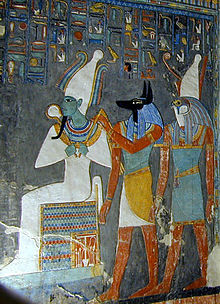
Enthroned Osiris judging the dead
The Gods
Today the gods and religion of ancient Egyptians are portrayed as mundane and soulless; there is no sense that the gods were holy, divine, or transcendent and certainly no sense that once people believed they contained the ultimate mystery of life, death and, the cosmos.
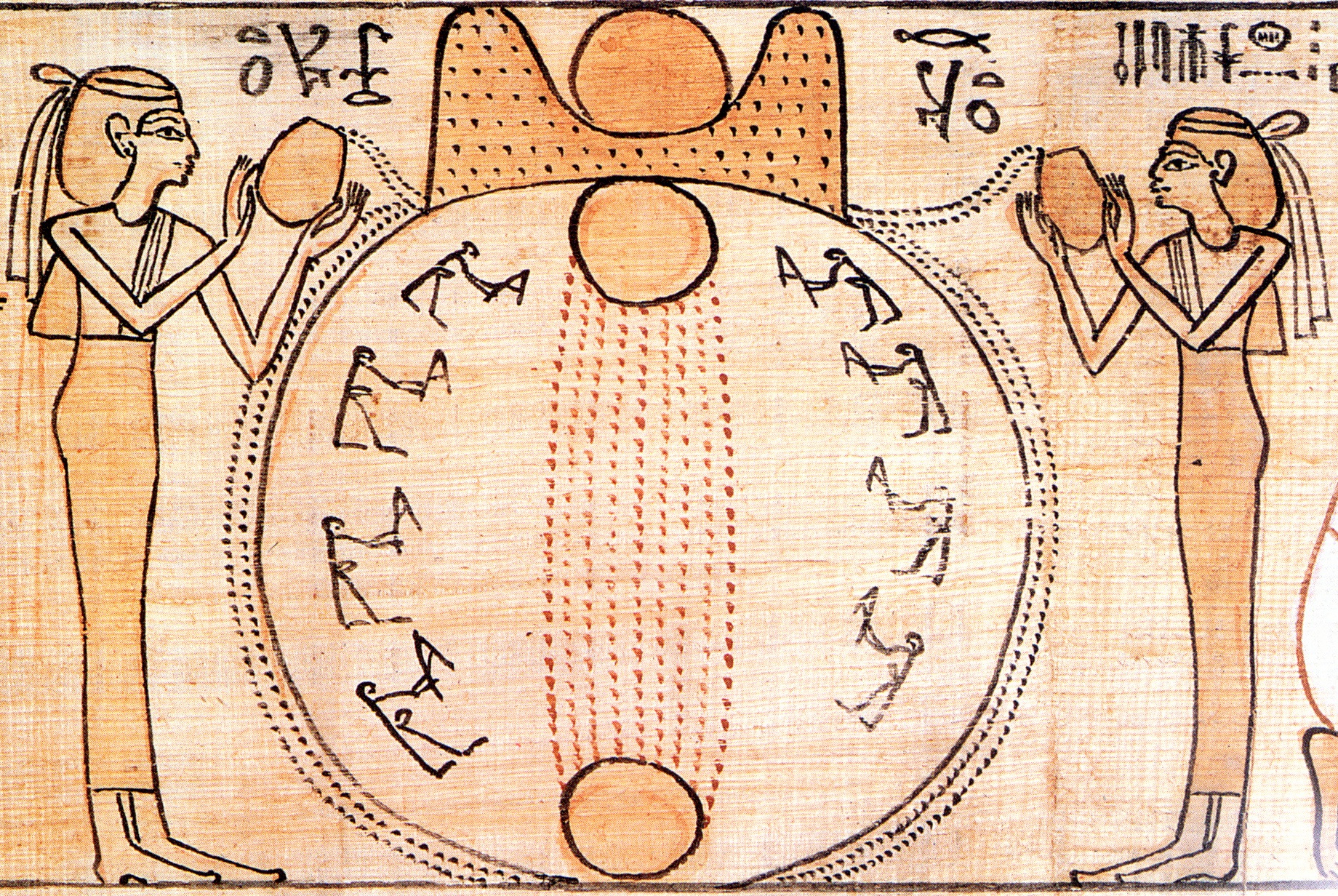
The sun rises over the circular mound of creation as goddesses pour out the primeval waters around it.
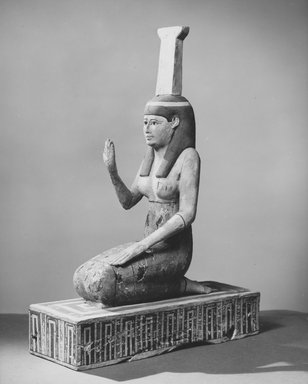
Brooklyn Museum A figure of the Goddess Nephthys
In ancient times, the gods were kept from common view, they were kept or made pure and special. This kept them sacred and helped people to believe the gods were powerful enough to help them fulfill their deepest needs and longings. But the gods were not just there to help when times were bad they filled people with both reverence and terror. What was sacred was protected and adored. Sacred spaces and objects represented the intersection between the limits of temporal human effort and the unlimited possibilities of the metaphysical.
Egyptian religion was not an individual means for orienting or transforming oneself in the world as religion is in the West today. Instead, it was a complex and rich human phenomenon that formed the mental architecture of the whole of society.
The King
In Egyptology, sacredness is believed to lie primarily in the person of the king; in his tomb, his temples and in his cult statue, in his images and in the ritual objects he used in sacred performances.
In theory, it was the pharaoh’s duty to carry out temple rituals, as he was the human link to the gods - his dead father and mother were believed to be gods and he himself would become a god when he joined them in the afterlife.
For the Egyptians, the king was the pinnacle of Egyptian society. He was the head of the state, their supreme warlord, and the chief priest of every god in the kingdom.
The ancient Egyptian king was believed to be the son of a god, chief priest, and mediator between the gods in heaven and the people on earth. So, in reality, his ritual duties were almost always carried out by priests.
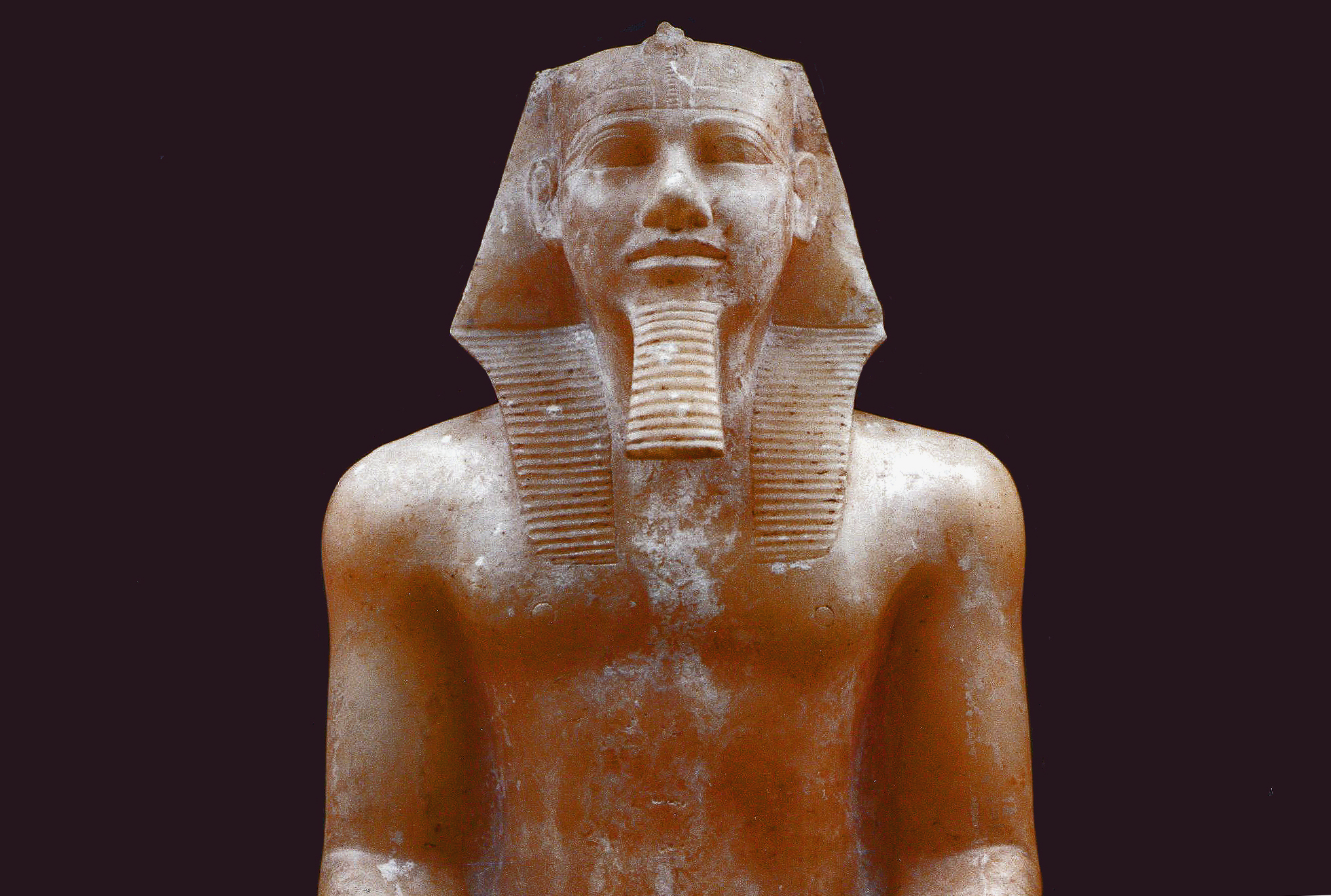
The picture above: Khafra (also read as Khafre, Khefren and Greek: Χεφρήν Chephren) was an ancient Egyptian king (pharaoh) of the 4th Dynasty during the Old Kingdom. He was the son of Khufu and the throne successor of Djedefre. According to the ancient historian Manetho, Khafra was followed by king Bikheris, but according to archaeological evidence, he was instead followed by king Menkaure. Khafra was the builder of the second-largest pyramid of Giza.
The Priests
The king’s priests were initiated into the sacred cults; they learned and maintained the sacred systems; its requirements, and its taboos; and they maintained the sacred order and the prevailing worldview among the non-literate. The concept of sacredness extended beyond the king to the natural world, to the river Nile, the sky, the sun, the moon, and the stars.
Once initiated, the priest led the community in connecting with the supernatural to access its divine benefits - health, good fortune, and life after death.
During the Old and Middle Kingdoms, government officials served as priests on a part-time basis. Full-time priests only appear in the New Kingdom.
The temple staff also included many people other than priests, such as musicians and chanters in temple ceremonies.
Outside the temple were artisans and other labourers who helped supply the temple’s needs, as well as farmers who worked on temple estates. All were paid with portions of the temple’s income. Large temples were therefore very important centres of economic activity, sometimes employing thousands of people.
There were many different types of priests:
- Male priests were known as hem-netjer, females as hemet-netjer or servants of the god. The top priest was the hem-netjer-tepi, or ‘first servant of god’.
- The wab priests, the lowest rank, did all the routine unskilled work in the temple.
- The hour-priests were astronomers.
- Sem priests presided over mortuary rituals and conducted funeral services.
- The Lector priest or hery-heb or cheriheb wrote the religious texts, instructed trainee clergy, and recited the prayers invoking the gods’ presence in the temple and at festivals. In ancient Egyptian literature, lector priests are often portrayed as the keepers of secret knowledge and the performers of amazing magical feats.
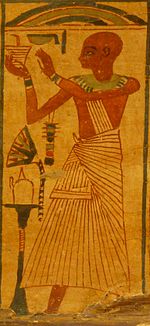
Sacerdote kher-heb
The Moral Vision
Evidence from the archaeological record shows that the ancient Egyptians believed they were responsible for their own moral behaviour. They believed, at least in some form, of what we would call ‘free will’. The gods, particularly Osiris, were the ultimate judges of people’s moral actions. Leading a moral life was the gateway to a second life beyond death and was called ma’at.
The average ancient Egyptian was a lover of life. He or she felt sure that right-doing brought success and happiness, whereas evil-doing was bound to bring failure. This social ethic covered all members of society. Family, friends, neighbours, village and town, the nation and foreigners too. Fair-dealing and benevolence were viewed as the leading virtues; greed was deemed the most pernicious vice.
In sum, the ancient Egyptian recognized the brotherhood of mankind.
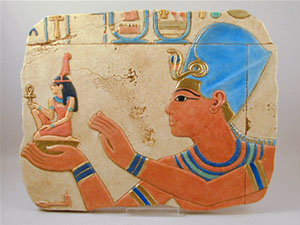
The presentation of ma’at
Conclusion
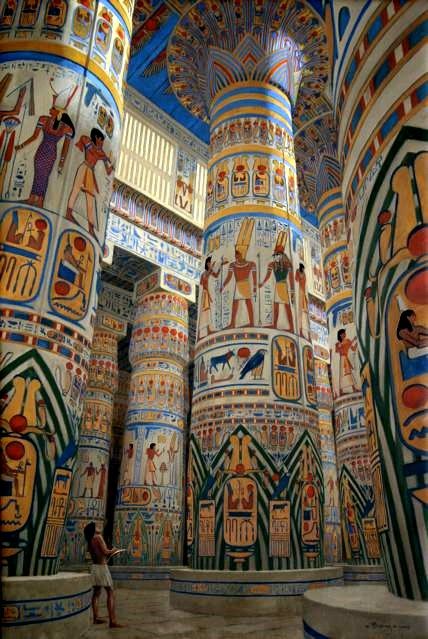
By understanding what was sacred to the ancient Egyptians it is possible to get a new view over ancient Egypt, a view that reveals the rich religious symbolism and philosophy of the world’s first great religion.
Egyptian religion was a very deep religion. It consisted of many levels of knowledge and participation.
Whether we could recreate this religion with all its rituals, ceremonies and mysticism is unlikely. It would be difficult to fool an ancient Egyptian into believing he/she was in a real temple, following a real service because there is so much we don’t know and perhaps will never know. However, I am sure the ancient Egyptians had a religion and that it was both deeply meaningful to them. After all, look what their beliefs inspired.
Go to Bookshop
Find me on Facebook
Find me on Quora
Find me on Linkedin
To Discover How Egypt’s Story Was Discovered
Read Champollion - The Rosetta Stone
A New Mini-History By Julia Herdman.
Buy it Now
#History, #historyhomework, , #historicalassociation, #historicalmaps, #historychannel, #historyprogrammes, #histoyquizquestions, #womens historynetwork, #womenshistorymonth, #histoyreview, #histoybooks, #historicacharacter, #historicafiction,#ebook, #ebooks, #free, #download, #girls, #bedroomhistory, #histoydegree, #historicfigures #historical, #non-fiction, #meaningof history, #definitionofhistory, #time, #bookshop, #books, #bookstoread, #bookshelf, #books4people, #romanticbooks, #historicalauthors, #online, #novels, #publishers, #novelists, #historysociety, #bestbooks2021, #bestbooks2020, #historicalnotes,#historic houses #classical #ancient #egyptology #archaeology #Greek #Roman #Egyptian
See also
Questions in Egyptology No 3. Did the Egyptians Influence the Greeks?
Questions in Egyptology No. 2: How Long Did it Take to Mummify a Pharaoh?
The Tragic Life of Annia Aurelia Galeria Lucilla

by Julia Herdman | Jul 21, 2019 | Blog
I know that the generally accepted academic view is that the ancient Egyptians had no influence on the development of Greek mathematics, philosophy and cosmology.
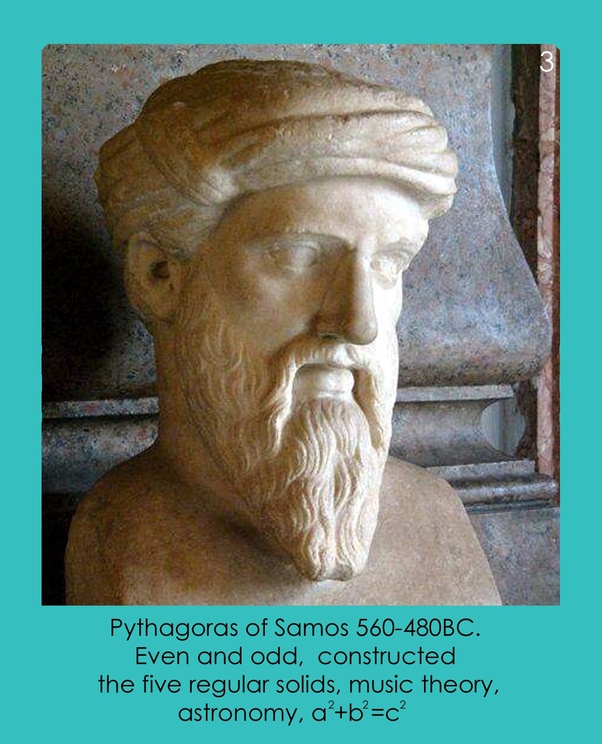
But I believe there is evidence, that has been overlooked by the mainstream. This evidence shows the Greek mathematicians and philosophers such as Meltis, Pythagoras (or the Pythagorean cult I know the character we call Pythagoras probably never existed) and Plato were all influenced by what they learned about numbers in Egypt.
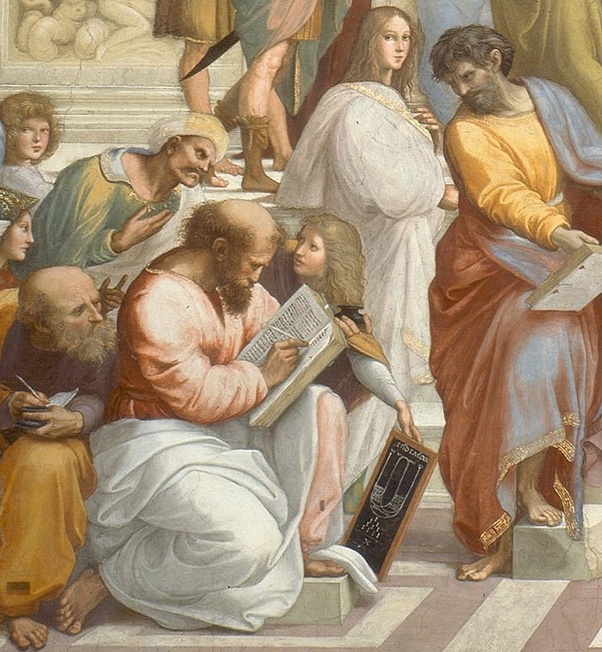
In Raphael’s fresco The School of Athens, Pythagoras is shown writing in a book as a young man presents him with a tablet showing a diagrammatic representation of a lyre above a drawing of the sacred tetractys.
The Academics do not Understand
The reason Egypt’s contribution to the development of mathematics and Western culture has been misunderstood is because academics do not understand what the ancient Egyptians did with numbers. They have decided Egyptian numbers were used in a purely profane way, meaning to quantify stuff or put things in numerical order. However, there is a good deal of evidence that the ancient Egyptian also used numbers as metaphors to describe the cosmos. I’m working on a book about numbers as metaphors for what was sacred in ancient Egypt, and the evidence is compelling. Well, I can hear you say. ‘She would say that wouldn’t she.’ But I think when the book comes out a lot of people will agree.
In the ancient Greek civilisation where the first philosophers attempted to explain the creation of the Universe, the hymns of mysticist Orpheus proved to be of significant importance. These myths introduced the term ‘Chaos’ to our vocabulary. This is another reason Egyptian cosmology has not been understood. The Greek notion of chaos has been superimposed onto the ancient Egyptians whose prima materia was not chaotic but inert, dark, limitless, timeless and without form.
According to Orpheus, Chaos condensed into the giant Cosmic Egg, whose rupture resulted in the creation of Phanes and Ouranos and of all the gods who symbolise the creation of the Universe. Later, Greek philosophers supported the view that chaos describes the unformed and infinite void, from which the Universe was created.
Engraving of a marble relief of Phanes.jpg. From Wikimedia Commons …
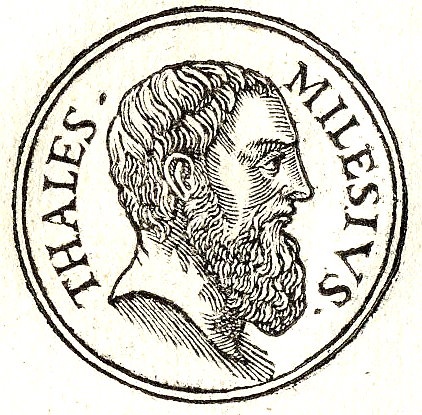
After visiting Egypt, so his biographer said, Thales of Miletus (624/623 – c. 548/545 BCE) claimed that the Earth floats on water and that earthquakes occur when the Earth is rocked by waves, an idea he probably picked up in Egypt where they believed all of creation came out of the infinite waters of the Nun and where the Earth was believed to be surrounded by the water of Nun.
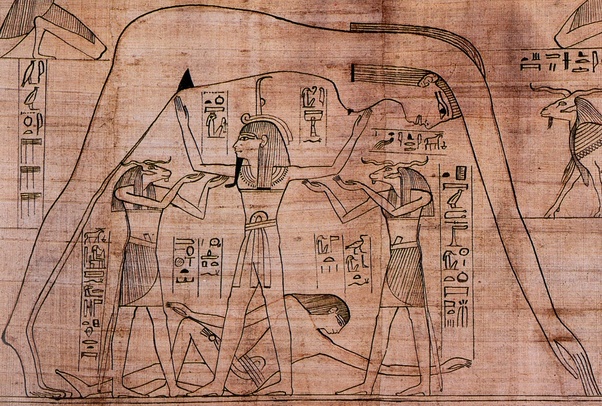
Thales was also known for his innovative use of geometry. For example, he said: Megiston topos: apanta gar chorei (Μέγιστον τόπος· ἄπαντα γὰρ χωρεῖ.) The greatest is space, for it holds all things. Again this is an idea he may have learned about in Egypt. The ancient Egyptian god Shu was the god of space or emptiness. Shu held the bubble of air that contained the Earth in the ancient Egyptian cosmology. Shu’s role in creating the triangle of creation occurred when he mythically lifted the body of the goddess Nut to form the vault of the sky, beneath him lay the body of the Earth god Geb. Flinders Petrie was the first to notice that the King’s Chamber of the Great Pyramid of Giza was based on a 3–4–5 pyramid, built c. 2,500 BCE and this may be why it’s there.
Wikimedia: Nut forming the arc of the heavens, Shu supported by Khumn in the centre, and Geb in a prone position lying on the Earth.
Mathematically, topos, Newtonian-style space, is connected with the verb, chorei. This word has the connotation of yielding before things or spreading out to make room for them, which is ‘extension’. Within this extension, things have a position. Points, lines, planes and solids related by distances and angles follow from this presumption. Thales’ understanding of triangles may have started in Egypt where the triangle is an enduring feature of their architecture and creation myths. However, unlike the Egyptians who used triangles for sacred things. Thales may well have taken what he learned about Egyptian sacred space and used in a more practical way. It is said that he measured the height of the pyramids by their shadows at the moment when his own shadow was equal to his height. This is possible because a right triangle with two equal legs is a 45-degree right triangle, all of which are similar. The length of the pyramid’s shadow measured from the centre of the pyramid at that moment must have been equal to its height.
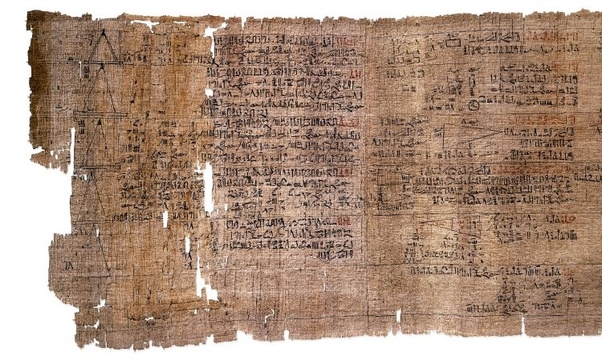
Thales use of the right-angled triangle is a clear indication he was familiar with the Egyptian seked, or seqed, the ratio of the run to the rise of a slope (cotangent). The seked is at the base of problems 56, 57, 58, 59 and 60 of the Rhind Mathematical Papyrus which dates to the Second Intermediate Period of Egypt. It was copied by the scribe Ahmes (i.e., Ahmose; Ahmes is an older transcription favoured by historians of mathematics), from a now-lost text from the reign of King Amenemhat III (12th dynasty).
Wikimedia Commons: Rhind Mathematical Papyrus
Pythagoras of Samos (c. 570 – c. 495 BC)
Pythagoras was an ancient Ionian Greek philosopher and the eponymous founder of Pythagoreanism. His political and religious teachings were well known in Magna Graecia and influenced the philosophies of Plato, Aristotle, and, through them, Western philosophy.
According to Aristotle, the Pythagoreans used mathematics for solely mystical reasons. Their use of number was devoid of all practical application. They believed that all things were made of numbers.
The number one (the monad) represented the origin of all things.
The number two (the dyad) represented matter.
The number three was an “ideal number” because it had a beginning, middle, and end and was the smallest number of points that could be used to define a plane triangle, which they revered as a symbol of the god Apollo.
The number four signified the four seasons and the four elements.
The number seven was also sacred because it was the number of planets and the number of strings on a lyre, and because Apollo’s birthday was celebrated on the seventh day of each month.
They believed that odd numbers were masculine, that even numbers were feminine, and that the number five represented marriage because it was the sum of two and three.
Ten was regarded as the “perfect number” and the Pythagoreans honoured it by never gathering in groups larger than ten. Pythagoras was credited with devising the Tetractys, the triangular figure of four rows which add up to the perfect number, ten.
The Tetractys
The Tetractys was made using counting stones (psēphoi). Four rows of stones were placed one above another in the shape of an equilateral triangle. The equilateral triangle was considered a perfect figure.
The Pythagoreans regarded the Tetractys as a symbol of utmost mystical importance.
Iamblichus, in his Life of Pythagoras, states that the Tetractys was “so admirable, and so divinised by those who understood [it],” that Pythagoras’s students would swear oaths by it. As a mystical symbol, it was very important to the secret worship of Pythagoreanism.
Pythagorean cosmology was based on the assumption that the cosmos is harmoniously ordered according to mathematical rules. For the Pythagoreans, the Tetractys expressed the universal harmony of the cosmos. Therefore, some Pythagoreans assumed that there must be ten celestial bodies in motion.

The Tetratys
Modern scholars debate whether these numerological teachings were developed by Pythagoras himself or by the later Pythagorean philosopher Philolaus of Croton.
I believe Pythagoras whoever he was, and his followers developed the Tetractys after visiting Egypt.
The Pythagorean Mystery Numbers are not exactly the same as the meaning of the Egyptian sacred numbers I have discovered but I believe the Pythagoreans got the idea of modelling the universe with numbers from the Egyptians. I will show how they did it in the book I’m working on with the working title, ‘The Numbers of Thoth’ by Julia and Martin Herdman.
Short Bibliography
Imhausen, A. (2016). Mathematics in Ancient Egypt, A Contextual History. Princeton University Press
Rossi, C. (2004). Architecture and Mathematics in Ancient Egypt. Cambridge University Press.
Smith, D. (1958). The History of Mathematics: Volume II. Dover.
Thomas, I. B. (1983). Plato’s Theory of Number. The Classical Quarterly, 375-384.
Zhmud, L. (1989). Pythagoras as a Mathematician. Historia Mathematica, 249-268.
Academia.com
Go to Bookshop
Find me on Facebook
Find me on Quora
Find me on Linkedin
See Also:
Forty years of documenting the Great Sphinx of Giza
Ancient Egypt - Cheapskate Coffin Makers
Getting the Pharaoh to the Afterlife
Garden Paintings in Tombs
#History, #historyhomework, , #historicalassociation, #historicalmaps, #historychannel, #historyprogrammes, #histoyquizquestions, #ebooks, #histoydegree, #historicfigures #historical, #non-fiction, #meaningof history, #definitionofhistory, #time, #bookshop, #books, #bookstoread, #bookshelf, #books4people, #romanticbooks, #historicalauthors, #online, #novels, #publishers, #novelists, #historysociety, #bestbooks2021, #bestbooks2020, #historicalnotes,#historic houses #classical #ancient #egyptology #archaeology #Greek #Roman #Egyptian #mathematics #arithmetic #numbers #historyofmathematics #alternativehistory #alternativearchaeology #alternativeegyptology #numbermysticism #sacrednumbers #pythagoras, news,

by Julia Herdman | Jul 5, 2019 | Blog, Egypt
How Long Did it Take to Mummify a Pharaoh?
The preservation of the body, or mummifying, was an essential part of ancient Egyptian funerary belief and practice. The burial customs began with wrapping the body either in a mat or animal skin to prevent direct contact with the sand and to hold the parts of the body together.
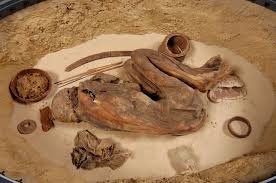
The ancient Egyptians were terrified of the disintegration of the body. The hot sand drew out the body’s liquids to aid its preservation. This kind of preservation is known as “natural mummification,” meaning that preservation was carried out without human intervention.
Natural mummification
The practice of embalming or mummifying aimed to improve on what nature could do on its own. It was considered essential to mummify a Pharaoh. Early mummification involved the wrapping of specific parts of the body such as the face and hands. The best literary account of the mummification process is given by Herodotus, an ancient Greek historian. He records that the entire process took seventy days. There were 30 days of evisceration and drying and 40 days of perfecting with stuffing and embalming with oils.
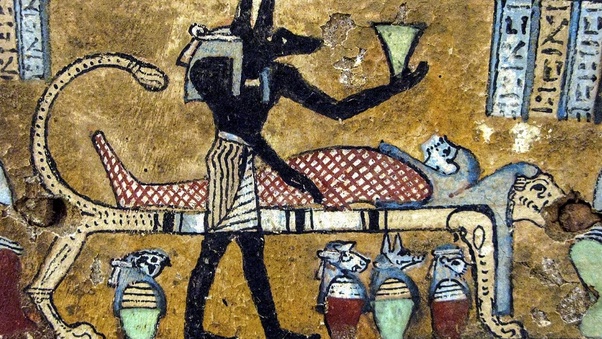
Anubis, with the deceased on the lion bed of resurrections, beneath the four canopic jars face right, Anubis offers a libation.
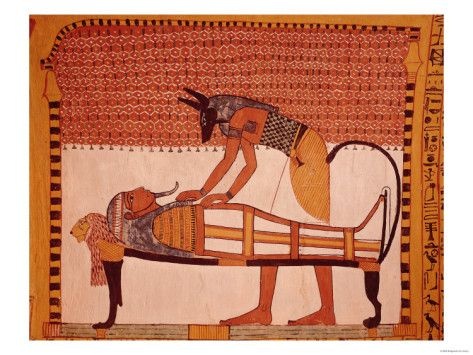
Anubis was the god responsible for embalming, especially for the Pharaoh. The Pyramid Texts describe Anubis as the Pharaoh’s (Osiris’s) embalmer. “His entrails having been washed by Anubis; the services of Horus having been served in Abydos, [even] the embalming of Osiris”It is clear from this passage that the god Anubis had responsibility for washing the viscera of the deceased king. Egyptologist Bob Brier (1996) has suggested that embalming took place in a tent that was erected on the top of a hill away from the unpleasant smell that resulted from the process of treating the dead bodies. This suggestion is based on the titles of god Anubis that often occur in the offering formulae and the Pyramid Texts “Anubis, who presides in the sh-ntr” (896c), his tent. “He who is upon his hill (tp dw.f). the sh-ntr, which is translated as a “divine booth” (Wb. III, 465), was the place where the bodies of the kings were purified. The tent is described in various texts. it had a number of rooms, the central part of the tent was the place where the purification procedures were carried out. The doorways were shown as closed wooden doors (Merrewka), or curtains as in the tomb of Qar, or they were left open as in the tomb of Idu. There was a central ramp: In each tent, there was a central ramp, which connected the tent to a water channel.
Anubis mummifies the Pharaoh in his tent.
To mummify the body, the internal organs, apart from the heart and kidneys, were removed via a cut in the left side. The organs were dried and wrapped and placed in canopic jars, or later replaced inside the body. The brain was removed, often through the nose, and discarded. Texts suggest that the heart was removed during the Old Kingdom, although there is no proof this from the physical bodies. In a passage in the Pyramid Texts, the heart is removed from the body. The passage (1162a), which might be referring to putting a heart amulet in place of the original heart, reads: “To say: my father made for himself his heart, after the other (heart) was taken from him” In this passage, the word “other” could be a reference either to the god giving another heart to the deceased, or providing a heart amulet in its place.
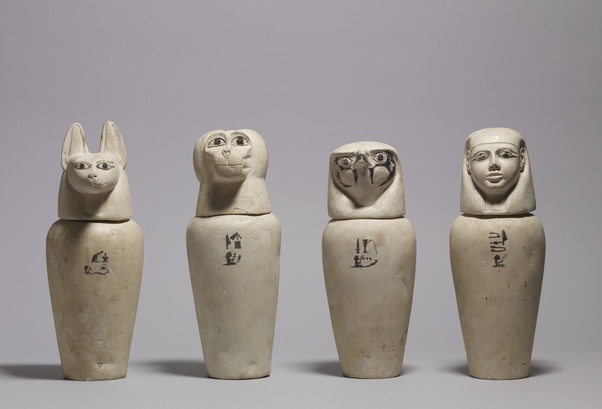
The canopic jars.
Bags of natron or salt were packed both inside and outside the body and left for forty days until all the moisture had been removed from the remaining body tissue. The body was then cleansed with aromatic oils and resins and wrapped with bandages, often household linen torn into strips. Between the layers of wrapping, the embalmers place amulets to protect the deceased. Heart scarabs were placed in the wrappings with the mummy. They had spells carved on them to protect the deceased person’s heart from being lost or separated from the body in the underworld.
The canopic jars were used to store the soft tissue. “Anubis, who is the chief of the divine booth (sh-ntr), has commanded thy purification with thy eight nmst-jars and [thy] eight ‘3bt-jars, which come from the sh-ntr ” (2012b-c ). By the New Kingdom, there were only four jars. The lids of canopic jars represented gods called the ‘four sons of Horus’. These gods protected internal organs. Duamutef the jackal-headed god looks after the stomach Hapy the baboon-headed god looks after the lungs Imsety the human-headed god looks after the liver. Qebehsenuef the falcon-headed god looks after the intestines.
Scientific analysis of mummies using processes such as X-ray and CT scanning has revealed a wealth of information about how individuals lived and died. It has been possible to identify conditions such as lung cancer, osteoarthritis and tuberculosis, as well as parasitic disorders.
Sources:
British Museum website, Mummification in The Old Kingdom By Ahmed Saleh and, #ancientegypt #ancienthistory #anubis #pyramids #mummification #ancientegyptianmummies
Academia.com
Go to Bookshop
Find me on Facebook
Find me on Quora
Find me on Linkedin
Champollion By Julia Herdman
Buy Now
See Also:
Questions in Egyptology 6: Did Anubis Have a Magic Eye?
Questions in Egyptology 5: What was the punishment for Ancient Egyptians if caught tomb-robbing?
Questions in Egyptology No. 4: Did the Ancient Egyptians Have a Religion?
Questions in Egyptology No 3. Did the Egyptians Influence the Greeks?
Questions in Egyptology No. 2: How Long Did it Take to Mummify a Pharaoh?

Recent Comments