The Tragic Annia Aurelia Galeria Lucilla was born around 150 AD.
Her father was the Roman Emperor Marcus Aurelius, her mother the Empress Faustina the Younger. Lucilla was the elder sister of Emperor Commodus.
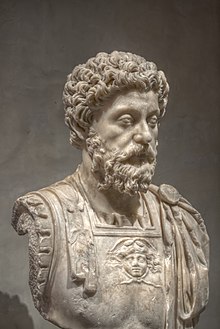
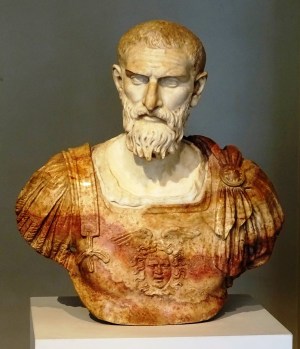
A marble bust of Marcus Aurelius at the Musée Saint-Raymond, Toulouse, France
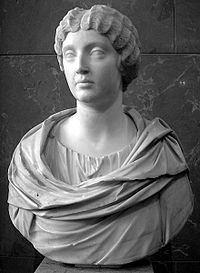
Faustina the Younger
A character loosely based on Lucilla was the love interest to Russell Crowe in the blockbuster film Gladiator in 2000. The film was directed by Ridley Scott.
In the film, the character based on Lucilla was played by the Danish actress Connie Nielsen. Crowe portrays the Hispano-Roman general Maximus Decimus Meridius, the man betrayed by Commodus.
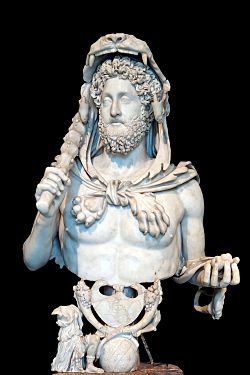
Bust of Commodus as Hercules, hence the lion skin, the club and the golden apples of the Hesperides. Part of a statuary group representing Commodus’ apotheosis.
Reduced to slavery, the character Maximus rises through the ranks of the gladiatorial arena to avenge the murders of his family. That, of course, was fiction. If you haven’t seen the film, try the clip below. The film’s great by the way.
Back to Real Life
Lucilla’s Marriages
The real Lucilla was married her father’s dashing co-ruler Lucius Verus in 164 CE when she was just 14.
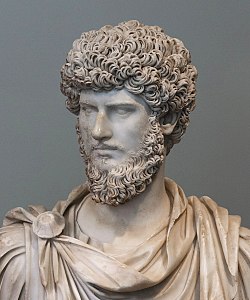
Lucius Aurelius Verus (15 December 130 – 23 January 169) was Roman emperor from 161 until his death in 169, alongside his adoptive brother Marcus Aurelius. He was a member of the Nerva-Antonine dynasty. Verus’ succession together with Marcus Aurelius marked the first time that the Roman Empire was ruled by multiple emperors.
Her husband was 18 years her senior. On her wedding day, the groom would have led a procession to her family home, where she and her bridesmaids were waiting to meet him. She would be wearing a tunica recta — a white woven tunic — belted with an elaborate “Knot of Hercules.”
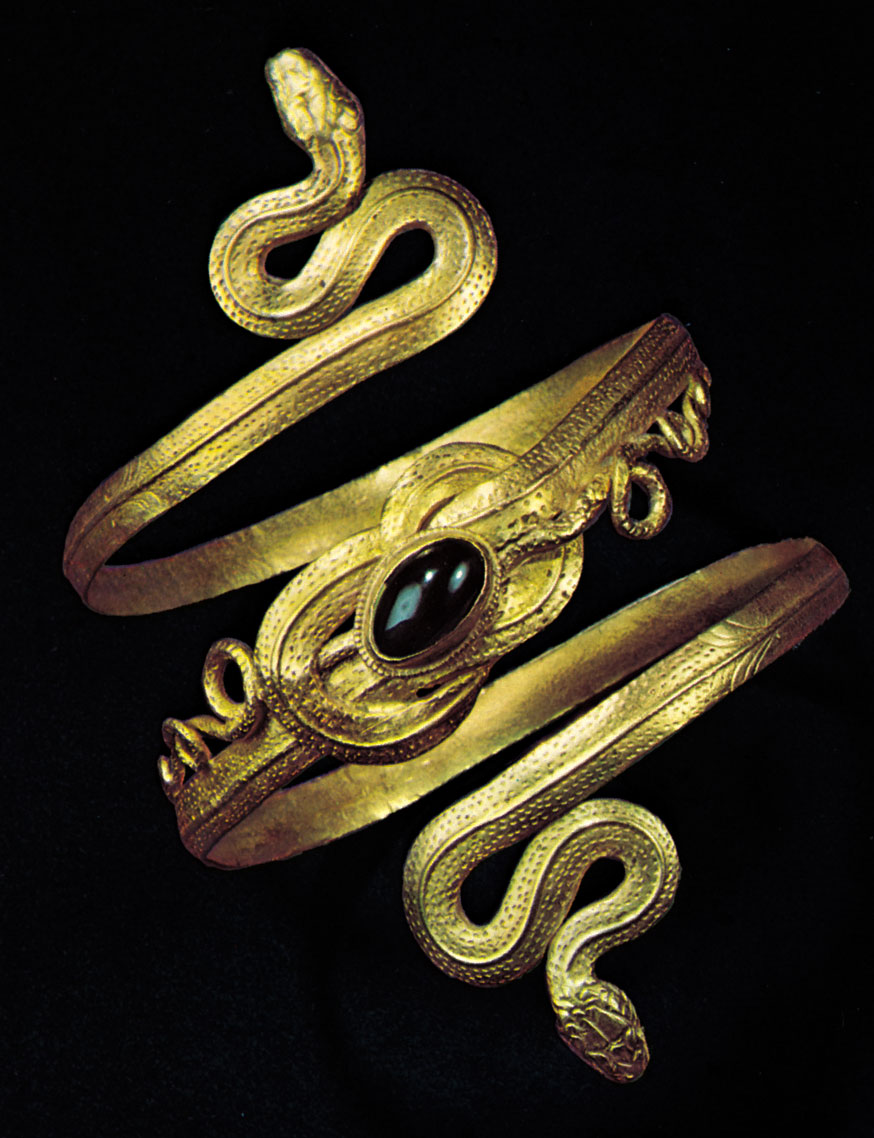
The marriage knot or knot of Hercules ( a reef knot, or square knot), originated as a religious symbol in ancient Egypt but is best known as a wedding symbol, incorporated into the protective girdles worn by brides, which were ceremonially untied by the new groom on the wedding night. This custom is the likely origin of the phrase “tying the knot.” According to Roman lore, the knot symbolized the legendary fertility of the God Hercules and the legendary power of Girdle of Diana captured from the Amazon Queen Hippolyta. Both are symbols of the moon, the ancient symbol of fertility.
Greek gold spiral bracelet of two snakes whose tails are tied in a Hercules knot that is decorated with a garnet in a bezel setting; in the Schmuckmuseum Pforzheim, Germany.
Lucilla would have carefully arranged hair and would be wearing a red wedding veil, a flammeum and red shoes to show that she was full of life and for good luck. After the marriage contract was signed, there was an enormous feast. The day ended with a noisy procession to the couple’s new home where her husband would carry his new bride over the threshold. Upon marriage, Lucilla received the title of Augusta and became a Roman Empress.
Bust of Lucius Verus at the Metropolitan Museum of ArtMarriage at such a young age was normal in the Roman world. Early marriages led to an astonishingly high death rate among the aristocracy. Even today a woman getting pregnant in her early teens runs higher risks than a more mature woman. Today’s teenage mums often suffer hyperemesis gravid arum or severe vomiting and dehydration, eating disorders, anaemia, bleeding, and pre-eclampsia during pregnancy. Most find giving birth and breastfeeding difficult due to their physical immaturity.
Lucilla gave Lucius three children: Aurelia Lucilla was born in 165 in Antioch, Lucilla Plautia and Lucius Verus. Aurelia and another boy died young.
After Lucius Verus died, in 169, her father arranged a second marriage for her. This time it was to Tiberius Claudius, a Syrian Roman general who distinguished himself during Rome’s wars against the Parthians and the Marcomanni. Quintianus was a hero amongst his men but he was at least twice Lucilla’s age. Nevertheless, they were married in 170 CE.
Tiberius Claudius Pompeianus (Museo Archeologico Nazionale di Venezia)
After the death of her mother Faustina her father honoured Lucilla as Emperess, an honour continued by her brother Commodus until he married. Lucilla Quintianus a son named Pompeianus.
Find out more: https://www.redbubble.com/people/greenlillies/shop?asc=u
Her Cowardly Brother
The Roman historian Cassius Dio wrote that Commodus ‘was not naturally wicked, but, on the contrary, was as guileless as any man that ever lived.’
Commodus was nineteen years old when his father died. He was the 10th of 14 children and the only male to survive. He was the anthesis of his father, Marcus because he was simple and cowardly and a slave to his companions.
Commodus was a very handsome man, with clear eyes and curly hair that was naturally blond. Dio claims he was left-handed and was very proud of this fact, but busts of Commodus as Hercules show him with a club in his right hand. Left-handedness was frowned upon in antiquity – as the word for left-handed, sinister, demonstrates – so it is possible this fact was obscured by the sculptors. Dio was in his twenties when Commodus became Emperor so his claim may be true.
Upon his accession, he had advice from his many guardians in the Senate, which he steadfastly ignored. He hated exertion of duty and craved the comfortable life of the city.’
Commodus’ behaviour became increasingly disturbing as the years went by. Dio reported that ‘many plots were formed by various people against Commodus, and he killed a great many, both men and women, some openly and some by means of poison, secretly, making away, in fact, with practically all those who had attained eminence during his father’s reign and his own, with the exception of Pompeianus, Pertinax and Victorinus; these men for some reason or other he did not kill. I state these and subsequent facts, not, as hitherto, on the authority of others’ reports, but from my own observation.’
When Sextus Condianus, a noble heard that Commodus had passed a sentence of death on him he was said to have drunk the blood of a hare, then mounted a horse and purposely fell from it vomiting blood. Feigning death, a ram was burnt on his funeral pyre and Sextus made his escape. The escapade did not stay a secret for very long. Soon Commodus was on his trail. Many were punished in his stead on account of their resemblance to him, and many, who helped him were also put to the sword. Many severed heads were brought to Rome, but whether any one of them was Sextus remains a mystery. Perhaps he really did get away.
Commodus gave himself up to chariot-racing and licentiousness and performed scarcely any of the duties pertaining to his office. He renamed Rome Commodiana. The legions became Commodian, and he renamed himself, Hercules. He re-styled Rome as the “Immortal, Fortunate Colony of the Whole Earth”. A 1000 pound gold statue was erected of him together with a bull and a cow - the bull no doubt representing Zeus/Jupiter and the cow Hera/Juno. Finally, all the months were named after him, so that they were enumerated as follows: Amazonius, Invictus, Felix, Pius,12 Lucius, Aelius, Aurelius, Commodus, Augustus, Herculeus, Romanus, Exsuperatorius.
Her brother’s increasing savagery and mental aberrations led Lucilla to hatch a plot to kill and replace him.
The Plot
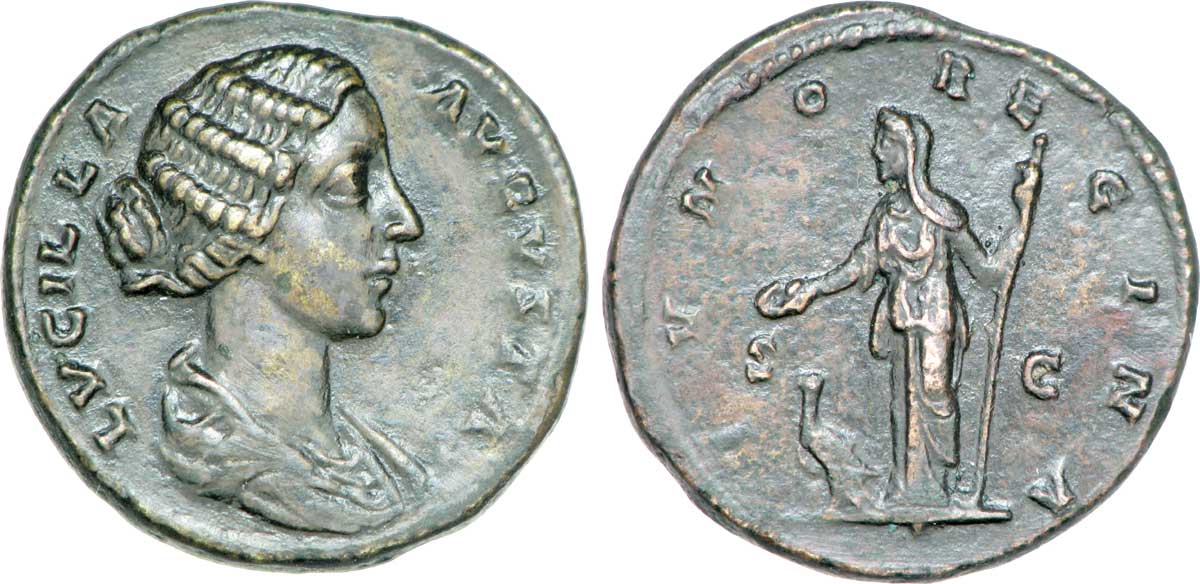
Dupondius depicting Lucilla Augusta (obverse) and Juno Regina with a peacock (reverse). The peacock was a symbol of immortality because the ancients believed that the peacock had flesh that did not decay after death.
Lucilla planned to put an end to Commodus with the help of her husband Pompeianus Quintianus, her nephew, her daughter, and two of her cousins; one of which was her lover Marcus Ummidius Quadratus Annianus.
The murder was to done by Quintianus who Lucilla loathed. If the plan failed and she did not become Empress then she would at least be free of Quintianus. The attack took place as Commodus was entering the hunting theatre. Standing in its narrow entrance passage Quintianus stood next to his nephew who thrust his sword at his brother-in-law. But, he missed his target, and Commodus survived unscathed.
Needless to say, the male members of the plot were immediately put to death. When Lucilla’s involvement in the plot came out she, her daughter and Commodus’ wife Crispina were imprisoned on the island of Capri. Crispina was not part of the plot, her crime was adultery. However, they did not escape death for long, Commodus had them all executed a year later, in 182 AD.
In the 1964 film The Fall of the Roman Empire, Lucilla is played by Sophia Loren, her part in the film’s plot bearing only a very loose relation to Lucilla’s real life.
In the 2016 six-part docuseries Roman Empire: Reign of Blood, Lucilla is played by Tai Berdinner-Blades.
Sources:
Epitome of Book LXXIII, Roman History by Cassius Dio, Vol. IX of the Loeb Classical Library edition, 1927
Wikipedia and Wikiwand
Julia Herdman writes historical fiction.
Buy eBook Now Sinclair is set in the London Borough of Southward, the Yorkshire town of Beverley and in Paris and Edinburgh in the late 1780s. Strong female leads include the widow Charlotte Leadam and the farmer’s daughter Lucy Leadam. Sinclair is a story of love, loss and redemption. Prodigal son James Sinclair is transformed by his experience of being shipwrecked on the way to India to make his fortune. Obstacles to love and happiness include ambition, conflict with a God, temptation and betrayal. Remorse brings restitution and recovery. Sinclair is an extraordinary book. It will immerse you in the world of 18th century London where the rich and the poor are treated with kindness and compassion by this passionate Scottish doctor and his widowed landlady, the owner of the apothecary shop in Tooley Street. Sinclair is filled with twists and tragedies, but it will leave you feeling good.
Princess Charlotte August was in labour for more than two days before she died on 6th November 1817.
Princess Charlotte Augusta of Wales (1796 – 1817) was the only child of George, Prince of Wales (later King George IV) and Caroline of Brunswick. If she had lived Charlotte would have become Queen of the United Kingdom.
Before her marriage, Charlotte was what we might call a ‘wild child’. She was a good horsewoman and a bit of a ‘tomboy.’
Charlotte’s parents loathed the sight of each other and separated soon after she was born. Her father debauched himself with every form of excess except fatherly love and attention. Her mother lived the lonely life of an abandoned woman. As an only child, Charlotte’s welfare was left in the hands of palace staff and her estranged mother whom she visited regularly at her house in Blackheath.
As Charlotte entered her teenage years, members of the Court considered her behaviour undignified. Lady de Clifford complained about her ankle-length underdrawers that showed. Lady Charlotte Bury, a lady-in-waiting to her mother Caroline described the Princess as a “fine piece of flesh and blood” who had a candid manner and rarely chose to “put on dignity”. Her father, however, was proud of her horsemanship and her tolerably good piano playing.
By the time she was age 15, the curvey Charlotte looked and dressed like a woman; she developed a liking for opera and men and soon became infatuated with her first cousin, George FitzClarence, the illegitimate son of the Duke of Clarence.
To put an end to the budding romance FitzClarence was called to Brighton to join his regiment, and Charlotte’s gaze fell on Lieutenant Charles Hesse of the Light Dragoons, reputedly the illegitimate son of Charlotte’s uncle, Prince Frederick, Duke of York and Albany.
Her mother colluded with Charlotte as far as Hesse was concerned not because she approved of the romance but to peeve her husband who did not. Caroline allowed the pair to meet in her apartments but the liaison was shortlived. Britain was at war with France and Hesse was called to duty in Spain.
Her father’s plan was to marry Charlotte to William Prince of Orange, the Dutch king. Neither her mother nor the British public wanted Charlotte to leave the country to pursue such a match. Charlotte, therefore, informed the Prince of Orange that if they wed, her mother would have to live with them at their home in the Netherlands. This was a condition sure to be unacceptable to the Prince of Orange and their engagement was broken before it was started.
Charlotte finally settled on the dashing young Prince Leopold of Saxe-Coburg-Saalfeld, Leopold had a commission in the Imperial Russian Army and fought against Napoleon after French troops overran Saxe-Coburg until Napoleon’s defeat at Waterloo.
The Marriage
The marriage ceremony was set for 2 May 1816. The war with France was over and the people of London were in the mood to celebrate. On the wedding day, huge crowds filled the streets and at nine o’clock in the evening in the Crimson Drawing Room at Carlton House, with Leopold dressing for the first time as a British General (the Prince Regent wore the uniform of a Field Marshal), the couple were married. Charlotte’s wedding dress cost over ₤10,000, an enormous sum of money - the average doctor earned less than £300 per year. The only mishap was during the ceremony happened when Charlotte was heard to giggle when the impoverished Leopold promised to endow her with all his worldly goods.
At the end of April 1817, Leopold informed the Prince Regent that Charlotte was pregnant and that there was every prospect of the Princess carrying the baby to term.
Charlotte’s pregnancy was the subject of the most intense public interest. Betting shops quickly set up a book on what sex the child would be. Economists calculated that the birth of a princess would raise the stock market by 2.5%; the birth of a prince would raise it 6%.
The mum to be Charlotte spent her time quietly, however, spending much time sitting for a portrait by Sir Thomas Lawrence. She ate heavily and got little exercise; when her medical team began prenatal care in August 1817, they put her on a strict diet, hoping to reduce the size of the child she was carrying. The diet and occasional bleeding they subjected her to seemed to weaken Charlotte and did little to reduce her weight.
The Pregnancy
Much of Charlotte’s day to daycare was undertaken by Sir Richard Croft. Croft was not a physician, but an accoucheur, or male midwife. Male midwives were much in fashion among the well-to-do. In, ‘The Princess Charlotte of Wales: A triple obstetric tragedy’ Sir Edward Holland (J Obst & Gynaec Brit Emp 58:905-919, 1951) describes Sir Richard Croft as a diffident, sensitive man without much self-confidence despite his skill and experience. “He was not the sort of man to deviate from the rules of practice by doing something unconventional or risky. He played it by the book, but his library was small.”
Charlotte was believed to be due to deliver on 19 October, but as October ended, she had shown no signs of giving birth and drove out as usual with Leopold on Sunday 2 November. On the evening of 3 November, her contractions began. Sir Richard encouraged her to exercise, but would not let her eat: late that evening, he sent for the officials who were to witness the birth of the third in line to the throne.
A Labour in Vain
The first stage of labour lasted 26 hours, which is not uncommon for a first child. With the cervix fully dilated, Croft sent for Dr. Sims, perhaps because the uterus was acting inertly and irregularly, and also because, should a forceps delivery be necessary, Sims had been chosen consultant on that point. Sims was the “odd man out” among the four doctors; his principal work was as a botanist and editor, but he was also physician to the Surrey Dispensary and Charity for Delivering Poor Women in their Homes.
Almost certainly the outcome would have been better had the second stage of labour not lasted as long as the first. The optimal time the second stage is around two hours. Dr. Sims arrived at 2:00 am on November 5 after the second stage had been in progress for about seven hours.
Thirty-three hours after Charlotte’s labour had began Dr. Sims was ready with the forceps, but his assistance was not called for. Croft continued to let nature take its course. After 15 hours of second-stage labour, about noon on November 5, meconium-stained amniotic fluid appeared. Three hours after that, the baby’s head appeared. At nine o’clock in the evening of 5 November, Charlotte finally gave birth to a stillborn boy weighing nine pounds. Efforts to resuscitate the child proved fruitless. Onlookers commented that the dead child was a handsome boy, resembling the Royal Family.
The third stage of labour was no less distressing. Croft informed Sims that he suspected an hourglass contraction of the uterus. This happens when the placenta gets trapped in the upper part of the womb as it contracts Croft removed the placenta manually with some difficulty, and it seemed to do the trick. Soon after midnight, Charlotte began vomiting violently and complaining of pains in her stomach. Croft returned to Charlotte’s bedside to find her cold to the touch, breathing with difficulty, and bleeding profusely. He placed hot compresses on her, the accepted treatment at the time for postpartum bleeding, but the bleeding did not stop. Charlotte died an hour and a half later.
The Aftermath
Charlotte had been Britain’s hope: George III and Queen Charlotte, had had thirteen children but only Charlotte survived. She was the sole legitimate heir to the throne of Great Britain and Ireland. Her father, with his spendthrift behaviour and penchant for womanising, was already unpopular with the public and his brothers were viewed in much the same light. The Prince of Wales’s girth and reputation for gluttony prompted his critics to dub him the “Prince of Whales.” The people were devasted by Charlotte’s tragic death.
Post-mortems on Charlotte and her stillborn son exonerated the Croft from any wrong-doing. The postmortem results showed Charlotte died because she lost too much blood, her baby because of lack of oxygen. In 1817 there were no blood transfusions for Croft to call on when Charlotte began to lose blood but he could have done things differently and she may not have died. Croft decided not to use forceps, had he Charlotte and her baby might have been saved. Croft was following fashion and the dictum of Dr. Denman an authority of midwifery and childbirth at the time. Since the death of the hugely influential Scottish obstetrician William Smellie’s in 1760, the use of forceps had fallen into disfavour because of the injuries that could be caused by the instrument when used by unskilled accoucheurs. Hundreds of unskilled or partially trained doctors were operating in Britain’s unregulated medical market at the time. The late Dr. Denman had overreacted to these injuries and had advocated a policy of “Let nature do the work. …The use of forceps ought not to be allowed from any motives of eligibility (i.e. of choice, election, or expediency). Consider the possible mistakes and lack of skill in younger practitioners.”
Denman had however hedged his position with a qualification: “Care is also to be taken that we do not, through an aversion to the use of instruments, too long delay that assistance we have the power of affording. In the last edition of his book (1816, posthumously) he wrote: “But if we compare the general good done with instruments, however cautiously used, with the evils arising from the unnecessary and improper use, we might doubt whether it would not have been happier for the world if no instrument of any kind had ever been contrived for, or recommended in the practice of midwifery.”
Croft had relied on Denman’s ultraconservative precepts, his passive obstetrics was just as dangerous as meddlesome obstetrics. The adroit accoucheur steered a middle course, but Croft was not adroit. Three months later, Croft was involved in a similar case, and, when the patient died, he shot himself with a pistol he found in the house. What happened in the wake of Princess Charlotte’s death was too much for Croft to bear.
By today’s standards, the first and second stages of Charlotte’s labour were far too long. Modern obstetricians would use forceps to extract the baby and drugs would be given to speed-up and strengthen the contractions.The most recent CEMD report indicates that in 2009-12, 357 women died during or within 6 weeks of the end of their pregnancy. This represents a decrease in the maternal mortality ratio (MMR) from 11 (2006-8) to 10.12 per 100,000 live births (2010-12), mainly due to a decrease in deaths due to direct obstetric causes. However, there has been no change in the MMR for indirect maternal deaths in the last 10 years; the current ratio (6.87 per 100,000 live births) is almost twice that of direct deaths (3.25 per 100,000 live births).
Sources:
THE YALE JOURNAL OF BIOLOGY AND MEDICINE 65 (1992), 201-210
Obstetrical Events That Shaped Western European History
WILLIAM B. OBER, M.D.
Bergen County Medical Examiners Office, Paramus, New Jersey
Received March 26, 1991
Benjamin Franklin wrote a good love letter. In 1779, Benjamin Franklin fell in love with Anne Catherine Helvétius, the widow of the Swiss-French philosopher, Claude-Adrien Helvétius. He was serving as the U.S. envoy to France at the time.
Nicknamed “Minette”, Anne maintained a renowned salon in Paris using her dead husband’s accumulated wealth. Among its habitués were France’s leading politicians, philosophers, writers, and artists.
Courting her attention, Franklin sent her many letters expressing his love, admiration, and passion. In one, he claimed that he had dreamed that their dead spouses had married in heaven and that they should avenge their union by doing the same on earth!
He wrote In another passionate plea: “If that Lady likes to pass her Days with him, he, in turn, would like to pass his Nights with her; and as he has already given her many of his days…she appears ungrateful never to have given him a single one of her nights.”
“Don’t be upset. Don’t listen to me. I only meant that I am jealous of a dark, unconscious element, something irrational, unfathomable. I am jealous of your toilet articles, of the drops of sweat on your skin, of the germs in the air you breathe which could get into your blood and poison you. And I am jealous of Komarovsky, as if he were an infectious disease. Someday he will take you away, just as certainly as death will someday separate us. I know this must seem obscure and confused, but I can’t say it more clearly. I love you madly, irrationally, infinitely.”
I think you’ll agree that’s powerful stuff but how would you feel if you got a letter like that? Would it please you or make you run a mile? I think I’d make a run for it. So what should you write to your love? Well if want to woo your love successfully science has some tips for you.
Yale psychologist Robert Sternberg’s theory of love, suggests that the ideal love letter should include the following components—intimacy, passion, and commitment. To test this hypothesis Donelson Forsyth and Kelli Taylor constructed a number of letters and asked people what they thought of them.
They discovered that, when it comes to love letters, commitment conquered all. The letter that proclaimed, “I know we will be happy together for the rest of our lives” and “I couldn’t imagine a world without you in it,” was rated much higher, in terms of expressing love, than one that made no mention of commitment.
Adding language that spoke of closeness and caring increased the letter’s good impression with readers, but it was a commitment that left readers feeling loved and in love.
As to expressing passion in a letter; frisky letters, which went on for too long about the sender’s sexual passions, were viewed generally negatively by both genders; perhaps because they were more about lust than love.
They also discovered that a message of commitment need not be delivered in a traditional love letter or a card; a simple email will do which is lucky as so many of us have lost the art of putting pen to paper. However, research shows that people think that letters are more trustworthy, and a handwritten letter shows effort and care too.
Therefore, if you want your love letter to get results you need to write it yourself, show your commitment to the relationship and put it in an envelope. Call me old-fashioned but a bunch of flowers wouldn’t go amiss either.
The pursuit of love and happiness was an 18th-century ideal.
Voltaire (1694-1778), the French philosopher and author was one of its chief exponents and is one of the heroes of my character Sinclair. Sinclair takes his copy of Candide, Voltaire’s satirical novel to India with him but he loses it when the ship goes down. Once he’s established himself in Tooley Street he’s quick to buy himself another copy.
Candide was an 18th century best seller. The story is about a young man who is the illegitimate nephew of a German baron. He grows up in the baron’s castle under the tutelage of the scholar Dr. Pangloss, who teaches him that this world is “the best of all possible worlds.” Candide falls in love with the baron’s young daughter, Cunégonde which does not please the baron at all and so the young man and his teacher are thrown out of the castle and their adventure begins.
The work describes the abrupt end of their idyllic lifestyle and Candide’s slow, painful disillusionment with the world as he witnesses and experiences its hardships.
The book ends with Candide, not rejecting Dr. Pangloss’s optimism outright but advocating that “we must cultivate our garden”, rather than rely on optimism alone to make it flourish. Thus, Candide rejects the Leibnizian mantra of Pangloss, “all is for the best” in the “best of all possible worlds” for the act of making the world we desire by cultivating it like a garden.
Voltaire was a man of passion and emotion as well as ideas. At the age of nineteen Voltaire was sent as an attache to the French Ambassador to the Netherlands. It was there that he fell in love with Olympe Dunover, the poor daughter of lower-class women. Their relationship was not approved of by either the ambassador of Olympe’s mother and Voltaire was soon imprisoned to keep them apart.
Writing from his prison cell in The Hague in 1713 he poured out his love for Olympe.
“I am a prisoner here in the name of the King; they can take my life, but not the love that I feel for you. Yes, my adorable mistress, to-night I shall see you, and if I had to put my head on the block to do it.
“For heaven’s sake, do not speak to me in such disastrous terms as you write; you must live and be cautious; beware of madame your mother as of your worst enemy. What do I say? Beware of everybody; trust no one; keep yourself in readiness, as soon as the moon is visible; I shall leave the hotel incognito, take a carriage or a chaise, we shall drive like the wind to Scheveningen; I shall take paper and ink with me; we shall write our letters.”
“If you love me, reassure yourself; and call all your strength and presence of mind to your aid; do not let your mother notice anything, try to have your pictures, and be assured that the menace of the greatest tortures will not prevent me to serve you. No, nothing has the power to part me from you; our love is based upon virtue and will last as long as our lives. Adieu, there is nothing that I will not brave for your sake; you deserve much more than that. Adieu, my dear heart!”
Arout (Voltaire)
His time in prison was brief. Being young and fit and the prison not so secure, he jumped out a window and got away.
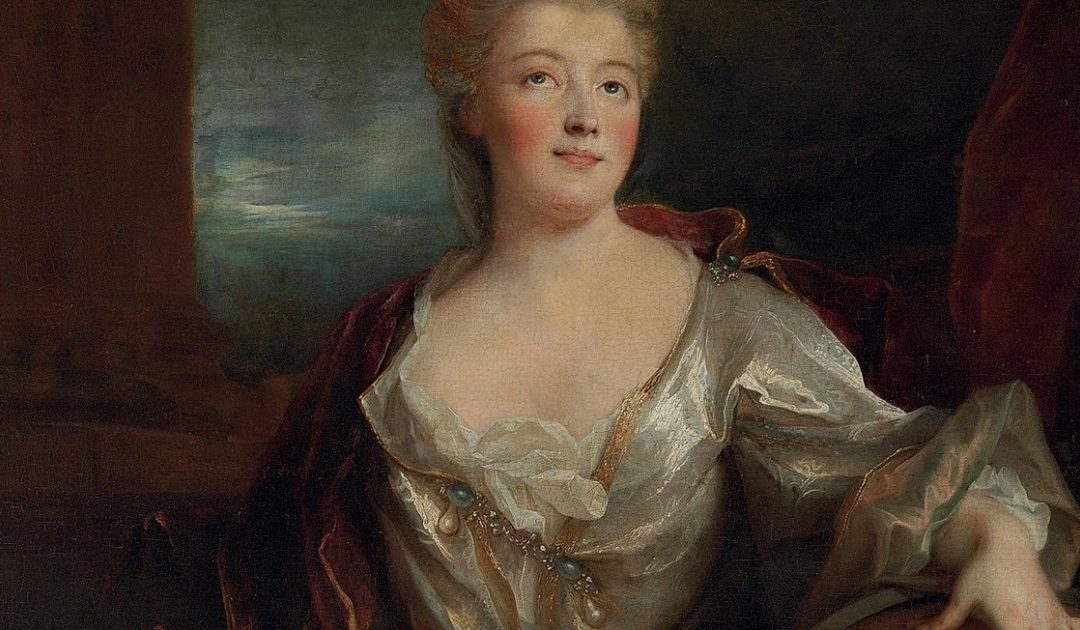
Twenty years later, in 1733, Voltaire would meet the love of his life, Émilie, Marquise du Châtelet. She was the wife of an aristocrat. He, by then was by then a successful writer. Having just returned from a period of enforced exile from France for his political views Voltaire was introduced to Émilie by friends.
The attraction was immediate, physical and cerebral. He wrote of her; “That lady whom I look upon as a great man… She understands Newton, she despises superstition and in short, she makes me happy.”
Soon the pair were living together in the Marquis du Châtelet’s chateau. The arrangement suited them all. Voltaire who was a rich man paid for the much-needed renovations to the chateau, Émilie’s husband the Marquis hunted all day and at night he lent Voltaire his willing wife.
Their love bore intellectual fruits; Émilie translated Newton’s Principia Mathematica and wrote her philosophical magnum opus, Institutions de Physique (Paris, 1740, first edition), or Foundations of Physics. Her own work circulated widely generated heated debates and was republished and translated into several other languages. During her time with Voltaire, she participated in the famous vis viva debate, concerning the best way to measure the force of a body and the best means of thinking about conservation principles. Posthumously, her ideas were heavily represented in the most famous text of the French Enlightenment, the Encyclopédie of Denis Diderot and Jean le Rond D’Alembert.
In 1737, Châtelet published a paper entitled Dissertation sur la nature et la propagation du feu, based upon her research into the science of fire, that predicted what is today known as infrared radiation and the nature of light.
In another publication, she debated the nature of happiness. During the Age of Enlightenment, personal happiness was one of the great philosophical themes. Many philosophers and writers studied it. There were many discourses on the subject but they were by men. Chatelet offers a new perspective on the philosophical question of happiness, a woman’s perspective. Her views on happiness were published posthumously long after she had ended her relationship with Voltaire.
Chatelet begins her work on happiness by recognising the difficulty of finding or achieving happiness due to the obstacles of circumstance such as age and other hindrances. She explains that fortune has placed individuals in specific states and that one of the most important elements in achieving happiness is not to try to change those circumstances. Chatelet’s way to happiness is to be satisfied with the condition we find ourselves in.
Happiness for Chatelet lies in satisfying personal tastes and passions and from “… having got rid of prejudices, being virtuous, getting well,….” In other words, she says it’s up to the individual to know and do what makes them happy.
I suppose that was alright for her she was a Marquise with a chateau, a husband, and rich lovers.
Her pet hate was religion which she saw as the ultimate prejudice. Prejudice she believed made people vicious and we cannot be both vicious and happy. Happiness, she believed came from virtue, inner satisfaction and the health of the soul. Finally, she concluded that happiness relied on illusion or the arts and that it was important to retain the illusions that produced pleasant feelings, such as laughter during a comedy.
Whilst I cannot argue with her view that pursuing interests, being free from prejudice and enjoying the arts all help us to achieve a state of happiness I cannot help being aghast at this very clever woman’s nativity. Perhaps she was so happy for most of her life, so happy with her studies and her lovers that she didn’t notice the people around her. Perhaps she didn’t notice the poor people who did her cooking and cleaning and grew everything she ate. Perhaps she lived life through such rose-tinted spectacles that she was blind to the routine injustice the state handed down to ordinary people and anyone who got in its way. Was Chatelet like so like so many aristocrats who met with Madame Guillotine a generation later - totally unaware of how they had created their own grisly fate? Did they not see that they had failed to ‘cultivate the garden’?
Julia Herdman writes historical fiction. Her books are available worldwide on Amazon.
As the daughter of a king Princess Augusta was denied access to men of her own rank except those in her immediate family for most of her life. Like several of George III’s daughters she found herself lonely and drawn into romances with gentleman at court whether they were suitable or not.
It is believed that Princess Augusta first met Sir Brent Spencer, an Irish general in the British Army, around 1800. Augusta later told her brother, the future George IV, the two entered into a relationship in 1803 while Spencer was stationed in Britain. Although the couple conducted their relationship with the utmost privacy, Augusta did petition the Prince Regent in 1812 to be allowed her to marry Spencer, promising further discretion in their behaviour. While no official record of a marriage between the two exists, it was noted at the court of Hesse-Homburg at the time of her sister Elizabeth’s marriage in 1818 that Augusta was “privately married.”
Princess Augusta Sophia was born at Buckingham House, London, the sixth child and second daughter of George III (1738–1820) and his wife Queen Charlotte. The young princess was christened on 6 December 1768, by Frederick Cornwallis, The Archbishop of Canterbury, in the Great Council Chamber at St. James’s Palace. Princess Augusta had an older sister Charlotte (born 1766) and her younger sister Elizabeth (born 1770). In 1771, the two oldest princesses started travelling to Kew to take lessons under the supervision of Lady Charlotte Finch and Miss Planta. The pair, who had formerly been very close to their older brothers now saw little of them, except when their paths crossed on daily walks. In 1774, Martha Goldsworthy, or “Gouly” was put in charge of their education which included the feminine pursuits of deportment, music, dancing, and the arts. Their mother also ensured that they learned English, French, German, and Geography.
In 1782, aged 14, Augusta made her court debut on the occasion of her father’s birthday. Being terrified of crowds; the princess was painfully shy, and stammered when in front of people she didn’t know; her mother gave her only two days notice of the event. That year she lost her two baby brothers, Prince Alfred and Prince Octavius. Alfred had a bad reaction to his inoculation against smallpox and died aged nearly two. Six months after Alfred’s death, her younger brother Octavius and her sister Sophia were taken to Kew Palace in London to be inoculated with the smallpox virus. (This may seem irresponsible today but smallpox was virulent and no respecter of rank so inoculation, even with its risks was still probably a better bet than not being inoculated at all.) Sophia recovered without incident, but like his brother, before him, Octavius became ill and died several days later, he was just four years old. As was traditional at the time, the household did not go into mourning for the deaths of royal children under the age of fourteen but Augusta, who had loved the children dearly, was distraught.
Her formal education now came to an end. Now her duty was to join her elder sister and her parents at court and accompany them to the theatre and the Opera. With six daughters to clothe and educate the royal budget was stretched. The royal princesses often appeared in what was basically the same dress each in a different colour to save money and at home, they wore plain, everyday clothes unlike their royal contemporaries in Europe.
By 1785, Augusta and Charlotte were reaching an age where they could be considered as potential brides for foreign princes. In that year the Crown Prince of Denmark (later King Frederick VI) indicated to her father that he was interested in Augusta but George decided he could not allow his lovely daughter to go to Denmark after his sister’s disastrous marriage to King Christian VII. As their friends at court found husbands the sisters began to wonder when their turn would come. Their father it seems was reluctant to see them leave and the subject was not one for discussion in case it disturbed the often addled mind of their sick father. So, the years slid by with neither of them married. This was when pretty Augusta made her own arrangements with the dashing officer, Brent Spencer.
Spencer was upper middle class not royal; he became a commissioned officer in 1778 and fought with great credit in the West Indies in 1779–1782 during the American Revolutionary War and again in 1790–1794 during the War of the First Coalition. He was a professional soldier who rose through the ranks, first to Brigadier General, serving in the wars against Napoleon in Europe and Egypt. He was eight years older than Augusta and served with Wellington as his second in command during the Peninsular War where he became a full General. After the war, he became the MP for Sligo.
Such a match would be considered wholly acceptable today but not in the 18th century. It is said that he and Augusta maintained their relationship through these years of separation and that he died with a picture of her in his hand at the age of 68. Augusta died on 22 September 1840 at Clarence House, aged 71.
Source: Wikipedia. Illustration: Augusta Sophia of the United Kingdom. Copy of the portrait exhibited at the Royal Academy in 1819 and now in the Museum of Fine Arts, Baltimore.
Julia Herdman writes historical fiction that puts women to the fore. Her latest book Sinclair, Tales of Tooley Street Vol. 1. is Available on Amazon

 Sinclair is set in the London Borough of Southward, the Yorkshire town of Beverley and in Paris and Edinburgh in the late 1780s. Strong female leads include the widow Charlotte Leadam and the farmer’s daughter Lucy Leadam. Sinclair is a story of love, loss and redemption. Prodigal son James Sinclair is transformed by his experience of being shipwrecked on the way to India to make his fortune. Obstacles to love and happiness include ambition, conflict with a God, temptation and betrayal. Remorse brings restitution and recovery. Sinclair is an extraordinary book. It will immerse you in the world of 18th century London where the rich and the poor are treated with kindness and compassion by this passionate Scottish doctor and his widowed landlady, the owner of the apothecary shop in Tooley Street. Sinclair is filled with twists and tragedies, but it will leave you feeling good.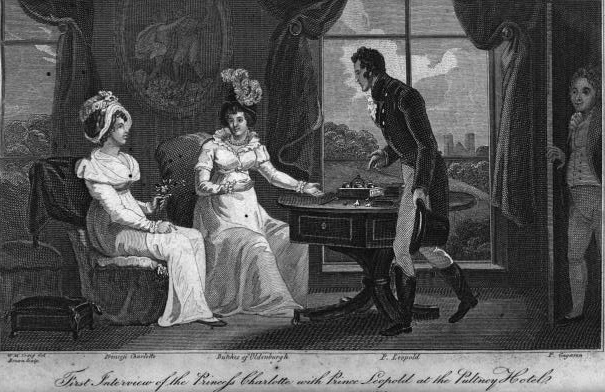


Recent Comments