Whether you’re a man or a woman the process of writing a book that is a good read about someone of the opposite sex can be tricky. Historical characters have to be every bit as complex as people today, they have to think and feel, have a back story, desires and beliefs.
People of either sex and those who class themselves as something in between are complex. Do you know where your characters score on the Big Five Personality Taits?
Openness
Conscientiousness
Extraversion
Agreeableness
Neuroticism
Where would your characters fit in the Myres Briggs range of personality types?
As an author who wants to write historical fiction books with believable characters, I try to make my characters multidimensional and rounded. I like to write characters who change and grow as they overcome the obstacles I put in their way. So, who they are and what happens to them affects how they react, and what they do and say.
As a writer, you have to show your reader the character.
To do this your actors have to understand some things about themselves, the people around them have to understand parts of their personality they are unaware of, and they have to discover things about themselves as the story unfolds.
Use A Johari Window
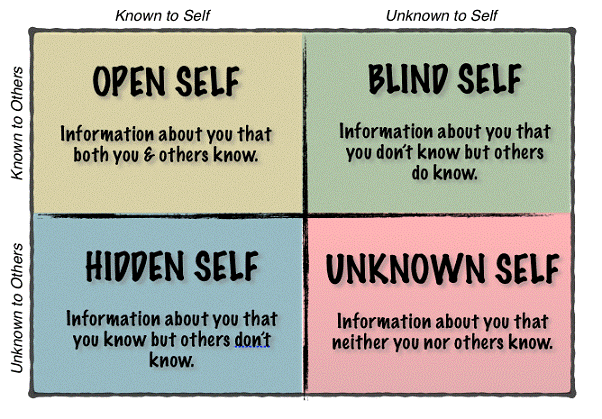
Think of the Johari Window – In the open pane there are things known to self and others, then there are things known only to self, there are things known by others and not by self, and finally things about the character that are unknown to both. These are the things the character will learn of their journey.
Making your character want something big will give you a good starting point to build around. What will Jane or Belle do get what her heart desires? Of course, what she will do wholly depends on how you’ve set her up. So much women’s fiction, historical and modern literary fiction is based on morally deviant characters these days because its an easy way to get Jane or Belle to do something extraordinary, something shocking and unexpected.
What makes these characters so well-loved is that they overcame the obstacles society and their families put in front of them.
So, to write an attractive female character, she needs a goal and a lot of opposition, not necessarily a bad-ass attitude to the law.
Draw a Picture - Warts and All
Angels are for heaven, not this earthly realm.
Being human, male or female, means we come with strengths and weaknesses and lots of imperfections. Try to make your characters interestingly flawed. Strengths, when we rely on them too much can be our downfall just as much as weaknesses.
Fears and Weaknesses
Overcoming weaknesses could be the making of a remarkable historical character, so don’t think to create a sassy heroine she has to be macho or fearless.
The most common fears for women are pretty much the same as they have always been. Which of these fears are you going to challenge your female historical characters with?
not getting married or finding a life partner,
not having kids or losing a child,
getting old, maimed, or scarred,
being killed or raped,
being trapped in a loveless relationship,
being abandoned
ending up in poverty or dying alone.
Good writers let the reader know which fate awaits their historical heroine should she fail.
Mesmerising historical characters use everything they’ve got, their strengths, weaknesses, and their ingenuity to save themselves from their horrible fate.
Not the Prettiest Girl in Town
Characters we come to love are not the prettiest girls in town or the girls who never lose their temper.
Jo March in Louisa M Alcott’s Little Women has a fearful temper, and so does my character Charlotte Leadam.
Charlotte Leadam suffers from secondary infertility and has a temper too.
Historical women had pride, intellect, and ambition. They felt pain, they hated people, and if you had been around to prick them they would bleed.
If your historical female character is the sidekick to an all-conquering male protagonist, why shouldn’t she feel peeved and throw the odd spanner in the works from time to time?
Surprises
Let your characters surprise you and surprise themselves.
Turn the tables on them, flip things around. Make what seemed impossible possible.
Let your characters find their courage, make fortuitous mistakes, try something they have never tried before even if it is taking the wrong advice.
Let your characters learn painful lessons, be confronted by their hypocrisy or the results of their stupidity.
Let them learn a secret that gives them power over others – lead them into temptation, and see how they perform.
Finally
Remember, whether you’re creating a female character or writing about a woman, she’s just human.
And that being human is to be full of possibilities.
Julia Herdman writes history and historical fiction. Her book Sinclair is set in the London Borough of Southward, the Yorkshire town of Beverley, and in Paris and Edinburgh in the late 1780s.
Strong female leads include the widow Charlotte Leadam and the farmer’s daughter Lucy Leadam.
Julia’s debut novel Sinclair is available on Amazon.
Sinclair is a story of love, loss, and redemption. Prodigal son James Sinclair is transformed by his experience of being shipwrecked on the way to India to make his fortune. Obstacles to love and happiness include ambition, conflict with a God, and sexual temptation and betrayal. Remorse brings restitution and recovery.
Sinclair is an extraordinary book. It will immerse you in the world of 18th century London where the rich and the poor are treated with kindness and compassion by this passionate Scottish doctor and his widowed landlady, the owner of the apothecary shop in Tooley Street. Sinclair is filled with twists and tragedies, but it will leave you feeling good.
Sinclair is set in the London Borough of Southward, the Yorkshire town of Beverley and in Paris and Edinburgh in the late 1780s. Strong female leads include the widow Charlotte Leadam and the farmer’s daughter Lucy Leadam. Sinclair is a story of love, loss and redemption. Prodigal son James Sinclair is transformed by his experience of being shipwrecked on the way to India to make his fortune. Obstacles to love and happiness include ambition, conflict with a God, temptation and betrayal. Remorse brings restitution and recovery. Sinclair is an extraordinary book. It will immerse you in the world of 18th century London where the rich and the poor are treated with kindness and compassion by this passionate Scottish doctor and his widowed landlady, the owner of the apothecary shop in Tooley Street. Sinclair is filled with twists and tragedies, but it will leave you feeling good.
Find a Good Starting Point:
When I wrote my book, Sinclair, I had no idea where or when to start my story. I had had the idea for a book for a long time, but it was very unformed. I wanted to write a book that was a good book to read, but I was struggling for somewhere to start.
I had discovered I had married into a family whose ancestors were apothecary surgeons working at Guy’s Hospital and living in Tooley Street close to London Bridge in the late 18th century.
The family were quite a well-documented, as the historical record goes. I had already done a lot of research, but I did not have a story and I could not see how I was ever going to write a book.
Determined not to give up on my quest to be a writer of novels I searched the internet for ideas and found one that I thought would work for me. I looked for a dramatic historical incident, adapted it and put my characters into it. Suddenly, my writer’s block had disappeared, and my characters were telling their own story.
The sinking of the Halsewell, by Turner
Keep the End in Mind:
When I was writing my book Sinclair, I always knew how the story would end.
I did not know how my characters would get there, but I knew where I wanted to get them.
Keeping the end in mind is a tried an tested technique in many endeavours, and it works well when you’re writing historical fiction or any book for that matter.
Hit the Books:
Getting the history right is important when writing historical fiction, but don’t get hung up on having to get everything right in the first draft. If you don’t know what they called something in the 1870s, just give the thing its common name and get on with the flow of your story.
Details can be corrected later. What cannot be repaired are fundamental errors such basing your book on an iron or steel ship in the 1780s when everything was made of wood.
Details matter, to the avid historical fiction reader. I remember reading a book set in the 1950s and the author described the stuffing coming out of an old settee as foam. It grated on me all the way through the book.
When I wrote my book I had to research the history of medicine and the key players in its development, particularly the London teaching hospitals.
To my horror, I found that medicine of the 1780s was very primitive. There were no anaesthetics, no antibiotics and doctors didn’t even have stethoscopes.
Visit Locations:
Getting a feel for scale is hard when you’re writing about the past.
Visiting the sites or similar locations to those you are writing about in your book will help you get a sense of how long it took people to do things in the past.
Putting the house or the street you are writing about into its context will help you paint a more vivid picture. I looked at old maps, old painting and illustrations and used contemporary descriptions of places I used in my story when I could find.
I also visited the central locations in Sinclair - London, Edinburgh and Beverley in Yorkshire.
When I write about the past, I know I am taking my reader into a foreign country.
Beyond the memory of your own generation, the past is a mystery, it is an uncharted territory that is both dangerous and exciting.
I aim to create a world my reader can believe because I want to write a book that is a good read. I want to show my reader a world that they might have experienced if they had lived in that time and place.
As a writer, I place myself inside my characters, I see the world I have created through their eyes because I am telling their story.
So, remember to think about the journey your characters will take, what will they be like when your tale is told. What will they have learned about life, themselves and their friends? No matter how accurate your history is if your characters are not believable and do not grow, you have not written a story, people will want to read.
Here are some websites to try if you’re thinking about writing historical fiction:
The Tragic Annia Aurelia Galeria Lucilla was born around 150 AD.
Her father was the Roman Emperor Marcus Aurelius, her mother the Empress Faustina the Younger. Lucilla was the elder sister of Emperor Commodus.
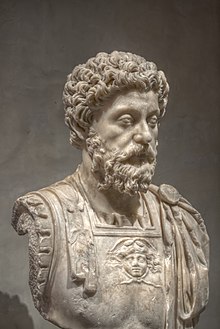
A marble bust of Marcus Aurelius at the Musée Saint-Raymond, Toulouse, France
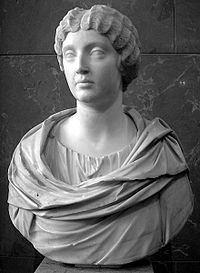
Faustina the Younger
A character loosely based on Lucilla was the love interest to Russell Crowe in the blockbuster film Gladiator in 2000. The film was directed by Ridley Scott.
In the film, the character based on Lucilla was played by the Danish actress Connie Nielsen. Crowe portrays the Hispano-Roman general Maximus Decimus Meridius, the man betrayed by Commodus.
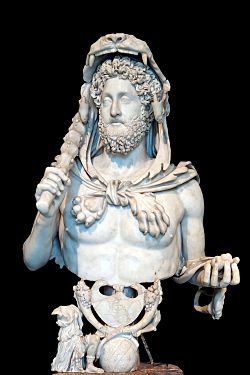
Bust of Commodus as Hercules, hence the lion skin, the club and the golden apples of the Hesperides. Part of a statuary group representing Commodus’ apotheosis.
Reduced to slavery, the character Maximus rises through the ranks of the gladiatorial arena to avenge the murders of his family. That, of course, was fiction. If you haven’t seen the film, try the clip below. The film’s great by the way.
Back to Real Life
Lucilla’s Marriages
The real Lucilla was married her father’s dashing co-ruler Lucius Verus in 164 CE when she was just 14.
Lucius Aurelius Verus (15 December 130 – 23 January 169) was Roman emperor from 161 until his death in 169, alongside his adoptive brother Marcus Aurelius. He was a member of the Nerva-Antonine dynasty. Verus’ succession together with Marcus Aurelius marked the first time that the Roman Empire was ruled by multiple emperors.
Her husband was 18 years her senior. On her wedding day, the groom would have led a procession to her family home, where she and her bridesmaids were waiting to meet him. She would be wearing a tunica recta — a white woven tunic — belted with an elaborate “Knot of Hercules.”
The marriage knot or knot of Hercules ( a reef knot, or square knot), originated as a religious symbol in ancient Egypt but is best known as a wedding symbol, incorporated into the protective girdles worn by brides, which were ceremonially untied by the new groom on the wedding night. This custom is the likely origin of the phrase “tying the knot.” According to Roman lore, the knot symbolized the legendary fertility of the God Hercules and the legendary power of Girdle of Diana captured from the Amazon Queen Hippolyta. Both are symbols of the moon, the ancient symbol of fertility.
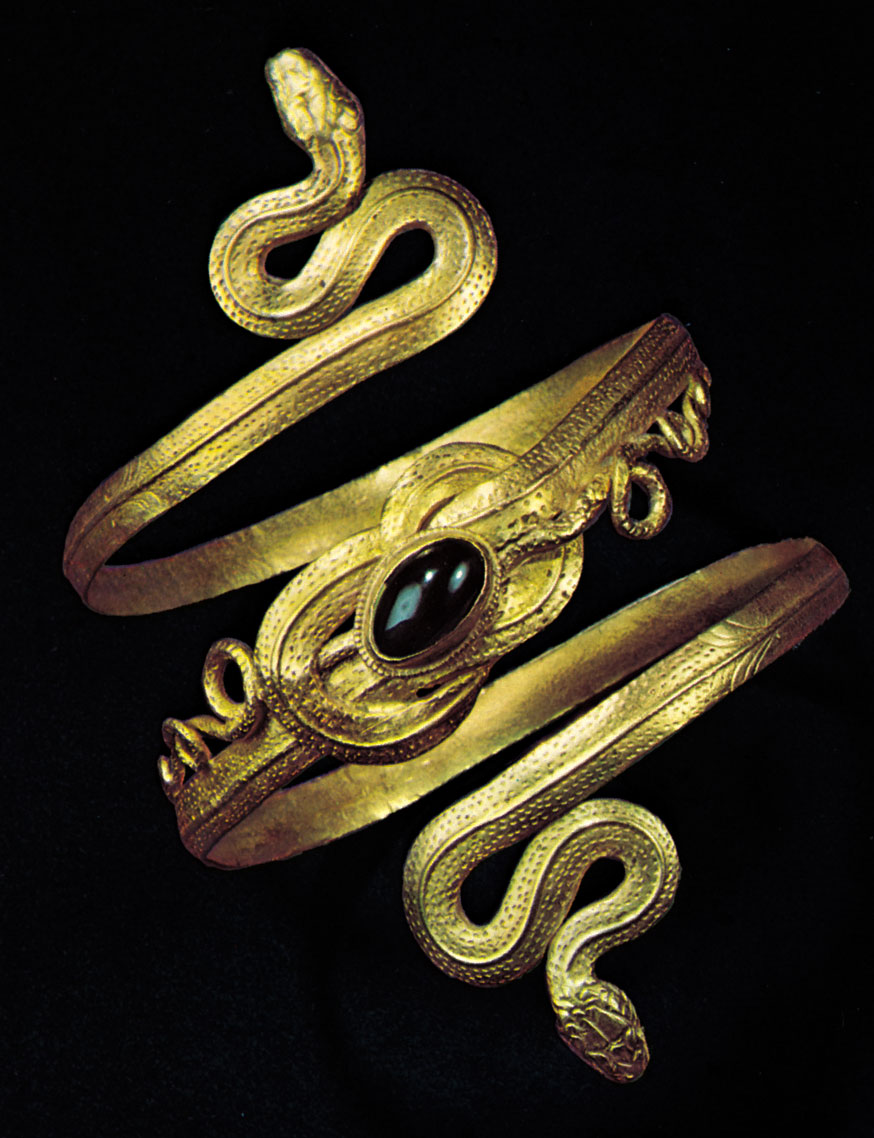
Greek gold spiral bracelet of two snakes whose tails are tied in a Hercules knot that is decorated with a garnet in a bezel setting; in the Schmuckmuseum Pforzheim, Germany.
Lucilla would have carefully arranged hair and would be wearing a red wedding veil, a flammeum and red shoes to show that she was full of life and for good luck. After the marriage contract was signed, there was an enormous feast. The day ended with a noisy procession to the couple’s new home where her husband would carry his new bride over the threshold. Upon marriage, Lucilla received the title of Augusta and became a Roman Empress.
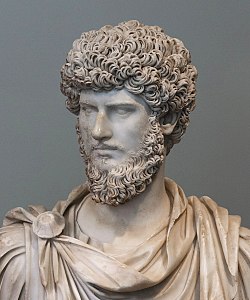
Bust of Lucius Verus at the Metropolitan Museum of ArtMarriage at such a young age was normal in the Roman world. Early marriages led to an astonishingly high death rate among the aristocracy. Even today a woman getting pregnant in her early teens runs higher risks than a more mature woman. Today’s teenage mums often suffer hyperemesis gravid arum or severe vomiting and dehydration, eating disorders, anaemia, bleeding, and pre-eclampsia during pregnancy. Most find giving birth and breastfeeding difficult due to their physical immaturity.
Lucilla gave Lucius three children: Aurelia Lucilla was born in 165 in Antioch, Lucilla Plautia and Lucius Verus. Aurelia and another boy died young.
After Lucius Verus died, in 169, her father arranged a second marriage for her. This time it was to Tiberius Claudius, a Syrian Roman general who distinguished himself during Rome’s wars against the Parthians and the Marcomanni. Quintianus was a hero amongst his men but he was at least twice Lucilla’s age. Nevertheless, they were married in 170 CE.
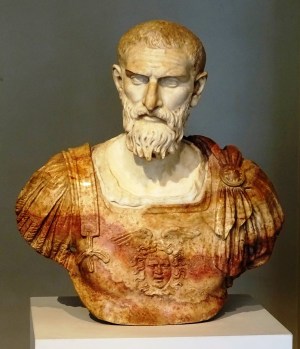
Tiberius Claudius Pompeianus (Museo Archeologico Nazionale di Venezia)
After the death of her mother Faustina her father honoured Lucilla as Emperess, an honour continued by her brother Commodus until he married. Lucilla Quintianus a son named Pompeianus.
Find out more: https://www.redbubble.com/people/greenlillies/shop?asc=u
Her Cowardly Brother
The Roman historian Cassius Dio wrote that Commodus ‘was not naturally wicked, but, on the contrary, was as guileless as any man that ever lived.’
Commodus was nineteen years old when his father died. He was the 10th of 14 children and the only male to survive. He was the anthesis of his father, Marcus because he was simple and cowardly and a slave to his companions.
Commodus was a very handsome man, with clear eyes and curly hair that was naturally blond. Dio claims he was left-handed and was very proud of this fact, but busts of Commodus as Hercules show him with a club in his right hand. Left-handedness was frowned upon in antiquity – as the word for left-handed, sinister, demonstrates – so it is possible this fact was obscured by the sculptors. Dio was in his twenties when Commodus became Emperor so his claim may be true.
Upon his accession, he had advice from his many guardians in the Senate, which he steadfastly ignored. He hated exertion of duty and craved the comfortable life of the city.’
Commodus’ behaviour became increasingly disturbing as the years went by. Dio reported that ‘many plots were formed by various people against Commodus, and he killed a great many, both men and women, some openly and some by means of poison, secretly, making away, in fact, with practically all those who had attained eminence during his father’s reign and his own, with the exception of Pompeianus, Pertinax and Victorinus; these men for some reason or other he did not kill. I state these and subsequent facts, not, as hitherto, on the authority of others’ reports, but from my own observation.’
When Sextus Condianus, a noble heard that Commodus had passed a sentence of death on him he was said to have drunk the blood of a hare, then mounted a horse and purposely fell from it vomiting blood. Feigning death, a ram was burnt on his funeral pyre and Sextus made his escape. The escapade did not stay a secret for very long. Soon Commodus was on his trail. Many were punished in his stead on account of their resemblance to him, and many, who helped him were also put to the sword. Many severed heads were brought to Rome, but whether any one of them was Sextus remains a mystery. Perhaps he really did get away.
Commodus gave himself up to chariot-racing and licentiousness and performed scarcely any of the duties pertaining to his office. He renamed Rome Commodiana. The legions became Commodian, and he renamed himself, Hercules. He re-styled Rome as the “Immortal, Fortunate Colony of the Whole Earth”. A 1000 pound gold statue was erected of him together with a bull and a cow - the bull no doubt representing Zeus/Jupiter and the cow Hera/Juno. Finally, all the months were named after him, so that they were enumerated as follows: Amazonius, Invictus, Felix, Pius,12 Lucius, Aelius, Aurelius, Commodus, Augustus, Herculeus, Romanus, Exsuperatorius.
Her brother’s increasing savagery and mental aberrations led Lucilla to hatch a plot to kill and replace him.
The Plot
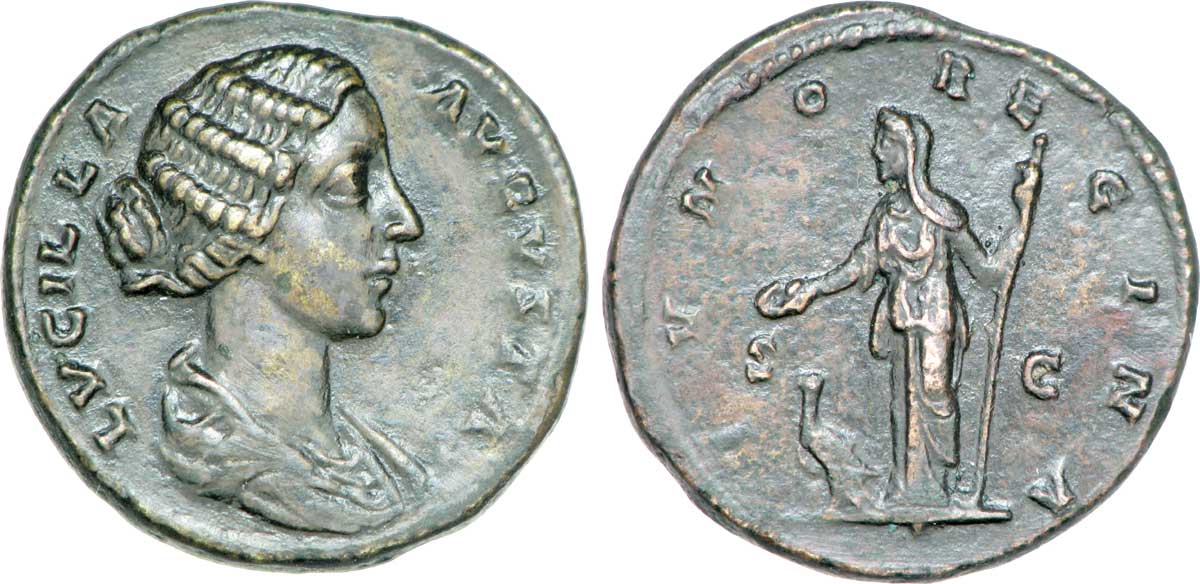
Dupondius depicting Lucilla Augusta (obverse) and Juno Regina with a peacock (reverse). The peacock was a symbol of immortality because the ancients believed that the peacock had flesh that did not decay after death.
Lucilla planned to put an end to Commodus with the help of her husband Pompeianus Quintianus, her nephew, her daughter, and two of her cousins; one of which was her lover Marcus Ummidius Quadratus Annianus.
The murder was to done by Quintianus who Lucilla loathed. If the plan failed and she did not become Empress then she would at least be free of Quintianus. The attack took place as Commodus was entering the hunting theatre. Standing in its narrow entrance passage Quintianus stood next to his nephew who thrust his sword at his brother-in-law. But, he missed his target, and Commodus survived unscathed.
Needless to say, the male members of the plot were immediately put to death. When Lucilla’s involvement in the plot came out she, her daughter and Commodus’ wife Crispina were imprisoned on the island of Capri. Crispina was not part of the plot, her crime was adultery. However, they did not escape death for long, Commodus had them all executed a year later, in 182 AD.
In the 1964 film The Fall of the Roman Empire, Lucilla is played by Sophia Loren, her part in the film’s plot bearing only a very loose relation to Lucilla’s real life.
In the 2016 six-part docuseries Roman Empire: Reign of Blood, Lucilla is played by Tai Berdinner-Blades.
Sources:
Epitome of Book LXXIII, Roman History by Cassius Dio, Vol. IX of the Loeb Classical Library edition, 1927
Wikipedia and Wikiwand
Julia Herdman writes historical fiction.
Buy eBook Now Sinclair is set in the London Borough of Southward, the Yorkshire town of Beverley and in Paris and Edinburgh in the late 1780s. Strong female leads include the widow Charlotte Leadam and the farmer’s daughter Lucy Leadam. Sinclair is a story of love, loss and redemption. Prodigal son James Sinclair is transformed by his experience of being shipwrecked on the way to India to make his fortune. Obstacles to love and happiness include ambition, conflict with a God, temptation and betrayal. Remorse brings restitution and recovery. Sinclair is an extraordinary book. It will immerse you in the world of 18th century London where the rich and the poor are treated with kindness and compassion by this passionate Scottish doctor and his widowed landlady, the owner of the apothecary shop in Tooley Street. Sinclair is filled with twists and tragedies, but it will leave you feeling good.
The cartouche is a key symbol in Egyptology, but what did it mean and what did it protect?
My new mini-history ‘Champollion’ describes the importance understanding cartouches played in cracking the ancient Egyptian secret code of sacred writing we call hieroglyphics. The article below goes into more detail as to their possible meaning.
The conventional view of the cartouche in Egyptology was first identified in royal architecture by Flinders Petrie in the late 19th and early 20th centuries. Although his chronologies and his views on race have not stood the test of time, Petrie was right in almost every respect when it came to the architectural survey and analysis of Egyptian monuments says David Ian Lightbody, in his article, The Encircling Protection of Horus, Current Research in Egyptology, 2011.
In Egyptology, the cartouche is considered to be a form of protective symbolism that was represented graphically, and as a partially abstracted concept, by the shen ring, or shenu.
It was depicted as twin oval loops of rope, tied at the bottom.
These protective symbols encircle the hieroglyphs of the pharaoh’s name.
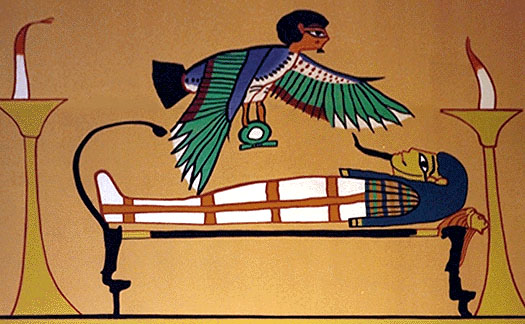
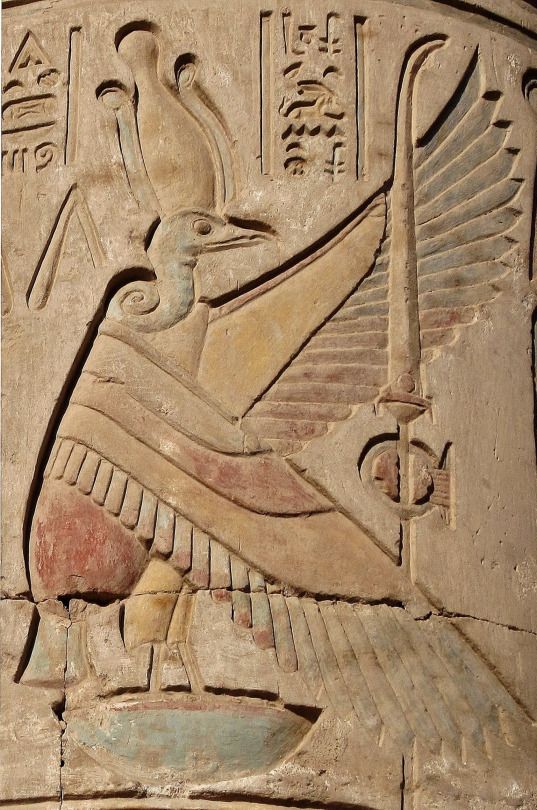
Ba bird in the form of a vulture hovering over the dead king holding a shen ring.
In The Encircling Protection of Horus, Current Research in Egyptology, 2011, Lightbody proposes, “The protective symbolism was represented graphically, as a partially abstracted concept, by the shen ring.
The shenu is also known in its elongated form as the cartouche and was depicted as twin oval loops of rope, tied at the bottom.
They encircle the pharaoh’s praenomen, throne name, or nomen, birth name, in hieroglyphs. Other motifs and deities were closely associated with this ring and the cartouche, such as the royal falcon Horus, the royal uraeus snake, and the vulture goddess Nekhbet.
Together, they represented the ideas of royal protection and dominion over the encircled world.
Scenes incorporating these icons were often depicted on the architectural elements of tombs and temples, particularly at entrances and on thresholds, such as under architraves, down door jambs, or along the tops of enclosure walls. In this way, they protected the royal building entrances and perimeters.”
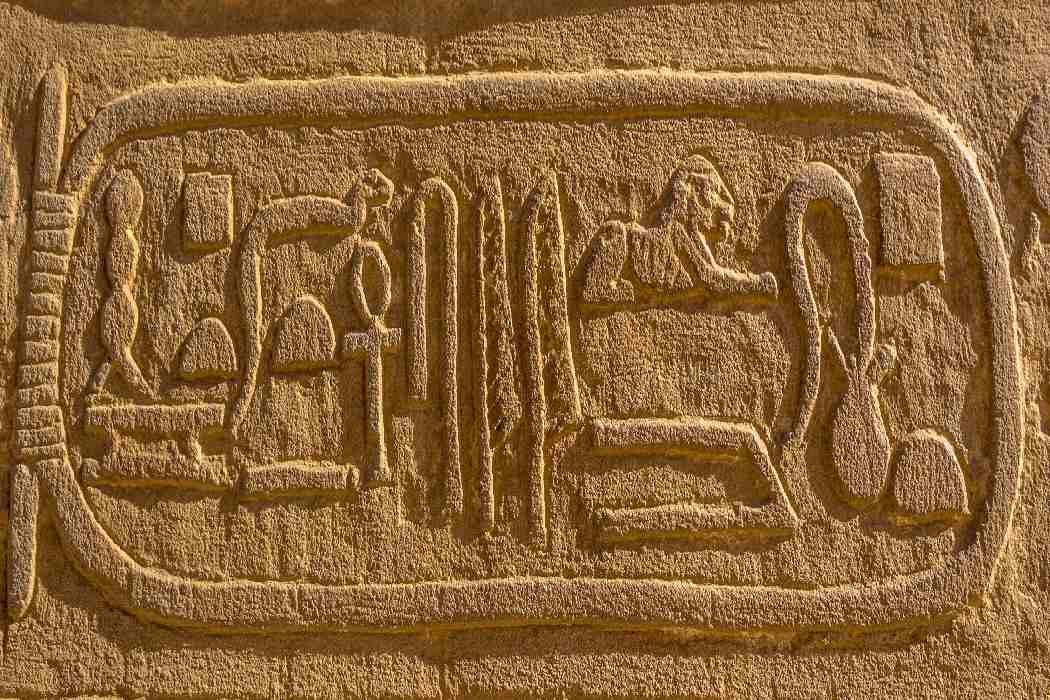
Cartouche inscriptions on temple columns.
Magic Circles
However, the cartouche is not circular. It is true, circular symbols include the royal uraeus, represented in the image of a snake, and the vulture goddess Nekhbet and the earliest known shen ring.
Lightbody concludes that “Petrie was right to conclude that circular symbolism was used in the royal architecture of the Old Kingdom. The circular symbolism represented eternal royal protection encircling the pharaoh and his territorial dominion, and was represented by the shen, and/or cartouche symbols, often carried by Horus above. The cartouche and shen were not just decorative motifs. They were absolutely central to the ideology of kingship, and represented the importance of sacred protection for the pharaoh, his territorial domination, and his unique status as Horus, the living son of Ra.”
The critical question for me is the cartouch symbol part of a functional magical system of royal protection, and if so was it offering protection like an amulet or spell, or was it designed specifically to protect the king’s name and therefore preserve him for eternity?
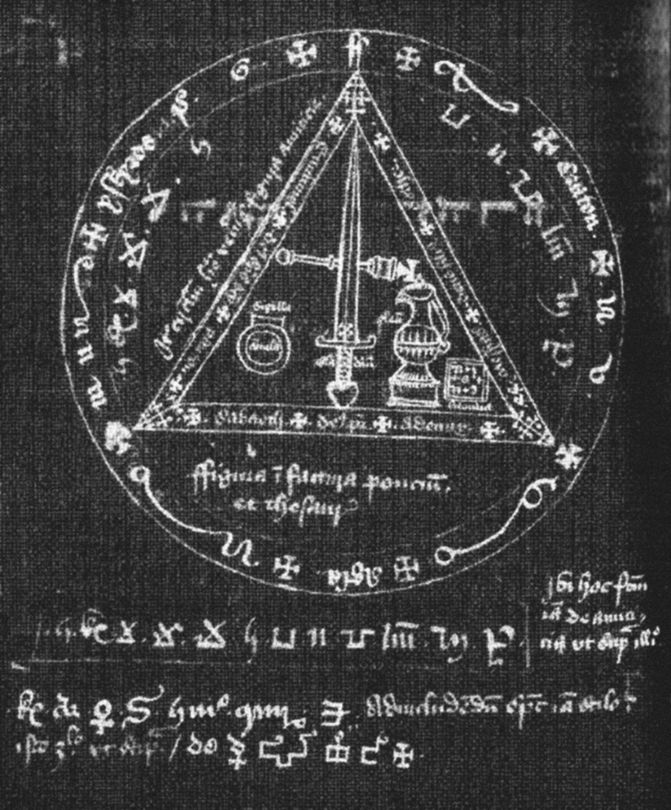
Traditionally, circles are believed by ritual magicians to form a protective barrier between themselves and what they summon.
Circles may or may not be physically marked out on the ground, and a variety of elaborate patterns for circle markings can be found in grimoires and magical manuals, often involving angelic and divine names. Such markings, or a simple unadorned circle, may be drawn in chalk or salt, or indicated by other means such as with a cord it provides a protective boundary by enclosing positive and beneficent energies within its confines. [1] In other words, it protects what is inside the circle not what is outside as in the examples mentioned by Lightbody.
The idea of forming a protective circle suggests there are things in the world the protected something in the circle needs to be protected from or evil things contained within it that the circle must constrain.
In Medieval witchcraft, magic circles were used to protect the person or thing inside the circle from the power of the devil or evil spirits. But, there is no devil in ancient Egypt so what could the cartouche be protecting the king from?
A magic circle from a 15th-century manuscript - Wiki Commons.
Chaos and Disintegration
Jan Assmann provides the answer in his discussion of the heart and connectivity in Death and Salvation in Egypt.
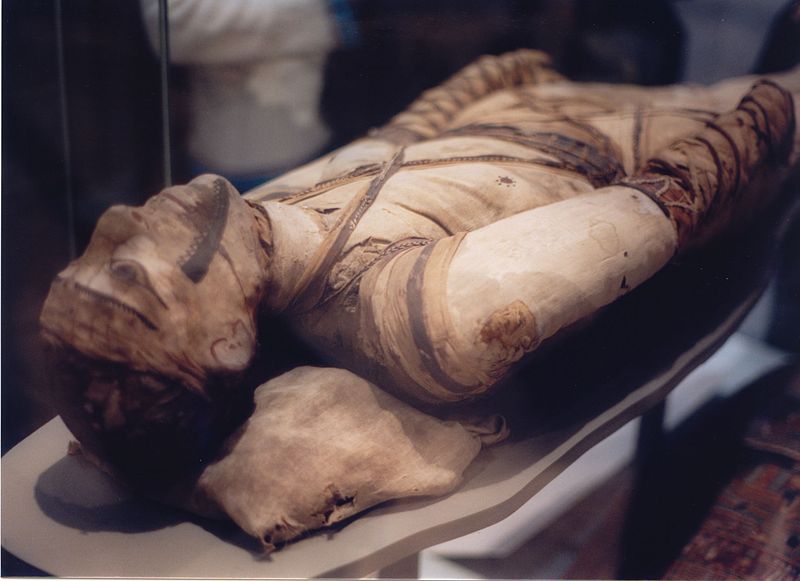
“For the Egyptians, this principle of “connectivity,” the attachment of an individual to a whole, was what characterized life in general. Life was connection, death was disintegration and isolation. But to be able to consider this connection, we must determine the entities between which the life-giving connectivity is to be in effect. It was for just that reason that the Egyptians cast a dissecting gaze on the world, so as all the more keenly to grasp its connectedness, that is, the connective structures and principles. They conceived of the body as a marionette only in order to catch sight of the life-giving and life-maintaining function of the circulatory system. The Egyptians thus did not really view the world with a dissecting gaze but with an integrating, one might almost say, an “embalming” gaze. For the embalming ritual was specifically intended to remedy the condition of dismemberment and decomposition that set in with the stopping of the heart and the ceasing of the circulation of the blood, and to benefit the marionette of the body by substituting a new, symbolic connectivity by means of ritual and chemistry. Because we ourselves do not have this embalming glance, what we see in Egyptian art and in other phenomena of Egyptian culture is primarily the additive, the isolating, and the paratactic. We are blind to the animating, the connective. Just as the Egyptian reader had to supply the vowels, for the writing system noted only the consonants, so also he had to supply the conjunctions, for the connection between clauses was mostly paratactic, and in both cases, he had no difficulty. In both cases, the reader breathed a connective life into the elements.” [2]
Museum Mummy - Wiki Commons.
The ancient Egyptians thought that chaos was all around them and that it could come crashing into the world at any time subsuming everything within it. Disintegration was thus an ever-present danger. As Assmann has pointed out embalming was a means of preventing the disintegration of the body in the eternal life of the tomb. Similarly, I believe the cartouche, which was the representation of a loop made from two pieces of rope joined together with a whip binding was designed to prevent the disintegration of the royal name.
The ancient Egyptians were perfectly capable of representing a continuous line, but they chose not to because knots and knot tying are particularly part of magical enchantments. The Egyptian magician spends a large part of his time tying knots according to Bruce Trigger et. al.
A magic knot is a point of convergence of the forces which unite the divine and the human worlds he and his colleagues say in The American Discovery of Ancient Egypt, (Nancy Thomas, Gerry D. Scott, Bruce G. Trigger, Los Angeles County Museum of Art, 1995.)
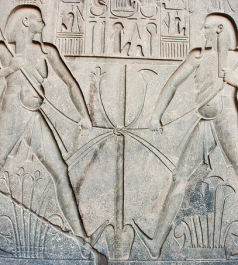
We see the knot-tying image in the sema-tawy image, a motif that shows the gods Horus and Set pulling on opposing ropes with the throne of Egypt in the centre. The image is said to represent unity and shows the king’s name in a cartouche joined to the heart and lungs of a bull. The symbolism of the heart, lungs, and trachea illustrate the complementary relationship between the organs, the lungs must work together to preserve the heart. It is an image of the two lands united by the king.
Sema-tawy - Hapi pulls the knot to tie the two lands of Egypt, Upper and Lower Egypt, or the two banks of the river together.
The shen ring quite a different object, but it is tied in the same way as the cartouche.
The Shen ring is usually seen carried by the vulture goddess Nekhbet and the god of eternity Heh. The Shen ring may be a protective charm when held over the king by Nekhbet. The vulture goddess may be constantly on guard to catch the king’s soul as soon as he shuffles off his mortal coil. We cannot say for sure, more work is required here. In the hands of the god, Heh, it represents millions of years or an eternity of cycles, and so indicates that the symbol is about enduring through time.
The Book of Coming Forth by Day also gives several examples of the magical power of the knot. In one, knots are tied around the deceased to help her come into the presence of the Deities: “The four knots are tied about me by the guardian of the sky [. . .] the knot was tied about me by Nuet, when I first saw Ma’et, when the gods and the sacred images had not yet been born. I am heaven born, I am in the presence of the Great Gods.” In addition to these four knots, there were seven knots, or tesut, that were tied about the deceased to protect him or her. The power of the magical knot is in its ability to both unite and “surround” things. The tied knot is a symbol of the coming together of two things in perfect wholeness, a condition that promotes a positive outcome.
The king wished his name to preserved through time, to be enduring through time, and to give thanks to the gods forever. The king could also make his name perfect through combat, by cementing his reputation as a brave warrior in all lands through its promotion by his officials who by writing his name ‘gave it cause to live’ or shenu. As long as a person’s name was said - as long as life was breathed into it by the speaker, the name lived. [5]
Life After Death
So, to conclude it is more likely the cartouche holds the king’s name together in the same way that bandages held his dead body together. The ancient Egyptian were obsessed with thwarting the process of decay. They understood that bodies if left unbound disintegrated into a pile of bones. If his name were damaged or completely destroyed, the soul would be lost and the deceased would be forgotten and fall for nothing. The cartouche was thus designed to hold the king’s name together so that it would remain intact, could be read and said, and so preserved his Ka spirit or his worldly persona. The cartouche protected the king’s name not his tomb or the adjacent area. It provided the king with one of the many ways the ancient Egyptians believed a person could survive the forces of entropy, decay, and disintegration associated with mortality. The two ropes of the cartouch most probably represented the two ropes of time that were spooled out by the gods (See The Book of Gates). The shen ring, which began meaning ’causes to live’ was most probably a symbol of eternity and eternal life. For more on the Afterlife see:
[1] The Encircling Protection of Horus, Current Research in Egyptology, 2011.
[2]Cunningham, Scott (2001). Wicca: A Guide for the Solitary Practitioner, 29th edition, Llewellyn Publications.
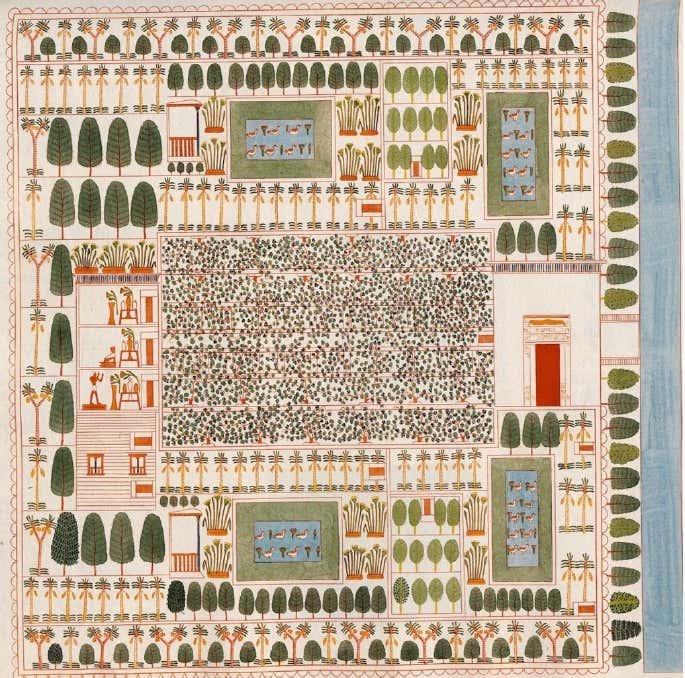
The beautiful illustration above show a garden laid out in typical ancient Egyptian style. The strange but charming perspective is called ‘aspective’ and it is the opposite of our modern western view called ‘perspective’. The aim of the ancient Egyptian artist was to show all the essential details of a thing or person from a universal, not a personal viewpoint.
The image of the pond is a halcyon one, the animals, fishes and trees represent the peace and tranquillity of the ideal afterlife. The colours are cool and tranquil to illustrate the peace and comfort of life in the Hereafter. Heaven was not perceived as a garden but gardens were thought of as heavenly.
The painting is one of 11 paintings acquired by the British Museum from the tomb-chapel of a wealthy Egyptian official called Nebamun in the 1820s. Dating from about 1350t BC, they are some of the most famous works of art from Ancient Egypt.
The Tomb of Nebamun is from Dynasty XVIII. It was located in the Theban Necropolis on the west bank of the Nile at Thebes (present-day Luxor), in Egypt. The tomb was the source of a number of famous decorated tomb scenes that are currently on display in the British Museum, London.
Nebamun (c 1350 BCE) was a middle-ranking official scribe and grain counter at the temple complex in Thebes. His tomb was discovered in 1820 by a young Greek adventurer called Giovanni (“Yanni”) d’Athanasi, who was acting as an agent for Henry Salt, the British Consul-General. The tomb he found had plastered walls that were richly and skilfully decorated with fresco paintings, depicting idealised views of Nebamun’s life and activities.
D’Athanasi and his workmen literally hacked out the pieces he wanted with knives, saws and crowbars. Salt sold these works to the British Museum in 1821, though some of other fragments became located in Berlin and possibly Cairo. D’Athanasi later died in poverty without ever revealing the tomb’s exact location.
The best-known of the tomb’s paintings include Nebamun fowl hunting in the marshes, dancing girls at a banquet, and a pond in a garden. In 2009 the British Museum opened up a new gallery dedicated to the display of the restored eleven wall fragments from the tomb. They have been described as the greatest paintings from ancient Egypt to have survived and as one of the Museum’s greatest treasures
The frescoes are now on display together for the first time at the British Museum. Following the restoration process, they now give a true impression of the colour that would have been experienced by the ancient visitors to the tomb-chapel.
Objects dating from the same time period and a 3-D animation of the tomb-chapel help to set the tomb-chapel in context and allow visitors to experience how the finished tomb would have looked.
Formal Gardens
Formal memorial gardens were a regular feature of royal and upper-class tombs and were often constructed adjacent to temples. A model of a garden was discovered under the floor of the tomb chapel of Meketre, chancellor to King Mentuhotpe (fig. 4).31 It depicts a garden with a pond and surrounding trees, the house with it is small in comparison. This illustrates the prestige a garden provided. A model of one’s home to take to the afterlife would have been a necessary addition to the burial chamber.
The formal gardens represented in tomb scenes and the actual ones known from texts, illustrations and those found during excavations show they were mostly symmetrical in design and located close to either private homes and tombs, palatial residences, or cult centres, temples and shrines.
The formal garden of Amun-Re, Thebes (TT96), 1834, New York Public Library Digital Collections.
Formal gardens, like the one shown above, were first constructed by the pharaohs, who sometimes gifted them to members of the royal family or to valued officials. This began a trend in private memorial garden construction.
Palace gardens were lavish with facilities for sports, leisure, music, song, and dance performances. Boats were rowed on their vast lakes and memorial meals, wakes, banquets, and religious festivals and rituals were celebrated. The grounds were also used to grow food, flowers, herbs, fish farming, fruit and vine cultivation. Bees were kept in beehives for the making of honey.
Each of the 42 floral and 11animal species identified in these formal gardens has a specific growth and/or development cycle, which only allows them to be in bloom and/or be available for harvest at certain times of the year. Jayme Reichart of the American University in Cairo has catalogued and analysed 11 gardens constructed before the Amarna Period. An example of the number of trees of each type is listed
Jayme Rudolf Reichart, Pure and Fresh: A Typology of Formal Garden Scenes from Private Eighteenth Dynasty Theban Tombs Prior to the Amarna Period, Thesis Submitted to The Department of Sociology, Egyptology, and Anthropology In Partial Fulfilment of the Requirements for The Degree of Master of Arts in Egyptology and Coptology, 2020.
Ineni and his wife sit in a pavilion while a gardener carries water jugs. The text above this scene reads Inspecting his [S-formal garden] in the west, refreshing himself under his sycamore fig trees, seeing [those great] and beautiful trees that he planted on earth under the praises of that noble god [A]mun, [Lord of Thrones of the Two Lands].
Julia Herdman is currently working on the first book to tackle the subject of Ancient Egyptian Sacred Numbers for over a hundred years.
Sources:
British Museum Website, Egyptian Gardens, Alison Daines, Studia Antiqua 6, no. 1 2008, Jayme Rudolf Reichart, Pure and Fresh: A Typology of Formal Garden Scenes from Private Eighteenth Dynasty Theban Tombs Prior to the Amarna Period, Thesis Submitted to The Department of Sociology, Egyptology, and Anthropology In Partial Fulfilment of the Requirements for The Degree of Master of Arts in Egyptology and Coptology, 2020.




 Guy’s Hospital, London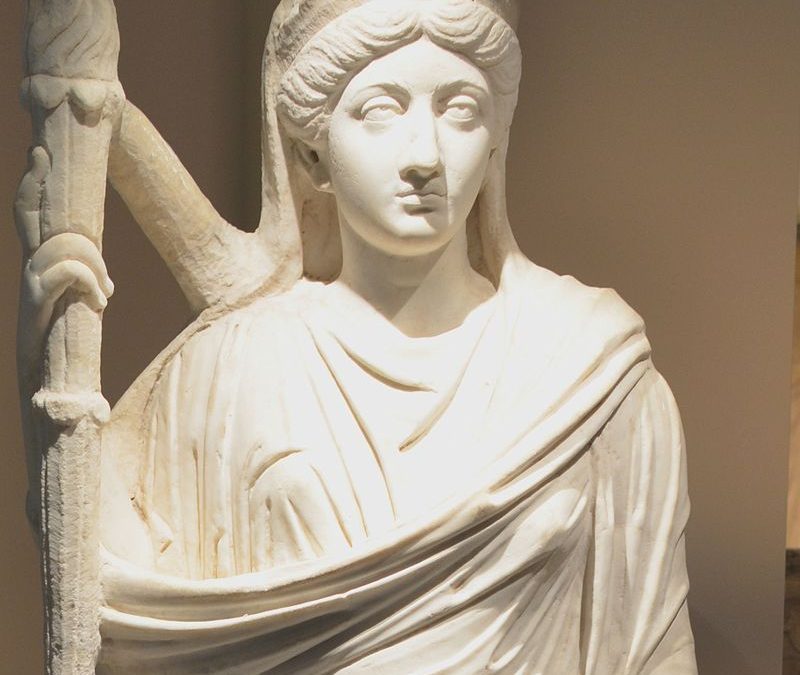





Recent Comments