
by Julia Herdman | May 5, 2017 | Blog
The Hipster, the Macaroni and the Fop
The emergence of the modern-day hipster is the antithesis of the 18th-century Macaroni, but they have some things in common.
Macaronis were fashionable fellows who dressed and even spoke in an outlandishly affected manner. The macaroni only wanted was new and expensive. They thrived on spending money on the most outlandish costumes and hair.
The term macaroni is a pejorative one and referred to a man who “exceeded the ordinary bounds of fashion” in terms of clothes, fastidious eating and gambling. It was used to describe young men who had been to Italy on the Grand Tour and developed a taste for maccaroni, a type of pasta little known in England then, and so they were said to belong to the Macaroni Club.
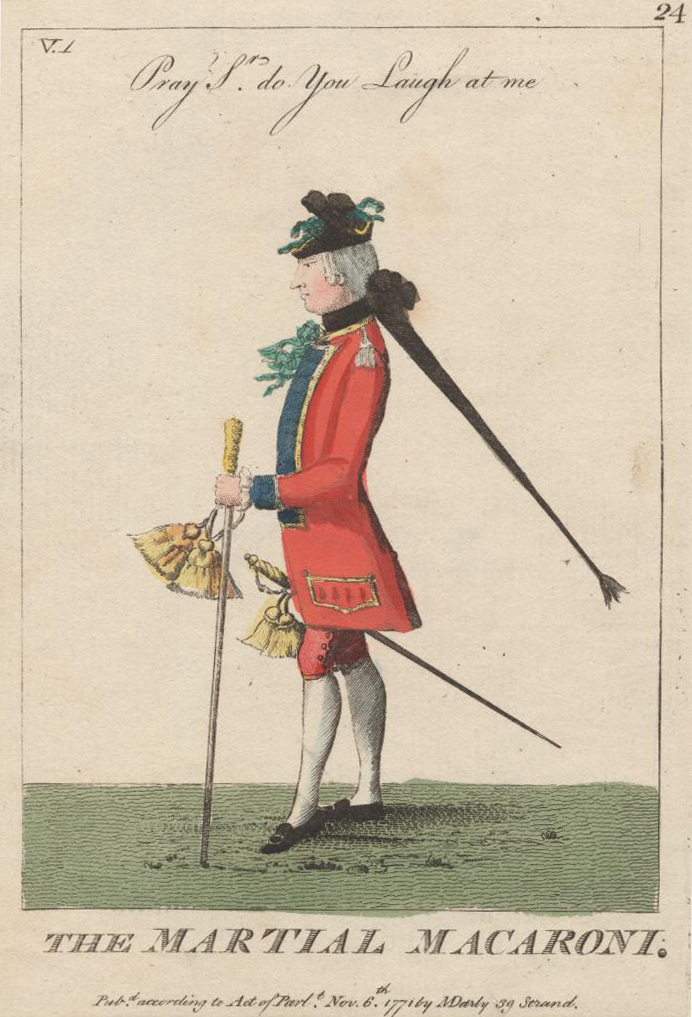
Macaronis were the object of some savage British satire. In the Middlesex Journal for November 7th, 1772 Juventis commented on the use of the term macaroni: “If I consult the prints, ’tis a figure with something uncommon in its dress or appearance; if the ladies, an effeminate fop; but if the’ prentice-boys, a queer fellow with a great large tail.” Basically, this meant that the author thought if a woman looked at an illustration of a Macaroni, she would think she was looking at an effeminate dandy, while a working-class boy would say the man was a homosexual.
Hipster men, gay and straight, have made Retro their cool. The environment they say is precious to them, so they have turned their backs on the ‘the new’. The purloin their style from the racks of the Vintage shops choosing tweeds, corduroy and shirts made of cotton. Hipsters want to wear Sylvia Plath’s cardigans and Buddy Holly’s glasses because to be cool isn’t to look like a television star. They have beards and wear their hair in ponytails and buns revelling in the irony of making what was once nerdy cool. The only new thing Hipsters want is technology and coffee. These latter-day dandies wish to live hi-tech and sustainably; eat organic, gluten-free grains and preen their whiskers in the Edwardian style barbers shops.

Dandies appeared in the late 18th-century. Of course, both the dandy and the macaroni appear in the popular American Revolution song ‘Yanki-doodle-dandy’ the song that describes how an American colonist stuck a feather in his cap and called it Macaroni.
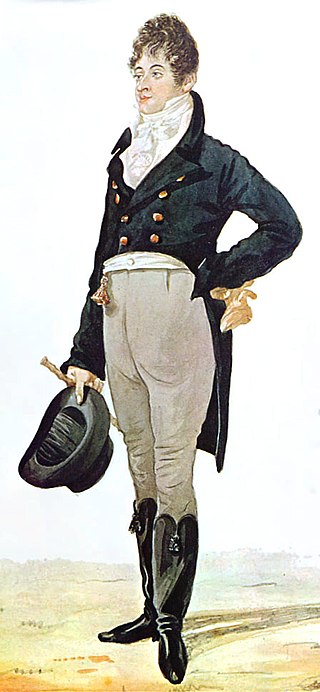
Napoleon and soldiering made ‘dandy’ a vogue word in the late 18th-century. Military men did not see themselves as men about town. Distinguishing a “dandy” from a “fop” was not difficult. The dandy was a rich, fashionable man about town, a man who could afford to copy the style of George Bryan “Beau” Brummell (1778–1840), in his early days, an undergraduate student at Oriel College, Oxford and later, an associate of the Prince Regent. The dandy’s dress was more refined and sober than the fop’s. The fop was a man of more modest means who made foolish and unfashionable choices about his wardrobe. The fop was a object of fun and was variously known as a coxcomb, a fribble, a popinjay (meaning ‘parrot’), a fashion-monger, or a ninny. He was the 18th-century equivalent of medallion man.
A 21st-century fop would be the hair-obsessed character Ulysses Everett McGill (played by George Clooney) in the Coen brothers film O Brother Where Art Thou (2001) and the character of Jack Sparrow (played by Johnny Depp) in the Pirates of the Caribbean film series. Depp’s style has been termed “grunge fop” because he has dreadlocks. The actor’s mannerisms caused concerns among executives at the Walt Disney Company Depp’s characterisation of Sparrow prevailed, thereby creating a new generation of fans of the fop.
Hipsters, dandies and fops are extremes in men’s fashion. It is often said that women do not dress for men but for other women. When we look at the history of men’s fashion, the hipster, the dandy and the fop seem to have no interest in the opposite sex, they like women are dressing to impress each other.
Julia Herdman writes historical fiction. Her latest book Sinclair, Tales of Tooley Street Vol. 1. is Available on Amazon – Paperback £10.99 and on Kindle.
Sinclair is available of Amazon. Click here to get your copy.
Sinclair is set in the London Borough of Southward, the Yorkshire town of Beverley and in Paris and Edinburgh in the late 1780s. Strong female leads include the widow Charlotte Leadam and the farmer’s daughter Lucy Leadam. Sinclair is a story of love, loss and redemption. Prodigal son James Sinclair is transformed by his experience of being shipwrecked on the way to India to make his fortune. Obstacles to love and happiness include ambition, conflict with a God, temptation and betrayal. Remorse brings restitution and recovery. Sinclair is an extraordinary book. It will immerse you in the world of 18th century London where the rich and the poor are treated with kindness and compassion by this passionate Scottish doctor and his widowed landlady, the owner of the apothecary shop in Tooley Street. Sinclair is filled with twists and tragedies, but it will leave you feeling good.
Also available on:
Amazon Australia
Amazon Canada
Amazon New Zealand
Amazon South Africa
Amazon USA
Coco, Blue Jeans and Fashion’s Glass Ceiling

by Julia Herdman | Apr 25, 2017 | Blog
Astronomy, mathematics and physics were popular fields of study for many of the brightest 18th-century women with access to money and books. Gabrielle-Emilie Le Tonnelier de Breteuil was one such woman. She was the daughter of the French court’s chief of protocol and her father rather unusually for the time encouraged her education. By the time she was twelve she was fluent in Latin, Italian, Greek and German.
Gabrielle-Emilie was a precocious teenager as well as a child genius; she liked to dance, was a passable performer on the harpsichord, sang opera, and was an amateur actress. Being short of money for books, she used her mathematical skills to devise highly successful strategies for gambling. Her mother Gabrielle-Anne was horrified tried to have her clever daughter sent to a convent.
In 1725 Gabrielle-Emilie married the Marquis du Chatelet at the age of 19 and lived the life of a courtier at the French court. She bore her husband three children, but at age 27 she began studying mathematics seriously and then branched into physics. This interest intensified when she started an affair with the philosopher Voltaire. Their friendship, if not their relationship, was lifelong and one of mutual respect and admiration.
Her philosophical magnum opus, Institutions de Physique or Foundations of Physics, was published in 1740 when she was 34. It was an immediate success, circulated widely, and republished and translated into several other languages within two years of its publication. With a growing reputation in the world of men, she participated in the famous vis viva debate concerning the calculation of the motion of orbiting bodies - the planets. However, Du Chatelet’s most lasting contribution to science was her French translation of Isaac Newton’s Principia, which is still in use today.
At age 43, she fell in love with a young military officer and became pregnant; she died following complications during the birth of their child. Posthumously, her ideas were included in the Encyclopédie of Denis Diderot and Jean le Rond D’Alembert.
Sources: Smithsonian Magazine, Wikipedia, Illustration: The Granger Collection, New York.
Iona McNeal, is a character in my new novel, Sinclair. Iona is a bright young woman, the daughter of the head of Edinburgh’s medical school. She studies mathematics, physics and astronomy at home. You can find out what happens to her in my latest book Sinclair, Tales of Tooley Street Vol. 1. Available on Amazon – Paperback £10.99 and on Kindle
Also available on:
Amazon Australia
Amazon Canada
Amazon New Zealand
Amazon South Africa
Amazon USA
From Housemaid to Commit Catcher - Caroline Herschel
Witch or Saint ? Maria Gaetana Agnesi
Nursing by Numbers
Byron’s Daughters - A Tale of Three Sisters

by Julia Herdman | Apr 13, 2017 | Blog
Think of the words ‘white’ and ‘chocolate’ and the images that come to mind are those of the ‘The Milky Bar Kid’ or that luxury white chocolate flecked with fine black vanilla seeds but White’s and chocolate in the 18th century meant something entirely different; gambling.
The impetus for London’s chocolate craze came from France, introduced as an ‘excellent west indian drink’ in the mid 17th century. A decade later pamphlets proclaimed the miraculous, panacean qualities of the new drink, saying that it would boost fertility, cure consumption, alleviate indigestion and reverse ageing: with a mere lick, it was said, it would ‘make old women young and fresh and create new motions of the flesh’.
Unlike in Paris and Madrid, chocolate drinking was not confined to the social elite in London however it was never as popular as coffee with its enlivening caffeine boost.. It was only around St James’s Square that a cluster of super-elite self-styled ‘chocolate houses’ flourished. The principal chocolate houses were Ozinda’s and White’s, both on St James’s Street, and the Cocoa Tree on Pall Mall.As befitted their location their interiors were a cut above the wooden, workmanlike interiors of the City coffeehouses, boasting sofas, polished tables, dandyish waiters and, at least in Ozinda’s case, a collection of valuable paintings for the customers to admire. In fact Ozinda’s comfortable surroundings became a hot bed of Jacobite intrigue. On one occasion in 1715, Jacobite supporters were arrested there and taken off to Newgate prison.
White’s started life at 4 Chesterfield Street, off Curzon Street in Mayfair, in 1693; owned by an Italian immigrant named Francesco Bianco. It was later re-named Mrs. White’s Chocolate House with a side line in tickets for the King’s Theatre and Royal Drury Lane Theatre White’s quickly made the transition from cafe into an exclusive club. It was notorious as a gambling house; those who frequented it were known as “the gamesters of White’s.” The club gained a reputation for both its exclusivity and the often raffish behaviour of its members. Jonathan Swift referred to White’s as the “bane of half the English nobility.” In 1778 it moved to 37–38 St James’s Street and was from 1783 the unofficial headquarters of the Tory party, while the Whigs’ club Brooks’s was just down the road.
White’s had such a terrible reputation Hogarth depicted its inner gambling room as ‘Hell’, in the sixth episode of Hogarth’s Rake’s Progress. The place is on fire but no one seems to notice. It is a picture of greed and despair so far removed from the images of chocolate we have today.
Illustration: Meissen Chocolate Cup and Saucer.
Julia Herdman is a novelist. Her latest book Sinclair, Tales of Tooley Street Vol. 1 is Available on Amazon – Paperback £10.99 Kindle £2.29
Also available on:
Amazon Australia
Amazon Canada
Amazon New Zealand
Amazon South Africa
Amazon USA

by Julia Herdman | Apr 8, 2017 | Blog
Tooley Street in Southwark is the location of my new novel Sinclair. Today is it’s one of London’s best known streets, home to London Bridge Station and the London Dungeon, and is close to the London Shard and City Hall.
Running parallel to the Thames on the south side Tooley Street is one of the oldest streets in London. Its name is said to be a strange corruption of its former name, St. Olave’s Street, which is hard to believe but I suppose we’ll just have to accept what the local experts tell us on that one.
It’s a thriving place today with state of the art offices, clean and tidy streets and modern communications and although it was no less thriving in the past it was a very different place then. Here are some of the residents and trades listed as living and operating in the area in the 18th and 19th century:
Wharfingers (warehouse owners), merchants, instrument makers, factors, and agents; outfitters, biscuit-bakers, store-shippers, ship-chandlers, slop-sellers, block-makers, rope-makers, engineers, and then there were the surgeons who worked at the great charitable hospitals: Guy’s, St Thomas’ and the London.
My novel is set in eighteenth century Tooley Street in a house inhabited by my family’s ancestors for three generations. They owned an apothecary shop at No. 65 and worked as surgeons at Guy’s Hospital just a stone’s throw away. Members of the Leadam family pop in and out of the historical record; appearing in trade directories, hospital correspondence, or as witnesses in Old Bailey cases or giving evidence to Government enquiries on issues such as public health.Some members of the family are mentioned in magazine and newspaper articles of the day and some have published obituaries and their own publications.
In my story which is a fiction not a family history, a Scottish doctor down on his luck comes to live at No 65 Tooley Street after the unexpected death of Christopher Leadam who is based on the real Christopher Leadam who was born in Yorkshire and worked at Guy’s hospital as a surgeon and was secretary to one of its weekly committees. He died young leaving a widow, whom I have called Charlotte Leadam in the book and a teenage son. My story focuses on his widow’s struggle to keep the apothecary shop open and get her son, John, trained as a surgeon.
Illustration: Guy’s Hospital, London, opened 1725.
You can read my fictionalised account of life at No. 65 Tooley Street in Sinclair.
Available on Amazon – Paperback £10.99 Kindle £2.29
Amazon Australia
Amazon Canada
Amazon New Zealand
Amazon South Africa
Amazon USA
by Julia Herdman | Apr 4, 2017 | Blog
John Keats - The Apothecary Poet
The poet John Keats trained as an apothecary and a surgeon before deciding to dedicate himself to poetry.
Keats had first-hand experience of serious illness and death. His father died after falling from a horse, and his mother and uncle died of what was called ‘an unspecified decline.’ Keat’s only brother Tom was to die of tuberculosis in December 1818. Keats nursed his brother through his final months catching the deadly virus in the process. Keats’ disease became apparent early in 1820. Known as consumption in those days the disease was common, distressing and lethal.
Keats Early Life
Aged just 14 years old Keats was apprenticed to the family’s doctor, Thomas Hammond. In the summer of 1810, Keats moved in above Hammond’s surgery in Edmonton, North London. While an apprentice, Keats would have performed such tasks as making up medicines, cleaning the surgery, preparing leeches (blood-sucking worms that were used to bleed patients), and bookkeeping. As he progressed he may have moved on to dressing wounds, drawing teeth and visiting the sick.
Keats’s poetry received some harsh criticism form literary snobs because he was an apothecary. Having such a profession was seen by some to be beneath the dignity of a poet. The Tory critic John Gibson Lockhart, writing anonymously in Blackwood’s Edinburgh Magazine, Lockhart advised Keats that ‘It is a better and a wiser thing to be a starved apothecary than a starved poet.’
He seems to have left before his apprenticeship was completed, but he had done enough to satisfy the requirements of the 1815 Apothecaries Act, which came in while Keats was in the next stage of his training at Guy’s Hospital. Keats entered Guy’s Hospital as a student on 1 October 1815 and, with incredible speed, was promoted to the role of ‘dresser’ on 29 October 1815, less than a month after he had arrived at the hospital and just before he turned 20.
The Apothecaries Act had come into force on 12 July 1815 and was an attempt to regulate and professionalize apothecaries. To be allowed to practice, there was now a required minimum degree of training and an exam. Keats had done enough of his apprenticeship, the requisite six months of hospital training, and then passed the difficult exam (which his two housemates failed). He qualified for his apothecary license on 25 July 1816.
His knowledge of the human body and its suffering can be found in his narrative poem Lamia which was published in 1820. The poem was written in 1819, during the famously productive period that produced his 1819 odes. It was composed soon after his “La belle dame sans merci” and his odes on Melancholy, on Indolence, to a Grecian Urn, and to a Nightingale and just before “Ode to Autumn”. It tells how the god Hermes hears of a nymph who is more beautiful than all the rest and he goes searching for it but he finds Lamia, trapped in the form of a serpent. She reveals the previously invisible nymph to him and in return, he restores her human form. Her transformation into a woman contains all the pain and horror he had witnessed in his hospital work. It shows the knowledge of chemistry he gained at Guy’s Hospital. Lamia foamed at the mouth her eyes wild ‘Flash’d phosphor and sharp sparks’ (Part 1, ll. 148-52). The beautiful colours that had characterized her mythological, serpent body are replaced with the ‘pain and ugliness’ of human mortality and the change was horrible, physically painful ‘She writh’d about, convuls’d with scarlet pain’ (Part 1, l. 164; l. 154). Scarlet is, of course, the colour of blood and in his phrase ‘scarlet pain’, Keats describes the agony of Lamia’s transition into a fully mortal woman.
Keats Death
During 1820 Keats’ health declined. He suffered two lung haemorrhages in the first few days of February and lost a lot of blood. At the suggestion of his doctors, he agreed to move to Italy with his friend Joseph Severn. He took a house on the Spanish Steps in Rome, today the Keats–Shelley Memorial House museum. Despite the care of Severn and Dr. James Clark, his health rapidly deteriorated. Keats was placed on a starvation diet of one anchovy and a piece of bread a day intended to reduce the blood flow to his stomach. He was bled, a standard treatment of the day to reduce the agitation of his blood. Weak and knowing the fate he had in store Keats tried to poison himself with opium without success. His friends hoping to save him from himself took the opium away and Keats died in agony with nothing to ease the pain.
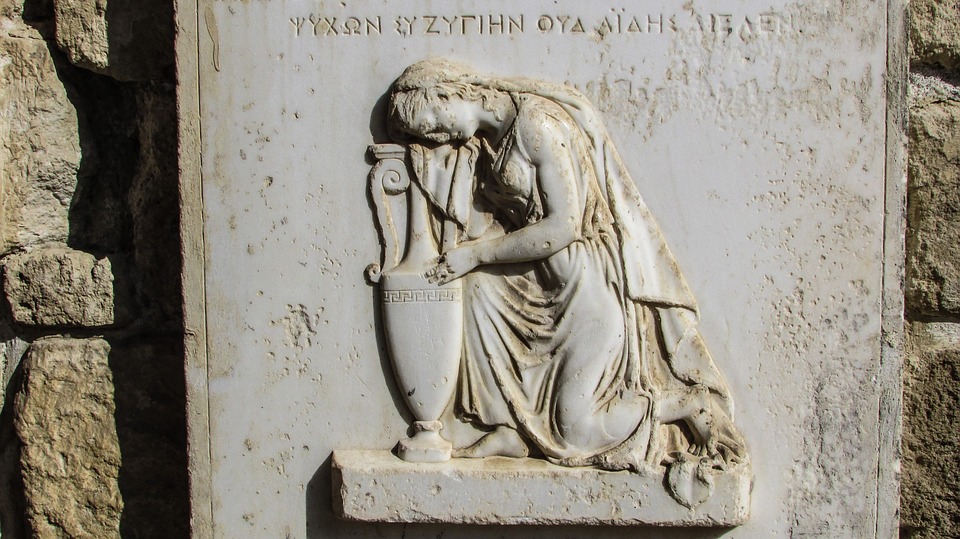
John Keats died in Rome on 23 February 1821 and was buried in the Protestant Cemetery. His last request was to be placed under a tombstone bearing no name or date, only the words, “Here lies One whose Name was writ in Water.” Severn and his doctor Brown erected the stone. On it they had a relief of a lyre with broken strings cut into it with the epitaph:
This Grave contains all that was Mortal of a Young English Poet Who on his Death Bed, in the Bitterness of his Heart at the Malicious Power of his Enemies Desired these Words to be engraved on his Tomb Stone: Here lies One Whose Name was writ in Water. 24 February 1821. The text echoes a sentiment from Catullus LXX. Sed mulier cupido quod dicit amanti, in vento et rapida scribere oportet aqua which means ‘ What a woman says to a passionate lover should be written in the wind and the running water.
About the author
Julia Herdman is a novelist writing about 18th and early 19th century London. Her debut novel Sinclair is about a family of apothecary surgeons working at Guy’s and St Thomas’s Hospitals at the dawn of modern medicine. Available on Amazon - Paperback £10.99 on Kindle
Julia Herdman is a novelist writing about 18th and early 19th century London. Her debut novel Sinclair is about a family of apothecary surgeons working at Guy’s and St Thomas’s Hospitals.
What people are saying about Sinclair.
5 stars – Fantastic Tale of the 18th century
This book is superbly written and pulls the reader right into 18th-century life! Truth be told, I am not usually a fan of historical fiction, but Sinclair has changed that for sure! I was fully immersed in this tale, and have recommended it to all of my friends & colleagues! C.Miller, USA
Available on Amazon - Paperback £10.99 and Kindle
Amazon Australia
Amazon Canada
New Zealand
South Africa
Amazon USA

Recent Comments