Did the ancient Egyptians have a religion, or did they worship cults?
Whether the ancient Egyptians had what we would call religion is a topic Egyptologists struggle with and disagree about.
What is Religion?
The word religion has a Latin origin. The ancient Egyptians had no word for religion and so the argument goes, therefore, they had no concept of religion. They also had no word of cosmos or art but they believed they lived in a god-made cosmos and they practiced all manner of arts. So, the absence of a word for something does not mean it did not exist.
Egyptologists take their lead on religion from anthropologists. This makes religion into the study of people, not the study of belief or spiritual beings and relationships with them. (Tylor, 1871). Tylor’s definition is not the most up-to-date. But it works. It provides a good definition of what most of us think of when we think about religion.
The anthropologist Edward Burnett Tylor (1832–1917) defined religion as belief in spiritual beings and stated that this belief originated as explanations of natural phenomena. … They used this by extension to explain life and death, and belief in the afterlife.
In Egyptology, the term cult means the daily tending and worship of an image of a deity. In ancient Egypt, the temples were the houses of the gods. The gods were thought to descend from the sky temporarily to live in their cult statues which were located in the temple’s inner sanctuaries.
The temples were also the stage for daily rituals that were ideally performed by the pharaoh, but in practice were performed by the resident priests. During religious festivals, cult statues could be brought out of the temple. For example at Dendera statues were brought out onto the cult terrace so that people could see them.
The Daily Cult Routine and Ceremonies
The shrine containing the god’s cult image was:
opened at dawn,
greeted and praised with prayers and hymns,
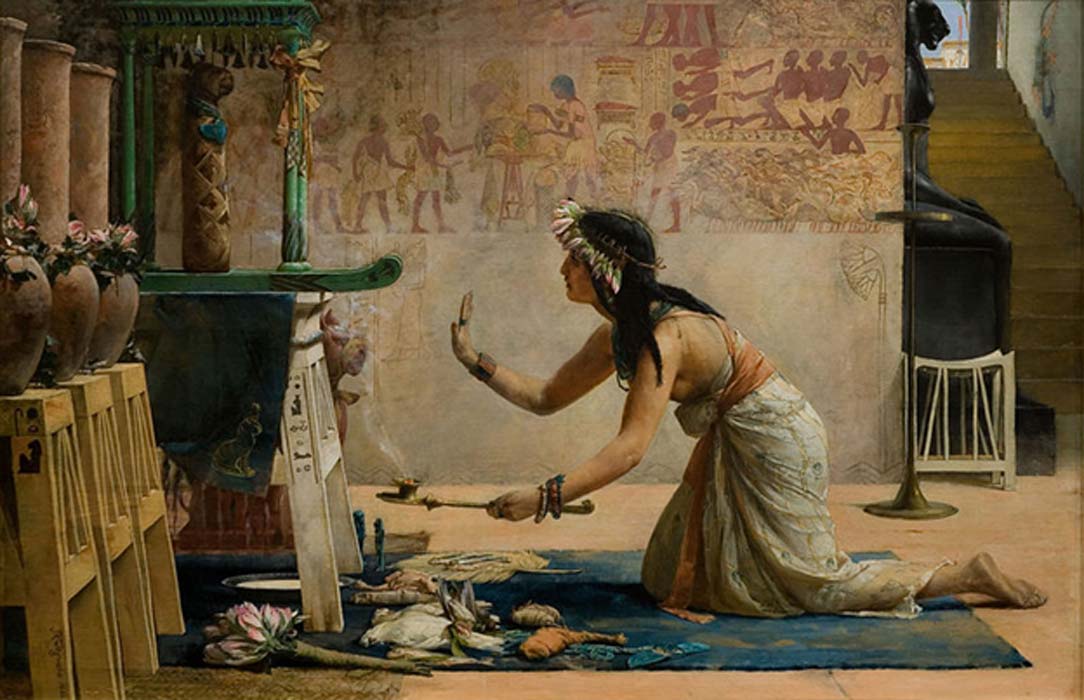
purified with libations and the burning of incense,
clothed in fresh linen, and
fed with bread, cakes and water.
The Obsequies of an Egyptian Cat, John Reinhard Weguelin, 1886.
Every day at dawn the priests performed the ceremony of the creation of the cosmos. It began with a ritual called “Lighting the Fire.” This ritual was held in the most sacred room of the temple and was performed by the high ranking members of the priesthood in the name of the king. It was a reenactment of the first appearance,
and daily reappearance, of the sun.
Next, they performed a ritual known as “Drawing the Bolt.” During this rite, the priests opened the door to the shrine where the main cult statue stood. The statue’s clothing was removed; and underwent ritual purification, dressing, and feeding. The lower-ranking priests were responsible for preparing the ceremony and disposing of the food and water.
At midday, ceremonies of ritual purification for the lesser gods were performed and as the daylight faded the whole morning ceremony was reversed. The statues of the gods were closed again and left to sleep overnight ready for their morning awakening.
So, was there an ancient Egyptian religion, or was it a collection of cults?
When Jean François Champollion unlocked the secret code of Egypt’s most sacred language, hieroglyphs, in 1822 he unlocked many wonders of a long-hidden world. It was a world populated by strange and mysterious gods with human bodies and animal heads.
From the start, Egyptology committed itself to the study of Egypt’s ancient religion; particularly to its beliefs about life after death. But it has never agreed that the ancient Egyptians had a comprehensive worldview or ‘metaphysical moral vision’ that was accepted as binding because it was held to be in itself basically true and just even if all dimensions of it could not be either fully confirmed or refuted.
And so, since the translation of the ‘divine words’ Egyptology has fallen short in one important respect: it has failed to produce a description of the ancient Egyptian gods and religion that is in any way commensurate with the scale and impressiveness of its sacred monuments.
Egyptologists focused on words, almost to the exclusion of everything else. Buildings and monuments are the domain of the archaeologists; the wonderful art of the tombs and precious funeral artefacts found in them were the domain of art historians, and the anthropologists are processing ancient Egyptian religion through a variety of pan-world theories that render religion down to observable social behaviours.
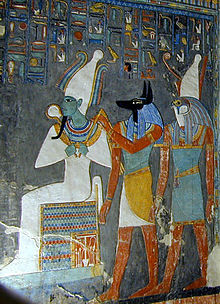
Enthroned Osiris judging the dead
The Gods
Today the gods and religion of ancient Egyptians are portrayed as mundane and soulless; there is no sense that the gods were holy, divine, or transcendent and certainly no sense that once people believed they contained the ultimate mystery of life, death and, the cosmos.
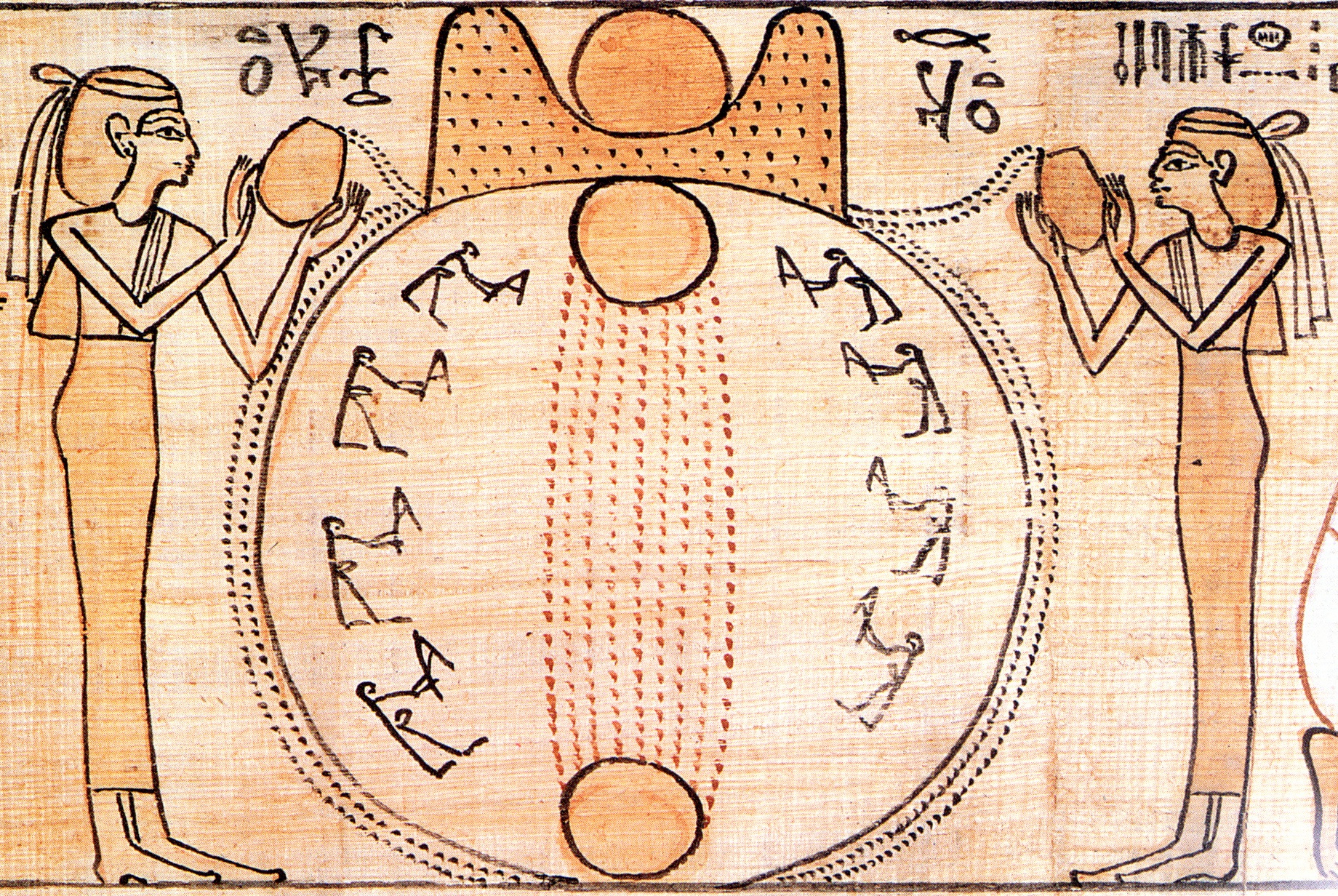
The sun rises over the circular mound of creation as goddesses pour out the primeval waters around it.
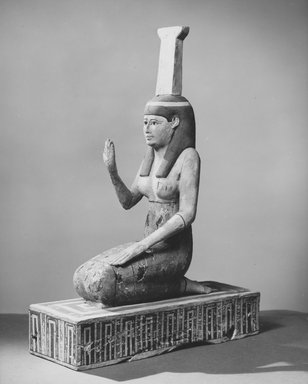
Brooklyn Museum A figure of the Goddess Nephthys
In ancient times, the gods were kept from common view, they were kept or made pure and special. This kept them sacred and helped people to believe the gods were powerful enough to help them fulfill their deepest needs and longings. But the gods were not just there to help when times were bad they filled people with both reverence and terror. What was sacred was protected and adored. Sacred spaces and objects represented the intersection between the limits of temporal human effort and the unlimited possibilities of the metaphysical.
Egyptian religion was not an individual means for orienting or transforming oneself in the world as religion is in the West today. Instead, it was a complex and rich human phenomenon that formed the mental architecture of the whole of society.
The King
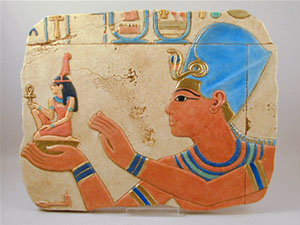
In Egyptology, sacredness is believed to lie primarily in the person of the king; in his tomb, his temples and in his cult statue, in his images and in the ritual objects he used in sacred performances.
In theory, it was the pharaoh’s duty to carry out temple rituals, as he was the human link to the gods - his dead father and mother were believed to be gods and he himself would become a god when he joined them in the afterlife.
For the Egyptians, the king was the pinnacle of Egyptian society. He was the head of the state, their supreme warlord, and the chief priest of every god in the kingdom.
The ancient Egyptian king was believed to be the son of a god, chief priest, and mediator between the gods in heaven and the people on earth. So, in reality, his ritual duties were almost always carried out by priests.
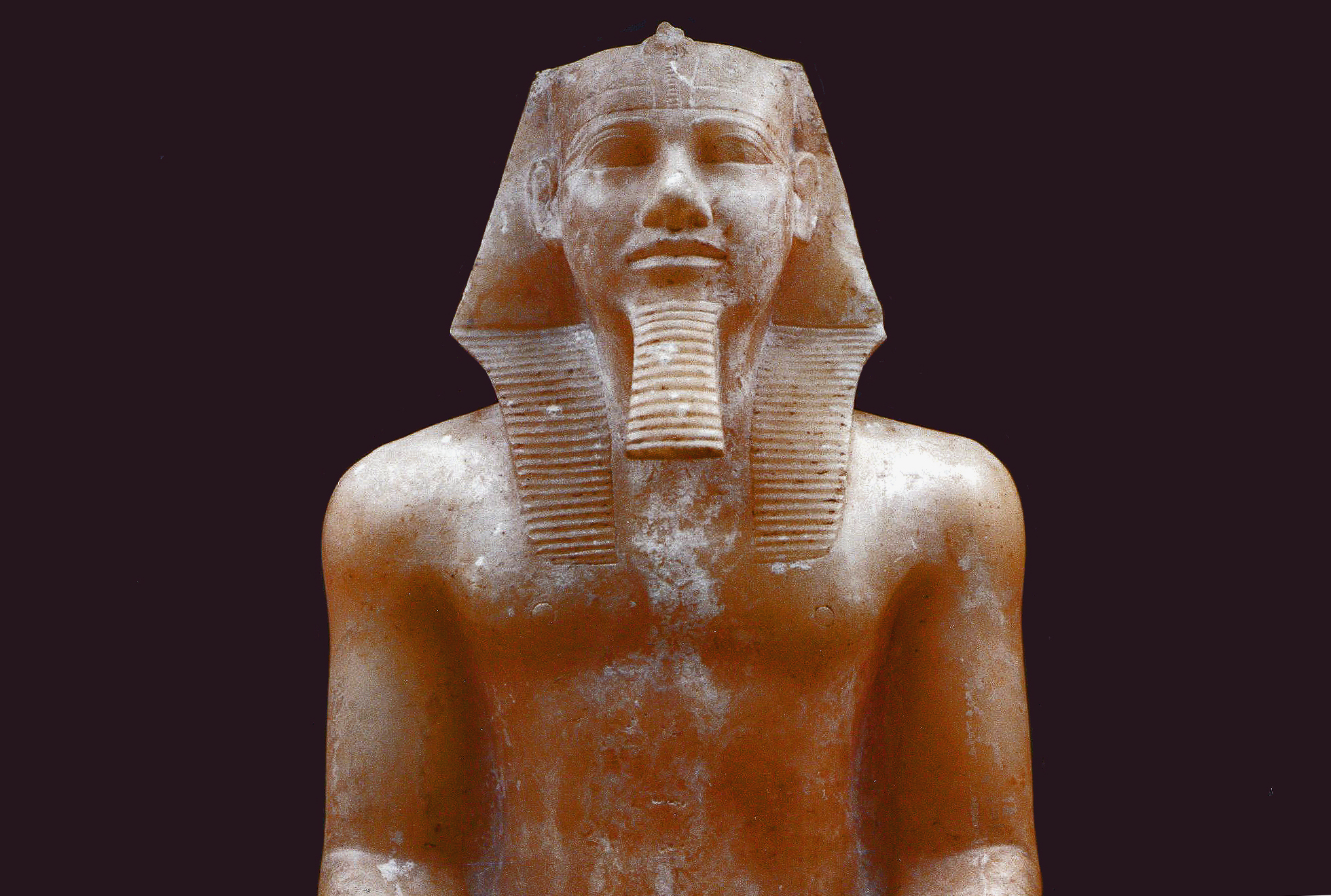
The picture above: Khafra (also read as Khafre, Khefren and Greek: Χεφρήν Chephren) was an ancient Egyptian king (pharaoh) of the 4th Dynasty during the Old Kingdom. He was the son of Khufu and the throne successor of Djedefre. According to the ancient historian Manetho, Khafra was followed by king Bikheris, but according to archaeological evidence, he was instead followed by king Menkaure. Khafra was the builder of the second-largest pyramid of Giza.
The Priests
The king’s priests were initiated into the sacred cults; they learned and maintained the sacred systems; its requirements, and its taboos; and they maintained the sacred order and the prevailing worldview among the non-literate. The concept of sacredness extended beyond the king to the natural world, to the river Nile, the sky, the sun, the moon, and the stars.
Once initiated, the priest led the community in connecting with the supernatural to access its divine benefits - health, good fortune, and life after death.
During the Old and Middle Kingdoms, government officials served as priests on a part-time basis. Full-time priests only appear in the New Kingdom.
The temple staff also included many people other than priests, such as musicians and chanters in temple ceremonies.
Outside the temple were artisans and other labourers who helped supply the temple’s needs, as well as farmers who worked on temple estates. All were paid with portions of the temple’s income. Large temples were therefore very important centres of economic activity, sometimes employing thousands of people.
There were many different types of priests:
Male priests were known as hem-netjer, females as hemet-netjer or servants of the god. The top priest was the hem-netjer-tepi, or ‘first servant of god’.
The wab priests, the lowest rank, did all the routine unskilled work in the temple.
The hour-priests were astronomers.
Sem priests presided over mortuary rituals and conducted funeral services.
The Lector priest or hery-heb or cheriheb wrote the religious texts, instructed trainee clergy, and recited the prayers invoking the gods’ presence in the temple and at festivals. In ancient Egyptian literature, lector priests are often portrayed as the keepers of secret knowledge and the performers of amazing magical feats.
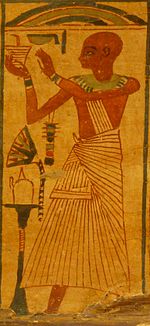
Sacerdote kher-heb
The Moral Vision
Evidence from the archaeological record shows that the ancient Egyptians believed they were responsible for their own moral behaviour. They believed, at least in some form, of what we would call ‘free will’. The gods, particularly Osiris, were the ultimate judges of people’s moral actions. Leading a moral life was the gateway to a second life beyond death and was called ma’at.
The average ancient Egyptian was a lover of life. He or she felt sure that right-doing brought success and happiness, whereas evil-doing was bound to bring failure. This social ethic covered all members of society. Family, friends, neighbours, village and town, the nation and foreigners too. Fair-dealing and benevolence were viewed as the leading virtues; greed was deemed the most pernicious vice.
In sum, the ancient Egyptian recognized the brotherhood of mankind.
The presentation of ma’at
Conclusion
By understanding what was sacred to the ancient Egyptians it is possible to get a new view over ancient Egypt, a view that reveals the rich religious symbolism and philosophy of the world’s first great religion.
Egyptian religion was a very deep religion. It consisted of many levels of knowledge and participation.
Whether we could recreate this religion with all its rituals, ceremonies and mysticism is unlikely. It would be difficult to fool an ancient Egyptian into believing he/she was in a real temple, following a real service because there is so much we don’t know and perhaps will never know. However, I am sure the ancient Egyptians had a religion and that it was both deeply meaningful to them. After all, look what their beliefs inspired.
The preservation of the body, or mummifying, was an essential part of ancient Egyptian funerary belief and practice. The burial customs began with wrapping the body either in a mat or animal skin to prevent direct contact with the sand and to hold the parts of the body together.
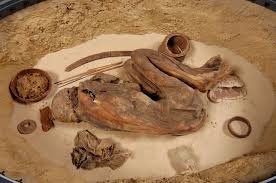
The ancient Egyptians were terrified of the disintegration of the body. The hot sand drew out the body’s liquids to aid its preservation. This kind of preservation is known as “natural mummification,” meaning that preservation was carried out without human intervention.
Natural mummification
The practice of embalming or mummifying aimed to improve on what nature could do on its own. It was considered essential to mummify a Pharaoh. Early mummification involved the wrapping of specific parts of the body such as the face and hands. The best literary account of the mummification process is given by Herodotus, an ancient Greek historian. He records that the entire process took seventy days. There were 30 days of evisceration and drying and 40 days of perfecting with stuffing and embalming with oils.
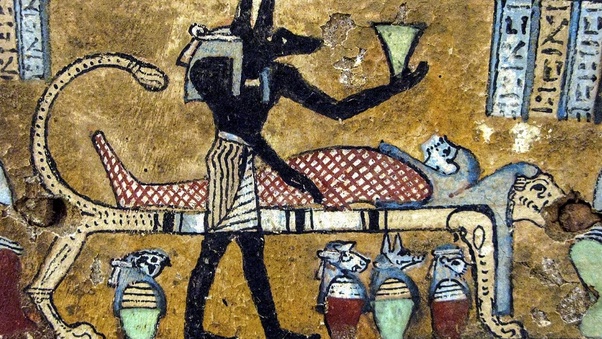
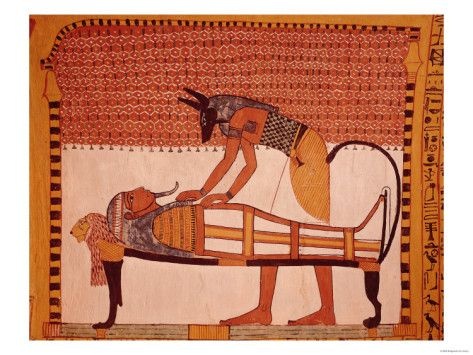
Anubis, with the deceased on the lion bed of resurrections, beneath the four canopic jars face right, Anubis offers a libation.
Anubis was the god responsible for embalming, especially for the Pharaoh. The Pyramid Texts describe Anubis as the Pharaoh’s (Osiris’s) embalmer. “His entrails having been washed by Anubis; the services of Horus having been served in Abydos, [even] the embalming of Osiris”It is clear from this passage that the god Anubis had responsibility for washing the viscera of the deceased king. Egyptologist Bob Brier (1996) has suggested that embalming took place in a tent that was erected on the top of a hill away from the unpleasant smell that resulted from the process of treating the dead bodies. This suggestion is based on the titles of god Anubis that often occur in the offering formulae and the Pyramid Texts “Anubis, who presides in the sh-ntr” (896c), his tent. “He who is upon his hill (tp dw.f). the sh-ntr, which is translated as a “divine booth” (Wb. III, 465), was the place where the bodies of the kings were purified. The tent is described in various texts. it had a number of rooms, the central part of the tent was the place where the purification procedures were carried out. The doorways were shown as closed wooden doors (Merrewka), or curtains as in the tomb of Qar, or they were left open as in the tomb of Idu. There was a central ramp: In each tent, there was a central ramp, which connected the tent to a water channel.
Anubis mummifies the Pharaoh in his tent.
To mummify the body, the internal organs, apart from the heart and kidneys, were removed via a cut in the left side. The organs were dried and wrapped and placed in canopic jars, or later replaced inside the body. The brain was removed, often through the nose, and discarded. Texts suggest that the heart was removed during the Old Kingdom, although there is no proof this from the physical bodies. In a passage in the Pyramid Texts, the heart is removed from the body. The passage (1162a), which might be referring to putting a heart amulet in place of the original heart, reads: “To say: my father made for himself his heart, after the other (heart) was taken from him” In this passage, the word “other” could be a reference either to the god giving another heart to the deceased, or providing a heart amulet in its place.
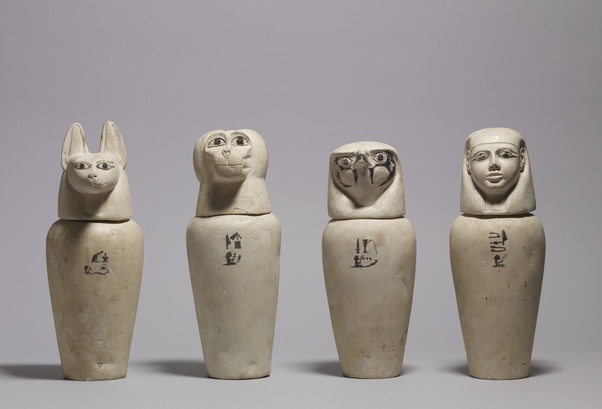
The canopic jars.
Bags of natron or salt were packed both inside and outside the body and left for forty days until all the moisture had been removed from the remaining body tissue. The body was then cleansed with aromatic oils and resins and wrapped with bandages, often household linen torn into strips. Between the layers of wrapping, the embalmers place amulets to protect the deceased. Heart scarabs were placed in the wrappings with the mummy. They had spells carved on them to protect the deceased person’s heart from being lost or separated from the body in the underworld.
The canopic jars were used to store the soft tissue. “Anubis, who is the chief of the divine booth (sh-ntr), has commanded thy purification with thy eight nmst-jars and [thy] eight ‘3bt-jars, which come from the sh-ntr ” (2012b-c ). By the New Kingdom, there were only four jars. The lids of canopic jars represented gods called the ‘four sons of Horus’. These gods protected internal organs. Duamutef the jackal-headed god looks after the stomach Hapy the baboon-headed god looks after the lungs Imsety the human-headed god looks after the liver. Qebehsenuef the falcon-headed god looks after the intestines.
Scientific analysis of mummies using processes such as X-ray and CT scanning has revealed a wealth of information about how individuals lived and died. It has been possible to identify conditions such as lung cancer, osteoarthritis and tuberculosis, as well as parasitic disorders.
Sources:
British Museum website, Mummification in The Old Kingdom By Ahmed Saleh and, #ancientegypt #ancienthistory #anubis #pyramids #mummification #ancientegyptianmummies
The Tragic Annia Aurelia Galeria Lucilla was born around 150 AD.
Her father was the Roman Emperor Marcus Aurelius, her mother the Empress Faustina the Younger. Lucilla was the elder sister of Emperor Commodus.
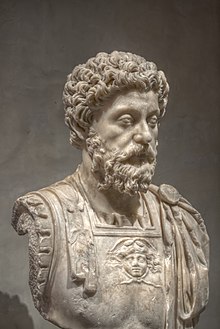
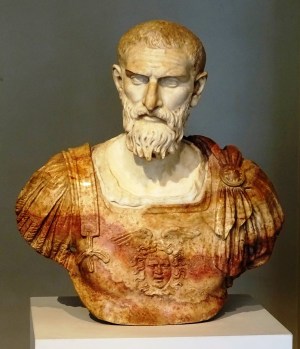
A marble bust of Marcus Aurelius at the Musée Saint-Raymond, Toulouse, France
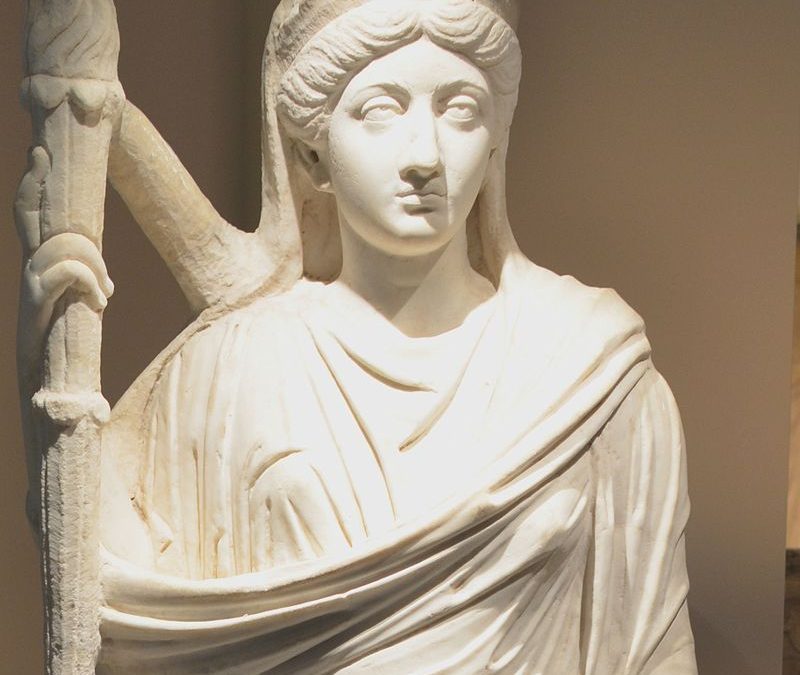
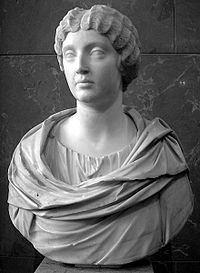
Faustina the Younger
A character loosely based on Lucilla was the love interest to Russell Crowe in the blockbuster film Gladiator in 2000. The film was directed by Ridley Scott.
In the film, the character based on Lucilla was played by the Danish actress Connie Nielsen. Crowe portrays the Hispano-Roman general Maximus Decimus Meridius, the man betrayed by Commodus.
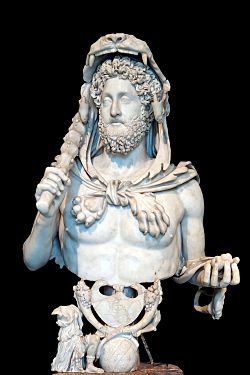
Bust of Commodus as Hercules, hence the lion skin, the club and the golden apples of the Hesperides. Part of a statuary group representing Commodus’ apotheosis.
Reduced to slavery, the character Maximus rises through the ranks of the gladiatorial arena to avenge the murders of his family. That, of course, was fiction. If you haven’t seen the film, try the clip below. The film’s great by the way.
Back to Real Life
Lucilla’s Marriages
The real Lucilla was married her father’s dashing co-ruler Lucius Verus in 164 CE when she was just 14.
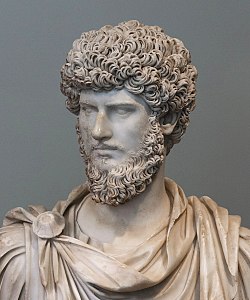
Lucius Aurelius Verus (15 December 130 – 23 January 169) was Roman emperor from 161 until his death in 169, alongside his adoptive brother Marcus Aurelius. He was a member of the Nerva-Antonine dynasty. Verus’ succession together with Marcus Aurelius marked the first time that the Roman Empire was ruled by multiple emperors.
Her husband was 18 years her senior. On her wedding day, the groom would have led a procession to her family home, where she and her bridesmaids were waiting to meet him. She would be wearing a tunica recta — a white woven tunic — belted with an elaborate “Knot of Hercules.”
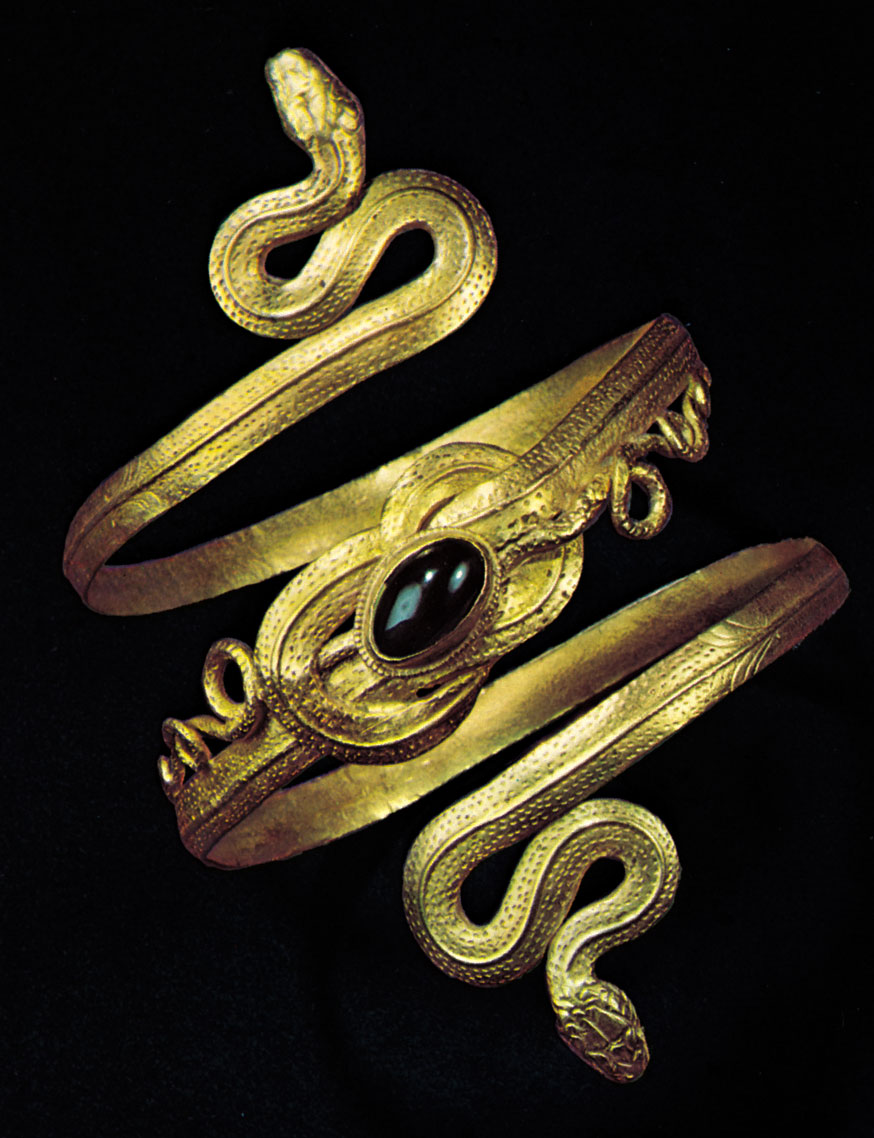
The marriage knot or knot of Hercules ( a reef knot, or square knot), originated as a religious symbol in ancient Egypt but is best known as a wedding symbol, incorporated into the protective girdles worn by brides, which were ceremonially untied by the new groom on the wedding night. This custom is the likely origin of the phrase “tying the knot.” According to Roman lore, the knot symbolized the legendary fertility of the God Hercules and the legendary power of Girdle of Diana captured from the Amazon Queen Hippolyta. Both are symbols of the moon, the ancient symbol of fertility.
Greek gold spiral bracelet of two snakes whose tails are tied in a Hercules knot that is decorated with a garnet in a bezel setting; in the Schmuckmuseum Pforzheim, Germany.
Lucilla would have carefully arranged hair and would be wearing a red wedding veil, a flammeum and red shoes to show that she was full of life and for good luck. After the marriage contract was signed, there was an enormous feast. The day ended with a noisy procession to the couple’s new home where her husband would carry his new bride over the threshold. Upon marriage, Lucilla received the title of Augusta and became a Roman Empress.
Bust of Lucius Verus at the Metropolitan Museum of ArtMarriage at such a young age was normal in the Roman world. Early marriages led to an astonishingly high death rate among the aristocracy. Even today a woman getting pregnant in her early teens runs higher risks than a more mature woman. Today’s teenage mums often suffer hyperemesis gravid arum or severe vomiting and dehydration, eating disorders, anaemia, bleeding, and pre-eclampsia during pregnancy. Most find giving birth and breastfeeding difficult due to their physical immaturity.
Lucilla gave Lucius three children: Aurelia Lucilla was born in 165 in Antioch, Lucilla Plautia and Lucius Verus. Aurelia and another boy died young.
After Lucius Verus died, in 169, her father arranged a second marriage for her. This time it was to Tiberius Claudius, a Syrian Roman general who distinguished himself during Rome’s wars against the Parthians and the Marcomanni. Quintianus was a hero amongst his men but he was at least twice Lucilla’s age. Nevertheless, they were married in 170 CE.
Tiberius Claudius Pompeianus (Museo Archeologico Nazionale di Venezia)
After the death of her mother Faustina her father honoured Lucilla as Emperess, an honour continued by her brother Commodus until he married. Lucilla Quintianus a son named Pompeianus.
Find out more: https://www.redbubble.com/people/greenlillies/shop?asc=u
Her Cowardly Brother
The Roman historian Cassius Dio wrote that Commodus ‘was not naturally wicked, but, on the contrary, was as guileless as any man that ever lived.’
Commodus was nineteen years old when his father died. He was the 10th of 14 children and the only male to survive. He was the anthesis of his father, Marcus because he was simple and cowardly and a slave to his companions.
Commodus was a very handsome man, with clear eyes and curly hair that was naturally blond. Dio claims he was left-handed and was very proud of this fact, but busts of Commodus as Hercules show him with a club in his right hand. Left-handedness was frowned upon in antiquity – as the word for left-handed, sinister, demonstrates – so it is possible this fact was obscured by the sculptors. Dio was in his twenties when Commodus became Emperor so his claim may be true.
Upon his accession, he had advice from his many guardians in the Senate, which he steadfastly ignored. He hated exertion of duty and craved the comfortable life of the city.’
Commodus’ behaviour became increasingly disturbing as the years went by. Dio reported that ‘many plots were formed by various people against Commodus, and he killed a great many, both men and women, some openly and some by means of poison, secretly, making away, in fact, with practically all those who had attained eminence during his father’s reign and his own, with the exception of Pompeianus, Pertinax and Victorinus; these men for some reason or other he did not kill. I state these and subsequent facts, not, as hitherto, on the authority of others’ reports, but from my own observation.’
When Sextus Condianus, a noble heard that Commodus had passed a sentence of death on him he was said to have drunk the blood of a hare, then mounted a horse and purposely fell from it vomiting blood. Feigning death, a ram was burnt on his funeral pyre and Sextus made his escape. The escapade did not stay a secret for very long. Soon Commodus was on his trail. Many were punished in his stead on account of their resemblance to him, and many, who helped him were also put to the sword. Many severed heads were brought to Rome, but whether any one of them was Sextus remains a mystery. Perhaps he really did get away.
Commodus gave himself up to chariot-racing and licentiousness and performed scarcely any of the duties pertaining to his office. He renamed Rome Commodiana. The legions became Commodian, and he renamed himself, Hercules. He re-styled Rome as the “Immortal, Fortunate Colony of the Whole Earth”. A 1000 pound gold statue was erected of him together with a bull and a cow - the bull no doubt representing Zeus/Jupiter and the cow Hera/Juno. Finally, all the months were named after him, so that they were enumerated as follows: Amazonius, Invictus, Felix, Pius,12 Lucius, Aelius, Aurelius, Commodus, Augustus, Herculeus, Romanus, Exsuperatorius.
Her brother’s increasing savagery and mental aberrations led Lucilla to hatch a plot to kill and replace him.
The Plot
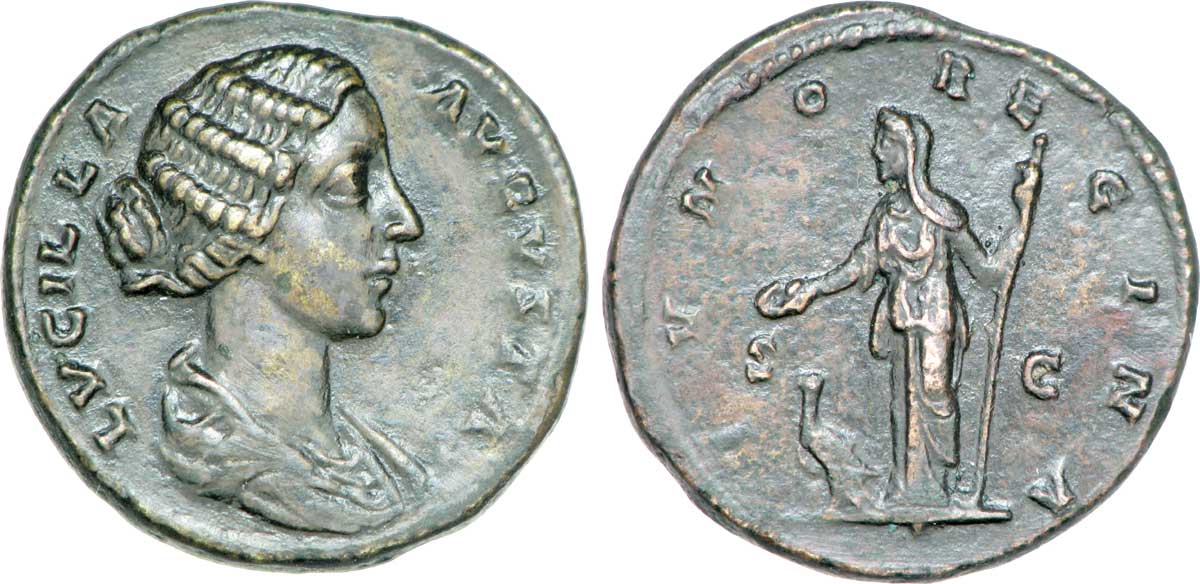
Dupondius depicting Lucilla Augusta (obverse) and Juno Regina with a peacock (reverse). The peacock was a symbol of immortality because the ancients believed that the peacock had flesh that did not decay after death.
Lucilla planned to put an end to Commodus with the help of her husband Pompeianus Quintianus, her nephew, her daughter, and two of her cousins; one of which was her lover Marcus Ummidius Quadratus Annianus.
The murder was to done by Quintianus who Lucilla loathed. If the plan failed and she did not become Empress then she would at least be free of Quintianus. The attack took place as Commodus was entering the hunting theatre. Standing in its narrow entrance passage Quintianus stood next to his nephew who thrust his sword at his brother-in-law. But, he missed his target, and Commodus survived unscathed.
Needless to say, the male members of the plot were immediately put to death. When Lucilla’s involvement in the plot came out she, her daughter and Commodus’ wife Crispina were imprisoned on the island of Capri. Crispina was not part of the plot, her crime was adultery. However, they did not escape death for long, Commodus had them all executed a year later, in 182 AD.
In the 1964 film The Fall of the Roman Empire, Lucilla is played by Sophia Loren, her part in the film’s plot bearing only a very loose relation to Lucilla’s real life.
In the 2016 six-part docuseries Roman Empire: Reign of Blood, Lucilla is played by Tai Berdinner-Blades.
Sources:
Epitome of Book LXXIII, Roman History by Cassius Dio, Vol. IX of the Loeb Classical Library edition, 1927
Wikipedia and Wikiwand
Julia Herdman writes historical fiction.
Buy eBook Now Sinclair is set in the London Borough of Southward, the Yorkshire town of Beverley and in Paris and Edinburgh in the late 1780s. Strong female leads include the widow Charlotte Leadam and the farmer’s daughter Lucy Leadam. Sinclair is a story of love, loss and redemption. Prodigal son James Sinclair is transformed by his experience of being shipwrecked on the way to India to make his fortune. Obstacles to love and happiness include ambition, conflict with a God, temptation and betrayal. Remorse brings restitution and recovery. Sinclair is an extraordinary book. It will immerse you in the world of 18th century London where the rich and the poor are treated with kindness and compassion by this passionate Scottish doctor and his widowed landlady, the owner of the apothecary shop in Tooley Street. Sinclair is filled with twists and tragedies, but it will leave you feeling good.
The cartouche is a key symbol in Egyptology, but what did it mean and what did it protect?
My new mini-history ‘Champollion’ describes the importance understanding cartouches played in cracking the ancient Egyptian secret code of sacred writing we call hieroglyphics. The article below goes into more detail as to their possible meaning.
The conventional view of the cartouche in Egyptology was first identified in royal architecture by Flinders Petrie in the late 19th and early 20th centuries. Although his chronologies and his views on race have not stood the test of time, Petrie was right in almost every respect when it came to the architectural survey and analysis of Egyptian monuments says David Ian Lightbody, in his article, The Encircling Protection of Horus, Current Research in Egyptology, 2011.
In Egyptology, the cartouche is considered to be a form of protective symbolism that was represented graphically, and as a partially abstracted concept, by the shen ring, or shenu.
It was depicted as twin oval loops of rope, tied at the bottom.
These protective symbols encircle the hieroglyphs of the pharaoh’s name.
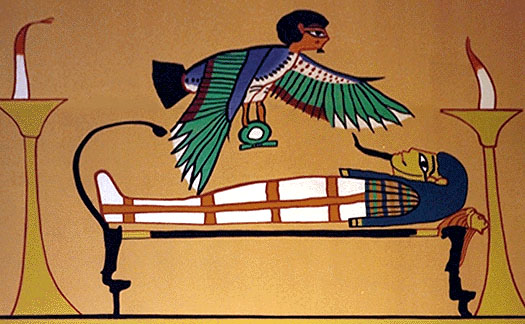
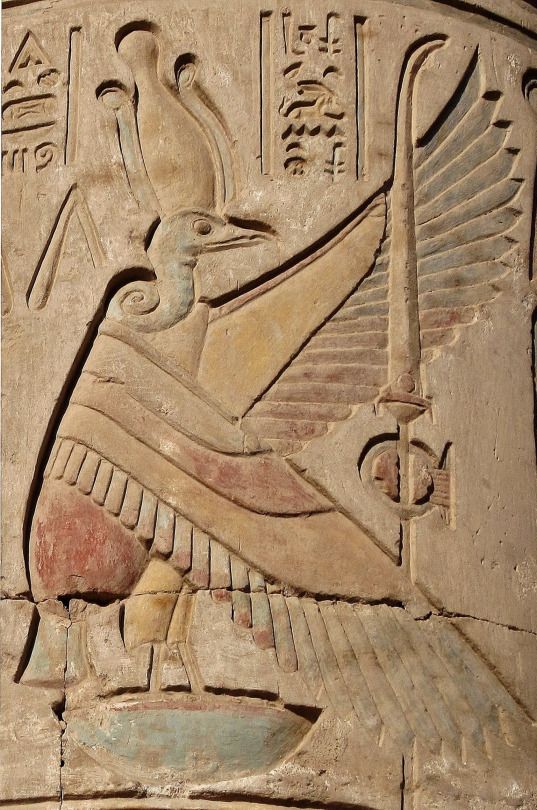
Ba bird in the form of a vulture hovering over the dead king holding a shen ring.
In The Encircling Protection of Horus, Current Research in Egyptology, 2011, Lightbody proposes, “The protective symbolism was represented graphically, as a partially abstracted concept, by the shen ring.
The shenu is also known in its elongated form as the cartouche and was depicted as twin oval loops of rope, tied at the bottom.
They encircle the pharaoh’s praenomen, throne name, or nomen, birth name, in hieroglyphs. Other motifs and deities were closely associated with this ring and the cartouche, such as the royal falcon Horus, the royal uraeus snake, and the vulture goddess Nekhbet.
Together, they represented the ideas of royal protection and dominion over the encircled world.
Scenes incorporating these icons were often depicted on the architectural elements of tombs and temples, particularly at entrances and on thresholds, such as under architraves, down door jambs, or along the tops of enclosure walls. In this way, they protected the royal building entrances and perimeters.”
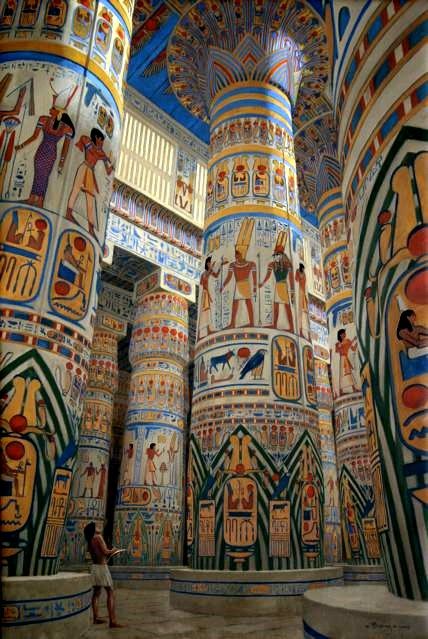
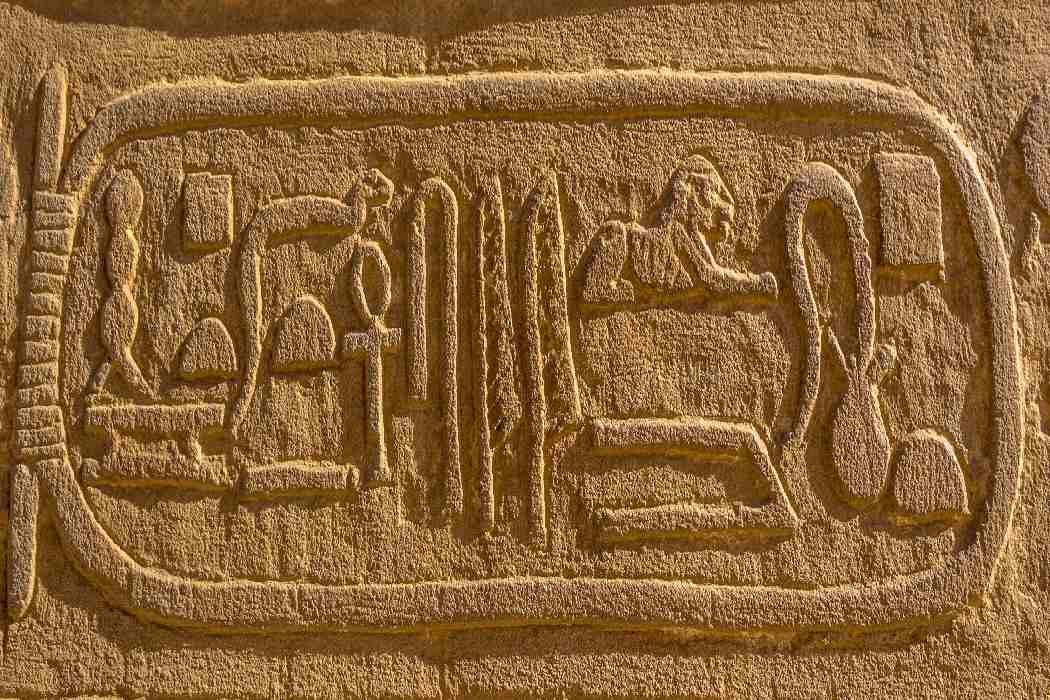
Cartouche inscriptions on temple columns.
Magic Circles
However, the cartouche is not circular. It is true, circular symbols include the royal uraeus, represented in the image of a snake, and the vulture goddess Nekhbet and the earliest known shen ring.
Lightbody concludes that “Petrie was right to conclude that circular symbolism was used in the royal architecture of the Old Kingdom. The circular symbolism represented eternal royal protection encircling the pharaoh and his territorial dominion, and was represented by the shen, and/or cartouche symbols, often carried by Horus above. The cartouche and shen were not just decorative motifs. They were absolutely central to the ideology of kingship, and represented the importance of sacred protection for the pharaoh, his territorial domination, and his unique status as Horus, the living son of Ra.”
The critical question for me is the cartouch symbol part of a functional magical system of royal protection, and if so was it offering protection like an amulet or spell, or was it designed specifically to protect the king’s name and therefore preserve him for eternity?
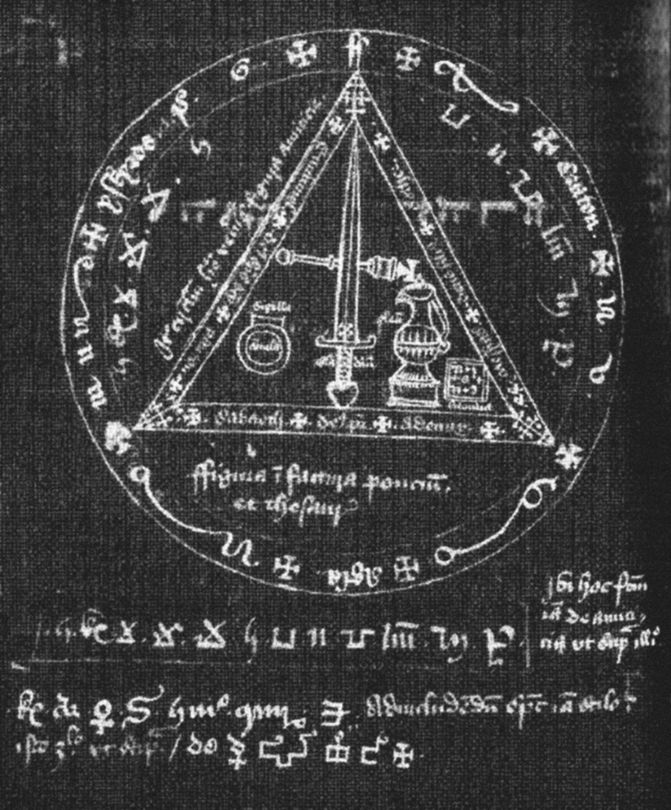
Traditionally, circles are believed by ritual magicians to form a protective barrier between themselves and what they summon.
Circles may or may not be physically marked out on the ground, and a variety of elaborate patterns for circle markings can be found in grimoires and magical manuals, often involving angelic and divine names. Such markings, or a simple unadorned circle, may be drawn in chalk or salt, or indicated by other means such as with a cord it provides a protective boundary by enclosing positive and beneficent energies within its confines. [1] In other words, it protects what is inside the circle not what is outside as in the examples mentioned by Lightbody.
The idea of forming a protective circle suggests there are things in the world the protected something in the circle needs to be protected from or evil things contained within it that the circle must constrain.
In Medieval witchcraft, magic circles were used to protect the person or thing inside the circle from the power of the devil or evil spirits. But, there is no devil in ancient Egypt so what could the cartouche be protecting the king from?
A magic circle from a 15th-century manuscript - Wiki Commons.
Chaos and Disintegration
Jan Assmann provides the answer in his discussion of the heart and connectivity in Death and Salvation in Egypt.
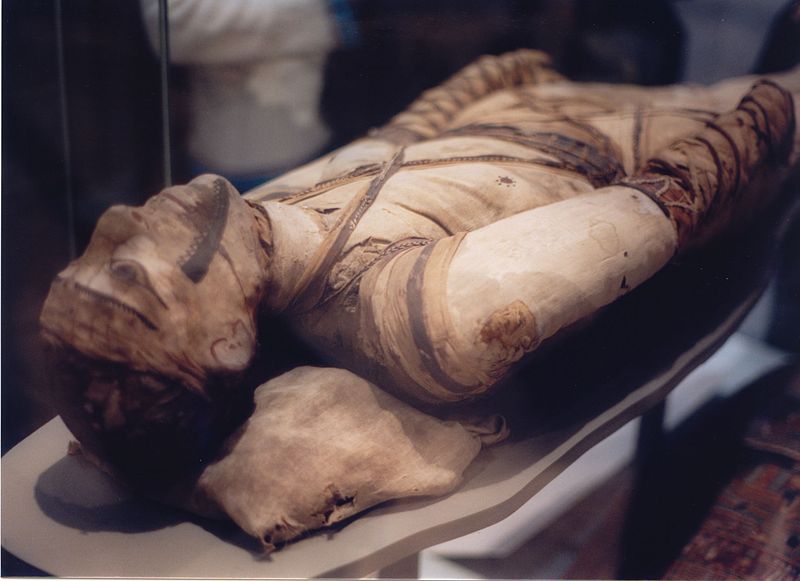
“For the Egyptians, this principle of “connectivity,” the attachment of an individual to a whole, was what characterized life in general. Life was connection, death was disintegration and isolation. But to be able to consider this connection, we must determine the entities between which the life-giving connectivity is to be in effect. It was for just that reason that the Egyptians cast a dissecting gaze on the world, so as all the more keenly to grasp its connectedness, that is, the connective structures and principles. They conceived of the body as a marionette only in order to catch sight of the life-giving and life-maintaining function of the circulatory system. The Egyptians thus did not really view the world with a dissecting gaze but with an integrating, one might almost say, an “embalming” gaze. For the embalming ritual was specifically intended to remedy the condition of dismemberment and decomposition that set in with the stopping of the heart and the ceasing of the circulation of the blood, and to benefit the marionette of the body by substituting a new, symbolic connectivity by means of ritual and chemistry. Because we ourselves do not have this embalming glance, what we see in Egyptian art and in other phenomena of Egyptian culture is primarily the additive, the isolating, and the paratactic. We are blind to the animating, the connective. Just as the Egyptian reader had to supply the vowels, for the writing system noted only the consonants, so also he had to supply the conjunctions, for the connection between clauses was mostly paratactic, and in both cases, he had no difficulty. In both cases, the reader breathed a connective life into the elements.” [2]
Museum Mummy - Wiki Commons.
The ancient Egyptians thought that chaos was all around them and that it could come crashing into the world at any time subsuming everything within it. Disintegration was thus an ever-present danger. As Assmann has pointed out embalming was a means of preventing the disintegration of the body in the eternal life of the tomb. Similarly, I believe the cartouche, which was the representation of a loop made from two pieces of rope joined together with a whip binding was designed to prevent the disintegration of the royal name.
The ancient Egyptians were perfectly capable of representing a continuous line, but they chose not to because knots and knot tying are particularly part of magical enchantments. The Egyptian magician spends a large part of his time tying knots according to Bruce Trigger et. al.
A magic knot is a point of convergence of the forces which unite the divine and the human worlds he and his colleagues say in The American Discovery of Ancient Egypt, (Nancy Thomas, Gerry D. Scott, Bruce G. Trigger, Los Angeles County Museum of Art, 1995.)
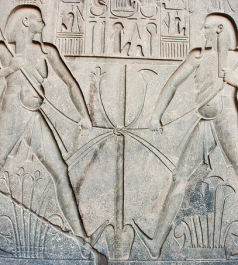
We see the knot-tying image in the sema-tawy image, a motif that shows the gods Horus and Set pulling on opposing ropes with the throne of Egypt in the centre. The image is said to represent unity and shows the king’s name in a cartouche joined to the heart and lungs of a bull. The symbolism of the heart, lungs, and trachea illustrate the complementary relationship between the organs, the lungs must work together to preserve the heart. It is an image of the two lands united by the king.
Sema-tawy - Hapi pulls the knot to tie the two lands of Egypt, Upper and Lower Egypt, or the two banks of the river together.
The shen ring quite a different object, but it is tied in the same way as the cartouche.
The Shen ring is usually seen carried by the vulture goddess Nekhbet and the god of eternity Heh. The Shen ring may be a protective charm when held over the king by Nekhbet. The vulture goddess may be constantly on guard to catch the king’s soul as soon as he shuffles off his mortal coil. We cannot say for sure, more work is required here. In the hands of the god, Heh, it represents millions of years or an eternity of cycles, and so indicates that the symbol is about enduring through time.
The Book of Coming Forth by Day also gives several examples of the magical power of the knot. In one, knots are tied around the deceased to help her come into the presence of the Deities: “The four knots are tied about me by the guardian of the sky [. . .] the knot was tied about me by Nuet, when I first saw Ma’et, when the gods and the sacred images had not yet been born. I am heaven born, I am in the presence of the Great Gods.” In addition to these four knots, there were seven knots, or tesut, that were tied about the deceased to protect him or her. The power of the magical knot is in its ability to both unite and “surround” things. The tied knot is a symbol of the coming together of two things in perfect wholeness, a condition that promotes a positive outcome.
The king wished his name to preserved through time, to be enduring through time, and to give thanks to the gods forever. The king could also make his name perfect through combat, by cementing his reputation as a brave warrior in all lands through its promotion by his officials who by writing his name ‘gave it cause to live’ or shenu. As long as a person’s name was said - as long as life was breathed into it by the speaker, the name lived. [5]
Life After Death
So, to conclude it is more likely the cartouche holds the king’s name together in the same way that bandages held his dead body together. The ancient Egyptian were obsessed with thwarting the process of decay. They understood that bodies if left unbound disintegrated into a pile of bones. If his name were damaged or completely destroyed, the soul would be lost and the deceased would be forgotten and fall for nothing. The cartouche was thus designed to hold the king’s name together so that it would remain intact, could be read and said, and so preserved his Ka spirit or his worldly persona. The cartouche protected the king’s name not his tomb or the adjacent area. It provided the king with one of the many ways the ancient Egyptians believed a person could survive the forces of entropy, decay, and disintegration associated with mortality. The two ropes of the cartouch most probably represented the two ropes of time that were spooled out by the gods (See The Book of Gates). The shen ring, which began meaning ’causes to live’ was most probably a symbol of eternity and eternal life. For more on the Afterlife see:
[1] The Encircling Protection of Horus, Current Research in Egyptology, 2011.
[2]Cunningham, Scott (2001). Wicca: A Guide for the Solitary Practitioner, 29th edition, Llewellyn Publications.







Recent Comments