
by Julia Herdman | Sep 9, 2017 | Blog
Bonnie Prince Charlie and Toad - What do they have in common?
It is a surprising thing to say but Bonnie Prince Charlie and Kenneth Graham’s character Toad, (Wind in the Willows, 1908) have much in common. Both were good-natured, kind-hearted and not without intelligence but they were also spoiled, reckless and obsessive. Although one is a character of fiction and the other of history and legend they both escaped the forces of law enforcement dressed as a woman - a washerwoman in Toad’s case, and the Bonnie Prince as an Irish seamstress, Betty Burke. Both left a trail of destruction behind them but of course the Bonnie Prince’s was real.
Copy of the Declaration of Miss MacDonald, Apple Cross Bay, July 12th 1746
Miss Mc. Donald, Daughter in Law of Mc. Donald of Milton in Sky, [Skye] being, by General Campbell’s order, made Prisoner for assisting the eldest son [Bonnie Prince Charlie] of the Pretender in his escape from South Uist, & asked to declare the Circumstances thereof, says, That about six weeks ago, she left her Father in Law’s house at Armadach [Armadale] in Sky, & went South to see some friends.
Being asked, if she had any Invitation from those who persuaded her to do what she afterwards ingaged [engaged] in for the young Pretender or any Body else, before she left Sky; answered in the Negative, and says that at the time of her leaving Sky, she did know where the young Pretender was, but only heard He was Some where on the long Island: that she stay’d at (what they call) a Sheilling [small hut or cottage] of her brother’s, on the hills, near Ormaclait [Ormacleit] the house of Clan Ronald; and that, about the 21of June, O Neil, or as they call him Nelson, came to where she stay’d, & proposed to her, that as he heard she was going to Sky, that the young Pretender should go with her.
With her in Woman’s cloathes [clothes], as her servant which she agreed to. O Neil then went and fetched the young Pretender who was on the Hills not far off, when they settled the manner of their going.
Miss MacDonald says, that after this she went & stay’d with Lady Clan Ranold [Ronald], at her House, three days, communicated the scheme to her, & desired that she would furnish cloathes for the young Pretender, as her own would be too little. During Miss MacDonald’s stay at Ormaclait, O Neil came frequently from the young Pretender to Clan Ronald’s House to inform her where he was, what stepps had been taken for their voiage [voyage], and at the same time to hasten her to get her affairs in Readiness for going off.
Miss Mac Donald says, that the 27th past, she, Lady Clan Ronald, her eldest Daughter, & one John MacLean, who had by Lady Clan Ronald’s order, acted as Cook to the Pretender, during his stay on the Hills, went to a place called Whea where they expected to meet the young Pretender; but not finding him there, they went on to a Placed called Roychenish, where they found him, taking with them the women’s Apparel furnished by Lady Clan Ronald, he was dressed in. Here they heard of General Campbell’s being come to South Uist, & that Captain Fergussone was within a mile of them. When they got this Information, they were just going to Supper. But then went of very precipitately, & sat up all night at a Sheilling call’d Closchinisch.
Saturday, June 25th: the Cutter and Wherrier, which attended General Campbell having got from Bernera [Berneray], near the Harris, through the last side of the long island, & passing not far from them, put them again into great Fears, least anybody should land there. However, they continued there ’till about 9 at Night, when the Young Pretender, Miss Mac Donald, one MacAchran, with five men for the Boat’s crew, imbarked [embarked] & put to sea, Lady Clan Ronald having provided Provisions for the voyage.
The 29 about 11 in the Morning they got to Sky near Sir Alexander MacDonald’s House. Here Miss Mac Donald and Mac Achran landed, leaving the young Pretender in the Boat, they went to Sir Alexander Mac Donald’s House; and from thence Miss MacDonald sent for one Donald Mac Donald, who had been in the Rebellion, but had delivered up his arms some time ago. She imployed this Person to procure [get] a Boat to carry the young Pretender to Rasay, after acquainting him with their late voyage & where she had left the young Pretender . Miss Mac Donald stay’d & dined with Lady Margaret Mac Donald, but Mac Donald & Mac Achran returned to the Boat, to inform what was done.
Miss Mac Donald being asked why Rasay was pitched upon for the young Pretender to retreat to, she answered that it was in hopes of meeting Rasay himself, with whom he was to consult for his future security.
After dinner, Miss Mac Donald set out for Portree it being resolved that they should lodge there that Night; but on the Road overtook the young Pretender & Mac Anchran of Kingsbury. She told them she must call at Kingsbury’s House, & desired they would go there also. Here, Miss Mac Donald was taken sick, & therefore with the other two, was desired to stay all night, which they agreed to. She had a Room to herself; But the young Pretender & Mac Achran lay in the same Room. At this time he appeared in women’s Cloathes, his Face being partly concealed by a Hood or Cloak.
Being asked, if while they were at Kingsbury’s House, any of the Family inquired who the disguised Person was; answers, that they did not ask; but that she observed the People of the Family whispering as if they suspected him to be some Person that desired not to be known and from the Servants she found they suspected him to be Mac Leod of Bernera, who had been in Rebellion. But, being pressed to declare what she knew or believed of Kingsbury’s knowledge of his Guest, owns, that she believes, he must suspect it was the young Pretender.
The 30th of June, Miss Mac Donald set out on Horseback from Kingsbury’s House for Portree, having first desired the young Pretender might put on his own cloathes somewhere on the Road to Portree, as she had observed that the other dress rather made him more suspected. Miss got to Portree about 12: at night, where she found Donald Mac Donald, who had been sent before to procure a Boat then The young Pretender & Mac Ancran arrived about an Hour after. Here he took some Refreshment, changed a Guinea [twenty-one shillings], paid the Reckoning [bill], took his Leave of Miss Mac Donald & went out with Donald Mac Donald, but who, after seeing him to the Boat returned. She believes he went to Rasay [Raasay, an island between the Isle of Skye and the mainland of Scotland], but cannot tell what is become of him since.
Source: The National Archives
by Julia Herdman | Sep 5, 2017 | Blog
The retribution that followed the defeat of the Jacobite Army at Culloden in 1746 has passed into legend for its brutality and savagery and has formed the backdrop to many classic stories including Robert Louis Stevenson’s Kidnapped and more recently Diana Gabaldon’s Outlander series of novels.
Today, we are so accustomed to the picture of the suppression of the Highlands by the British Army painted in these novels that we are hardly surprised by it. However, when I looked at the records in the Scottish National Archive for this article I found the pastiche of brutality in the films and TV shows suddenly and shapely transformed from fiction to fact and the true horror of what took place became fresh and alive once more.
I have chosen some examples from the records of the Fraser Clan to illustrate what happened as there is currently so much interest in it due to the success of the Starz Outlander TV series.
I am sure that if I had been alive at that time I would not have been a Jacobite. But that does not mean I condone what took place in 1746. Neither, I’m glad to say did some of the people involved in it at the time as these accounts of the death of Charles Fraser, the Younger of Inverallochy show. The most basic record reads;
“Aged 20 years. Killed at Culloden on 17 April 1746. While lying grievously wounded on Culloden battlefield was shot in cold blood at the order of Cumberland or General Hawley. The future General Wolfe had previously refused to act as executioner. In the Muster Roll, there is a suggestion (false) that he was not killed but escaped to Sweden.”
In A Short but Genuine Account of Prince Charlie’s Wanderings from Culloden to his meeting with Miss Flora MacDonald, by Edward Bourk the story is further elaborated.
‘But soon after, the enemy appearing behind us, about four thousand of our men were with difficulty got together and advanced, and the rest awakened by the noise of canon, which surely put them into confusion. After engaging briskly there came up between six and seven hundred Frazers commanded by Colonel Charles Frazer, younger, of Inverallachie, who were attacked before they could form a line of battle, and had the misfortune of having their Colonel wounded, who next day was murdered in cold blood, the fate of many others’. (folio 327).
In Lyon in Mourning, Vol. III a collection of stories, speeches, and reports by Robert Forbes the following version taken from Bourk in person in 1747 expands the previous versions.
‘The Duke himself (Cumberland) rode over the field and happened to observe a wounded Highlander, a mere youth, resting on his elbow to gaze at him. He turned to one of his staff and ordered him to “shoot that insolent scoundrel.’ The officer, Colonel Wolfe (later General) flatly refused, declaring that his commission was at the service of His Royal Highness, but he would never consent to become an executioner. The other officers of his suite, to their credit, followed the noble example of the future Hero of Louisburg and Quebec, but Cumberland, not to be baulked of his prey, ordered a common soldier to do the odious work, which he did without demur. The young victim was Charles Fraser, younger of Inverallochy, an officer in Lord Lovat’s Regiment.’
The story of Ensign, Alexander Fraser prisoner 950 and his comrades from Lord Lovat’s Regiment is no less disturbing. He was shot through the thigh or (knee) at Culloden and ‘carried off in the heat of the action to a park wall pointing towards the house of Culloden.
‘‘A short time after the battle he and 18 other wounded officers who had made their escape to a small plantation of wood near to where Fraser was lying. He was taken prisoner and carried with the others to Culloden House, where he lay for two days without his wounds being dressed.’ ‘On 19 April 1746, Fraser along with 18 other prisoners that were held in Culloden House were put in carts to be taken, so they thought, to Inverness to have their wounds treated. The carts stopped at a park dyke some distance from Culloden House. The whole of them were taken out and placed against a dyke. The soldiers immediately drew up opposite them. They levelled their guns and fired among them. Fraser fell with the rest. ‘
‘The soldiers were ordered by their officers to go among the dead and ‘knock out the brains’ of such that were not quite dead. Observing signs of life in John Fraser one of the soldiers, using his gun butt, struck on the face dashed out one of his eyes, beat down his nose flat and shattered his cheek and left him for dead.’ ‘Lord Boyd riding out with his servant espied some life in Fraser as he had crawled away from the dead. Lord Boyd asked him who he was. Fraser told him he was an officer in the Master of Lovat’s corps. He was offered money but Fraser said he had no use for it and asked to be carried to a certain cottar house where he said he would be concealed and taken care of. Lord Boyd did as asked. Fraser was put in a corn kiln where he remained for three months. He was able to walk with the aid of crutches’.
The Duke of Cumberland’s callousness and willingness to engage in what we would call war crimes today won him the soubriquet ‘the butcher.’
The Scottish History Society has published, in three well-documented volumes, “Prisoners of the ’45”, a list of 3,470 people known to have been taken into custody after Culloden. The list includes men, women and children combatants and supporters alike. It was decided by the Privy Council in London that the prisoners should be tried in England and not Scotland which was a breach of the Treaty of Union and on 10th June, the prisoners held at Inverness were loaded onto seven leaky ships named Margaret & Mary , Thane of Fife, Jane of Leith, Jane of Alloway, Dolphin, and the Alexander & James and transported to England. They eventually landed at Tilbury Fort or were kept in prison ships on the Thames. Accounts show that the prisoners held at Tilbury were selected for trial on the basis ‘lotting.’ This was a process in which 19 white slips and 1 black slip of paper where placed in a hat and the prisoners were invited to draw lots to see who would go before the Commission.
Records show that one hundred and twenty prisoners were executed: four of them, peers of the realm, were executed on Tower Hill including the 80-year-old Lord Lovat, who was the last person to be beheaded in public in England, beheading being a privilege of their rank.
The others such as Francis Townley, Esquire, Colonel of the Manchester regiment who suffered the barbaric ritual of hanging, drawing, and quartering after his claim to be a French Officer was rejected by the court on the evidence of Samuel Maddock, an ensign in the same regiment, who, to save his own life, turned king’s evidence against his former comrades.
Of the remainder 936 were transported to the colonies, to be sold to the highest bidder: 222 were banished, being allowed to choose their country of exile: 1,287 were released or exchanged: others died, escaped, or were pardoned and there were nearly 700 whose fates could not be traced.
After the defeat of the Jacobite army, the British government started the systematic dismantling of the ancient social and military culture of the Highland clans. The wearing of Highland garb, particularly tartan plaid, was banned, and the semi-feudal bond of military service to the Clan chief was removed. But despite the widespread and systematic oppression, it was the peace between Great Britain and France in 1748 that finally finished off the 1745 rebellion. Without the hope of French money and support the Stuart cause was lost.
This did not stop the reckless Bonnie Prince from trying again. It seems that he turned up in London in 1750, probably in disguise once more as he was what we might call, ‘Britain’s Most Wanted’ at the time and tried to drum up support for another rising. Luckily, this madcap scheme to kidnap or kill King George II in St. James’s Palace on 10 November 1752 petered out through lack of support and money. But the British Government kept their eye on the conspirators through a spy in the Princes’s camp known only by his nom de guerre of “Pickle”, who kept his employers informed of every Jacobite movement that came to his notice for years.
See also:
Bonnie Prince Charlie and Toad Escape Dressed as Women
Sources:
http://www.jacobites.net/prisoners.html
http://www.historyextra.com/article/feature/10-facts-jacobites-bonnie-prince-charlie-culloden
https://www.thurrock.gov.uk/historical-figures/jacobites-culloden-and-tilbury-fort
http://www.electricscotland.com/history/charles/100
by Julia Herdman | Sep 3, 2017 | Blog
Pirates and Smuggling Fact and Fiction
In the 18th century, the British government collected a good deal of its income from customs duties - tax paid on the import of goods such as tea, cloth, wine, and spirits.
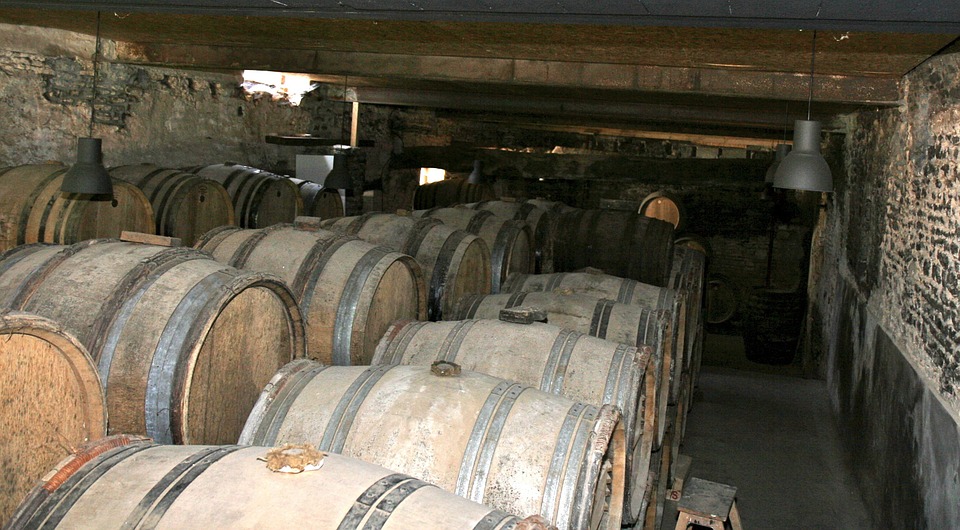
The tax on imported goods could be up to 30% so smuggled goods were a lot cheaper than those bought through official channels. Smugglers operated all around the coasts of Britain. They worked in aggressive, well-organised gangs along the south coast, only a night’s sail from France. The gangs were often too big for the Customs officials to deal with as with the death penalty was a certainty if they were caught so the smugglers were prepared to use violence.
Many ordinary people approved of smuggling or took part in it. Labourers could earn more in a night’s work carrying brandy barrels up from the beach than they could in a month’s hard work in the fields. Others left their barns or cellars unlocked and didn’t ask questions about what was put in there.
Quite respectable people were involved: sometimes for money, sometimes because they didn’t regard smuggling as a crime.
Britain’s most infamous smuggler
Born in 1778 Britain’s most famous smuggler was a man called Rattenbury. He started his life at sea as a fisherman but soon progressed to the more interesting and lucrative trade of defrauding the king.
When he was fifteen he was part of the crew of a privateer but was captured and was taken prisoner by the French, and thrown into gaol. Rattenbury escaped and got back to England.
Rattenbury’s journal recounts many adventures including one where he tricked his drunken French captures into believing they were heading back to France when all the time he was steering the ship to England. As they approached the coast he made his escape by diving into the sea and swimming into Swanage harbour. Once ashore, he raised the alarm and notified the customs authorities that there was a hostile French ship in the harbour!
When Prime Minister William Pitt lowered duties in the 1780s, smuggling became less profitable and gradually the trade began to fall away. Further removal of duties in the 19th century put an end to the kind of smuggling which went on so openly in the 18th century. It seems to be the case that smuggling is always with us. Whenever governments try to stop, or tax, the movement of goods people really want, smugglers will move in no matter how high the stakes.
Fictional Smugglers
Smuggling and smugglers have been a vast source of inspiration for fiction writers. Perhaps the most famous fictional smuggler being, The Reverend Doctor Christopher Syn by Russell Thorndike. The idea for the novel came from smuggling in the 18th century Romney Marsh, where brandy and tobacco were brought in at night by boat from France. Minor battles were fought between gangs of smugglers, such as the Hawkhurst Gang and the Revenue, supported by the army and local militias in South Kent and West Sussex.
The first book, Doctor Syn: A Tale of the Romney Marsh was published in 1915. Three film adaptations have been made of Dr. Syn’s exploits.Doctor Syn (1937) featured noted actor George Arliss. Captain Clegg (1962) known as Night Creatures in the U. S., was produced by Hammer Film Productions with actor Peter Cushing in the lead role; and The Scarecrow of Romney Marsh (1963) starring Patrick McGoohan in the title role.
Modern Smuggling
Smuggling today is probably just as risky as it was in the past, if not more so. Smugglers today use their bodies as a vehicle for drugs and put their own lives on the line in the same way as the smugglers of old.
The number of swallowed drug packages recovered by customs officers at Heathrow airport is usually between 80 and 150 a year. The drugs are wrapped in condoms, balloons or cling-film, forming neat packages about the size of a large grape, and swallowed with syrup to make them more palatable. Couriers take a constipating agent before they embark and tend not to eat during the flight.
In March 2015 the Daily Telegraph online reported on a strange case of modern smuggling. A man was caught trying to enter Spain through Madrid airport with a suspiciously large bulge between his legs in much the same vein as the fictional Derek Smalls played by Harry Shearer in the film Spinal Tap. In this case, the hidden appendage turned out to be half a kilo of cocaine whereas Smalls’ turned out to be cucumber if I remember it rightly.
Julia Herdman writes historical fiction that puts women to the fore. Her latest book Sinclair, Tales of Tooley Street Vol. 1. is Available on Amazon – Paperback £10.99 Kindle £2.42 Also available on:
Amazon Australia
Amazon Canada
Amazon New Zealand
Amazon South Africa
Amazon USA
Also on Smashwords

by Julia Herdman | Aug 7, 2017 | Blog
Turquerie was the fashion for all things Turkish. It started in the late sixteenth century and lasted well into the nineteenth. unconcerned with the realities of life in the east it was rather a product of European fantasies about the luxuries of the Orient. Turkey was a supplier of exotic goods such as coffee, perfumes, spices, and tea.
First diplomatic relations with the far east started near the end of the sixteenth century with Sir Robert Shirley going to Persia in 1599 to train the Persian army in the ways of English military warfare.
The West had a growing interest in Turkish-made products and art, including music, visual arts, architecture, and sculptures.
This fashionable phenomenon became more popular through trading routes and increased diplomatic relationships between the Ottomans and the European nations, exemplified by the Franco-Ottoman alliance in 1715 when Louis XIV received the first Persian ambassadors to France.
European portraits of the 18th century were used to portray social position and wealth. Dress, posture, and props were carefully selected in order to communicate the appropriate status. Choosing the exotic turquerie style to express one’s elite position in society involved wearing loose, flowing gowns belted with ornate bands of embroidered cloth. Some sitters donned ermine-trimmed robes while others chose tasselled turbans. Scandalously, most have abandoned their corsets and attached strings of pearls to their hair. (There has always been one law for the rich and one for the lower classes when it comes to letting one’s social hair down.) Many portraits have Turkish carpets displayed on the floor, woven with bright colours and exotic designs. The loose clothing and the unorthodox styles added to the lewd perceptions of the Ottomans.
At the same time portraits of real Turkish people by European artists were a la mode. They were often depicted as exotic, and it was rare that portraits were painted without wearing their traditional cultural clothing.
Perhaps the most influential transformation into the turquerie vogue in Europe was done by Lady Mary Wortley Montagu. Montagu went to Turkey in 1717 when her husband was posted as ambassador there. Her collected letters while there, describing Turkish fashion were distributed widely in manuscript form. They were then printed after her death in 1762. These letters helped shape how Europeans interpreted the Turkish fashion and how to dress. This phenomenon eventually found its way across the Atlantic and in colonial America, where Montagu’s letters were also published.
Julia Herdman writes historical fiction that puts women to the fore. Her latest book Sinclair, Tales of Tooley Street Vol. 1. is Available on Amazon – Paperback £10.99 Kindle £2.42 Also available on:
Amazon Australia
Amazon Canada
Amazon New Zealand
Amazon South Africa
Amazon USA
by Julia Herdman | Jul 31, 2017 | Blog
The pursuit of love and happiness was an 18th-century ideal.
Voltaire (1694-1778), the French philosopher and author was one of its chief exponents and is one of the heroes of my character Sinclair. Sinclair takes his copy of Candide, Voltaire’s satirical novel to India with him but he loses it when the ship goes down. Once he’s established himself in Tooley Street he’s quick to buy himself another copy.
Candide was an 18th century best seller. The story is about a young man who is the illegitimate nephew of a German baron. He grows up in the baron’s castle under the tutelage of the scholar Dr. Pangloss, who teaches him that this world is “the best of all possible worlds.” Candide falls in love with the baron’s young daughter, Cunégonde which does not please the baron at all and so the young man and his teacher are thrown out of the castle and their adventure begins.
The work describes the abrupt end of their idyllic lifestyle and Candide’s slow, painful disillusionment with the world as he witnesses and experiences its hardships.
The book ends with Candide, not rejecting Dr. Pangloss’s optimism outright but advocating that “we must cultivate our garden”, rather than rely on optimism alone to make it flourish. Thus, Candide rejects the Leibnizian mantra of Pangloss, “all is for the best” in the “best of all possible worlds” for the act of making the world we desire by cultivating it like a garden.
Voltaire was a man of passion and emotion as well as ideas. At the age of nineteen Voltaire was sent as an attache to the French Ambassador to the Netherlands. It was there that he fell in love with Olympe Dunover, the poor daughter of lower-class women. Their relationship was not approved of by either the ambassador of Olympe’s mother and Voltaire was soon imprisoned to keep them apart.
Writing from his prison cell in The Hague in 1713 he poured out his love for Olympe.
“I am a prisoner here in the name of the King; they can take my life, but not the love that I feel for you. Yes, my adorable mistress, to-night I shall see you, and if I had to put my head on the block to do it.
“For heaven’s sake, do not speak to me in such disastrous terms as you write; you must live and be cautious; beware of madame your mother as of your worst enemy. What do I say? Beware of everybody; trust no one; keep yourself in readiness, as soon as the moon is visible; I shall leave the hotel incognito, take a carriage or a chaise, we shall drive like the wind to Scheveningen; I shall take paper and ink with me; we shall write our letters.”
“If you love me, reassure yourself; and call all your strength and presence of mind to your aid; do not let your mother notice anything, try to have your pictures, and be assured that the menace of the greatest tortures will not prevent me to serve you. No, nothing has the power to part me from you; our love is based upon virtue and will last as long as our lives. Adieu, there is nothing that I will not brave for your sake; you deserve much more than that. Adieu, my dear heart!”
Arout (Voltaire)
His time in prison was brief. Being young and fit and the prison not so secure, he jumped out a window and got away.
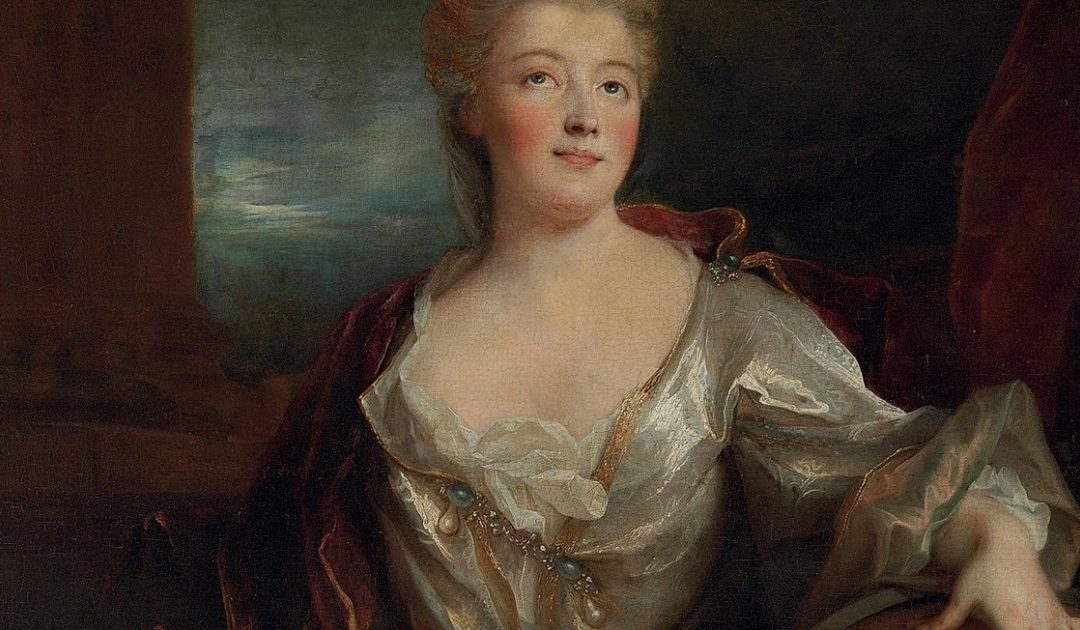
Twenty years later, in 1733, Voltaire would meet the love of his life, Émilie, Marquise du Châtelet. She was the wife of an aristocrat. He, by then was by then a successful writer. Having just returned from a period of enforced exile from France for his political views Voltaire was introduced to Émilie by friends.
The attraction was immediate, physical and cerebral. He wrote of her; “That lady whom I look upon as a great man… She understands Newton, she despises superstition and in short, she makes me happy.”
Soon the pair were living together in the Marquis du Châtelet’s chateau. The arrangement suited them all. Voltaire who was a rich man paid for the much-needed renovations to the chateau, Émilie’s husband the Marquis hunted all day and at night he lent Voltaire his willing wife.
Their love bore intellectual fruits; Émilie translated Newton’s Principia Mathematica and wrote her philosophical magnum opus, Institutions de Physique (Paris, 1740, first edition), or Foundations of Physics. Her own work circulated widely generated heated debates and was republished and translated into several other languages. During her time with Voltaire, she participated in the famous vis viva debate, concerning the best way to measure the force of a body and the best means of thinking about conservation principles. Posthumously, her ideas were heavily represented in the most famous text of the French Enlightenment, the Encyclopédie of Denis Diderot and Jean le Rond D’Alembert.
In 1737, Châtelet published a paper entitled Dissertation sur la nature et la propagation du feu, based upon her research into the science of fire, that predicted what is today known as infrared radiation and the nature of light.
In another publication, she debated the nature of happiness. During the Age of Enlightenment, personal happiness was one of the great philosophical themes. Many philosophers and writers studied it. There were many discourses on the subject but they were by men. Chatelet offers a new perspective on the philosophical question of happiness, a woman’s perspective. Her views on happiness were published posthumously long after she had ended her relationship with Voltaire.
Chatelet begins her work on happiness by recognising the difficulty of finding or achieving happiness due to the obstacles of circumstance such as age and other hindrances. She explains that fortune has placed individuals in specific states and that one of the most important elements in achieving happiness is not to try to change those circumstances. Chatelet’s way to happiness is to be satisfied with the condition we find ourselves in.
Happiness for Chatelet lies in satisfying personal tastes and passions and from “… having got rid of prejudices, being virtuous, getting well,….” In other words, she says it’s up to the individual to know and do what makes them happy.
I suppose that was alright for her she was a Marquise with a chateau, a husband, and rich lovers.
Her pet hate was religion which she saw as the ultimate prejudice. Prejudice she believed made people vicious and we cannot be both vicious and happy. Happiness, she believed came from virtue, inner satisfaction and the health of the soul. Finally, she concluded that happiness relied on illusion or the arts and that it was important to retain the illusions that produced pleasant feelings, such as laughter during a comedy.
Whilst I cannot argue with her view that pursuing interests, being free from prejudice and enjoying the arts all help us to achieve a state of happiness I cannot help being aghast at this very clever woman’s nativity. Perhaps she was so happy for most of her life, so happy with her studies and her lovers that she didn’t notice the people around her. Perhaps she didn’t notice the poor people who did her cooking and cleaning and grew everything she ate. Perhaps she lived life through such rose-tinted spectacles that she was blind to the routine injustice the state handed down to ordinary people and anyone who got in its way. Was Chatelet like so like so many aristocrats who met with Madame Guillotine a generation later - totally unaware of how they had created their own grisly fate? Did they not see that they had failed to ‘cultivate the garden’?
Julia Herdman writes historical fiction. Her books are available worldwide on Amazon.
myBook.to/TalesofTooleyStreet

Recent Comments