by Julia Herdman | Jul 17, 2017 | Blog
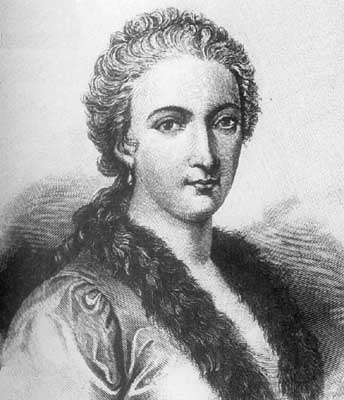
Maria Gaetana Agnesi 16 May 1718 – 9 January 1799 was an Italian mathematician, philosopher, theologian and humanitarian.
Born in Milan, to a wealthy and literate family Maria Gaetana was the third of 21 children. Her father, Pietro Agnesi, was not a professor, or even a mathematician as many sources suggest. He was born into a family of wealthy silk merchants. Evidence from family wills show that he was so wealthy he may never have worked in the family business at all. Pietro Agnesi enjoyed socializing with scholars and noblemen. Her mother was the daughter of a prosperous silk manufacturer as were his two later wives. Each brought a substantial marriage portion with them an between them produced 21 children, 13 of whom survived to adulthood.
Maria’s father supported her learning but in keeping with tradition, he gave priority to the education of his sons. Soon Maria outstripped her brothers. When she was 10 she was recognised as a child prodigy along with her sister Theresa the musician. Maria could speak both Italian and French when she was five years old. When she was nine years old, she composed and delivered an hour-long speech in Latin to some of the most distinguished intellectuals of the day; and the subject was, of course, a women’s right to be educated. By her eleventh birthday, she had added Greek, Hebrew, Spanish, German, and Latin to her arsenal of knowledge. With such a flair for languages, she was often referred to as the “Seven-Tongued Orator”. At the age of 12, she was found to be suffering from some undefined malaise, which may, of course, have been grief for her dead mother. Her ill health was automatically attributed to her excessive studying. Her doctors prescribed vigorous dancing and horseback riding as a remedy. However, this treatment did not work. Maria began to experience extreme convulsions, and on doctor’s orders, the vigorous exercise was curtailed. Henceforth Maria was encouraged to be moderate in all her pursuits.
There was no stopping Gaetana, though. By the age of fourteen she was studying ballistics and geometry and a year after that her father began to regularly include her in his gatherings which included some of the most learned men in Milan. Some believe he educated Maria, and her younger sister, Theresa, to increase his popularity among the upper classes of the town and get the family a coat of arms. He dearly wanted entry into the town senate, which had been dominated by a few key families for more than 400 years. His talented daughters were one of the town’s social and intellectual elite’s main sources of free entertainment, but they did not get him what he wanted.
At her father’s soirees, Maria would read papers on the most abstruse philosophical questions of the day. Records of these meetings are given in Charles de Brosses’ Lettres sur l’Italie and in the Propositiones Philosophicae, which her father published in 1738. In 1739 two Burgundian gentlemen who were passing through Milan on their ‘Grand Tour’ were invited to join Signore Agnesi and his family. They were Charles De Brosses, conseiller, at the parliament of Dijon and its future president and Germain Ann Loppin de Montmort, conseiller at the parliament of Bourgogne, who was also a mathematician. While touring the churches and libraries of Milan in July 1739 they met a friend of Agnesi, Count Belloni and were invited to attend a salon or conversazione at the Agnesi Palazzo. The evening was that of the 16th of July.
The travellers arrived tired and thirsty. Their first thoughts were that the palazzo’s exterior was disappointingly plain. Everything changed however when they got inside. They were then led through a large room decorated with gold and silver threaded tapestries that glistened in the candlelight. A grand portrait of the Holy Roman Emperor Charles VI and his consort for Elizabeth Christine gazed down on them from on high. When the entered the salon they found it was the music room. The guests were an usual collection of aristocrats, clerics, city notables, and learned gentlemen and ladies. The travellers were treated to a gala evening spent amidst the elegant people and the Agnesi art collection which included a work by Titian and some drawings by Leonardo. As the travellers noted in their diaries (the precious source for this history), the evening centred on musical performances by Maria Gaetana’s two sisters and a series of Latin orations and debates on questions of natural philosophy by Gaetana herself. Agnesi was all of nine years old at the time of this performance. The conversation began when Count Belloni rose and asked Gaetana a question in Latin. The question concerned the nature of tides. She began the discourse in the form an academic disputation first putting forward ideas then dismissing them. An hour later Brosses was invited to ask a question. He decided to ask her two questions. One on the subject of the nature of the soul and the body and one on the nature of light and colours. De Montmort’s question concerned the nature of circles and curves. When the discussion was over they were served fruit flavoured ices and her sister Theresa played the harpsichord to entertain the guests.
As urbane and worldly as the Palazzo Agnesi was it was also a proper Catholic home with a strong respect for traditional religion. Gaetana was well-schooled in the Catholic catechism, languages, mathematics and philosophy with no distinction made between religion and science. Her father’s intellectual sensibilities leaned toward those wings of the Catholic church that emphasized the harmonies between secular and religious life, and engaged teachers for his daughters who shared his values. This was not difficult in Milan as the city had a long history of independent thinking within the Roman Catholic world. ‘The Catholic Enlightenment’ that took place in Milan in Gaetana’s lifetime brought those Catholics devoted to progressive social and political reform and those devoted to certain progressive theological currents together. This religious and cultural background would shape Gartana’s intellectual and emotional life. Her unconventional scientific education gave her room to think outside the usual conventions of the age.
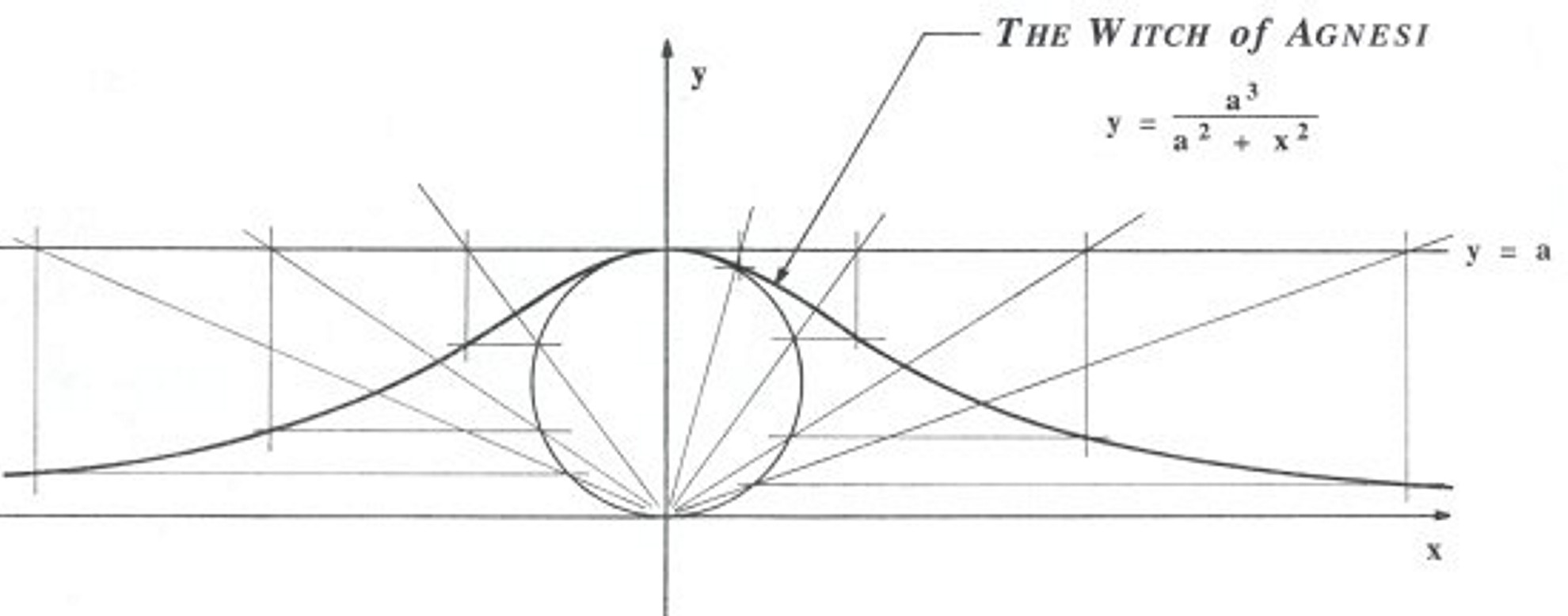
In 1740, aged twenty-two, Gaetana began a period of studies with Father Ramiro Rampinelli, professor of physics and mathematics at the monastery of Olivetani of San Vittore. Rampinelli was an Olivetan monk and chair of mathematics and physics at ‘ University of Pavia. With Rampinelli Maria started to study other notable mathematicians and to develop her mathematical skill by learning differential and integral calculus. Differential Calculus cuts things into small pieces to find how it changes. Integral Calculus joins (integrates) the small pieces together to find how much there is. These skills led to her main contribution to the world of mathematics, the formula for a curve called ‘versiera’ a term derived from Latin vertere, to turn. The name ‘versiera’ is from Guido Grandi (Quadratura circuli et hyperbolae, Pisa, 1703) and is a type 63 in Newton’s classification. Its principal use today is in astronomy and to show the distribution of energy in objects such as ocean waves.
With the help of fellow mathematician and astronomer Jacopo Riccati, she drafted her first book, Institutions Analytical for use by the Italian Youth which was published in two volumes in 1748 and 1749. Dedicated it to Empress Maria Teresa, the Empress sent her a gift of jewels in return. In the book, she argues for women to be able to access the ‘sublime sciences’ yet she seems to have had no desire to enter the 18th-century world of female scholars who were generating some Europe’s best science and literature. Her books were well received and translated into French in 1755 and English in 1801. Its two volumes were written in Italian not Latin, as was the custom for great mathematicians such as Newton and Euler. The vernacular made it more accessible to students. In 1750, she began teaching mathematics at ‘ University of Bologna and she remained a tutor there until she died in 1752. Pope Benedict XIV gave her a special dispensation to hold the rank of Professor but she did not take it up. Instead, she dedicated herself to charitable works. She opened a small hospital and worked there herself nursing the poor at the end of their lives. Gaetana was a devout Catholic and wrote extensively on the marriage between intellectual pursuit and mystical contemplation, most notably in her essay Il Cielo Mistico (The Mystic Heaven). She saw the rational contemplation of God as a complement to prayer.
Gaetana was caught at a unique point in time, between two contrasting and seemingly irreconcilable elements of the Catholic Enlightenment. Her heart’s desire was to maintain the traditions of the Catholic Church with its philosophy of verbal disputation and logic, but her intellect drew her towards the experimentation of physics and disputation based on mathematical reasoning. After suffering bouts of ‘unexplained’ illness for periods of her life that have been interpreted as epilepsy or neurosis, which may have been depression Gaetana reconciled herself to the study of algebra because it did not concern enquiry into the physical nature of reality. Thus she was able to save her sanity, maintain her Catholic view of a world and continue to work on her beloved mathematics.
Gaetana undoubtedly benefited from a brief opening of opportunity for a few talented women at the top of the church during the pontificate of Benedict XIV (1740-1758). She was the first woman to write a book on mathematics and the first to teach mathematics at a university. She was the first female professor of mathematics too although she never took up the post. Her lasting legacy is her wave, known as The Witch of Agnesi. Other honours included the dedication of one of the largest craters on the planet Venus, and a metal model of a versiera is embedded in the square outside the town hall of the city of Varedo as a tribute to their most famous inhabitant. The house she lived in until she died in 1799 is now a music academy. As a tribute to her genius, several Italian cities have dedicated a street in her honour. In Merate ( LC ) there is a high school specialising in science and languages named after her.
How this deeply religious woman became known as a witch is down to an error in translation. The name “Witch of Agnesi” was invented by Cambridge University mathematics professor John Colson when he translated Maria’s textbook from Italian into English. Colson gave the book it’s English title: Analytical Institutions. Unfortunately, when Colson translated Maria’s description of the curve, he apparently confused “la versiera” with “l’avversiera,” which means “wife of the devil.” Because of this mistake, Colson named the curve the “Witch of Agnesi” and the silly pun is still preserved in most English textbooks. Her curve appeared in the writings of Fermat (Oeuvres, I, 279–280; III, 233–234) and in the work of other prominent mathematicians.
Sources:
Wikipedia
The World of Maria Gaetana Agnesi, Mathematician of God By Massimo Mazzotti, JHU Press, 2012
Carmela Martino https://www.carmelamartino.com/_i_playing_by_heart__i__.htm
Julia Herdman writes historical fiction that puts women to the fore. Her latest book Sinclair, Tales of Tooley Street Vol. 1. is Available on Amazon
Amazon Australia
Amazon Canada
Amazon New Zealand
Amazon South Africa
Amazon USA

by Julia Herdman | Jul 14, 2017 | Blog
As the daughter of a king Princess Augusta was denied access to men of her own rank except those in her immediate family for most of her life. Like several of George III’s daughters she found herself lonely and drawn into romances with gentleman at court whether they were suitable or not.
It is believed that Princess Augusta first met Sir Brent Spencer, an Irish general in the British Army, around 1800. Augusta later told her brother, the future George IV, the two entered into a relationship in 1803 while Spencer was stationed in Britain. Although the couple conducted their relationship with the utmost privacy, Augusta did petition the Prince Regent in 1812 to be allowed her to marry Spencer, promising further discretion in their behaviour. While no official record of a marriage between the two exists, it was noted at the court of Hesse-Homburg at the time of her sister Elizabeth’s marriage in 1818 that Augusta was “privately married.”
Princess Augusta Sophia was born at Buckingham House, London, the sixth child and second daughter of George III (1738–1820) and his wife Queen Charlotte. The young princess was christened on 6 December 1768, by Frederick Cornwallis, The Archbishop of Canterbury, in the Great Council Chamber at St. James’s Palace. Princess Augusta had an older sister Charlotte (born 1766) and her younger sister Elizabeth (born 1770). In 1771, the two oldest princesses started travelling to Kew to take lessons under the supervision of Lady Charlotte Finch and Miss Planta. The pair, who had formerly been very close to their older brothers now saw little of them, except when their paths crossed on daily walks. In 1774, Martha Goldsworthy, or “Gouly” was put in charge of their education which included the feminine pursuits of deportment, music, dancing, and the arts. Their mother also ensured that they learned English, French, German, and Geography.
In 1782, aged 14, Augusta made her court debut on the occasion of her father’s birthday. Being terrified of crowds; the princess was painfully shy, and stammered when in front of people she didn’t know; her mother gave her only two days notice of the event. That year she lost her two baby brothers, Prince Alfred and Prince Octavius. Alfred had a bad reaction to his inoculation against smallpox and died aged nearly two. Six months after Alfred’s death, her younger brother Octavius and her sister Sophia were taken to Kew Palace in London to be inoculated with the smallpox virus. (This may seem irresponsible today but smallpox was virulent and no respecter of rank so inoculation, even with its risks was still probably a better bet than not being inoculated at all.) Sophia recovered without incident, but like his brother, before him, Octavius became ill and died several days later, he was just four years old. As was traditional at the time, the household did not go into mourning for the deaths of royal children under the age of fourteen but Augusta, who had loved the children dearly, was distraught.
Her formal education now came to an end. Now her duty was to join her elder sister and her parents at court and accompany them to the theatre and the Opera. With six daughters to clothe and educate the royal budget was stretched. The royal princesses often appeared in what was basically the same dress each in a different colour to save money and at home, they wore plain, everyday clothes unlike their royal contemporaries in Europe.
By 1785, Augusta and Charlotte were reaching an age where they could be considered as potential brides for foreign princes. In that year the Crown Prince of Denmark (later King Frederick VI) indicated to her father that he was interested in Augusta but George decided he could not allow his lovely daughter to go to Denmark after his sister’s disastrous marriage to King Christian VII. As their friends at court found husbands the sisters began to wonder when their turn would come. Their father it seems was reluctant to see them leave and the subject was not one for discussion in case it disturbed the often addled mind of their sick father. So, the years slid by with neither of them married. This was when pretty Augusta made her own arrangements with the dashing officer, Brent Spencer.
Spencer was upper middle class not royal; he became a commissioned officer in 1778 and fought with great credit in the West Indies in 1779–1782 during the American Revolutionary War and again in 1790–1794 during the War of the First Coalition. He was a professional soldier who rose through the ranks, first to Brigadier General, serving in the wars against Napoleon in Europe and Egypt. He was eight years older than Augusta and served with Wellington as his second in command during the Peninsular War where he became a full General. After the war, he became the MP for Sligo.
Such a match would be considered wholly acceptable today but not in the 18th century. It is said that he and Augusta maintained their relationship through these years of separation and that he died with a picture of her in his hand at the age of 68. Augusta died on 22 September 1840 at Clarence House, aged 71.
Source: Wikipedia. Illustration: Augusta Sophia of the United Kingdom. Copy of the portrait exhibited at the Royal Academy in 1819 and now in the Museum of Fine Arts, Baltimore.
Julia Herdman writes historical fiction that puts women to the fore. Her latest book Sinclair, Tales of Tooley Street Vol. 1. is Available on Amazon
Amazon Australia
Amazon Canada
Amazon New Zealand
Amazon South Africa
Amazon USA

by Julia Herdman | Jul 7, 2017 | Blog
The position of women in the historical novel is problematic for authors. I am interested in exploring the strengths and weaknesses of my characters and how they cope with the historical world and I want to show women in a positive and realistic light. However, when it comes to writing about women in past I am confronted with some tricky problems. The main problem is that for most of history women were legally, socially and economically subject to the will of men.
In a strange way, poor women were the freest to be themselves as they worked even when they were married and had children. Poor women earned their own money. The problem for these women was that their earnings were always vastly inferior to men’s. A woman alone in the past was almost invariably a poor and exploited one.
It is true that in London and in other large towns where there was the possibility of social anonymity many women turned to prostitution as a more lucrative way of staying alive.
For women of the middling sort, I hesitate to use the word class here, as for most of history there was no middle class as we know today, financial dependence on men was the norm even into the middle of the last century. Of course, financial dependence on men has not gone away as women are still paid on average 16% less than men for the same work but women are thankfully no longer forced into financial servitude to men.
A single ‘free’ woman in the past was the exception. Any unmarried woman would almost certainly be viewed as unsuccessful.
Marriage and children were the markers of success for a woman in past. With no meaningful contraception, women were constantly burdened with pregnancy and subject to premature death in childbirth. They were responsible for almost all childcare unless a woman was wealthy enough to employ a nurse or nanny.
Of course marriage still an honourable estate for most men and women but more women are going it alone than ever before and are happy with their decision. For the majority of us who marry, it’s a struggle to manage a demanding career and a family no matter how successful we are in our chosen profession.
So how does the modern author go about creating their female historical characters?
Well, some authors focus their attention on the few women who broke the mould in the past while other abandon any sense of historical verisimilitude. Some use the Cinderella formula while others make their female characters masculine, sassy and ruthless. All of these forms can work if the story is good enough but they were not for me in the Tales of Tooley Street as the characters are inspired by actual people who lived and worked at 65 Tooley Street for three generations.
Approaches to representing female characters in the past:
Some argue that The Fortunes and Misfortunes of the Famous Moll Flanders (commonly known simply as Moll Flanders) a novel by Daniel Defoe, first published in 1722 is the prototype for a female character who by the end of the novel controls her own life and is financially independent. Moll achieves what many feminists call success.
Feminist writer Diana Del Vecchio says, “By the end of the book, Moll has completely appropriated the role of the husband, the provider, the masculine, the seeker, the adventurer, the leader, the thinker, and has figuratively donned the clothing of man, while keeping her nature as woman intact. She makes the final decision to enter and sign a legal contract with her son, where he manages her inherited land and gives her an annual compensation of the lands’ produce. When she returns to Jemy, it is she that supplies him with a dowry of a gold watch, a hundred pounds in silver, a deerskin purse, Spanish pistols, three horses with harnesses and saddles, some hogs, two cows, and other gifts for the farm. She enters this relationship with the fortune of her inheritance and the many accouterments that she has acquired and accumulated in her years as a thief. For the first time in her life, she forms a relationship with a man, where she is the one in control.”
The fact that Moll has to step outside the law to become independent is the problem for me but it is probably a realistic one as Defoe was fully aware of the way society worked in the early 18th century. Prostitution and thieving were rife in London in the 18th century but most women involved in the trade did not end up like Moll. Most ended in an early grave, at the end of a noose or transported for life if caught. My character is inspired by a respectable widow who raises her son to be a successful doctor so prostitution and thieving are not options for her.
Historian Lucy Worsley’s most recent BBC TV series on the Wives of Henry III offers an alternative approach to the female character and narrative in history.
In the series, Dr. Worsley looked at the events of Henry’s reign through the eyes of the women involved. She cleverly managed to breath new life into this overworked territory by showing Katherine of Aragon as a competent and popular queen not as the obsessively religious woman of traditional portrayals. She showed Katherine was intelligent, ambitious and for much of her 24-year marriage to Henry, she gave as good as she got. Anne Boleyn too was shown as a clever and ambitious woman betrayed by her husband and removed on trumped up charges of adultery. Jane Seymour was a young and tragic a woman fed to the old lecher of a king by her male relatives only to die in childbirth. Ann of Cleaves was a smart political operator who negotiated herself out of disaster and ended up one of the richest women in England. Catherine Howard was what we would call an abused child who did not know how to say no to powerful and determined men; and, Katherine Parr was a wily woman of great learning and intellect who used her position to promote the establishment of the ‘new religion’ Protestantism and managed to outmaneuver and outwit her enemies at court.
In my own writing, I have taken the Lucy Worsley approach. My heroine, Charlotte Leadam, the widow of the Tooley Street surgeon, Christopher Leadam, is intelligent and resourceful but she is an 18th-century woman living in 18th century London. She faces financial ruin when her husband dies. As a woman, she cannot run the apothecary shop she owns because she cannot hold an apothecary license as a woman but she must pay her husband’s debts. As a widow, she yearns for the return of the feeling of financial security and independence she enjoyed when she was married but she does not want to remarry. Charlotte achieves her desires by complying with some social conventions of the day and by ignoring others but she’s always well within the law. Here’s an excerpt.
“You and John will stay here with us now that Christopher has gone,” her mother said, in a tone that indicated it was not a matter for discussion.
“That’s very kind of you and father, but Christopher has not gone, as you put it. He died; my husband is dead. I am a widow, not an abandoned child.”
“We know that, dearest. Your father and I comprehend the situation all too clearly,” she said, handing her daughter a fresh towel and a bar of soap. “You’re a woman without a husband and without an income. You cannot simply go back to your old life, Charlotte; it no longer exists. Your father and I have discussed the matter, and we have decided that it is best that you and John stay here where we can provide for you. That is until you marry again.”
The flame of ire burning in Charlotte’s chest was rekindled and refuelled. Whilst she could not dispute her mother’s analysis of the situation, she was nonetheless livid with her for expressing it so clearly. She bit her lip, held her tongue and breathed the long slow breaths that Christopher had taught her to use in such situations. Experience told her that this was not the time or the place to have an argument with her mother. Losing her temper never worked; she had to be more cunning than that. As calmly as she could she said, “Mother, I have no plans to remarry.”
“I’m not saying that you have to forget Christopher. I’m not that cruel and insensitive. ” She pointed to the bath. “Your father took this in lieu of payment from a whore in St James’s. The poor woman could not pay her rent either, so your father took the bath before the landlord did. My friend Mrs. Peacock says that bathing is of great benefit for the nerves, so I thought you might like to try it. I shall not be doing so: I’m too old to change the habits of a lifetime. Besides, they cost a fortune in hot water – which is all very well for Mrs. Peacock: her husband is a banker. And I can’t use poor Millie like this again; she is exhausted with carrying the pails from the kitchen.”
When her mother had gone Charlotte launched herself face down onto the bed and let out a long, low scream of frustration. How dare her mother decide what she was going to do with her life without even talking to her about it? And why had she told her about the whore? Was she trying to warn her what happens to women who are left on their own?
Julia Herdman writes historical fiction that puts women to the fore. Her latest book Sinclair, Tales of Tooley Street Vol. 1. is Available on Amazon
Amazon Australia
Amazon Canada
Amazon New Zealand
Amazon South Africa
Amazon USA

by Julia Herdman | Jul 7, 2017 | Blog
The actress Frances Barton or Frances “Fanny” Barton was the daughter of a private soldier who started her working life as a flower girl and a street singer. As an actress, she performed in taverns and resorted to selling herself as many hard-up women did in those days before she made it onto the stage.
Her first step to success came when she got a job as a servant to a French milliner. Fanny learned about costume and acquired some French which afterward stood her in good stead as she mingled in London’s high society as a famous actress.
Actress Fanny first appeared on the stage was at Haymarket in 1755 as Miranda in Mrs. Centlivre’s play, Busybody. Following that she became a member of the Drury Lane Company, where she was overshadowed by its more established actresses Hannah Pritchard and Kitty Clive. However, Fanny was an she was an ambitious actress and travelled to Ireland where she had her first major success Lady Townley in The Provok’d Husband by Vanbrugh and Cibber. Fanny worked at her trade, she became a consumate actress and five years after she began her career she received an invitation from David Garrick to return to Drury Lane.
Fanny married her music teacher, James Abington, a royal trumpeter, in 1759. It was not happy and the pair separated but she retained his name calling herself Mrs. Abington. She remained at Drury Lane for eighteen yearsFanny played Mrs. Teasel in Sheridan’s School for Scandal making the role her own. She also played Shakespearean heroines – Beatrice, Portia, Desdemona and Ophelia and the comic characters Miss Hoyden, Biddy Tipkin, Lucy Lockit, and Miss Prue. Mrs. Abington’s Kitty in “High Life Below Stairs” put her in the foremost rank of comic actresses, making the mop cap she wore in the role the reigning fashion“.
This cap was soon referred to as the “Abington Cap” and frequently seen on stage as well as in hat shops across Ireland and England. Adoring fans donned copies of this cap and it became an essential part of the well-appointed woman’s wardrobe. The actress soon became known for her avant-garde fashion and she even came up with a way of making the female figure appear taller. She began to wear a tall-hat called a ziggurat adorned with long flowing feathers and began to follow the French custom of putting red powder on her hair.

An example of Fanny’s influence on fashion - the high ziggurat style hat.
Sir Joshua Reynolds painted her as Miss Prue a character from Congreve’s Love for Love. The portrait is the best-known of his half-dozen or more portraits of her. In 1782 she left Drury Lane for Covent Garden. After an absence from the stage from 1790 until 1797, she reappeared, quitting it finally in 1799. Her ambition, personal wit, and cleverness won her a distinguished position in society, in spite of her humble origin.
Source; Wikipedia
Illustrations: Fanny Abington, Joshua Reynolds, Portrait of Marie-Dauncey,1789, James-Northcote, Fanny as Miss Prue, Joshua Reynolds.
Julia Herdman writes historical fiction that puts women to the fore. Her latest book Sinclair, Tales of Tooley Street Vol. 1. is Available on Amazon
Amazon Australia
Amazon Canada
Amazon New Zealand
Amazon South Africa
Amazon USA

by Julia Herdman | Jul 3, 2017 | Blog
Humble Beginnings
Jeanne Baret was born on July 27, 1740, in the village of La Comelle in the Burgundy region of France. Her record of baptism survives and identifies her as the legitimate issue of Jean Baret and Jeanne Pochard. Her father is identified as a day labourer and seems likely to have been illiterate, as he did not sign the parish register.
Housekeeper and Servant
At some point between 1760 and 1764, Baret became employed as housekeeper to naturalist, Philibert Commerson, who had settled in Toulon-sur-Arroux, some 20 km to the south of La Comelle, upon his marriage in 1760. Commerson’s wife, who was the sister of the parish priest, died shortly after giving birth to a son in April 1762, and it seems that Baret took over management of Commerson’s household at that time, if not before.
Lover and Friend
It seems Baret and Commerson shared a more than an interest in his household as she became pregnant in 1764. French law at that time required women who became pregnant out of wedlock to obtain a “certificate of pregnancy” in which they could name the father of their unborn child. Baret’s certificate, from August 1764, survives; it was filed in a town 30 km away and witnessed by two men of substance who likewise had travelled a considerable distance from their homes. She refused to name the father of her child, but historians do not doubt that it was Commerson and that it was Commerson who had made the arrangements with the lawyer and witnesses on her behalf.
Paris and a Child
Shortly afterward, Baret and Commerson moved together to Paris, where she continued in the role of his housekeeper having left his legitimate son in the care of his brother-in-law in Toulon-sur-Arroux and never saw him again in his lifetime. Baret apparently changed her name to “Jeanne de Bonnefoy” during this period. Her child was born in December 1764 and was given the name Jean-Pierre Baret. Baret gave the child up to the Paris Foundlings Hospital and he was quickly placed with a foster mother. The child suffered the fate of so many at that time and died in the summer of 1765.
The Expedition
That year Commerson was invited to join Bougainville’s expedition to circumnavigate the globe to claim territory for the French king similar to the expeditions of his contemporary the English Captain Cook. Commerson hesitated in accepting because he was often in poor health; he required Baret’s assistance as a nurse as well as in running his household and managing his collections and papers. Finally, he accepted and as his appointment allowed him a servant, paid as a royal expense, he decided to take his companion and helpmate Jeanne with him. The problem was that women were completely prohibited on French navy ships at this time. Together they devised a plan for Jeanne to disguise herself as a man and join the ship just before it sailed. Before leaving Paris, Commerson drew up a will in which he left to “Jeanne Baret, known as de Bonnefoi, my housekeeper”, a lump sum of 600 livres along with back wages owed and the furnishings of their Paris apartment.
Breaking the Rules
The pair boarded the ship Étoile in December 1766 and because of the vast quantity of equipment Commerson brought with him the ship’s captain, François Chesnard de la Giraudais, gave up his own large cabin to Commerson and his “assistant”. This fortuitous act gave Baret significantly more privacy than she might otherwise have expected on board and she did not have to use the shared heads like other members of the crew to relieve herself.
Surviving accounts of the expedition differ on when Baret’s gender was first discovered. According to Bougainville, rumours that Baret was a woman had circulated for some time, but her gender was not finally confirmed until the expedition reached Tahiti in April 1768. As soon as she and Commerson landed on shore to botanize, Baret was immediately surrounded by Tahitians who cried out that she was a woman. It was necessary to return her to the ship to protect her from the excited Tahitians. Bougainville recorded this incident in his journal some weeks after it happened when he had an opportunity to visit the Étoile to interview Baret personally.
Another account says that there was much speculation about Baret’s gender early in the voyage and asserts that Baret claimed to be a eunuch when confronted directly by the Captain, La Giraudais (whose own official log has not survived). After crossing the Pacific, the expedition was desperately short of food. After a brief stop for supplies in the Dutch East Indies, the ships made a longer stop at the island of Mauritius in the Indian Ocean. This island, known as Isle de France, was then an important French trading station. Commerson was delighted to find that an old friend and fellow botanist Pierre Poivre was serving as governor on the island, and Commerson and Baret remained behind as Poivre’s guests, probably encouraged by Bougainville as it allowed him to rid himself of the problem of a woman illegally on board his expedition.
Assistant and Housekeeper
On Mauritius, Baret continued in her role as Commerson’s assistant and housekeeper. It is likely that she accompanied him to botanize on Madagascar and Bourbon Island in 1770-1772. Commerson continued to have serious health problems, and he died in Mauritius in February 1773. After Commerson’s death, Baret seems to have found work running a tavern in Port Louis for a time. Then, on 17 May 1774, she married Jean Dubernat, a non-commissioned officer in the French Army who was most likely on the island on his way home to France.
Marriage and Return to France
There is no record of exactly when Baret and her husband arrived in France, thus completing her voyage of circumnavigation. Most likely it was sometime in 1775. In April 1776, she received the money that was due to her under Commerson’s will after applying directly to the Attorney General. With this money, she settled with Dubernat in his native village of Saint-Aulaye where he may have set up as a blacksmith.
State Recognition of Services to Botany
In 1785, Baret was granted a pension of 200 livres a year by the Ministry of Marine. The document granting her this pension makes clear the high regard with which she was held by this point:
Jeanne Baret, by means of a disguise, circumnavigated the globe on one of the vessels commanded by Mr de Bougainville. She devoted herself in particular to assisting Mr de Commerson, doctor and botanist, and shared with great courage the labours and dangers of this savant. Her behaviour was exemplary and Mr de Bougainville refers to it with all due credit…. His Lordship has been gracious enough to grant to this extraordinary woman a pension of two hundred livres a year to be drawn from the fund for invalid servicemen and this pension shall be payable from 1 January 1785. She died in Saint-Aulaye on August 5, 1807, at the age of 67.
Honours and Publications
Commerson named many of the plants he collected after friends and acquaintances. One of them, a tall shrub with dark green leaves and white flowers that he found on Madagascar, he named Baretia Bonafidia. But Commerson’s name for this genus did not survive, as it had already been named by the time his reports reached Paris; it is currently known as Turraea. While over seventy species are named in honour of Commerson, only one, Solanum baretiae, honors Baret.
For many years, Bougainville’s published journal – a popular best-seller in its day, in English translation as well as the original French – was the only widely available source of information about Baret. More recent scholarship has uncovered additional facts and documentation about her life, but much of the new information remained little-known and inaccessible to the general public, particularly outside France. The first English-language biography of Baret, by John Dunmore, was not published until 2002, and then only in New Zealand. Other articles appeared only in scholarly journals.
The 2010 biography of Baret by Glynis Ridley, The Discovery of Jeanne Baret, brought Baret to the attention of a wider audience and helped to overturn some of the old misconceptions about her life.
Julia Herdman writes historical fiction that puts women to the fore. Her latest book Sinclair, Tales of Tooley Street Vol. 1. is Available on Amazon
Amazon Australia
Amazon Canada
Amazon New Zealand
Amazon South Africa
Amazon USA

Recent Comments