

Forty years of documenting the Great Sphinx of Giza
Advertisement
Champollion - a new mini-history from Julia Herdman
Buy Now
Top Facts About the Great Sphinx of Giza
- Nobody knows its original name or its age. The Great Sphinx of Egypt remains a mystery.
- The name Sphinx is not even Egyptian; it’s Greek.
- Sphinx means a human-headed animal with a lion’s body in ancient Greek mythology.
- The word Sphinx came into use some 2,000 years after the Great Sphinx of Egypt was built.
- There are hundreds of tombs at Giza with hieroglyphic inscriptions dating back some 4,500 years, but not one mentions the monument.
- The trouble is the Egyptians didn’t write history as we do; they were not interested in precise dates or explanations.
- Although we don’t fully understand the Great Sphinx of Giza, it was undoubtedly part of their sacred landscape of death and resurrection.
You can find out more about the Great Sphinx of Egypt at https://www.arce.org/sphinx-map where Mark Lehner and James Allen reveal the results of their forty-year study of the monument.
The Dream Stele
The Dream Stele is a rectangular piece of red granite, 3.6 meters (12 ft) tall. It originally formed the back wall of a small open-air chapel built by Thutmose IV and sits between the paws of the Great Sphinx. The Stele itself is a reused door lintel from the entry to the mortuary temple of the Pharaoh Khafre, the owner of the second-largest pyramid at Giza. The scene in its lunette, the semi-circular window-like space at the top of the stone, shows the Pharaoh Thutmose IV on the left and the right making offerings and libations to the Sphinx.
The Stele records how Thutmose slept under the protection of the Great Sphinx one afternoon when he was tired from hunting. While he slept, he dreamt he struck a bargain with the mighty Sphinx. In return for refurbishing the monument, the Sphinx promised to make him king.
The Stele gives rise to the Great Sphinx being named Harmachis-Chepre-Re-Atum because that is the name the god of the Great Sphinx goes by when speaking to Thutmose IV in his sleep.
‘Look at me, look at me, my son Thutmose. I am your father Harmachis-Chepre-Re-Atum, who gives you the kingdom on earth at the head of the living. ” Sphinx stele (Urk IV, 1539a-1544)
The Greek Myth: Oedipus and the Riddle of the Sphinx
During his great journey, Oedipus came upon the town of Thebes; he found the great Sphinx there. The Sphinx sat in front of Thebes and asked a riddle of everyone who tried to enter the city. If you could answer the riddle, the Sphinx let you go, but if you could not answer the riddle, then the Sphinx ate you! Nobody ever knew the answer.
This was the Sphinx’s riddle:
What goes on four feet in the morning, two feet at noon and three feet in the evening?
Answer:
A man: As a baby in the morning of their life a man crawls on fours.
As an adult in the noon of their life, a man walks upright on two feet.
But when he is old, in the twilight of life, he walks with a cane or on three legs.
When Oedipus answered the riddle correctly, the Sphinx was so upset that she fainted, and Oedipus went on into Thebes. When he got there, the Thebans were very upset because somebody had killed their king, Laius. But they were happy to hear that Oedipus had figured out the riddle of the Sphinx. So, they made Oedipus their new king.
Forty years of documenting the Great Sphinx of Giza
In 1979, Mark Lehner and James Allen started work on the first comprehensive mapping of the Sphinx.
- They studied its structure and geology
- They documented every detail
- Their goal was to determine how and when this iconic monument was built
- Recorded its current state of preservation
- Their data is now available thanks to a grant from ARCE’s Antiquities Endowment Fund
- If you’d like to search the data yourself, good starting points are the project homepage or try browsing some of the over 5500 photographs and 364 maps and drawings and see what you find!
https://www.arce.org/sphinx-map

The Great Sphinx
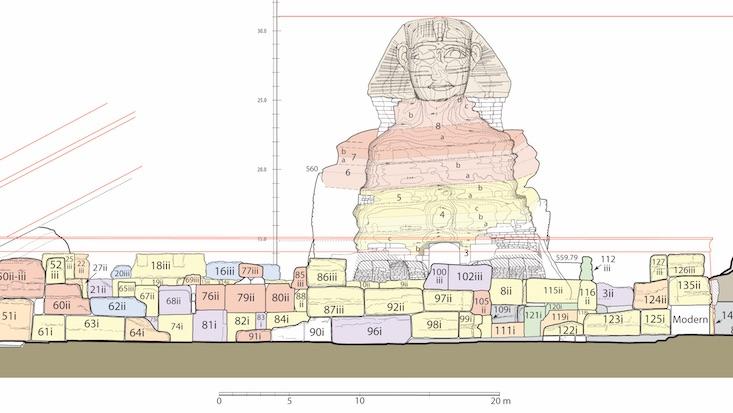
Elevation of the Sphinx Temple, showing east and west walls and the Sphinx from Ulrich Kapp’s 1979 photogrammetric elevation and profiles with core blocks numbered and color-coded for type.
Photo: Mark Lehner.
See Also:
Questions in Egyptology 5: What was the punishment for Ancient Egyptians if caught tomb-robbing?
Questions in Egyptology No. 4: Did the Ancient Egyptians Have a Religion?
Questions in Egyptology No 3. Did the Egyptians Influence the Greeks?
Questions in Egyptology No. 2: How Long Did it Take to Mummify a Pharaoh?
Questions in Egyptology No. 1 - The Cartouche - what did it protect?

Recent Comments