
by Julia Herdman | Jun 22, 2017 | Blog
 Benjamin Franklin was a lover of knowledge; after all, he was the quintessential Renaissance man. He gave us the lightning rod, the Franklin stove, bifocals, and Poor Richard’s Almanack. He was also an indispensable politician and civic activist who not only helped lay the groundwork for the Declaration of Independence and the United States Constitution but was also the country’s first ambassador to France where in 1779 he fell in love with Anne Catherine Helvétius, the widow of the Swiss-French philosopher, Claude-Adrien Helvétius.
Nicknamed “Minette”, she maintained a renowned salon in Paris using her dead husband’s accumulated wealth and among its habitués were France’s leading politicians, philosophers, writers, and artists. In courting her attention, he sent her many letters expressing his love, admiration, and passion. In one, he claimed that he had a dream that their dead spouses had married in heaven and that they should avenge their union by doing the same on earth! In another passionate plea, he wrote: “If that Lady likes to pass her Days with him, he, in turn, would like to pass his Nights with her; and as he has already given her many of his days…she appears ungrateful never to have given him a single one of her nights.”
Franklin’s libido was apparently so strong, he himself was scared of it. In his autobiography, he confessed: “the hard-to-be-governed passion of my youth had hurried me frequently into intrigues with low women that fell in my way.”
One of the more revealing documents on his views on women, which had been known in certain circles but kept under wraps for almost 200 years, was a letter he wrote in 1745, offering advice to a young man who was having trouble with his own insatiable libido. In the letter, which was entitled “Advice to a Young Man on the Choice of a Mistress,” Franklin advised: “In all your Amours, you should prefer old Women to young ones.” He goes on to explain that with older women they tend to have more discretion, will take care of you when you’re sick, are cleaner than prostitutes, and that “there is no hazard of children.” He also offered that you can’t really tell who’s old or young when you’re in the dark. What a romantic!!!
Julia Herdman writes historical fiction that puts women to the fore. Her latest book Sinclair, Tales of Tooley Street Vol. 1. is Available on Amazon – Paperback £10.99 Kindle £4.99 Also available on:
Amazon Australia
Amazon Canada
Amazon New Zealand
Amazon South Africa
Amazon USA

by Julia Herdman | Jun 7, 2017 | Blog
Did Queen Marie Antoinette ever say ‘Let them eat cake’?
‘Let them eat cake.’ is one of the most famous quotes in history, but did the queen ever say it and what was going on in France for such a quote to become so popular?
Love her or hate her Marie Antoinette is one of the most famous women in French history but was she blamed for things she never said or had any control over?
The Weather in 1788
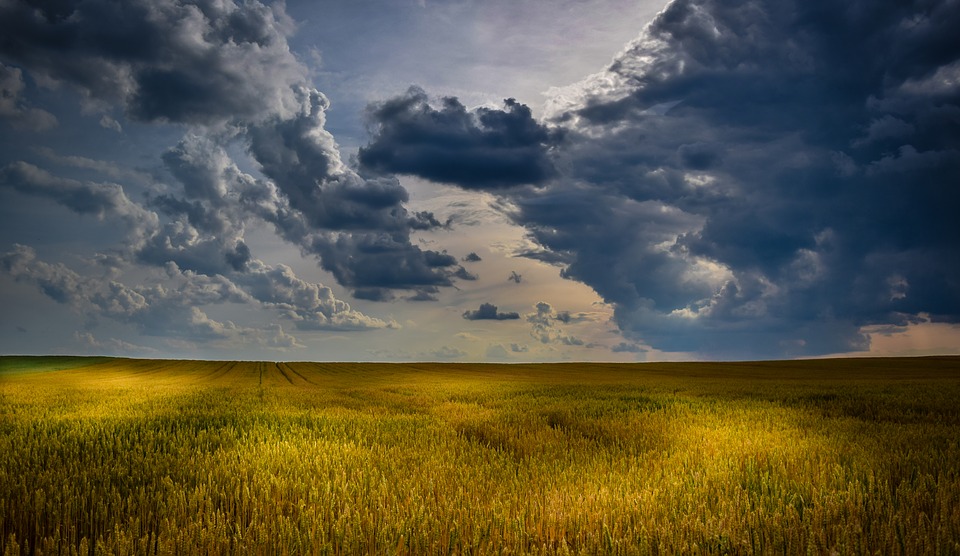
Historians and archaeologists are becoming increasingly aware of the influence of weather on the world’s significant events and as someone who has been researching life in the 18th century Britain and France I was amazed to find that the weather could be said to one of the causes of the French Revolution.
In the spring and summer of the year before the Revolution France suffered a drought. Although there was no drought in England the summer of 1788 was an unusually warm one in London. As temperatures soared in the capital, the incidence of Scarlet fever and Typhus spread through the city. In August over 1000 deaths were attributed to fever alone.
As Londoners sweltered the French baked. The French were not particularly competent farmers at the time, the aristocracy and major landowners were not interested in developing and improving their land for agriculture and food production, unlike their British counterparts. Consequently, food production was already pretty miserable when the drought struck.
The drought of 1788 ended when the skies opened and hail the size of fists fell from the sky bashing the fruit from the trees and the smashing the crops in the fields to smithereens so when the French entered the winter of 1788-9 food stocks were at an all-time low. The storms of July caused damage in parts of the country. To make matters worse, the disastrous harvest was followed by months of freezing weather. The temperature barely rose above freezing for three months through November, December and January. In London, the river Thames froze.
The bad weather was most likely caused by the eruption of the Laki volcanic fissure in southern Iceland which spewed out ash for eight months from 8 June 1783 to February 1784 killing much of the livestock and perhaps a quarter of the Icelandic population at the time. The British naturalist Gilbert White described that summer in his classic Natural History of Selborne as “an amazing and portentous one … the peculiar haze, or smokey fog that prevailed for many weeks in this island, and in every part of Europe, and even beyond its limits was a most extraordinary appearance, unlike anything known within the memory of man.”
The State of French Agriculture
Tobias Smollett wrote about Boulogne near Calais in 1763. As much as he hates France he can see that the peasants and landowners around the town have adopted some English farming improvements unlike in the rest of France. ” I am certain that a man may keep house in Boulogne for about one half of what it will cost him in London; and this is said to be one of the dearest places in France. The adjacent country is very agreeable, diversified with hill and dale, corn-fields, woods, and meadows. There is a forest of a considerable extent, that begins about a short league from the Upper Town: it belongs to the king, and the wood is farmed to different individuals. In point of agriculture, the people in this neighbourhood seem to have profited by the example of the English. Since I was last in France, fifteen years ago, a good number of inclosures and plantations have been made in the English fashion. There is a good many tolerable country-houses, within a few miles of Boulogne; but mostly empty. I was offered a compleat house, with a garden of four acres well laid out, and two fields for grass or hay, about a mile from the town, for four hundred livres, about seventeen pounds a year: it is partly furnished, stands in an agreeable situation, with a fine prospect of the sea, and was lately occupied by a Scotch nobleman, who is in the service of France.” ( Project Gutenberg’s Travels Through France and Italy, by Tobias Smollett.)
High Prices and High Taxes
The poorer classes, 95% of whose diet consisted of bread and cereals and which before the drought had to spend about 55% of their earnings on bread, were forced by the famine conditions of the first half of 1789 to spend now 85% and over of their income on this staple food. In France rural taxes called “privilege seigneriaux” or seigniorial privileges, severely burdened farmers.The clergy and nobility exercised a preeminent right over all land property but evaded most of the taxes and financial burdens of managing it. By 1789, some 90% of the population were hungry by the beginning of 1789. The famine added to the woes of the French people who was also suffering from a 10 year economic slump with its attendant unemployment.
The Riots and the Queen’s Response
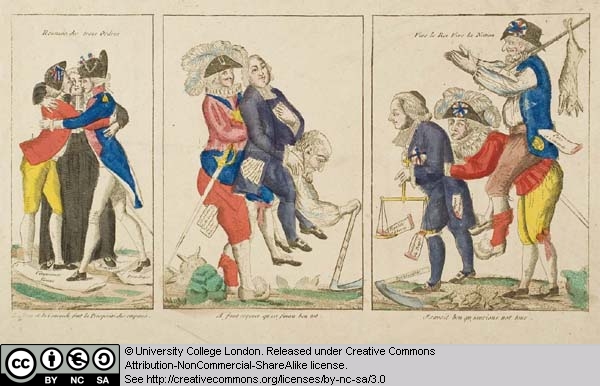
When the riots did come, they were triggered by a chance remark by a wallpaper manufacturer named Reveillon, who said in a public meeting that the government should lower grain prices so that wages could be limited to 15 sous. Rumours of impending wage reductions swept the restless capital and set off the train of events we call The French Revolution.
Queen Marie-Antoinette never said, “Let them eat cake,” on hearing there was no bread to be had in Paris but it was just the sort of thing the crowd thought her capable of saying. As was expected of a woman of her class and position she was remote but she was also totally unaware and untroubled by the plight of her people. She was, as all 18th century monarchs in Europe were, living a life of secluded luxury in their palaces. Marie Antoinette was of course living at one of Europe’s most opulent homes, the Palace at Versailles.
The phrase,’Let them eat cake’ first appeared in a slightly different form about Marie-Thérèse, the Spanish princess who married King Louis XIV in 1660. Marie-Thérèse allegedly suggested that the French people eat “la croûte de pâté” (or the crust of the pastry or the top of the pie - this was usually discarded as pastry was designed to protect the meat while it cooked). Over the next century, several other royals had the phrase attributed to them including two aunts of Louis XVI as it was a phrase that spoke of the royal family’s callousness to their people.
Land Reform
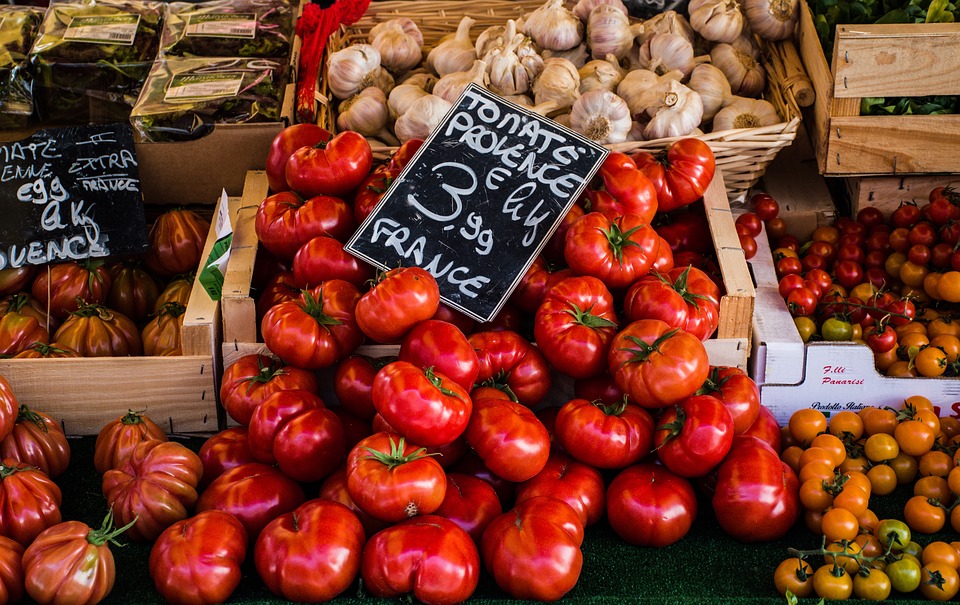
The Revolution brought the repealed feudal tenures, freed all those bound into serfdom, abolished feudal courts, and cancelled all payments not based on real property, including tithes. Once the reforms were in place; however, the peasants seized the land and refused to pay rent to the government, and in 1792, all payments were finally cancelled. Property of the clergy and political emigrants was confiscated and sold at auction, together with common land. The terms of sale, however, often favoured the wealthy, which may explain the rise of a new class of large landowners among the supporters of Napoleon I. The redistribution of land became the basis of French democracy and the small family farm has been the main feature of French agriculture ever since. Having secured their piece of land, there was little incentive or money to improve it for the peasant owners and so the economic benefits of the reforms were limited, France still struggled to feed itself and agricultural improvements that were being introduced in England were slow to be adopted.
France was a rural nation as late as 1940. After the creation of the land owning peasant class after the Revolution a next major change came in with the railways in the 1850s according to Peasants Into Frenchmen (1976), by historian Eugen Weber. Weber traced the modernisation of French villages and argued that rural France went from backward and isolated to modern and possessing a sense of French nationhood during the late 19th and early 20th centuries. He emphasised the roles of railways, republican schools, and universal military conscription. He based his findings on school records, migration patterns, military service documents and economic trends. Weber argued that until 1900 or so a sense of French nationhood was weak in the provinces, a view that has been called into question by several writers. Nevertheless, he gives a good account of the development of rural France in the 19th century. Reforms brought in after World War II and France’s engagement in the European Union has transformed agricultural production again.
Sources:
https://www.britannica.com/topic/land-reform/History-of-land-reform
https://en.wikipedia.org/wiki/French_peasants
Great Historical Events That Were Significantly Affected by the Weather: The Year Leading to the Revolution of 1789 in France, J. Neumann, Department of Atmospheric Sciences, The Hebrew University, Jerusalem, Israel
Drought and the French Revolution:The effects of adverse weather conditions on peasant revolts in 1789, Maria Waldinger (London School of Economics)
Julia Herdman writes historical fiction. Her latest book Sinclair, Tales of Tooley Street Vol. 1. is Available on Amazon – Paperback £10.99 Kindle
Sinclair is available of Amazon. Click here to get your copy.
Sinclair is set in the London Borough of Southward, the Yorkshire town of Beverley and in Paris and Edinburgh in the late 1780s. Strong female leads include the widow Charlotte Leadam and the farmer’s daughter Lucy Leadam. Sinclair is a story of love, loss and redemption. Prodigal son James Sinclair is transformed by his experience of being shipwrecked on the way to India to make his fortune. Obstacles to love and happiness include ambition, conflict with a God, temptation and betrayal. Remorse brings restitution and recovery. Sinclair is an extraordinary book. It will immerse you in the world of 18th century London where the rich and the poor are treated with kindness and compassion by this passionate Scottish doctor and his widowed landlady, the owner of the apothecary shop in Tooley Street. Sinclair is filled with twists and tragedies, but it will leave you feeling good.
Also available on:
Amazon Australia
Amazon Canada
Amazon New Zealand
Amazon South Africa
Amazon USA
18th Century Smuggling Fact and Fiction
by Julia Herdman | May 26, 2017 | Blog
Voltaire, the great rationalist, was always falling in love and had numerous love affairs. His love life began with great passion when he was just seventeen years old.
‘Voltaire in Love‘ is perhaps the best known work about his love life. It is a popular history of the sixteen-year relationship between Voltaire and the Émilie, the Marquise du Châtelet. I wrote about Emilie last month, she was a great physicist who died tragically young giving birth to her lover’s child (not Voltaire’s their affair was long since over). The book was written by Nancy Mitford and first published in 1957. As well as telling the story of Voltaire’s love for Emilie it explores the French Enlightenment.
A musical featuring the music of Leonard Bernstein with contributions from the greatest lyricists of the 20th century, Stephen Sondheim to Dorothy Parker, is an outrageous musical satire that tells the story of Voltaire’s character, the naïve Candide, who is banished for romancing the Baron’s daughter only to be plagued by a series of absurd hardships that challenge his optimistic outlook of life and love. Candide will leave you enchanted. As you will see from the letter below the story is somewhat based on his own experience.
In my novel Sinclair, Voltaire (1694-1778), the French philosopher is one of my eponymous hero’s favourite authors. He takes a copy of Candide to India with him and loses it when the ship goes down but once he’s established himself in Tooley Street he’s quick to buy himself another copy.
“Knowing there was no going back, he made himself comfortable. He lit his lamp, took out a battered copy of ‘Candide’, his favourite book, and checked the hour with his treasured pocket watch. Like the book, it was French, and the most beautiful thing he had ever owned. He cradled it in his palm. The warmth of its golden body reminded him of the smoothness of a woman’s skin; its pearly white face was elegantly marked with Roman numerals; and the back, the part that he loved most of all, was made of cobalt blue enamel and shimmered like the silk of Iona McNeal’s ballgown the night they had danced at the Edinburgh Assembly Rooms. He turned it in his hand and kissed it then he put it back in his waistcoat pocket and started to read.
He chose the scene where Candide, the hero of the story, and his professor friend, Dr Pangloss, are nearly drowned in Lisbon harbour along with a sailor called Jacques. Candide and Pangloss survive, but Jacques dies attempting to save a fellow sailor. To explain how this is all part of God’s harmonious plan, Pangloss says that Lisbon harbour was created specifically so that Jacques could drown there and fulfil God’s divine plan for him. This was an idea so preposterous, like so many in the book, that it made Sinclair laugh out loud.”
Voltaire was incarcerated in the local prison for his own good to keep him away from the girl he had fallen in love with,Olympe Dunove. Olympe’s mother and the French ambassador disapproved of their relationship. Such was the power of French aristocrats before the Revolution. Shortly after he wrote the letter below, he managed to escape by climbing out of the window.
Voltaire to Olympe Dunover, written in 1713 while in prison in the Hague.
“I am a prisoner here in the name of the King; they can take my life, but not the love that I feel for you. Yes, my adorable mistress, to-night I shall see you, and if I had to put my head on the block to do it.
For heaven’s sake, do not speak to me in such disastrous terms as you write; you must live and be cautious; beware of madame your mother as of your worst enemy. What do I say? Beware of everybody; trust no one; keep yourself in readiness, as soon as the moon is visible; I shall leave the hotel incognito, take a carriage or a chaise, we shall drive like the wind to Sheveningen; I shall take paper and ink with me; we shall write our letters.
If you love me, reassure yourself; and call all your strength and presence of mind to your aid; do not let your mother notice anything, try to have your pictures, and be assured that the menace of the greatest tortures will not prevent me to serve you. No, nothing has the power to part me from you; our love is based upon virtue, and will last as long as our lives. Adieu, there is nothing that I will not brave for your sake; you deserve much more than that. Adieu, my dear heart!”
Arout, (Voltaire)
According to Victor Hugo: “To name Voltaire is to characterize the entire eighteenth century.” Goethe regarded Voltaire to be the greatest literary figure in modern times, and possibly of all times. According to Diderot, Voltaire’s influence on posterity would extend far into the future.
Napoleon commented that till he was sixteen he “would have fought for Rousseau against the friends of Voltaire, today it is the opposite…The more I read Voltaire the more I love him. He is a man always reasonable, never a charlatan, never a fanatic.”
Frederick the Great commented on his good fortune for having lived in the age of Voltaire.
Catherine the Great had been reading Voltaire for sixteen years prior to becoming Empress of Russia in 1762. In October 1763, she began a correspondence with the philosopher that continued till his death. The content of these letters has been described as being akin to a student writing to a teacher.Upon Voltaire’s death, the Empress purchased his library, which was then transported and placed in The Hermitage.
In England, Voltaire’s views influenced Godwin, Paine, Mary Wollstonecraft, Bentham, Byron, and Shelley.[195] Macaulay made note of the fear that Voltaire’s very name incited in tyrants and fanatics. Voltaire was a man of reason and passion just like my character Sinclair. You can read about his escapades in my novel - see below.
Julia Herdman writes historical fiction that puts women to the fore. Her latest book Sinclair, Tales of Tooley Street Vol. 1. is Available on Amazon – Paperback £10.99 Kindle £2.42 Also available on:
Amazon Australia
Amazon Canada
Amazon New Zealand
Amazon South Africa
Amazon USA

Recent Comments