Questions in Egyptology 9: Why Did Cleopatra Kill Herself?

Questions in Egyptology 9: Why Did Cleopatra Kill Herself?

Why Did Cleopatra Kill Herself?

Juan Luna de San Pedro y Novicio Ancheta Public Domain.

Did Cleopatra wish to be noble in death, or did she fear public humiliation at the hands of Octavius Augustus?

The Death of Cleopatra VII, the last ruler of Ptolemaic Egypt, took place on the 10th or 12th August, 30 BC, in Alexandria. Cleopatra was just 39 years old. The closest contemporary accounts of her death are given by theGreek and Roman historians Strabo, Horace, Plutarch, Livy and Cassius Dio.

According to American art historian Robert Bianchi, conflicting accounts of Cleopatra’s suicide were in circulation almost immediately after her death. He also claims Octavian would have savoured the thought of parading the defeated Cleopatra through the streets of Rome. [1]

Suicide, i.e. deliberately killing one’s self, was practically unheard of in ancient Egypt. This makes the story told about the end of Cleopatra’s life all the more intriguing. Egyptians generally did not see suicide as a violation of their religious or legal codes, and there is no archaeological evidence of suicides in the ancient Egyptian civilization. However, literary texts such as ‘Desperate from Life’, an intellectual dialogue on despair, injustice, and corruption in the world, suggest some people certainly thought about ending their own lives. [2]


The Death of Cleopatra, Guido Cagnacci, Met Museum, Public Domain.

The famous judicial papyrus of Turin records the so-called Harem Conspiracy, a plot to murder Ramses III. The conspirators were given punishments ranging from execution, suicide, flogging, imprisonment, and severing of the nose, for their respective roles in the crime. Although we do not know precisely how individual conspirators were punished, it is likely members of the royal family were offered the dignity of suicide as an alternative to execution.
Suicide was, however, a regular feature of elite Roman life. Romans promoted the idea of”patriotic suicide.” In other words, death was preferable to dishonour. Suicide was explicitly illegal for soldiers, slaves, and people accused of capital crimes.

Plutarch’s account of Cleopatra’s Death [3]

John Collier, Prado, Madrid. Public Domain.

On hearing of Antony’s defeat at Alexandria, Cleopatra took off to her tomb. ‘It is said that the asp was brought with those figs and leaves and lay hidden beneath them, for thus Cleopatra had given orders, that the reptile might fasten itself upon her body without her being aware of it. But when she took away some of the figs and saw it, she said: ‘There it is, you see,’ and baring her arm she held it out for the bite. But others say that the asp was kept carefully shut up in a water jar and that while Cleopatra was stirring it up and irritating it with a golden distaff it sprang and fastened itself upon her arm. But the truth of the matter no one knows; for it was also said that she carried about poison in a hollow comb and kept the comb hidden in her hair, and yet neither spot nor other sign of poison broke out upon her body.’

‘When they opened the doors of the tomb they found Cleopatra lying dead upon a golden couch, arrayed in royal state. And of her two women, the one called Iras was dying at her feet, while Charmion, already tottering and heavy-headed, was trying to arrange the diadem which encircled the queen’s brow. Then somebody said in anger: ‘A fine deed, this, Charmion!’ ‘It is indeed most fine,’ she said, ‘and befitting the descendant of so many kings.’ Not a word more did she speak, but fell there by the side of the couch.’

‘Moreover, not even was the reptile seen within the chamber, though people said they saw some traces of it near the sea, where the chamber looked out upon it with its windows. And some also say that Cleopatra’s arm was seen to have two slight and indistinct punctures; and this Caesar also seems to have believed. For in his triumph an image of Cleopatra herself with the asp clinging to her was carried in the procession. These, then, are the various accounts of what happened.’

‘But Caesar, although vexed at the death of the woman, admired her lofty spirit; and he gave orders that her body should be buried with that of Antony in splendid and regal fashion. Her women also received honourable interment by his orders. When Cleopatra died she was forty years of age save one, had been queen for two and twenty of these, and had shared her power with Antony more than fourteen. Antony was fifty-six years of age, according to some, according to others, fifty-three. Now, the statues of Antony were torn down, but those of Cleopatra were left standing, because Archibius, one of her friends, gave Caesar two thousand talents, in order that they might not suffer the same fate as Antony’s.’

Livy’s Account [4]

The Death of Cleopatra, Arthur Reginald Smith, Public Domain.

‘After Caesar had reduced Alexandria, and Cleopatra, to avoid falling in the victor’s hands, had died by her own hand, he returned to the city to celebrate three triumphs: one over Illyricum, a second for the victory at Actium, and a third one over Cleopatra; this was the end of the civil wars, in their twenty-second year.’

Livy wrote that when Octavian met Cleopatra, she told him frankly that “I will not be taken as an achievement.’ Octavian only gave the cryptic answer that her life would be spared. He did not offer specific details about his plans for Egypt or his royal family. When a spy informed Cleopatra that Octavian intended to take her to Rome to be presented as a prisoner in her Roman triumph, she decided to avoid this humiliation and took her own life at the age of 39; on August 30. Plutarch elaborates how Cleopatra approached his suicide in an almost ritual process that involved bathing and then a good meal that included figs brought in a basket. [ Book 133].

Strabo’s Account and Horace’s Ode [5]

“Nunc est bibendum” or “Now is the time for drinking”, sometimes known as the “Cleopatra Ode”, is one of the most famous of the odes of the Roman lyric poet Horace. Published in 23 BCE, it appeared as Poem 37 in the first book of Horace’s collected “Odes” or “Carmina.”
The poem tells to story of Octavian’s defeat of Mark Antony and Cleopatra at the Battle of Actium. Neither Cleopatra nor Mark Anthony is named in the poem. Some commentators say this is because loyal Horace prefers to describe the war as one between Egypt and Rome and not between two Roman families or civil war. Horace repeats the notion that Antony and Cleopatra killed themselves.

Horace concurs with Plutarch and Livy that Cleopatra died by her own hand as does Strabo.

Cassius Dio Account[6]
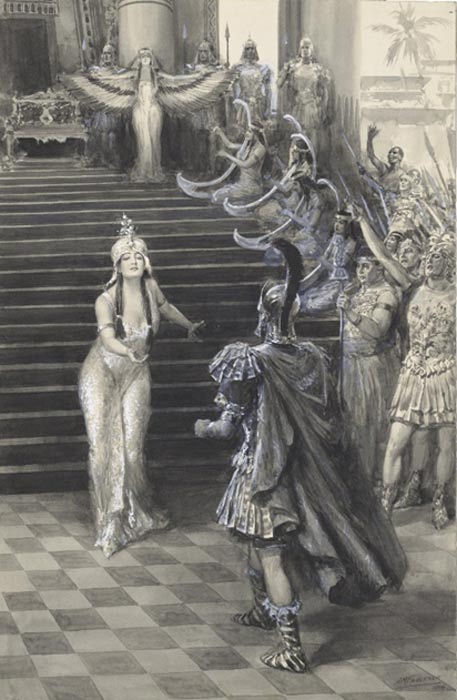
Cleopatra Meet Julius Caesar, Falkner: Public Domain

Cleopatra, on her part, unknown to Antony, sent to him (Octavian) a golden sceptre and a golden crown together with the royal throne, signifying that through them she offered him the kingdom as well; for she hoped that even if he did hate Antony, he would yet take pity on her at least. Caesar accepted her gifts as a good omen, but made no answer to Antony; to Cleopatra, however, although he publicly sent threatening messages, including the announcement that, if she would give up her armed forces and renounce her sovereignty, he would consider what ought to be done in her case, he secretly sent word that, if she would kill Antony, he would grant her pardon and leave her realm inviolate.

‘Upon hearing from the envoys the demands which Caesar made of them, sent to him again. Cleopatra promised to give him large amounts of money. Antony reminded him of their friendship and kinship, made a defence also of his connexion with the Egyptian woman, and recounted all the amorous adventures and youthful pranks which they had shared together. Finally, he surrendered to him Publius Turullius, who was a senator and one of the assassins of Caesar and was then living with Antony as a friend; and he offered to take his own life if in that way Cleopatra might be saved.

Caesar put Turullius to death, but this time also he gave no answer to Antony. So Antony despatched the third embassy, sending him his son Antyllus with much gold. Caesar accepted the money but sent the boy back empty-handed, giving him no answer. To Cleopatra, Octavian sent many threats and promises of love and loyalty alike, hoping to prevent her from destroying or absconding with the mountain of money she had stacked up in her tomb.
In the meantime, Octavian’s army proceeded to take the city of Pelusium in the delta. But believing Octavian’s protestations of affection, Cleopatra forbade the Alexandrians to rise against him, and so he took Alexandria as well. She clearly expected forgiveness, according to Cassius.

Antony, we are told, took refuge in his fleet and was preparing to give battle on the sea or, at any rate, to sail to Spain. When Cleopatra heard he was taking her ships, she ordered her sailors to desert and moved into her tomb, saying she feared Caesar and would thus take her own life. Cassius interprets this move as an act of betrayal to Antony. According to Cassius, Cleopatra’s cry for help would either make Antony rush to her side where she would kill him, or he would kill himself if he heard she had taken her own life. Either way, the wicked Cleopatra would ensure the end of the once noble Antony.

Cassius tells us that Antony went to the tomb dripping with blood because he had stabbed himself in the stomach when a friend refused to kill him. An implausible scenario, if you ask me. Why stab yourself before you go to rescue your wife and the mother of your children? Nevertheless, Cassius asks us to believe this and also that Antony died in Cleopatra’s arms in her tomb while she waited for Octavius to forgive her.

She embalmed Antony’s body and buried him. Then we are told Octavius removed anything she could use to kill herself from her apartment because he wanted her alive. A couple of sentences later, Cassius describes how Cleopatra redecorated the apartment, added a golden couch and draped herself upon it invitingly, thus ignoring her duty of mourning her dead husband, Antony. In Cassius’ eyes, Cleopatra was a fully paid up scheming slut.

Cleopatra, we are told, convinced Octavius she would travel to Rome with him while she planned her own demise. Her plan was to die as painlessly as possible. Cassius clearly thought she was a coward too. After putting on her best clothes and draping herself in symbols of royalty, she lay on her golden coach and killed herself.

Conclusions

The balance of evidence from the texts suggests Cleopatra died by her own hand. Such as death would have been perfectly acceptable and even honourable for a defeated queen in Egypt and in Rome.

In Doi’s version of her death, which is the most detailed, all the men are portrayed more honourably than her. This is the same Roman attitude to women who were considered to have transgressed sexually and betrayed their Imperial husbands as we see applied to Empress Messalina. It is straight forward misogyny.

A respectable woman in ancient Rome was required to keep a low profile. Women were supposed to be defined by their husbands, fathers, and sons. They were required to live faithful uncomplaining lives. Modesty and fidelity were the foremost virtues of a Roman woman – virtues Cleopatra clearly did not believe in either because she was not Roman or most probably because she was a queen in her own right and not a consort.

Whenever a Roman woman went out, assuming she was of noble birth, she would be chaperoned by slaves. She had to cover her body in a long gown called a stola, including her face. Over it, she wore a ‘palla’ or cloak. Indeed until the reign of Octavius Augustus, there were no statues of women at all. A noblewoman’s body was no business of anyone else except her husband. And, no respectable Roman woman would dare to be found lying around half-dress on a golden couch, especially when she was supposed to be mourning for her dead husband!

Valerius Maximus, writing in the century after Cleopatra’s death, gives several examples of errant women being ‘punished’ by their husbands. Egnatius Metellus, he tells us, bludgeoned his wife to death merely for drinking wine. Valerius tells his readers that far from being charged with murder, he received no public censure. According to Valerius, women needed to be kept under male control to stop them from scheming, as did Marcus Porcius Cato, otherwise known as Cato the Censor. [7]

It is possible Octavius might have paraded her at his triumph but unlikely. Working on the basis Cleopatra was not a ‘savage’ Gaul like Vertingeterex; and that she was the vanquished queen of the most culturally advanced nation on earth when she died, it is unlikely Augustus would have humiliated her. However, she was not a good example, so it was open season on her reputation for authors like Dio, whether she had died at her own hand or from a gnat bite.

Cleopatra - Waterhouse, Public Domain.

Sources

[1] LA Times, MIMI MANN, MARCH 15, 1992 12 AM PT
[2] Attitudes Toward Death and Suicide, HANKOFF L D, 1975, Pharos of Alpha Omega Alpha, v.38, no.2, (April 1975), p.60-64,75, SIEC No: 19840001
[3] Plutarch’s Lives, Tufts University.
[4] Livy, Periochae Book 133
[5] https://www.ancient-literature.com/rome_horace_odes_1_37.html#:~:text=%E2%80%9CNunc%20est%20bibendum%E2%80%9D%20(%E2%80%9C,Odes%E2%80%9D%20or%20%E2%80%9CCarmina%E2%80%9D.
[6] DIO’S ROMAN HISTORY, Book 51, THE LOEB CLASSICAL LIBRARY VI.
[7] Robert Garland, PhD, Colgate University, The Other Side of History: The Ideal Roman Woman, Great Courses Daily, 2021.


Academia.com Go to Bookshop Find me on Facebook Find me on Quora Find me on Linkedin

See Julia’s new book: Bedroom Diplomacy
Questions in Egyptology:

Questions in Egyptology 5: What was the punishment for Ancient Egyptians if caught tomb-robbing?

Questions in Egyptology No. 4: Did the Ancient Egyptians Have a Religion?

Questions in Egyptology No 3. Did the Egyptians Influence the Greeks?


Questions in Egyptology No. 2: How Long Did it Take to Mummify a Pharaoh?

Ancient Egypt - Cheapskate Coffin Makers


Questions in Egyptology 8: Who was Babi / Baba?

Questions in Egyptology 8: Who was Babi / Baba?

Who was Babi or Baba?

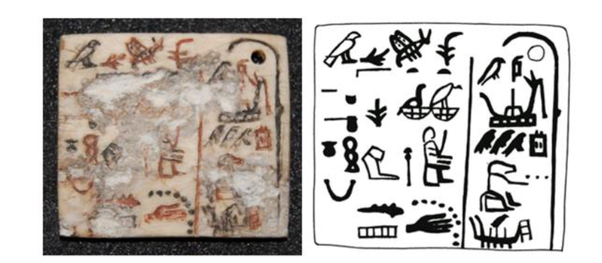
Babi or Baba, the ‘Bull of the Baboons’ was an early version of Thoth. The earliest evidence of the worship of Babi and baboons comes from Early Dynastic ivory tags. He is depicted as a white-backed baboon.

Ivory label of Semerkhet, Dynasty One, Abydos. Image of Babi the Baboon seated under three hawks - bottom right.

Tell Ibrahim Awad

Excavations in the Delta at Tell Ibrahim Awad, have uncovered evidence of Babi/Thoth or baboon worship dating to the 2nd Dynasty. A small fiance statue of seven baboons in one boat was found along with numerous other fragments of statues dedicated to Babi and Thoth.[1]

The Man in the Moon

Babi’s face was said to be that of the Man in the Moon, but he was not a friendly avuncular figure made of cheese. The ‘Great White One’ was the leader of the troop, the alpha male of the pack, and was thought by the ancient Egyptians to be an incarnation of a long-dead ancestor of a bloodthirsty and angry king who lived on the entrails of the unrighteous dead. His ghostly countenance was a reminder of the king’s wraithlike ancestors.


The Great White One - the Man in the Moon

Old Kingdom

In the Old Kingdom Pyramid Texts, the phallus of the ‘Bull of the Baboons Babi’ is described as the door-bolt of the sky. So Babi was the god who opened and closed the gate to the heavens. Later in the same text, we find the deceased king identifying himself with Babi and the moon calling himself, ‘Lord of the night sky.’

He is described as having red ears and purple hindquarters and living on the entrails of his enemies.

Image: Ancient Origins

Babi the Ferryman

The phallus of Babi, “which creates children and begets calves” is the mast of the netherworld ferry-boat in Coffin Text spell 397, and several other parts of the boat are identified with him in Spell 398. Babi’s body is the boat and his phallus the mast. His crew is the netherworld fishermen who catch the deceased with their nets. The god Mahaf, the one who looks backward, is the leader of the fishermen’ who threaten to trap the dead in their nets. It is therefore vital the deceased know the names of the parts of Babi’s boat. This secret knowledge appeases the bloodthirsty god and enables the lost soul to escape his fishermen’s evil clutches.

The Baboons of the West

The West in ancient Egypt was the place of the setting sun and of death, and the baboons of the west are connected with death. Thoth was the Foremost of the Westerners and Hathor the Lady of the West. In the Old Kingdom Pyramid Texts, the phallus of the ‘Bull of the Baboons Babi’ is described as the door-bolt of the sky. Images of squatting baboons appear in many tomb vignettes including in the famous tomb of Thutmoses III in the Valley of the Kings (tomb KV34). In Thutmoses III’s crypt, nine baboons appear at the beginning of the lower register of the Book of the Amduat or Hidden Chamber painted on its walls, they are the welcoming party for the sun as it enters the underworld. They are the baboons of the west who guard the western door to the akhet or horizon. Images of baboons and the mummified remains of baboons have been found in many New Kingdom tombs as for example in tomb KV 50 in the Valley of the Kings. Here the preserved bodies of a young baboon and a hunting dog were buried with the tomb owner either as pets or as sacred sacrifices to show the deceased the way to the afterlife.[3] As a devourer of the souls of the wicked, Babi resided near a lake of flame in the underworld.

Virility and Life

The baboon being an animal with a noticeably high sex drive and prominent genital markings connected Babi with male virility, particularly with the potency of the dead. This is an unusual concept for us today, but to the ancient Egyptians, it made sense, well to the men at least. Coffin Text Spell 304 promises the deceased that any woman who comes under this spell will make themselves available to the deceased for sex day or night.

Egyptian statuette of Osiris with phallus and amulets. Wikipedia.

Such incantations were vital to the ancient Egyptian dead because the ability to perform the sex act after death was a sure sign that the dead were fully alive in the afterlife and also protected a man’s social status in the world of the dead, which was remarkably similar to the world of the living.

Later in the same text, we find the deceased king identifying himself with Babi and the moon calling himself, ‘Lord of the night sky.’ In Coffin Text 822, the dead king claims to be the phallus of Babi, and in CT 359 the king claims to be Babi, the oldest son of Osiris the first mythical king of Egypt.

So, right from the start, Babi or Thoth was associated with the dead king, guarding the entrance to the afterlife, the moon, and the mythical king Osiris.

University of Kent - Academia.edu

The Numbers of Thoth


Sources:

Primates of Ancient Egypt: The Deification and Importance of Baboons and Monkeys—Part I

Baboons in Ancient Egyptian Art, Helena Pio, Stellenboch University.

[1] Egyptology at the Dawn of the Twenty-first Century: Proceedings of …, Volume 2 By INTERNATIONAL CONGRESS OF EGYPTOLOGISTS, Lyla Pinch Broc

[3] J. Murnane, William & Ikram, Salima & Dodson, Aidan. (2000). The Mummy in Ancient Egypt: Equipping the Dead for Eternity. Journal of the American Oriental Society. 120. 97. 10.2307/604889.

[4] Pyramid Text 1349.


Also available:

Questions in Egyptology 6: Did Anubis Have a Magic Eye?

Questions in Egyptology 5: What was the punishment for Ancient Egyptians if caught tomb-robbing?

Questions in Egyptology No. 4: Did the Ancient Egyptians Have a Religion?

Questions in Egyptology No 3. Did the Egyptians Influence the Greeks?

Questions in Egyptology No. 2: How Long Did it Take to Mummify a Pharaoh?
Ancient Egypt - Cheapskate Coffin Makers

Questions in Egyptology 7: Did the Ancient Egyptians go to Sea?

Questions in Egyptology 7: Did the Ancient Egyptians go to Sea?

Advertisement - New Mini-history of Champollion by Julia Herdman


Buy Now


Did the Ancient Egyptians go to Sea?

Plutarch tells us that the ancient Egyptians equated the seas with Typhon, the Greek version of the Egyptian god of chaos Seth. Having said that, some ancient Egyptian mariners must have sailed along the coast from time to time to get wood, notably cedarwood.

Egyptian manufactures dating to the 5the millennium BCE or Badarian culture, have been found as far north as Syria and the archaeological record shows that the predynastic Maadi were importing pottery as well as construction ideas from Canaan a thousand years later. Whether these ideas and trade came to Egypt over land or over the sea is still an unanswered question.

Shipbuilding was known to the Ancient Egyptians as early as 3000 BCE and perhaps earlier. The ancient Egyptians knew how to assemble planks of wood to form a ship’s hull. They used woven straps to lash the planks together and stuffed the gaps with reed and grass caulking. The Archaeological Institute of America reports that the first ship found to date was probably constructed for the Pharaoh Aha around 3000 BCE and was 75 feet long.

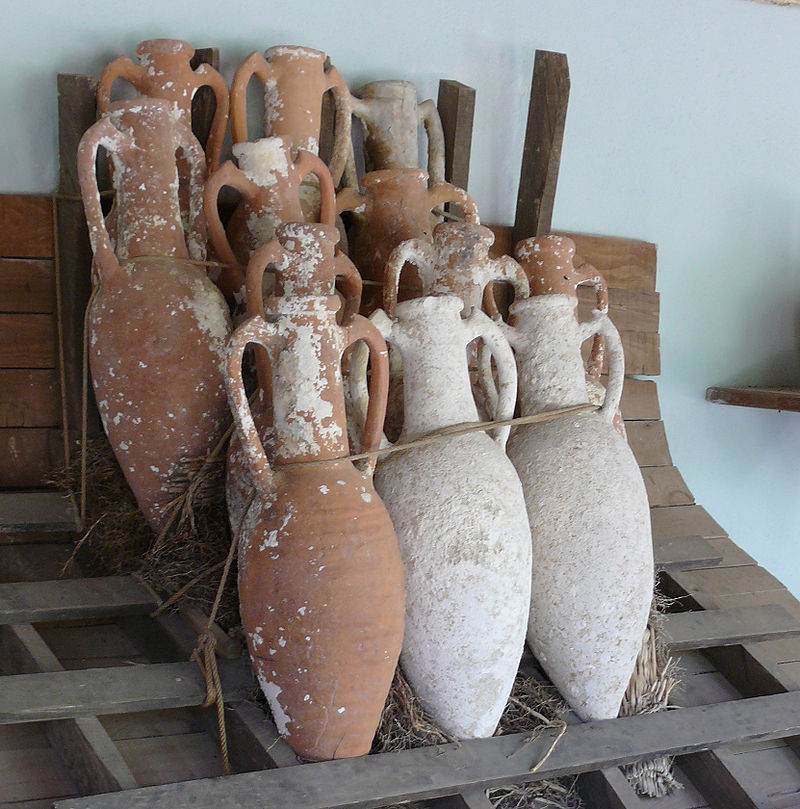
Evidence also suggests an Egyptian colony existed in southern Canaan in the First Dynasty. In 1994, excavators discovered an incised ceramic shard with the serekh sign of Narmer, dating to c. 3000 BCE. Mineralogical studies reveal the shard to be a fragment of a wine jar exported from the Nile valley to Palestine. Due to Egypt’s climate, wine was very rare and nearly impossible to produce so the wine probably came from Greece showing there were trade links to ancient Greece and the Greek island cultures.

Photograph of Greek wine amphora by Ad Meskens Amphorae stacking.jpg

The Old & Middle Kingdoms

The Palermo Stone records that to build his pyramids Pharaoh Sneferu commissioned the building of Tuataua, ships of mer wood of a hundred capacity, and the capture of 60 royal boats of sixteen capacity and of the bringing of forty ships of cedarwood (or perhaps “laden with cedarwood”). The wood was most probably from Byblos, or Phenicia, modern-day Lebonan.

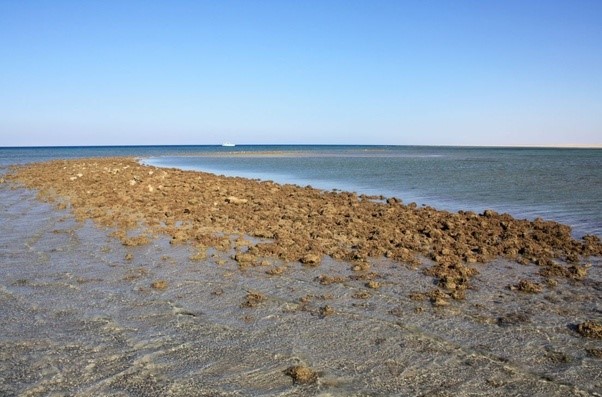
Recent discoveries on the Red Sea also indicate that ancient Egyptians did go to sea. They headed east in their quest for material for their royal projects. The remains of an enormous harbour were discovered under the waves by members of the French Institute of Archaeology in Cairo and the Sorbonne University at Wadi el-Jarf in 2014. The remains have been dated to 4,600 years ago. That is to the time of Khufu, the builder of the Great Pyramid of Giza who reigned from 2580 to 2550 B.C.E.

Detail of Cheops’ harbour jetty after excavations, near Wadi el-Jarf.

Note the remains of the L-shaped bank or wall extending into the sea. Pierre Tallet

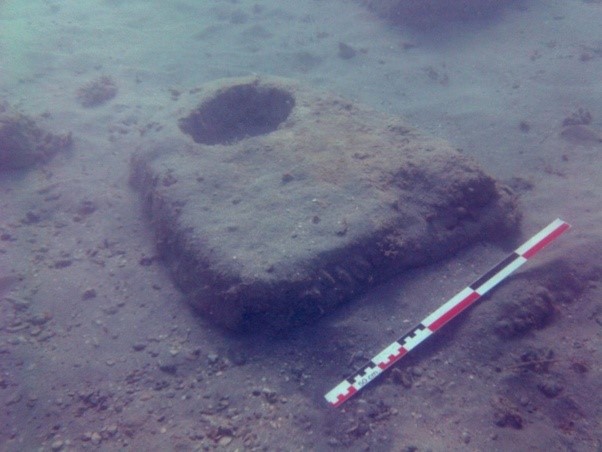
Khufu’s Red Sea harbour was 180 kilometres south of Suez, in the foothills of the desert mountains. More evidence supporting the idea that the ancient Egyptians went to see can was found on the seafloor. The site includes several stone sea anchors for boats that have long since perished.

Sea anchor: Pierre Tallet

Over the next millennia, the ancient Egyptians traded briskly with peoples around the region, operating from coastal towns on both the Red Sea and the Mediterranean. (Ancient Egyptian wares have been found as far north as Scandinavia but could have reached there through intermediaries in Europe.

So, we know that by the Old Kingdom, the Egyptian kings were authorising royal trading expeditions, endorsing centralised religious ideologies, and using royal favours to distribute status goods and services. Egyptian sea power remained strong throughout the Old Kingdom period.

The Ancient Egyptian term for sailors,seqedu, may specifically refer to those men experienced using the sails. Terms such as nefeu, ist, and aper are generic terms for the crew. The sailors (or recruits) were also called uau, which applies equally to the army as to maritime service. The New Kingdom sailors are shown wearing a leather loincloth designed to provide some cushioning when rowing. A finely made leather loincloth, probably used for parades, was found in the tomb of a fan-bearer named Mayherpery. It seems that the Egyptians had a ‘navy’ of some description. Indeed, the variety of Egyptian terms in use shows that the Ancient Egyptians operated in a sophisticated maritime environment and that their nautical knowledge was quite broad. For instance, the Egyptian term for navigator was nefuu. The word for helmsman was hemu or iry-hemyt, and a ship’s guardian was the sau. The transport officer was themeshekebu. The oarsmen were the khenyt, and the man at the prow or lookout was known at the iry hat (literally ‘the one who is at the head’).

The New Kingdom

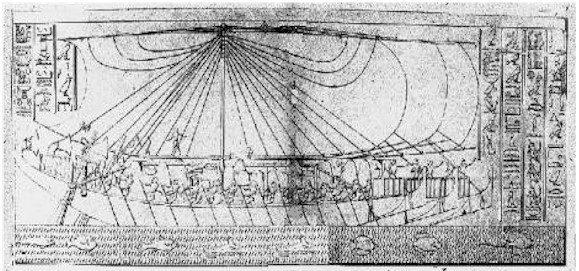
The female Pharaoh Hapshetsut’s tomb art depicts a fantastic sea adventure. Dated to 1,480 B.C., the story recorded in her temple tells that Hapshetsut consulted her gods and was told to follow in the footsteps of her ancestors and re-establish old trading associations that had fallen into the hands of middlemen.” In this inscription, new titles appear, in addition to some of the earlier ones, ‘fleet captain’, ‘captain of the ships of the king’, ‘captain of galleys’, ‘ship’s captain’, ‘captains of marines’ (literally ‘captain of the ship archers’), ‘officer of the ships’, ‘officer of marines’, ‘standard-bearer of the ship’, ‘standard-bearer of the Marines’, ‘commander of the rowers’, ‘chief of the rowers’, ‘ship archers’, and many more appear for the first time.

Hatshepsut’s tomb art.

Modern Reconstruction

CHERYL WARD, a maritime archaeologist, recreated an Egyptian ship of these old times, around 3,800 years ago, using traditional materials and local artisans. They succeeded in launching her and navigating down the Red Sea for a considerable way.

Later, Egypt would enter into alliances with the leaders of the great seafaring nation of the Greeks to counter the power of the Persians.

It seems that the ancient Egyptians always had a relationship with the sea, the Mediterranean, and the Red Sea. It was a relationship that brought them trade and wealth. As sailors, they were always more comfortable on their river, which is understandable because the sea is far more treacherous and unpredictable than any river.

Sources:

Wikipedia, ANCIENT EGYPTIAN SEAPOWER AND THE ORIGIN OF MARITIME FORCES By Gregory P. Gilbert,

Naomi Porat and Edwin van den Brink (editor), “An Egyptian Colony in Southern Palestine During the Late Predynastic to Early Dynastic,” in The Nile Delta in Transition: 4th to 3rd Millennium BC(1992), pp. 433–440

Naomi Porat, “Local Industry of Egyptian Pottery in Southern Palestine During the Early Bronze I Period,” in Bulletin of the Egyptological, Seminar 8 (1986/1987), pp. 109–129. See also University College London web post, 2

Homan, Michael (2004). “Beer and Its Drinkers: An Ancient near Eastern Love Story”. Near Eastern Archaeology. 67 (2): 87. doi:10.2307/4132364. JSTOR 4132364.

Ward, Cheryl. “World’s Oldest Planked Boats“, in Archaeology (Volume 54, Number 3, May/June 2001).Archaeological Institute of America.

Divers uncover world’s oldest harbor, in Red Sea, https://www.britishmuseum.org/PDF/Ward.pdf


Academia.com Go to Bookshop Find me on Facebook Find me on Quora Find me on Linkedin

More Questions In Egyptology Considered:

Questions in Egyptology 6: Did Anubis Have a Magic Eye?

Questions in Egyptology 5: What was the punishment for Ancient Egyptians if caught tomb-robbing?

Questions in Egyptology No. 4: Did the Ancient Egyptians Have a Religion?

Questions in Egyptology No 3. Did the Egyptians Influence the Greeks?

Questions in Egyptology No. 2: How Long Did it Take to Mummify a Pharaoh?

Questions in Egyptology No. 1 - The Cartouche - what did it protect?

Questions in Egyptology No. 2: How Long Did it Take to Mummify a Pharaoh?
Questions in Egyptology No. 2: How Long Did it Take to Mummify a Pharaoh?
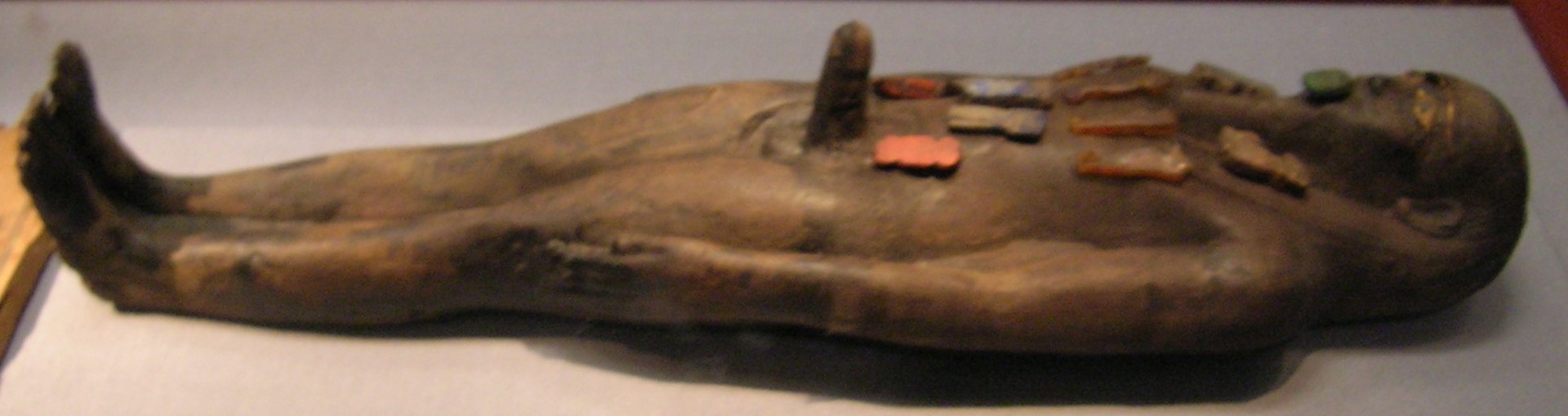
How Long Did it Take to Mummify a Pharaoh?

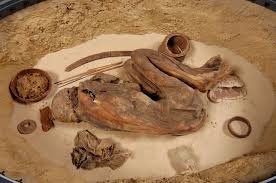
The preservation of the body, or mummifying, was an essential part of ancient Egyptian funerary belief and practice. The burial customs began with wrapping the body either in a mat or animal skin to prevent direct contact with the sand and to hold the parts of the body together.

The ancient Egyptians were terrified of the disintegration of the body. The hot sand drew out the body’s liquids to aid its preservation. This kind of preservation is known as “natural mummification,” meaning that preservation was carried out without human intervention.

Natural mummification

The practice of embalming or mummifying aimed to improve on what nature could do on its own. It was considered essential to mummify a Pharaoh. Early mummification involved the wrapping of specific parts of the body such as the face and hands. The best literary account of the mummification process is given by Herodotus, an ancient Greek historian. He records that the entire process took seventy days. There were 30 days of evisceration and drying and 40 days of perfecting with stuffing and embalming with oils.

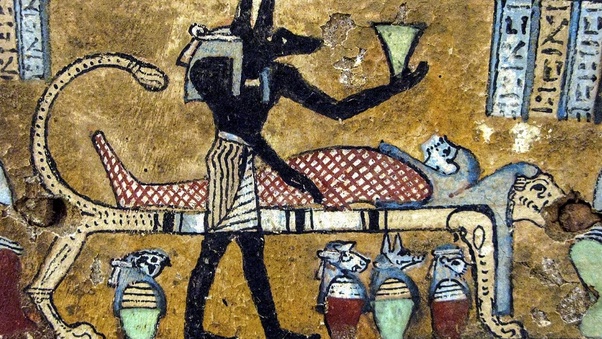
Anubis, with the deceased on the lion bed of resurrections, beneath the four canopic jars face right, Anubis offers a libation.

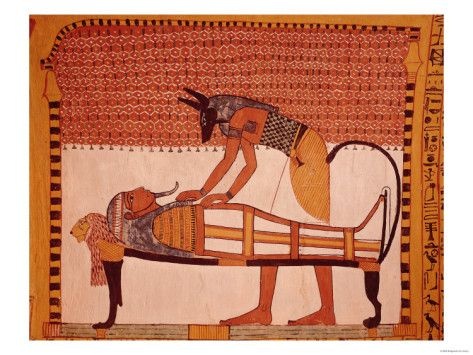
Anubis was the god responsible for embalming, especially for the Pharaoh. The Pyramid Texts describe Anubis as the Pharaoh’s (Osiris’s) embalmer. “His entrails having been washed by Anubis; the services of Horus having been served in Abydos, [even] the embalming of Osiris”It is clear from this passage that the god Anubis had responsibility for washing the viscera of the deceased king. Egyptologist Bob Brier (1996) has suggested that embalming took place in a tent that was erected on the top of a hill away from the unpleasant smell that resulted from the process of treating the dead bodies. This suggestion is based on the titles of god Anubis that often occur in the offering formulae and the Pyramid Texts “Anubis, who presides in the sh-ntr” (896c), his tent. “He who is upon his hill (tp dw.f). the sh-ntr, which is translated as a “divine booth” (Wb. III, 465), was the place where the bodies of the kings were purified. The tent is described in various texts. it had a number of rooms, the central part of the tent was the place where the purification procedures were carried out. The doorways were shown as closed wooden doors (Merrewka), or curtains as in the tomb of Qar, or they were left open as in the tomb of Idu. There was a central ramp: In each tent, there was a central ramp, which connected the tent to a water channel.

Anubis mummifies the Pharaoh in his tent.

To mummify the body, the internal organs, apart from the heart and kidneys, were removed via a cut in the left side. The organs were dried and wrapped and placed in canopic jars, or later replaced inside the body. The brain was removed, often through the nose, and discarded. Texts suggest that the heart was removed during the Old Kingdom, although there is no proof this from the physical bodies. In a passage in the Pyramid Texts, the heart is removed from the body. The passage (1162a), which might be referring to putting a heart amulet in place of the original heart, reads: “To say: my father made for himself his heart, after the other (heart) was taken from him” In this passage, the word “other” could be a reference either to the god giving another heart to the deceased, or providing a heart amulet in its place.

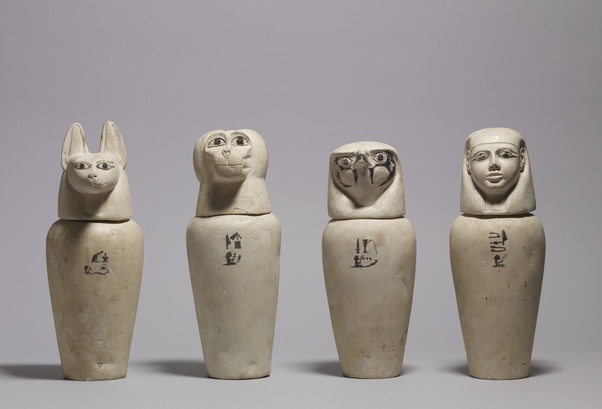
The canopic jars.

Bags of natron or salt were packed both inside and outside the body and left for forty days until all the moisture had been removed from the remaining body tissue. The body was then cleansed with aromatic oils and resins and wrapped with bandages, often household linen torn into strips. Between the layers of wrapping, the embalmers place amulets to protect the deceased. Heart scarabs were placed in the wrappings with the mummy. They had spells carved on them to protect the deceased person’s heart from being lost or separated from the body in the underworld.

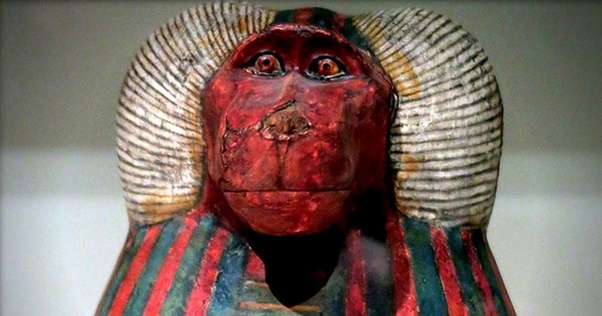
The canopic jars were used to store the soft tissue. “Anubis, who is the chief of the divine booth (sh-ntr), has commanded thy purification with thy eight nmst-jars and [thy] eight ‘3bt-jars, which come from the sh-ntr ” (2012b-c ). By the New Kingdom, there were only four jars. The lids of canopic jars represented gods called the ‘four sons of Horus’. These gods protected internal organs. Duamutef the jackal-headed god looks after the stomach Hapy the baboon-headed god looks after the lungs Imsety the human-headed god looks after the liver. Qebehsenuef the falcon-headed god looks after the intestines.

Scientific analysis of mummies using processes such as X-ray and CT scanning has revealed a wealth of information about how individuals lived and died. It has been possible to identify conditions such as lung cancer, osteoarthritis and tuberculosis, as well as parasitic disorders.

Sources:

British Museum website, Mummification in The Old Kingdom By Ahmed Saleh and, #ancientegypt #ancienthistory #anubis #pyramids #mummification #ancientegyptianmummies

Academia.com Go to Bookshop Find me on Facebook Find me on Quora Find me on Linkedin

Champollion By Julia Herdman

Buy Now

See Also:

Questions in Egyptology 6: Did Anubis Have a Magic Eye?

Questions in Egyptology 5: What was the punishment for Ancient Egyptians if caught tomb-robbing?

Questions in Egyptology No. 4: Did the Ancient Egyptians Have a Religion?

Questions in Egyptology No 3. Did the Egyptians Influence the Greeks?

Questions in Egyptology No. 2: How Long Did it Take to Mummify a Pharaoh?