
The Death of Cleopatra
Cleopatra’s Final Days: A Tragic Tale of Power and Betrayal
Cleopatra VII, the last Pharaoh of Egypt, is one of history’s most captivating figures. Known for her intelligence, charm, and political acumen, Cleopatra’s life was filled with dramatic turns. Yet, her death remains shrouded in mystery and intrigue. Was it suicide, murder, or a carefully orchestrated plan? Let’s delve into the final chapter of Cleopatra’s life and explore the theories surrounding her demise.
The Political Landscape: Rome’s Shadow Over Egypt
By 30 BCE, Cleopatra’s fate was intertwined with Rome’s rise. Her position became precarious after her lover, Mark Antony, was defeated at the Battle of Actium. Octavian, the future Augustus, was determined to consolidate his power. Cleopatra knew that her defeat would mean the end of Egypt’s independence. With her kingdom threatened, she faced a difficult choice.
Conflicting Historical Accounts
Cleopatra’s death has been debated since antiquity. Greek and Roman historians such as Plutarch, Livy, and Cassius Dio provided varying interpretations of the events leading to her death. Some accounts suggest she committed suicide to avoid the shame of being paraded as a prisoner in Octavian’s triumph. Others hint at a more complex series of events, possibly influenced by Roman political agendas.
Cleopatra’s Death: Suicide or Murder?
According to historical accounts, Cleopatra chose to take her own life rather than be paraded as a trophy in Rome. The traditional story suggests she used a venomous snake, likely an asp, to commit suicide. However, some historians question this narrative. They argue that Octavian might have killed her to prevent any potential rebellion. The exact method of her death remains a topic of debate, adding to the enigma of her life.
Suicide: An Uncommon Act in Ancient Egypt
Suicide was virtually unheard of in ancient Egypt, adding to the intrigue of Cleopatra’s death. Unlike in Rome, where suicide could be seen as a means of preserving honour, Egyptians generally did not view suicide as a moral or legal option. Literary texts like Desperate from Life indicate that while some Egyptians considered suicide in extreme circumstances, it was not a common practice. Cleopatra’s choice, therefore, stands out as an extraordinary decision for an Egyptian ruler.
Cleopatra’s Possible Motivations
Cleopatra was known for her intelligence and strategic thinking. Faced with the prospect of being humiliated by Octavian, it is plausible that she saw suicide as the only way to maintain her dignity. By choosing death, Cleopatra could preserve her legacy and avoid being a mere trophy in Rome’s victory parade. This act could be seen as a final assertion of her power and autonomy, even in defeat.
The Puzzling Circumstances of Her Death
The details of Cleopatra’s death remain shrouded in mystery. Plutarch’s account describes a death by snakebite, possibly from an asp, though other sources suggest different methods. Whether she died from a venomous bite or ingested poison, the lack of definitive evidence leaves room for speculation. What remains clear is that Cleopatra’s death was a carefully planned act, intended to leave a lasting impression.
A Legacy Wrapped in Mystery
Cleopatra’s death continues to be a topic of fascination and debate. The conflicting accounts and the unique nature of suicide in ancient Egypt add layers of complexity to her story. Whether she died to avoid humiliation or as a final act of defiance, Cleopatra’s death reflects the power dynamics and cultural values of her time. As historians continue to explore her life and death, Cleopatra remains a symbol of mystery, power, and enduring intrigue.
The Classical Accounts: A Mix of Fact and Fiction
The accounts of Cleopatra’s death, provided by classical historians, vary significantly, contributing to the ongoing mystery. Plutarch, one of the most detailed sources, offers a dramatic narrative, describing how Cleopatra allowed an asp to bite her, leading to her death. This account is filled with symbolic imagery, suggesting that Cleopatra’s death was as much a political statement as it was a personal choice.
Livy, another historian, offers a more straightforward version, stating that Cleopatra took her own life to avoid capture. Cassius Dio, however, provides a more cynical view, portraying Cleopatra as a manipulative figure who used her death to secure a final act of defiance against Octavian. Each account, while differing in details, points to a common theme: Cleopatra’s desire to control her fate in the face of inevitable defeat.
Cleopatra’s Final Hours: A Carefully Crafted Exit
Cleopatra’s death was not a spur-of-the-moment decision. Historical accounts suggest that she prepared meticulously for her final act. She dressed in her finest royal garments, adorned herself with symbols of power, and arranged for a golden couch on which she would lay. This attention to detail underscores Cleopatra’s intent to die as a queen, maintaining her royal dignity to the very end.
The presence of her loyal servants, Iras and Charmion, who also died with her, further highlights the ceremonial nature of her death. This act of solidarity, where her closest attendants chose to die alongside their queen, adds another layer of complexity to the event, emphasizing the strong bonds of loyalty and the shared belief in the righteousness of Cleopatra’s decision.
The Aftermath: Cleopatra’s Legacy
After Cleopatra’s death, Octavian, later known as Augustus, reportedly admired her spirit, though he had little choice but to portray her as a defeated enemy. Cleopatra was buried alongside Mark Antony, in a tomb befitting their status. However, her death marked the end of Ptolemaic rule in Egypt and the beginning of Egypt’s integration into the Roman Empire.
Despite Roman propaganda efforts to tarnish her image, Cleopatra’s legacy endured. She became a symbol of a powerful, intelligent, and ambitious woman who navigated the treacherous waters of international politics with skill and determination. Her death, while tragic, was also a final act of sovereignty, ensuring that she would be remembered on her terms.
Conclusion: The Enduring Mystery of Cleopatra’s Death
The death of Cleopatra remains one of the most debated events in ancient history. Whether seen as a noble sacrifice, a strategic move, or an act of despair, Cleopatra’s final moments were a culmination of her life’s work as a ruler, strategist, and woman of immense influence. Her death, like her life, was shrouded in mystery, leaving a legacy that continues to captivate and inspire.
Cleopatra’s story is a testament to the complexities of power, the weight of legacy, and the human desire to control one’s destiny. As historians continue to piece together the fragments of her life and death, Cleopatra remains an iconic figure whose story transcends time, embodying the enduring allure of ancient Egypt and the enigmatic nature of one of history’s most powerful women.

Juan Luna de San Pedro y Novicio Ancheta Public Domain.

The Death of Cleopatra, Guido Cagnacci, Met Museum, Public Domain.
 John Collier, Prado, Madrid. Public Domain.

The Death of Cleopatra, Arthur Reginald Smith, Public Domain.
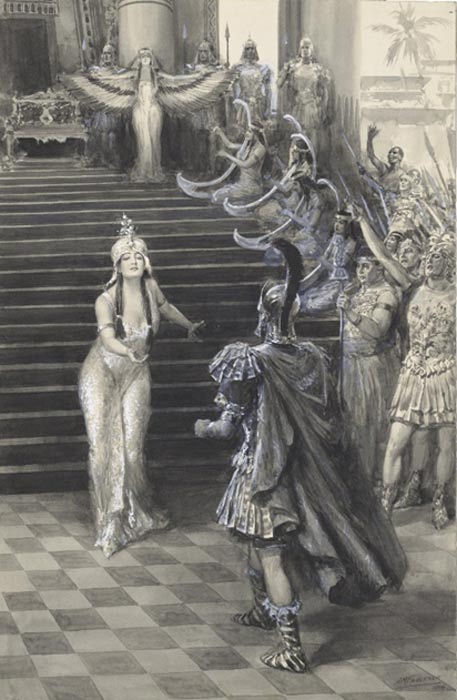
Cleopatra Meet Julius Caesar, Falkner: Public Domain

Cleopatra - Waterhouse, Public Domain.
Sources
[1] LA Times, MIMI MANN, MARCH 15, 1992 12 AM PT
[2] Attitudes Toward Death and Suicide, HANKOFF L D, 1975, Pharos of Alpha Omega Alpha, v.38, no.2, (April 1975), p.60-64,75, SIEC No: 19840001
[3] Plutarch’s Lives, Tufts University.
[4] Livy, Periochae Book 133
[5] https://www.ancient-literature.com/rome_horace_odes_1_37.html#:~:text=%E2%80%9CNunc%20est%20bibendum%E2%80%9D%20(%E2%80%9C,Odes%E2%80%9D%20or%20%E2%80%9CCarmina%E2%80%9D.
[6] DIO’S ROMAN HISTORY, Book 51, THE LOEB CLASSICAL LIBRARY VI.
[7] Robert Garland, PhD, Colgate University, The Other Side of History: The Ideal Roman Woman, Great Courses Daily, 2021.
[maxbutton id=”7″ ] [maxbutton id=”6″ ] [maxbutton id=”5″ ] [maxbutton id=”4″ ] [maxbutton id=”3″ ]
See Julia’s new book: Bedroom Diplomacy

Questions in Egyptology:
Recent Comments