
Advertisement - New Mini-history of Champollion by Julia Herdman

Buy Now
Did the Ancient Egyptians go to Sea?
Plutarch tells us that the ancient Egyptians equated the seas with Typhon, the Greek version of the Egyptian god of chaos Seth. Having said that, some ancient Egyptian mariners must have sailed along the coast from time to time to get wood, notably cedarwood.
Egyptian manufactures dating to the 5the millennium BCE or Badarian culture, have been found as far north as Syria and the archaeological record shows that the predynastic Maadi were importing pottery as well as construction ideas from Canaan a thousand years later. Whether these ideas and trade came to Egypt over land or over the sea is still an unanswered question.
Shipbuilding was known to the Ancient Egyptians as early as 3000 BCE and perhaps earlier. The ancient Egyptians knew how to assemble planks of wood to form a ship’s hull. They used woven straps to lash the planks together and stuffed the gaps with reed and grass caulking. The Archaeological Institute of America reports that the first ship found to date was probably constructed for the Pharaoh Aha around 3000 BCE and was 75 feet long.
Evidence also suggests an Egyptian colony existed in southern Canaan in the First Dynasty. In 1994, excavators discovered an incised ceramic shard with the serekh sign of Narmer, dating to c. 3000 BCE. Mineralogical studies reveal the shard to be a fragment of a wine jar exported from the Nile valley to Palestine. Due to Egypt’s climate, wine was very rare and nearly impossible to produce so the wine probably came from Greece showing there were trade links to ancient Greece and the Greek island cultures.
Photograph of Greek wine amphora by Ad Meskens 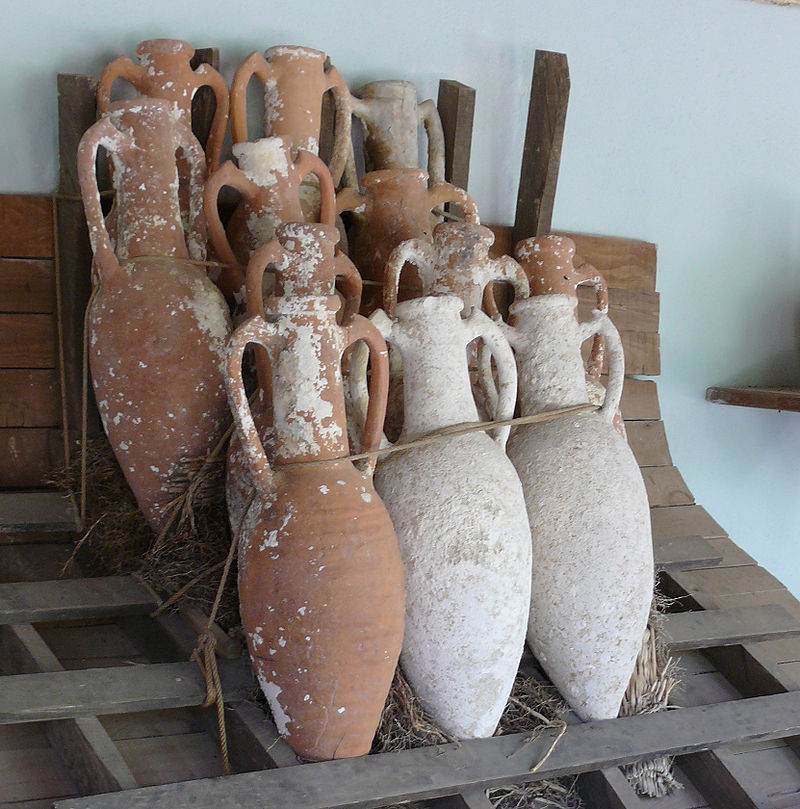
The Old & Middle Kingdoms
The Palermo Stone records that to build his pyramids Pharaoh Sneferu commissioned the building of Tuataua, ships of mer wood of a hundred capacity, and the capture of 60 royal boats of sixteen capacity and of the bringing of forty ships of cedarwood (or perhaps “laden with cedarwood”). The wood was most probably from Byblos, or Phenicia, modern-day Lebonan.
Recent discoveries on the Red Sea also indicate that ancient Egyptians did go to sea. They headed east in their quest for material for their royal projects. The remains of an enormous harbour were discovered under the waves by members of the French Institute of Archaeology in Cairo and the Sorbonne University at Wadi el-Jarf in 2014. The remains have been dated to 4,600 years ago. That is to the time of Khufu, the builder of the Great Pyramid of Giza who reigned from 2580 to 2550 B.C.E.
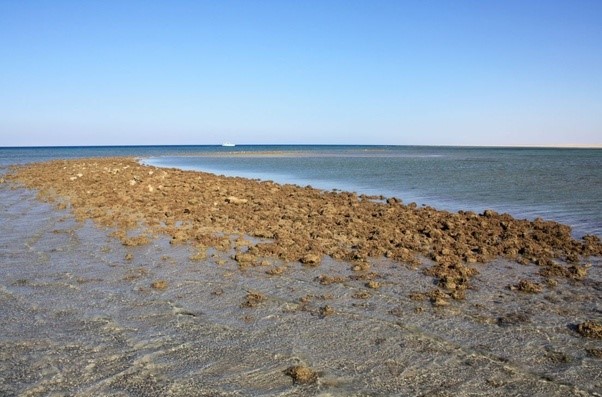
Detail of Cheops’ harbour jetty after excavations, near Wadi el-Jarf.
Note the remains of the L-shaped bank or wall extending into the sea. Pierre Tallet
Khufu’s Red Sea harbour was 180 kilometres south of Suez, in the foothills of the desert mountains. More evidence supporting the idea that the ancient Egyptians went to see can was found on the seafloor. The site includes several stone sea anchors for boats that have long since perished.
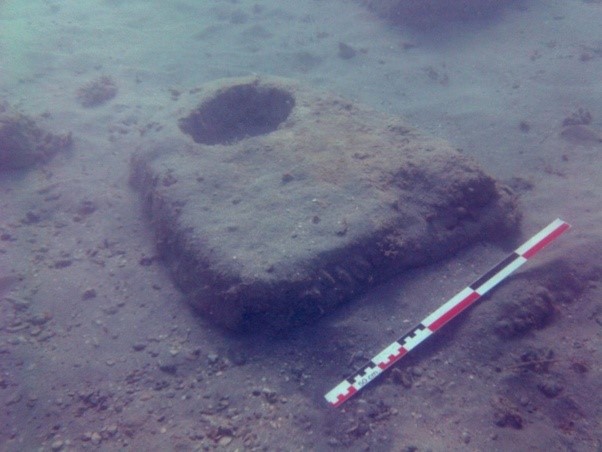
Sea anchor: Pierre Tallet
Over the next millennia, the ancient Egyptians traded briskly with peoples around the region, operating from coastal towns on both the Red Sea and the Mediterranean. (Ancient Egyptian wares have been found as far north as Scandinavia but could have reached there through intermediaries in Europe.
So, we know that by the Old Kingdom, the Egyptian kings were authorising royal trading expeditions, endorsing centralised religious ideologies, and using royal favours to distribute status goods and services. Egyptian sea power remained strong throughout the Old Kingdom period.

The Ancient Egyptian term for sailors,seqedu, may specifically refer to those men experienced using the sails. Terms such as nefeu, ist, and aper are generic terms for the crew. The sailors (or recruits) were also called uau, which applies equally to the army as to maritime service. The New Kingdom sailors are shown wearing a leather loincloth designed to provide some cushioning when rowing. A finely made leather loincloth, probably used for parades, was found in the tomb of a fan-bearer named Mayherpery. It seems that the Egyptians had a ‘navy’ of some description. Indeed, the variety of Egyptian terms in use shows that the Ancient Egyptians operated in a sophisticated maritime environment and that their nautical knowledge was quite broad. For instance, the Egyptian term for navigator was nefuu. The word for helmsman was hemu or iry-hemyt, and a ship’s guardian was the sau. The transport officer was themeshekebu. The oarsmen were the khenyt, and the man at the prow or lookout was known at the iry hat (literally ‘the one who is at the head’).
The New Kingdom
The female Pharaoh Hapshetsut’s tomb art depicts a fantastic sea adventure. Dated to 1,480 B.C., the story recorded in her temple tells that Hapshetsut consulted her gods and was told to follow in the footsteps of her ancestors and re-establish old trading associations that had fallen into the hands of middlemen.” In this inscription, new titles appear, in addition to some of the earlier ones, ‘fleet captain’, ‘captain of the ships of the king’, ‘captain of galleys’, ‘ship’s captain’, ‘captains of marines’ (literally ‘captain of the ship archers’), ‘officer of the ships’, ‘officer of marines’, ‘standard-bearer of the ship’, ‘standard-bearer of the Marines’, ‘commander of the rowers’, ‘chief of the rowers’, ‘ship archers’, and many more appear for the first time.
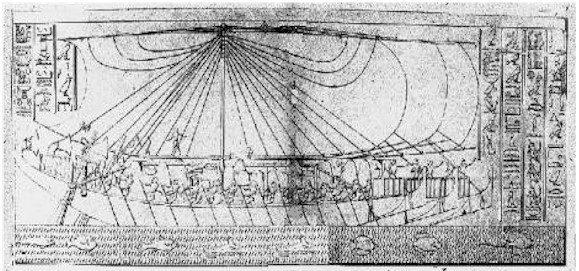
Hatshepsut’s tomb art.
Modern Reconstruction
CHERYL WARD, a maritime archaeologist, recreated an Egyptian ship of these old times, around 3,800 years ago, using traditional materials and local artisans. They succeeded in launching her and navigating down the Red Sea for a considerable way.

Later, Egypt would enter into alliances with the leaders of the great seafaring nation of the Greeks to counter the power of the Persians.
It seems that the ancient Egyptians always had a relationship with the sea, the Mediterranean, and the Red Sea. It was a relationship that brought them trade and wealth. As sailors, they were always more comfortable on their river, which is understandable because the sea is far more treacherous and unpredictable than any river.
Sources:
Wikipedia, ANCIENT EGYPTIAN SEAPOWER AND THE ORIGIN OF MARITIME FORCES By Gregory P. Gilbert,
Naomi Porat and Edwin van den Brink (editor), “An Egyptian Colony in Southern Palestine During the Late Predynastic to Early Dynastic,” in The Nile Delta in Transition: 4th to 3rd Millennium BC(1992), pp. 433–440
Naomi Porat, “Local Industry of Egyptian Pottery in Southern Palestine During the Early Bronze I Period,” in Bulletin of the Egyptological, Seminar 8 (1986/1987), pp. 109–129. See also University College London web post, 2
Homan, Michael (2004). “Beer and Its Drinkers: An Ancient near Eastern Love Story”. Near Eastern Archaeology. 67 (2): 87. doi:10.2307/4132364. JSTOR 4132364.
Ward, Cheryl. “World’s Oldest Planked Boats“, in Archaeology (Volume 54, Number 3, May/June 2001).Archaeological Institute of America.
Divers uncover world’s oldest harbor, in Red Sea, https://www.britishmuseum.org/PDF/Ward.pdf
Academia.com Go to Bookshop Find me on Facebook Find me on Quora Find me on Linkedin
Recent Comments