
The maritime history of ancient Egypt reveals their seafaring activities, trade links, and naval power. Discover the archaeological discoveries and shipbuilding techniques that shed light on Egypt’s relationship with the sea.
Did the Ancient Egyptians go to Sea?
Plutarch tells us that the ancient Egyptians equated the seas with Typhon, the Greek version of the Egyptian god of chaos Seth. Having said that, some ancient Egyptian mariners must have sailed along the coast from time to time to get wood, notably cedarwood.
We know this because Egyptian manufactures dating to the 5th millennium BCE or Badarian culture, have been found as far north as Syria and the archaeological record shows that the predynastic Maadi were importing pottery as well as construction ideas from Canaan a thousand years later. Whether these ideas and trade came to Egypt over land or over the sea is still an unanswered question.
Indeed, shipbuilding was known to the Ancient Egyptians as early as 3000 BCE and perhaps earlier. The ancient Egyptians knew how to assemble planks of wood to form a ship’s hull. They used woven straps to lash the planks together and stuffed the gaps with reed and grass caulking. The Archaeological Institute of America reports that the first ship found to date was probably constructed for the Pharaoh Aha around 3000 BCE and was 75 feet long.
Evidence also suggests an Egyptian colony existed in southern Canaan in the First Dynasty. In 1994, excavators discovered an incised ceramic shard with the serekh sign of Narmer, dating to c. 3000 BCE. Mineralogical studies reveal the shard to be a fragment of a wine jar exported from the Nile Valley to Palestine. Due to Egypt’s climate, wine was very rare and nearly impossible to produce so the wine probably came from Greece showing there were trade links to ancient Greece and the Greek island cultures.
Summary of the evidence so far:
- While Plutarch suggests that Egyptians equated the seas with chaos, some mariners from this civilization ventured along the coast to obtain valuable resources like cedarwood.
- Archaeological findings reveal that Egyptian manufactures dating back to the 5th millennium BCE reached as far north as Syria, indicating possible trade with neighbouring regions. However, whether these exchanges occurred overland or through maritime routes remains a mystery.
- Shipbuilding was a well-known skill among the ancient Egyptians, dating as far back as 3000 BCE. The construction of ship hulls using assembled planks of wood, woven straps, and reed and grass caulking allowed them to navigate the waters effectively. The Archaeological Institute of America discovered the first ancient Egyptian ship, believed to have been constructed for Pharaoh Aha around 3000 BCE, measuring an impressive 75 feet in length.
- Further evidence suggests the existence of an Egyptian colony in southern Canaan during the First Dynasty. The discovery of an incised ceramic shard with the sign of Narmer, dating back to approximately 3000 BCE, revealed trade links with Palestine. The shard, believed to be a wine jar fragment, highlights the rarity of wine production in Egypt’s climate, suggesting a probable import from Greece.
Photograph of Greek wine amphora by Ad Meskens 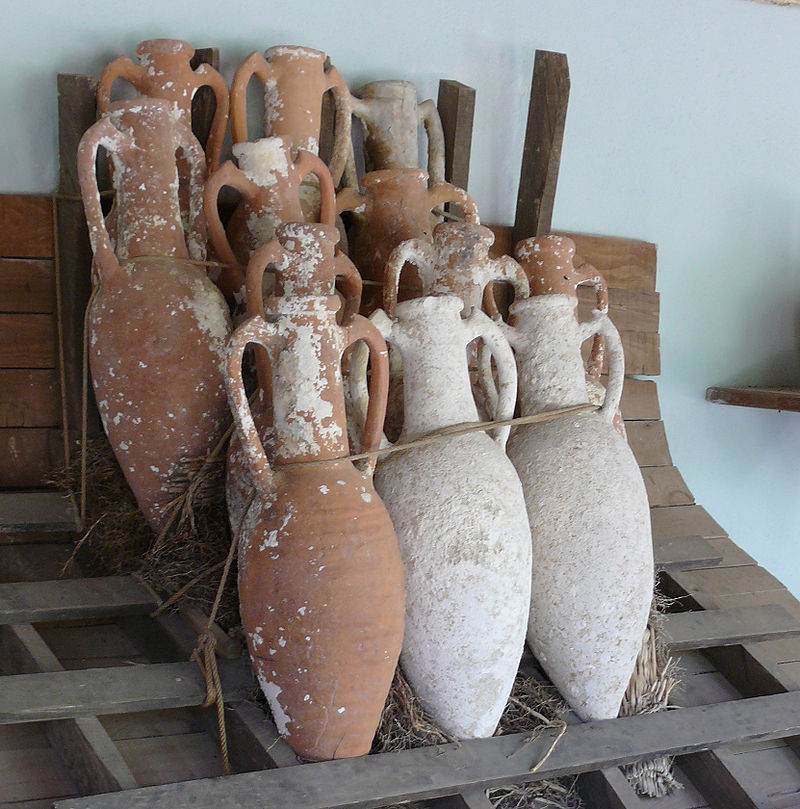
The Old & Middle Kingdoms
The mention of sea trade in ancient Egypt is evident in historical records and inscriptions that shed light on the significant role of maritime activities in the civilization’s economic and cultural development. One such notable reference comes from the Palermo Stone, an ancient Egyptian historical document that provides valuable insights into the reign of Pharaoh Sneferu.
According to the Palermo Stone, Pharaoh Sneferu, who ruled during the Old Kingdom period, commissioned the construction of Tuataua, ships made of precious mer wood, each with a capacity of one hundred. Additionally, the inscription records the capture of sixty royal boats, each capable of holding sixteen individuals, and the transportation of forty ships laden with cedarwood. These ships likely played a vital role in the pharaoh’s ambitious pyramid-building projects.
The reference to the wood’s origin suggests an intricate system of trade and connections with neighbouring regions. The cedarwood was most probably obtained from Byblos, an ancient city located in modern-day Lebanon. Byblos was renowned for its high-quality timber, especially cedar, which was highly sought after by the ancient Egyptians for construction purposes. This indicates the existence of maritime trade routes and the ability of ancient Egyptian sailors to navigate and venture to foreign lands in search of valuable resources.
Moreover, the inscription highlights the economic significance of sea trade in ancient Egypt. The procurement of wood from distant lands, such as Byblos, showcases the strategic importance of maritime commerce and the ability of the ancient Egyptians to engage in long-distance trade for their architectural and economic needs.
Apart from trade with foreign lands, the Palermo Stone also provides valuable information about a crucial trade centre known as Yam in Nubia. Yam was recognized as a resource-rich region for wood, ivory, and gold, and it held significant importance during the Old Kingdom. Though the precise location of Yam remains a subject of debate, it is believed to have been situated somewhere in the Shendi Reach area of the Nile in modern-day Sudan.
The trade relations with Yam illustrate the ancient Egyptians’ proficiency in exploring and exploiting resources beyond their borders. This expansion of trade networks not only facilitated economic growth but also played a vital role in cultural exchange and the dissemination of knowledge and ideas.
In conclusion, the references to sea trade found in the Palermo Stone and other historical records demonstrate the ancient Egyptians’ adeptness in maritime activities. Their prowess in sailing, navigation, and long-distance trade contributed to the flourishing of their civilization and played a pivotal role in the construction of monumental structures like the pyramids. The evidence of trade with regions like Byblos and Yam showcases the extensive reach and influence of ancient Egyptian sea trade, making it a crucial aspect of their remarkable civilization.
Recent Discoveries at Wadi el-Jarf
Recent archaeological findings have shed new light on the maritime activities of ancient Egypt, particularly during the reign of Pharaoh Khufu, the builder of the iconic Great Pyramid of Giza. These discoveries suggest that the ancient Egyptians had a significant presence at sea and actively ventured eastward on maritime expeditions in pursuit of materials essential for their royal projects.
In 2014, a team of archaeologists from the French Institute of Archaeology in Cairo and Sorbonne University made a groundbreaking discovery at Wadi el-Jarf on the Red Sea coast. Beneath the waves, they unearthed the remains of an enormous harbour that has been dated back an astounding 4,600 years ago. This places the harbour’s existence right in the era of Khufu, during his reign from 2580 to 2550 B.C.E.
The sheer size and complexity of the harbour point to its significance as a strategic hub for ancient Egyptian maritime activities. Experts believe that it served as a crucial port, facilitating the transportation of essential resources, materials, and manpower necessary for the construction of Khufu’s monumental pyramid. This discovery lends strong evidence to the notion that the ancient Egyptians possessed impressive seafaring capabilities and conducted maritime trade and exploration.
The harbour’s location, 180 kilometres south of Suez and nestled in the foothills of the desert mountains, was strategically chosen for its proximity to key resources and trade routes. Its positioning allowed the ancient Egyptians to efficiently acquire the materials they needed, such as high-quality limestone and other construction materials, to build awe-inspiring pyramids and other monumental structures.
The significance of the Wadi el-Jarf harbour goes beyond its function as a mere trading post. It reflects the organizational prowess of ancient Egyptian society, as building such an extensive harbour infrastructure required sophisticated engineering and construction skills. The harbour was likely equipped with various facilities to accommodate ships, warehouses to store goods, and workshops to process materials for construction projects.
The discovery at Wadi el-Jarf adds a new chapter to the narrative of ancient Egyptian history, showcasing the ancient civilization’s maritime prowess and its dedication to monumental building projects. It reveals how the ancient Egyptians skillfully navigated the Red Sea to access resources and trade with distant lands, leaving an enduring legacy of their seafaring achievements that continue to captivate modern scholars and historians.
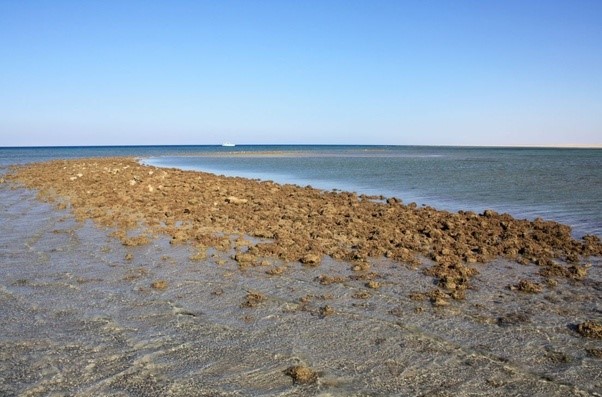
Detail of Cheops’ harbour jetty after excavations, near Wadi el-Jarf.
Note the remains of the L-shaped bank or wall extending into the sea. Pierre Tallet
More evidence supporting the idea that the ancient Egyptians went to sea can be found on the seafloor. The site includes several stone sea anchors for boats that have long since perished.
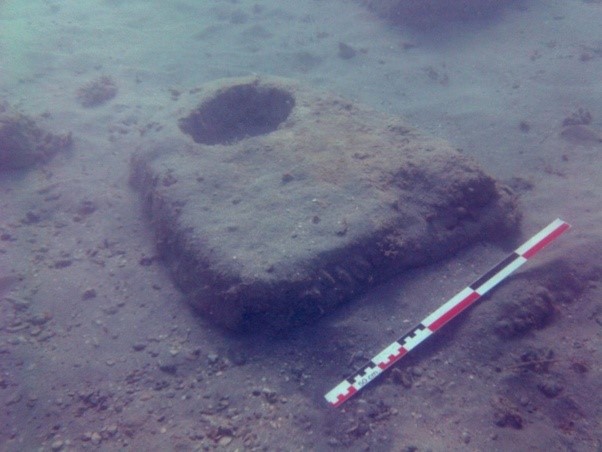
Sea anchor: Pierre Tallet
Over the next millennia, the ancient Egyptians traded briskly with peoples around the region, operating from coastal towns on both the Red Sea and the Mediterranean. (Ancient Egyptian wares have been found as far north as Scandinavia but could have reached there through intermediaries in Europe.
So, we know that by the Old Kingdom, the Egyptian kings were authorising royal trading expeditions, endorsing centralised religious ideologies, and using royal favours to distribute status goods and services. Egyptian sea power remained strong throughout the Old Kingdom period.

The Ancient Egyptian term for sailors,seqedu, may specifically refer to those men experienced using the sails. Terms such as nefeu, ist, and aper are generic terms for the crew. The sailors (or recruits) were also called uau, which applies equally to the army as to maritime service. The New Kingdom sailors are shown wearing a leather loincloth designed to provide some cushioning when rowing. A finely made leather loincloth, probably used for parades, was found in the tomb of a fan-bearer named Mayherpery. It seems that the Egyptians had a ‘navy’ of some description. Indeed, the variety of Egyptian terms in use shows that the Ancient Egyptians operated in a sophisticated maritime environment and that their nautical knowledge was quite broad. For instance, the Egyptian term for navigator was nefuu. The word for helmsman was hemu or iry-hemyt, and a ship’s guardian was the sau. The transport officer was themeshekebu. The oarsmen were the khenyt, and the man at the prow or lookout was known at the iry hat (literally ‘the one who is at the head’).
Unveiling Maritime Achievements of the Old & Middle Kingdoms
Summary:
- The Palermo Stone, reveals Pharaoh Sneferu’s commission to build impressive ships, including Tuataua made of mer wood and 60 royal boats captured for various purposes. Additionally, 40 ships carrying cedarwood were brought from Byblos or Phoenicia, modern-day Lebanon.
- Recent archaeological discoveries on the Red Sea unveil compelling evidence of ancient Egyptians venturing eastward for royal projects. In 2014, an enormous harbour was found underwater by the French Institute of Archaeology and the Sorbonne University at Wadi el-Jarf, dating back 4,600 years. This coincides with the reign of Khufu, the builder of the Great Pyramid of Giza, suggesting his quest for materials for the pyramid construction.
- Khufu’s Red Sea harbour, located 180 kilometres south of Suez, showcases further evidence of ancient Egyptian maritime prowess. Numerous stone sea anchors discovered on the seafloor provide insights into their nautical skills, even though the boats themselves have long since perished.
- Throughout the following millennia, the ancient Egyptians actively engaged in a brisk trade with neighbouring regions, operating from coastal towns on both the Red Sea and the Mediterranean. This trade network extended as far as Scandinavia, indicating their vast influence.
- In the Old Kingdom, Egyptian kings authorized royal trading expeditions, reflecting the endorsement of centralized religious ideologies and the distribution of status goods and services through royal favour. This period witnessed the consolidation of Egyptian sea power.
- We learn about the Ancient Egyptian term for sailors, seqedu, and various roles within the crew. Sailors were adept in using sails, while terms like nefeu, ist, and aper were used to describe crew members. Interestingly, sailors were also referred to as uau, a term applicable to both maritime and army service.
- Ancient Egyptian nautical knowledge was extensive, evident in their diverse terminologies for roles on board, such as navigator (nefuu), helmsman (hemu or iry-hemyt), ship’s guardian (sau), and transport officer (themeshekebu).
- Overall, the Old & Middle Kingdoms mark an era of remarkable maritime achievements for ancient Egypt, showcasing their advanced seafaring abilities and expansive trade connections.
The New Kingdom
The reign of the female Pharaoh Hatshepsut, who ruled Egypt from 1479 to 1458 B.C., was marked by significant maritime endeavours that left a lasting impact on Egypt’s history. The walls of her tomb art depict a remarkable sea adventure that showcases her ambitions to strengthen Egypt’s maritime trade and re-establish old trading associations.
In her temple, Hatshepsut records an inspiring story where she sought guidance from the gods, who instructed her to follow in the footsteps of her ancestors and revive ancient trading networks that had fallen into the hands of middlemen. This decision would prove to be a pivotal moment in Egypt’s maritime history.
The inscription on her temple walls also reveals the emergence of new titles related to maritime leadership, demonstrating the significance Hatshepsut placed on Egypt’s naval forces and maritime commerce. Among these titles were ‘fleet captain’, ‘captain of the ships of the king’, ‘captain of galleys’, ‘ship’s captain’, ‘captains of marines’ (literally ‘captain of the ship archers’), ‘officer of the ships’, ‘officer of marines’, ‘standard-bearer of the ship’, ‘standard-bearer of the Marines’, ‘commander of the rowers’, ‘chief of the rowers’, and ‘ship archers,’ among many others.
These new titles indicate the organization and expansion of Egypt’s naval fleet during Hatshepsut’s reign. The presence of officers overseeing various aspects of naval operations, from ship command to rowers and archers, reflects the meticulous planning and strategic approach Hatshepsut adopted to enhance Egypt’s maritime capabilities.
Hatshepsut’s sea adventure was not just a political move but also an economic endeavour. By reviving ancient trade routes and bypassing intermediaries, she aimed to bolster Egypt’s economic prosperity and promote direct trade relations with neighbouring regions. This maritime initiative allowed Egypt to establish direct control over its trade and resources, reducing dependency on middlemen and securing the kingdom’s wealth.
The depiction of this sea adventure in Hatshepsut’s tomb art serves as a testament to her visionary leadership and determination to strengthen Egypt’s maritime power. Her efforts resulted in a flourishing maritime trade network, contributing to Egypt’s status as a dominant player in the ancient world’s commercial activities.
The legacy of Hatshepsut’s maritime achievements can be seen not only in her reign but also in the continued development of Egypt’s maritime culture and prowess. Her strategic approach to naval expansion and trade laid the foundation for the prosperous New Kingdom period, where Egypt’s influence in the Mediterranean and Red Sea regions continued to grow.
In conclusion, Hatshepsut’s tomb art reveals a remarkable sea adventure that represents her ambitious efforts to revitalize Egypt’s maritime trade and assert her authority as a capable pharaoh. The emergence of new naval titles indicates the systematic organization of Egypt’s maritime forces. Hatshepsut’s initiatives not only strengthened Egypt’s economy but also solidified its position as a dominant player in the ancient world’s maritime affairs, leaving a lasting legacy in the annals of Egypt’s maritime history.
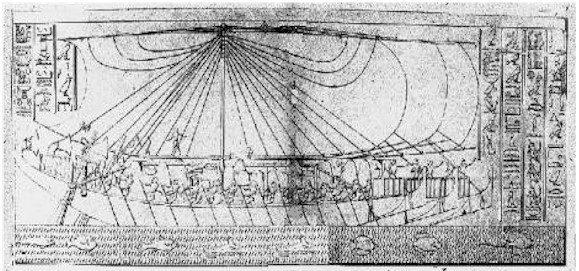
Hatshepsut’s tomb art.
A Modern Reconstruction

Cheryl Ward, a prominent maritime archaeologist, embarked on a fascinating endeavor to recreate an ancient Egyptian ship that sailed approximately 3,800 years ago. Utilizing traditional materials and collaborating with skilled local artisans, Ward successfully brought this historical vessel to life. The ship’s construction was a laborious and meticulous process, meticulously following the ancient techniques and craftsmanship of that era. Upon its completion, the ship was proudly launched, setting sail down the majestic Red Sea, just as its ancient counterparts had done centuries ago.
This ambitious project not only provided invaluable insights into ancient shipbuilding techniques but also shed light on the navigational skills and maritime expertise of the ancient Egyptians. The successful navigation of the ship along the Red Sea highlighted the seafaring capabilities of this ancient civilization, showcasing their remarkable understanding of maritime navigation and exploration.
Moreover, this recreation demonstrated the importance of maritime activities in ancient Egypt, emphasizing their reliance on the sea for trade, resources, and cultural exchanges with neighbouring regions. It underscored the vital role that maritime commerce played in shaping Egypt’s economy and international relations during ancient times.
Later in history, Egypt’s engagement with seafaring nations took a strategic turn. In response to the growing influence and power of the Persians, the Egyptian leaders formed alliances with the great seafaring nation of the Greeks. These alliances were part of Egypt’s efforts to counter the Persian influence and protect its sovereignty and interests in the Mediterranean and Red Sea regions.
These maritime alliances between Egypt and the Greeks marked a significant chapter in the history of ancient geopolitics. The collaborations between these maritime powers not only strengthened their mutual defences but also fostered cultural exchanges and trade connections between their respective societies. It led to the development of a rich maritime network that contributed to the prosperity and stability of both civilizations.
In conclusion, Cheryl Ward’s remarkable achievement in recreating an ancient Egyptian ship provided invaluable insights into the seafaring prowess of this ancient civilization. The successful navigation of the ship down the Red Sea demonstrated the maritime skills and navigational knowledge of the ancient Egyptians. Furthermore, Egypt’s later alliances with the Greeks showcased the strategic significance of maritime partnerships in shaping the geopolitical landscape of the ancient world. These historical events continue to be a testament to the enduring importance of maritime activities and exchanges in shaping civilizations throughout history.
Sources:
Gilbert, G. P., Porat, N., & van den Brink, E. (Eds.). “An Egyptian Colony in Southern Palestine During the Late Predynastic to Early Dynastic,” in The Nile Delta in Transition: 4th to 3rd Millennium BC(1992), pp. 433–440.
Hagen, R. (2000). Egypt and the Greeks. Cornell University Press.
Homan, M. (2004). “Beer and Its Drinkers: An Ancient Near Eastern Love Story”. Near Eastern Archaeology, 67(2), 87.
Jameson, R., & Shaw, I. (2008). A Dictionary of Archaeology. John Wiley & Sons.
Kitchen, K. A. (2014). The Palermo Stone. Journal of the Society for the Study of Egyptian Antiquities, 32, 7-37.
Porat, N. (1986/1987). “Local Industry of Egyptian Pottery in Southern Palestine During the Early Bronze I Period,” in Bulletin of the Egyptological Seminar 8, pp. 109–129.
Redford, D. B. (2005). The Wars in Syria and Palestine of Thutmose III. Brill.
Tallet, P. (2011). The Wadi el-Jarf Site and Its Role in the Egyptian Copper and Turquoise Exploitation and the Trade with the Sinai and Southern Canaan during the Fourth Millennium BC. Egyptian Archaeology, 38, 40-43.
Tyldesley, J. (1998). Hatchepsut: The Female Pharaoh. Viking.
Vagnetti, L. (Ed.). (2000). Maritime Technology in the Ancient Economy: Ship-design and Navigation. Brill.
Ward, C. (2002). The Origins of Sea Peoples. In E. H. Cline & D. O’Connor (Eds.), Amenhotep III: Perspectives on His Reign (pp. 87-98). University of Michigan Press.
Wikipedia, ANCIENT EGYPTIAN SEAPOWER AND THE ORIGIN OF MARITIME FORCES.
Wilson, J. A. (1969). Hatshepsut and Her Mortuary Temple: A Royal Sacrifice. The Journal of Egyptian Archaeology, 55(1/2), 79-96.
Divers uncover world’s oldest harbor, in Red Sea, https://www.britishmuseum.org/PDF/Ward.pdf
Recent Comments