

The cartouche is a key symbol in Egyptology, but what did it mean and what did it protect?
My new mini-history ‘Champollion’ describes the importance understanding cartouches played in cracking the ancient Egyptian secret code of sacred writing we call hieroglyphics. The article below goes into more detail as to their possible meaning.
Buy Now
Introduction
The conventional view of the cartouche in Egyptology was first identified in royal architecture by Flinders Petrie in the late 19th and early 20th centuries. Although his chronologies and his views on race have not stood the test of time, Petrie was right in almost every respect when it came to the architectural survey and analysis of Egyptian monuments says David Ian Lightbody, in his article, The Encircling Protection of Horus, Current Research in Egyptology, 2011.
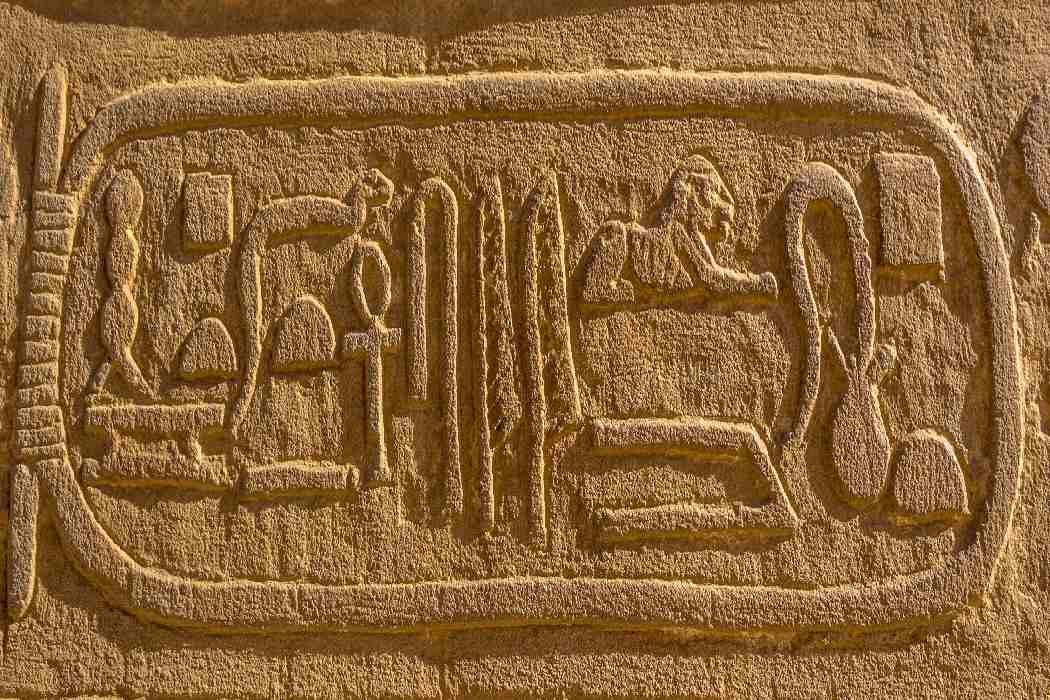
- In Egyptology, the cartouche is considered to be a form of protective symbolism that was represented graphically, and as a partially abstracted concept, by the shen ring, or shenu.
- It was depicted as twin oval loops of rope, tied at the bottom.
- These protective symbols encircle the hieroglyphs of the pharaoh’s name.
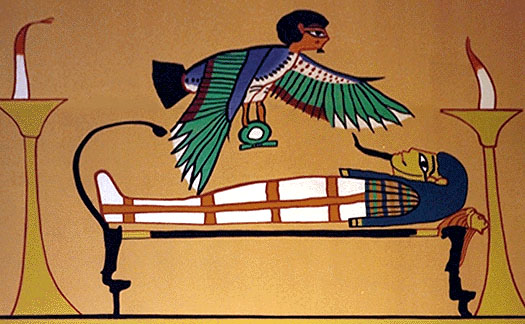
Ba bird in the form of a vulture hovering over the dead king holding a shen ring.
In The Encircling Protection of Horus, Current Research in Egyptology, 2011, Lightbody proposes, “The protective symbolism was represented graphically, as a partially abstracted concept, by the shen ring.
- The shenu is also known in its elongated form as the cartouche and was depicted as twin oval loops of rope, tied at the bottom.
- They encircle the pharaoh’s praenomen, throne name, or nomen, birth name, in hieroglyphs. Other motifs and deities were closely associated with this ring and the cartouche, such as the royal falcon Horus, the royal uraeus snake, and the vulture goddess Nekhbet.
- Together, they represented the ideas of royal protection and dominion over the encircled world.
- Scenes incorporating these icons were often depicted on the architectural elements of tombs and temples, particularly at entrances and on thresholds, such as under architraves, down door jambs, or along the tops of enclosure walls. In this way, they protected the royal building entrances and perimeters.”

Cartouche inscriptions on temple columns.
Magic Circles
However, the cartouche is not circular. It is true, circular symbols include the royal uraeus, represented in the image of a snake, and the vulture goddess Nekhbet and the earliest known shen ring.
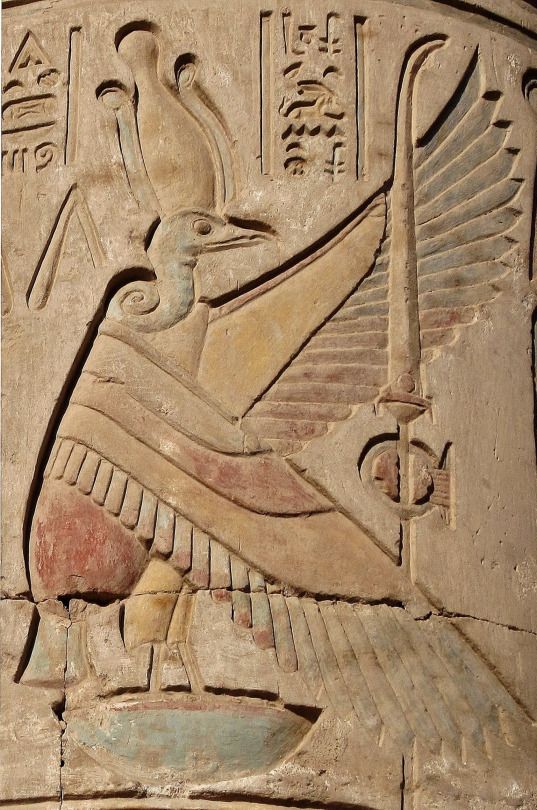
Lightbody concludes that “Petrie was right to conclude that circular symbolism was used in the royal architecture of the Old Kingdom. The circular symbolism represented eternal royal protection encircling the pharaoh and his territorial dominion, and was represented by the shen, and/or cartouche symbols, often carried by Horus above. The cartouche and shen were not just decorative motifs. They were absolutely central to the ideology of kingship, and represented the importance of sacred protection for the pharaoh, his territorial domination, and his unique status as Horus, the living son of Ra.”
The critical question for me is the cartouch symbol part of a functional magical system of royal protection, and if so was it offering protection like an amulet or spell, or was it designed specifically to protect the king’s name and therefore preserve him for eternity?
- Traditionally, circles are believed by ritual magicians to form a protective barrier between themselves and what they summon.
- Circles may or may not be physically marked out on the ground, and a variety of elaborate patterns for circle markings can be found in grimoires and magical manuals, often involving angelic and divine names. Such markings, or a simple unadorned circle, may be drawn in chalk or salt, or indicated by other means such as with a cord it provides a protective boundary by enclosing positive and beneficent energies within its confines. [1] In other words, it protects what is inside the circle not what is outside as in the examples mentioned by Lightbody.
- The idea of forming a protective circle suggests there are things in the world the protected something in the circle needs to be protected from or evil things contained within it that the circle must constrain.
- In Medieval witchcraft, magic circles were used to protect the person or thing inside the circle from the power of the devil or evil spirits. But, there is no devil in ancient Egypt so what could the cartouche be protecting the king from?
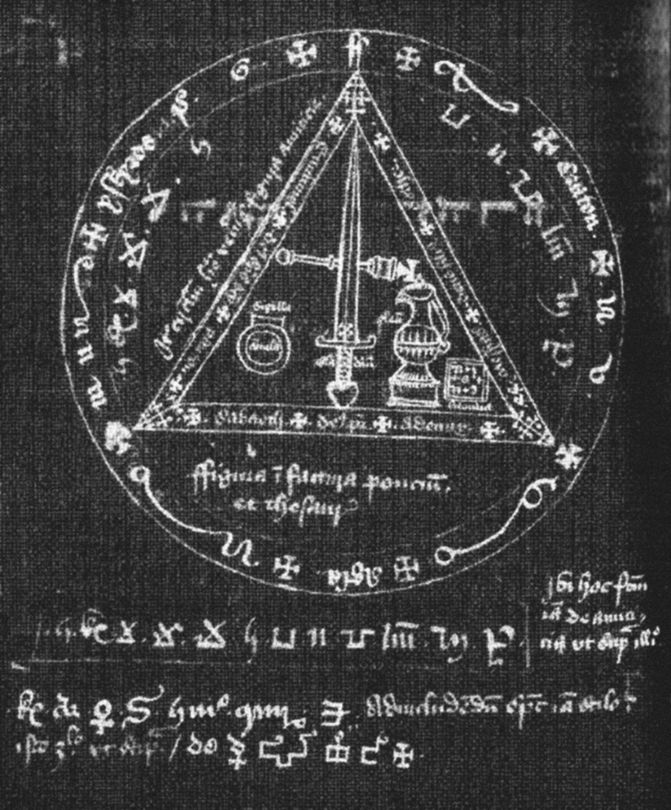
A magic circle from a 15th-century manuscript - Wiki Commons.
Chaos and Disintegration
Jan Assmann provides the answer in his discussion of the heart and connectivity in Death and Salvation in Egypt.
“For the Egyptians, this principle of “connectivity,” the attachment of an individual to a whole, was what characterized life in general. Life was connection, death was disintegration and isolation. But to be able to consider this connection, we must determine the entities between which the life-giving connectivity is to be in effect. It was for just that reason that the Egyptians cast a dissecting gaze on the world, so as all the more keenly to grasp its connectedness, that is, the connective structures and principles. They conceived of the body as a marionette only in order to catch sight of the life-giving and life-maintaining function of the circulatory system. The Egyptians thus did not really view the world with a dissecting gaze but with an integrating, one might almost say, an “embalming” gaze. For the embalming ritual was specifically intended to remedy the condition of dismemberment and decomposition that set in with the stopping of the heart and the ceasing of the circulation of the blood, and to benefit the marionette of the body by substituting a new, symbolic connectivity by means of ritual and chemistry. Because we ourselves do not have this embalming glance, what we see in Egyptian art and in other phenomena of Egyptian culture is primarily the additive, the isolating, and the paratactic. We are blind to the animating, the connective. Just as the Egyptian reader had to supply the vowels, for the writing system noted only the consonants, so also he had to supply the conjunctions, for the connection between clauses was mostly paratactic, and in both cases, he had no difficulty. In both cases, the reader breathed a connective life into the elements.” [2]
Museum Mummy - Wiki Commons. 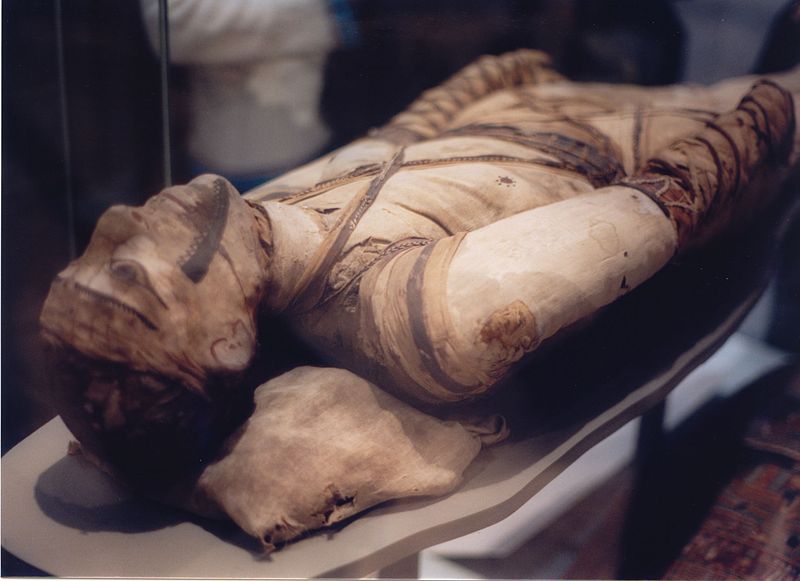
The ancient Egyptians thought that chaos was all around them and that it could come crashing into the world at any time subsuming everything within it. Disintegration was thus an ever-present danger. As Assmann has pointed out embalming was a means of preventing the disintegration of the body in the eternal life of the tomb. Similarly, I believe the cartouche, which was the representation of a loop made from two pieces of rope joined together with a whip binding was designed to prevent the disintegration of the royal name.
Magic Knots
The ancient Egyptians were perfectly capable of representing a continuous line, but they chose not to because knots and knot tying are particularly part of magical enchantments. The Egyptian magician spends a large part of his time tying knots according to Bruce Trigger et. al.
- A magic knot is a point of convergence of the forces which unite the divine and the human worlds he and his colleagues say in The American Discovery of Ancient Egypt, (Nancy Thomas, Gerry D. Scott, Bruce G. Trigger, Los Angeles County Museum of Art, 1995.)
- We see the knot-tying image in the sema-tawy image, a motif that shows the gods Horus and Set pulling on opposing ropes with the throne of Egypt in the centre. The image is said to represent unity and shows the king’s name in a cartouche joined to the heart and lungs of a bull. The symbolism of the heart, lungs, and trachea illustrate the complementary relationship between the organs, the lungs must work together to preserve the heart. It is an image of the two lands united by the king.
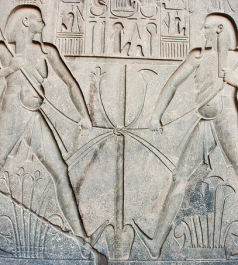
Sema-tawy - Hapi pulls the knot to tie the two lands of Egypt, Upper and Lower Egypt, or the two banks of the river together.
The shen ring quite a different object, but it is tied in the same way as the cartouche.
- The Shen ring is usually seen carried by the vulture goddess Nekhbet and the god of eternity Heh. The Shen ring may be a protective charm when held over the king by Nekhbet. The vulture goddess may be constantly on guard to catch the king’s soul as soon as he shuffles off his mortal coil. We cannot say for sure, more work is required here. In the hands of the god, Heh, it represents millions of years or an eternity of cycles, and so indicates that the symbol is about enduring through time.
The Book of Coming Forth by Day also gives several examples of the magical power of the knot. In one, knots are tied around the deceased to help her come into the presence of the Deities: “The four knots are tied about me by the guardian of the sky [. . .] the knot was tied about me by Nuet, when I first saw Ma’et, when the gods and the sacred images had not yet been born. I am heaven born, I am in the presence of the Great Gods.” In addition to these four knots, there were seven knots, or tesut, that were tied about the deceased to protect him or her. The power of the magical knot is in its ability to both unite and “surround” things. The tied knot is a symbol of the coming together of two things in perfect wholeness, a condition that promotes a positive outcome.
The king wished his name to preserved through time, to be enduring through time, and to give thanks to the gods forever. The king could also make his name perfect through combat, by cementing his reputation as a brave warrior in all lands through its promotion by his officials who by writing his name ‘gave it cause to live’ or shenu. As long as a person’s name was said - as long as life was breathed into it by the speaker, the name lived. [5]
Life After Death
So, to conclude it is more likely the cartouche holds the king’s name together in the same way that bandages held his dead body together. The ancient Egyptian were obsessed with thwarting the process of decay. They understood that bodies if left unbound disintegrated into a pile of bones. If his name were damaged or completely destroyed, the soul would be lost and the deceased would be forgotten and fall for nothing. The cartouche was thus designed to hold the king’s name together so that it would remain intact, could be read and said, and so preserved his Ka spirit or his worldly persona. The cartouche protected the king’s name not his tomb or the adjacent area. It provided the king with one of the many ways the ancient Egyptians believed a person could survive the forces of entropy, decay, and disintegration associated with mortality. The two ropes of the cartouch most probably represented the two ropes of time that were spooled out by the gods (See The Book of Gates). The shen ring, which began meaning ’causes to live’ was most probably a symbol of eternity and eternal life. For more on the Afterlife see:
[1] The Encircling Protection of Horus, Current Research in Egyptology, 2011.
[2]Cunningham, Scott (2001). Wicca: A Guide for the Solitary Practitioner, 29th edition, Llewellyn Publications.
[3] Assmann, J. Death and Salvation in Ancient Egypt, Trans: David Lorton, Cornell University Press, Ithaca and London, Original German edition, © 2001 by C. H. Beck, Munich.
[4] The American Discovery of Ancient Egypt, (Nancy Thomas, Gerry D. Scott, Bruce G. Trigger, Los Angeles County Museum of Art, 1995.)
[5] Leprohon, R, The Great Name, Ancient Egyptian Royal Titularly, Society of Bible Literature Atlanta, 2013.
#egyptology, #ancientegypt, #Davidlightbody #Brucetrigger #JanAssmann, #cartouche #magic, #ancientegyptiankings, #ancientmagic, #pyramids, #burials, #anthropology #archaeology #pharaohs #eteranllife #lifeafterdeath #religion #ancientreligion #Flinderspetrie
Recent Comments