

The Tomb of Nebamun
The beautiful illustration above show a garden laid out in typical ancient Egyptian style. The strange but charming perspective is called ‘aspective’ and it is the opposite of our modern western view called ‘perspective’. The aim of the ancient Egyptian artist was to show all the essential details of a thing or person from a universal, not a personal viewpoint.
The image of the pond is a halcyon one, the animals, fishes and trees represent the peace and tranquillity of the ideal afterlife. The colours are cool and tranquil to illustrate the peace and comfort of life in the Hereafter. Heaven was not perceived as a garden but gardens were thought of as heavenly.
The painting is one of 11 paintings acquired by the British Museum from the tomb-chapel of a wealthy Egyptian official called Nebamun in the 1820s. Dating from about 1350t BC, they are some of the most famous works of art from Ancient Egypt.
The Tomb of Nebamun is from Dynasty XVIII. It was located in the Theban Necropolis on the west bank of the Nile at Thebes (present-day Luxor), in Egypt. The tomb was the source of a number of famous decorated tomb scenes that are currently on display in the British Museum, London.
Nebamun (c 1350 BCE) was a middle-ranking official scribe and grain counter at the temple complex in Thebes. His tomb was discovered in 1820 by a young Greek adventurer called Giovanni (“Yanni”) d’Athanasi, who was acting as an agent for Henry Salt, the British Consul-General. The tomb he found had plastered walls that were richly and skilfully decorated with fresco paintings, depicting idealised views of Nebamun’s life and activities.
D’Athanasi and his workmen literally hacked out the pieces he wanted with knives, saws and crowbars. Salt sold these works to the British Museum in 1821, though some of other fragments became located in Berlin and possibly Cairo. D’Athanasi later died in poverty without ever revealing the tomb’s exact location.
The best-known of the tomb’s paintings include Nebamun fowl hunting in the marshes, dancing girls at a banquet, and a pond in a garden. In 2009 the British Museum opened up a new gallery dedicated to the display of the restored eleven wall fragments from the tomb. They have been described as the greatest paintings from ancient Egypt to have survived and as one of the Museum’s greatest treasures
The frescoes are now on display together for the first time at the British Museum. Following the restoration process, they now give a true impression of the colour that would have been experienced by the ancient visitors to the tomb-chapel.
Objects dating from the same time period and a 3-D animation of the tomb-chapel help to set the tomb-chapel in context and allow visitors to experience how the finished tomb would have looked.
Formal Gardens
Formal memorial gardens were a regular feature of royal and upper-class tombs and were often constructed adjacent to temples. A model of a garden was discovered under the floor of the tomb chapel of Meketre, chancellor to King Mentuhotpe (fig. 4).31 It depicts a garden with a pond and surrounding trees, the house with it is small in comparison. This illustrates the prestige a garden provided. A model of one’s home to take to the afterlife would have been a necessary addition to the burial chamber.
The formal gardens represented in tomb scenes and the actual ones known from texts, illustrations and those found during excavations show they were mostly symmetrical in design and located close to either private homes and tombs, palatial residences, or cult centres, temples and shrines.
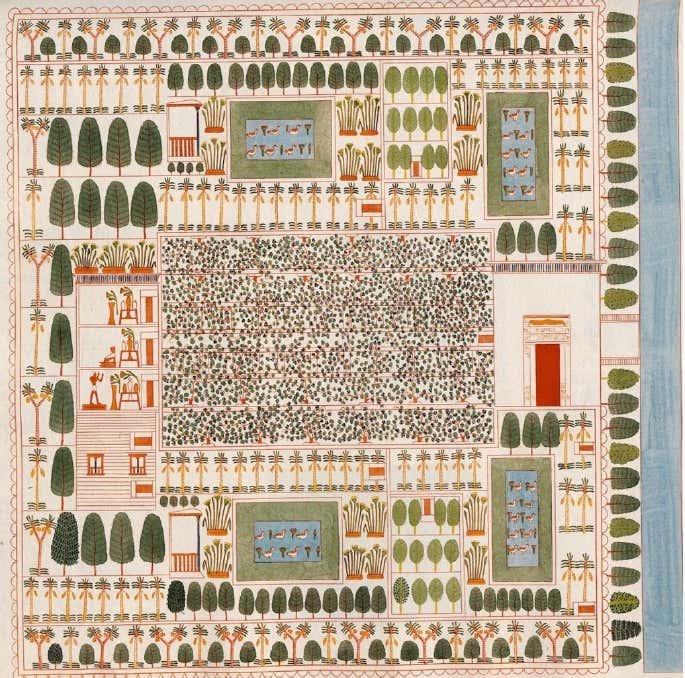
The formal garden of Amun-Re, Thebes (TT96), 1834, New York Public Library Digital Collections.
Formal gardens, like the one shown above, were first constructed by the pharaohs, who sometimes gifted them to members of the royal family or to valued officials. This began a trend in private memorial garden construction.
Palace gardens were lavish with facilities for sports, leisure, music, song, and dance performances. Boats were rowed on their vast lakes and memorial meals, wakes, banquets, and religious festivals and rituals were celebrated. The grounds were also used to grow food, flowers, herbs, fish farming, fruit and vine cultivation. Bees were kept in beehives for the making of honey.
Each of the 42 floral and 11animal species identified in these formal gardens has a specific growth and/or development cycle, which only allows them to be in bloom and/or be available for harvest at certain times of the year. Jayme Reichart of the American University in Cairo has catalogued and analysed 11 gardens constructed before the Amarna Period. An example of the number of trees of each type is listed

Jayme Rudolf Reichart, Pure and Fresh: A Typology of Formal Garden Scenes from Private Eighteenth Dynasty Theban Tombs Prior to the Amarna Period, Thesis Submitted to The Department of Sociology, Egyptology, and Anthropology In Partial Fulfilment of the Requirements for
The Degree of Master of Arts in Egyptology and Coptology, 2020.
Ineni and his wife sit in a pavilion while a gardener carries water jugs. The text above this scene reads Inspecting his [S-formal garden] in the west, refreshing himself under his sycamore fig trees, seeing [those great] and beautiful trees that he planted on earth under the praises of that noble god [A]mun, [Lord of Thrones of the Two Lands].
Julia Herdman is currently working on the first book to tackle the subject of Ancient Egyptian Sacred Numbers for over a hundred years.
Sources:
British Museum Website, Egyptian Gardens, Alison Daines, Studia Antiqua 6, no. 1 2008, Jayme Rudolf Reichart, Pure and Fresh: A Typology of Formal Garden Scenes from Private Eighteenth Dynasty Theban Tombs Prior to the Amarna Period, Thesis Submitted to The Department of Sociology, Egyptology, and Anthropology In Partial Fulfilment of the Requirements for The Degree of Master of Arts in Egyptology and Coptology, 2020.
Recent Comments