

What does the cartouche symbolise?
Unravelling the Mysteries of Ancient Egyptian Cartouches, Shen Rings, Magic Knots, and Magic Circles
Among the captivating mysteries of Ancient Egypt are the intriguing artefacts known as cartouches. Journey with us as we explore their significance and uncover the secrets they hold.
Firstly, let’s delve into the mysterious realm of cartouches. These oval-shaped enclosures surrounded the names of pharaohs and divine beings. Crafted with precision, cartouches shielded these esteemed names, symbolising protection and eternity. Transitioning from hieroglyphics to enigmatic cartouches, Egypt showcased its evolving power. The cartouche, a prominent symbol in Egyptology, holds significant importance in deciphering ancient Egyptian hieroglyphics. Represented as twin oval loops of rope encircling the pharaoh’s name, it is considered a form of protective symbolism. The art of crafting these enigmatic artefacts was not limited to skilled artisans. Priests and magicians dedicated their lives to understanding the secrets behind their creations. The methods remained veiled in secrecy, passed down through generations, preserving their mystical aura.
David Ian Lightbody’s research highlights its connection to the concept of Horus’s encircling protection. Lightbody’s treatise entitled ‘On the Origins of the Cartouche and Encircling Symbolism in the Old Kingdom
Pyramids’ describes a special type of encircling symbolism that was also incorporated into the
architecture of the pharaonic monuments at that time. He claims it manifested a ritualised form of protection
placed around the buildings and tomb chambers and became influential during the third dynasty. He bases his thesis on evidence from Old Kingdom texts and artworks which attest to ‘circumambulation’ rituals carried out by the pharaoh and the priests.
Lightbody claims that the origin of the cartouch is the shen ring which appears in the historical record in the third dynasty. The cartouche, he says is a development of the shen ring designed as a new architectural motif, for the pyramid, to elevate the status of the pharaoh and the members of his own powerful court.
This article explores other possible meanings and purposes of the cartouche, delving into its role in safeguarding the king’s name and preserving his legacy in the eternal afterlife. We also look into its possible connections with magic circles and magical knots.
The Cartouche
The conventional view of the cartouche in Egyptology was first identified in royal architecture by Flinders Petrie in the late 19th and early 20th centuries. Although his chronologies and his views on race have not stood the test of time, Petrie was right in almost every respect when it came to the architectural survey and analysis of Egyptian monuments says David Ian Lightbody, in his article, The Encircling Protection of Horus, Current Research in Egyptology, 2011.
In Egyptian hieroglyphs, a cartouche is an oval with a line at one end tangent to it, indicating that the text enclosed is a royal name. The first examples of the cartouche are associated with pharaohs at the end of the Third Dynasty, but the feature did not come into common use until the beginning of the Fourth Dynasty under Pharaoh Sneferu.
While the cartouche is usually vertical with a horizontal line, if it makes the name fit better it can be horizontal, with a vertical line at the end (in the direction of reading). The ancient Egyptian word for cartouche was shenu, and the cartouche was essentially an expanded shen ring. Demotic script reduced the cartouche to a pair of brackets and a vertical line.
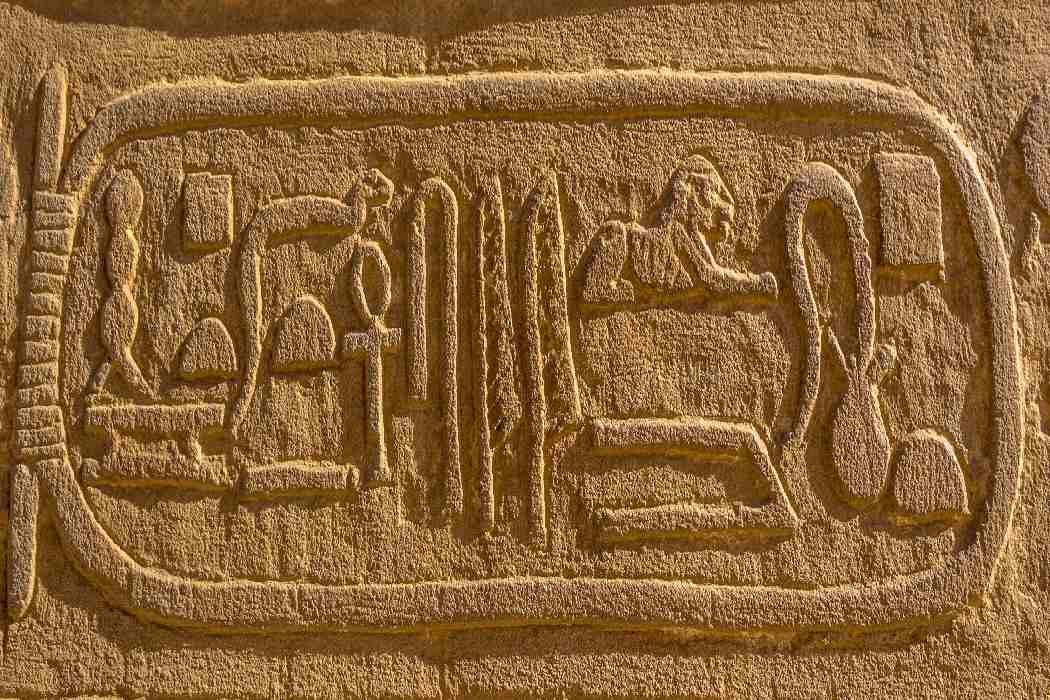
In Egyptology, the cartouche is considered to be a form of protective symbolism that was represented graphically, and as a partially abstracted concept, by the shen ring, or shenu.
It was depicted as twin oval loops of rope, tied at the bottom.
These protective symbols encircle the hieroglyphs of the pharaoh’s name.
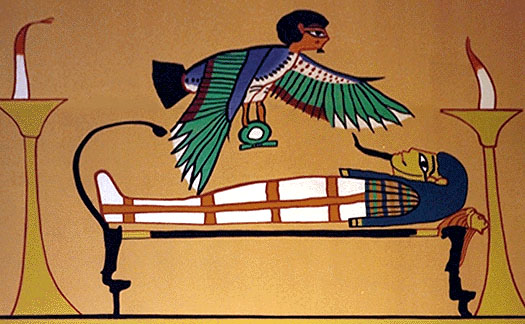
Ba bird in the form of a vulture hovering over the dead king holding a shen ring.
The Shen Ring
In ancient Egypt a shen ring was a circle with a line tangent to it, represented in hieroglyphs as a stylised loop of a rope. The word shen itself meant encircle, while the shen ring represented eternal protection.
The shenu is also known in its elongated form as the cartouche and was depicted as twin oval loops of rope, tied at the bottom. They encircle the pharaoh’s praenomen, throne name, or nomen, birth name, in hieroglyphs. Other motifs and deities were closely associated with this ring and the cartouche, such as the royal falcon Horus, the royal uraeus snake, and the vulture goddess Nekhbet. Together, they represented the ideas of royal protection and dominion over the encircled world.
According to Lightbody, scenes incorporating these icons were often depicted on the architectural elements of tombs and temples, particularly at entrances and on thresholds, such as under architraves, down door jambs, or along the tops of enclosure walls. In this way, they protected the royal building entrances and perimeters.”

Cartouche inscriptions on temple columns.
Lightbody concludes that “Petrie was right to conclude that circular symbolism was used in the royal architecture of the Old Kingdom. The circular symbolism represented eternal royal protection encircling the pharaoh and his territorial dominion and was represented by the Shen, and/or cartouche symbols, often carried by Horus above. The cartouche and shen were not just decorative motifs. They were absolutely central to the ideology of kingship, and represented the importance of sacred protection for the pharaoh, his territorial domination, and his unique status as Horus, the living son of Ra.”
The Critical Question
The critical question for us is whether the cartouch symbol, as a functional magical system of royal protection, was offering protection like an amulet or spell to everything surrounding it, or was it designed specifically to protect the king’s name and therefore preserve him for eternity?
If we look at the definition of an amulet given by the Metropolitan Museum of Art in New York we get a clearer picture of what an amulet is. The Met define an amulet as an object believed to have certain positive properties that can be magically bestowed upon its owner. In ancient Egypt, this magical power was often derived from a combination of several aspects, such as the amulet’s shape, decoration, inscription, colour, material, and words spoken over the piece or acts performed with it.
Amulets were usually worn or placed on the body to transfer their powers directly to the owner. Often amulets were pierced or featured a loop, which allowed their use as pendants on a necklace, for example. Among many other possibilities, they could be incorporated into rings or enfolded in a piece of fabric that was then attached to a string. This means that amulets could be worn without having any means of suspension themselves. When used for the dead, they were placed on the mummy or in between the mummy’s bandages.
So, could a cartouche be an amulet? Well, according to Lightbody the answer must be yes. Although the cartouche is not worn by the pharaoh himself, it is so to speak, worn by his monuments. Its primary purpose is to manifest a ritualised form of protection around the buildings and tomb chambers.
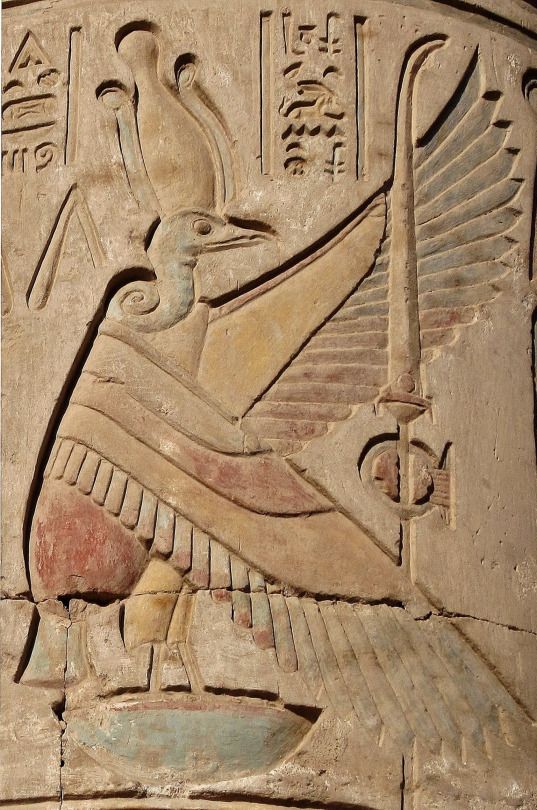
Nekhbet, Shen Rings and the Concepts of Return and Renewal
In artistic depictions, Nekhbet was often portrayed hovering above the royal image, with her majestic wings outstretched, while tightly clutching a shen symbol in her claws. The Shen symbol represented eternal encircling protection, emphasizing Nekhbet’s role as a guardian deity.
Depicted as a vulture or sometimes anthropomorphically, she wears a vulture headdress, symbolizing her role as the Goddess of Upper Egypt, while her counterpart, Wadjet, reigns as the Goddess of Lower Egypt. Together, they represent the unified sovereignty of Egypt, often appearing side by side in heraldic fashion.
Symbolically, the hieroglyphic sign of the vulture represents the word “mut,” signifying “mother.” This symbolism extends to the Goddess Mut, but Nekhbet is more closely linked to the vulture, accentuating her maternal qualities. She is often depicted as the nurturing nurse of Horus, highlighting her protective and caring nature.
At Nekhbet’s cult centre, Nekheb (also known as el-Kab or Eileithyiaspolis to the Greeks), seven “arrows” of Nekhbet are referenced. These “arrows” are potent forces, sometimes malevolent, but under the goddess’s control, they can act according to her will. The ability to command these forces demonstrates Nekhbet’s formidable power in protecting the pharaoh and combating disease and misfortune.
As a goddess connected with the king and the king’s mother, she is a goddess of earthly and cosmic order. We believe her shen rings represent a world free from disintegration. They represent the cosmos held together by the actions of the gods and the king. The cosmos is shown as held together by a magical whip binding.
The shen ring is secured by a knot tied at the end of a rope to keep the end from unravelling. The benefit of the whipping knot is that it is quite easy to tie and no tools are required. Usually, one end of the whipping cord is looped along the rope to be whipped, and the remaining cord is wound tightly over the loop. Finally, the loose end of the wound whipping is passed through the loop so that both ends may be drawn securely inside the winding. The same technique is seen in the Cartouche.
Thus, the shen ring is a symbol of unity, completeness, stability and enduring. It is the symbol of cosmic ma’at. It represented an unchanging and eternal cosmos. It rendered ” order ” to created things, physical and spiritual, and returned the cosmos to its state at the beginning of time. “The ancient Egyptians believed that Shu created a space between the earth and the sky in which creatures could breathe the air that gives life. In his space, the sun could rise for the first time and drive away the primaeval darkness. As part of establishing the divine order, Shu and Tefnut also become two different types of time. “Shu is Eternal Recurrence and Tefnut is Eternal Sameness.” This began a great cycle in which everything had to change to survive and yet everything remained fundamentally the same. Pinch – Handbooks of World Mythology, Handbook of Egyptian Mythology, Pinch, G ABC-Clio Inc, 2002.
An Example of a Cartouche Encircling the Body
New Kingdom Ramesside royal sarcophagi have cartouches encircling the body of the king and constitute a cosmogonic representation of the dead king as Osiris enveloped by the bounded universe.
The Cartouche as a Magic Circle
Traditionally, circles are believed by ritual magicians to form a protective barrier between themselves and what they summon. Circles may or may not be physically marked out on the ground, and a variety of elaborate patterns for circle markings can be found in grimoires and magical manuals, often involving angelic and divine names. Such markings, or a simple unadorned circle, may be drawn in chalk or salt, or indicated by other means such as with a cord it provides a protective boundary by enclosing positive and beneficent energies within its confines. In other words, it protects what is inside the circle not what is outside as in the examples mentioned by Lightbody.
The idea of forming a protective circle suggests there are things in the world that protected the something in the circle from evil things. In Medieval witchcraft, magic circles were used to protect the person or thing inside the circle from the power of the devil or evil spirits. But, there is no devil in ancient Egypt so what could the cartouche be protecting the king from?
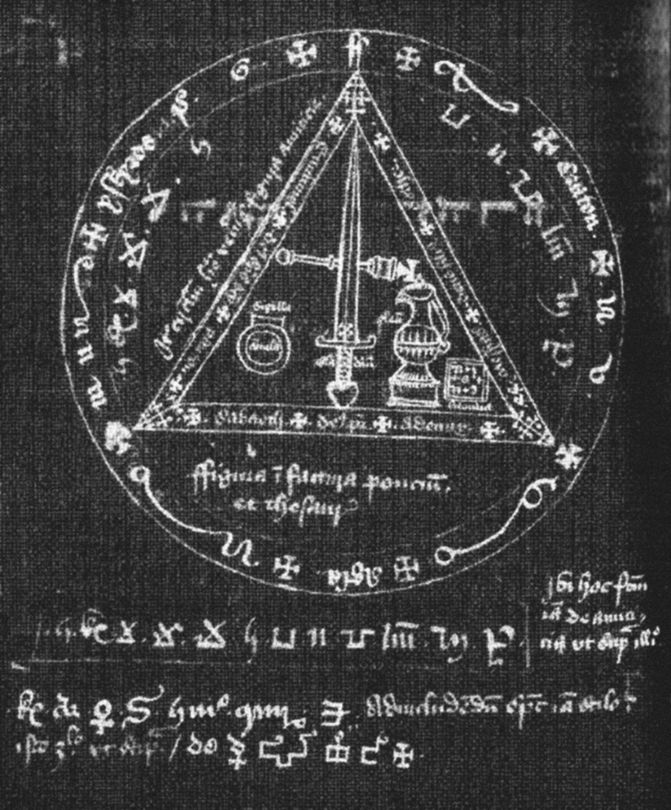
A magic circle from a 15th-century manuscript - Wiki Commons.
Why Create a Protective Circle?
Jan Assmann provides the answer in his discussion of the heart and connectivity in Death and Salvation in Egypt.
Assmann writes: “For the Egyptians, this principle of “connectivity,” the attachment of an individual to a whole, was what characterized life in general. Life was a connection, and death was disintegration and isolation. But to be able to consider this connection, we must determine the entities between which the life-giving connectivity is to be in effect. It was for just that reason that the Egyptians cast a dissecting gaze on the world, so as all the more keenly to grasp its connectedness, that is, the connective structures and principles.
They conceived of the body as a marionette only in order to catch sight of the life-giving and life-maintaining function of the circulatory system. The Egyptians thus did not really view the world with a dissecting gaze but with an integrating, one might almost say, an “embalming” gaze. The embalming ritual was specifically intended to remedy the condition of dismemberment and decomposition that set in with the stopping of the heart and the ceasing of the circulation of the blood and to benefit the marionette of the body by substituting new, symbolic connectivity by means of ritual and chemistry.
Because we ourselves do not have this embalming glance, what we see in Egyptian art and in other phenomena of Egyptian culture is primarily the additive, the isolating, and the paratactic. We are blind to the animating, the connective. Just as the Egyptian reader had to supply the vowels, for the writing system noted only the consonants, so also he had to supply the conjunctions, for the connection between clauses was mostly paratactic, and in both cases, he had no difficulty. In both cases, the reader breathed a connective life into the elements.” [2]
Museum Mummy - Wiki Commons. 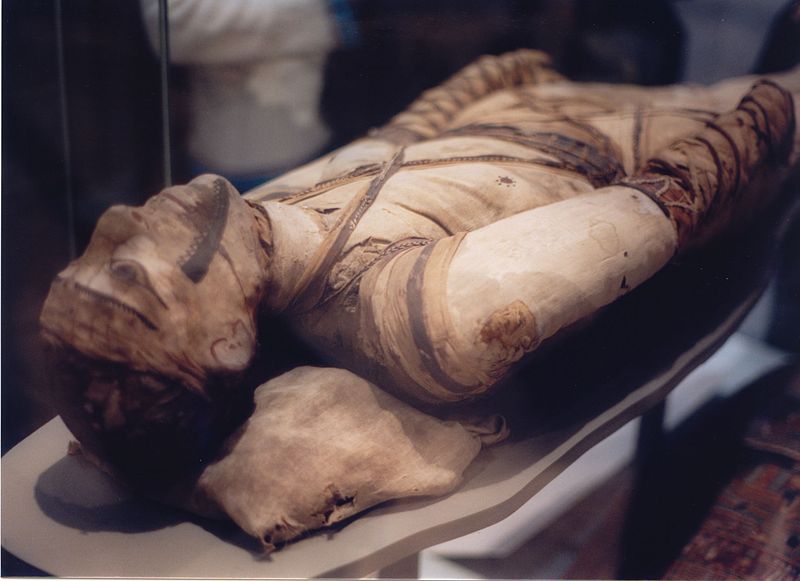
So, to conclude, the ancient Egyptians thought that chaos was all around them and that it could come crashing into the world at any time subsuming everything within it. Disintegration was thus an ever-present danger. As Assmann has pointed out embalming was a means of preventing the disintegration of the body in the eternal life of the tomb.
Similarly, we believe the cartouche, which was the representation of a loop made from two pieces of rope joined together with a whip binding was designed to prevent the disintegration of the royal name.
Why Protect a Name?
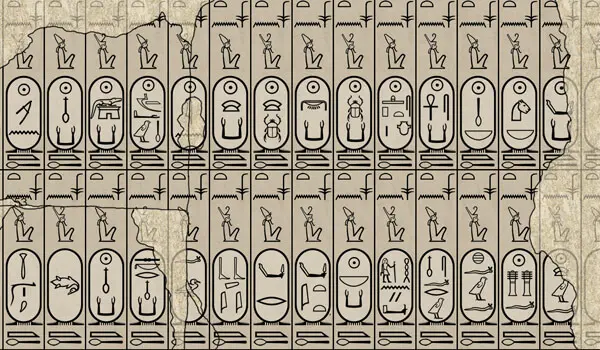
In the Ancient Near East and in Egypt in particular, the name contained the soul of the being that it inhabited. The meaning of the name was binding on the object or person, and the person or object forever had to live up to the fate defined by the name. In the Ancient Near East, the name is the soul and essence of the person who receives it, and the one who names binds the meaning of the name to the person as a fate or destiny. As long as the name of the being exists, the being will exist.
Each pharaoh had up to five names that symbolised their power and might. The full titulary was announced at the coronation when a pharaoh officially became king.
- Horus name — the oldest form of a pharaoh’s name, often enclosed in a serekh, a sort of “heraldic crest” representing a palace facade.
- Nebty name — the “Two Ladies”, the heraldic goddesses Nekhbet and Wadjet, representing Upper and Lower Egypt respectively.
- Gold name — gold was strongly associated with eternity, but the meaning of this title is disputed.
- Throne name — (prenomen) the first of the two names written in a cartouche.
- Personal name — (nomen) the name given at birth, often the name by which a pharaoh is known today.
The whip binding of the cartouch encloses and protects the very essence of the king, his royal house, the land of Egypt, his cosmic existence, and the throne of his ancestors and descendants.
When the Frenchman Jean-François Champollion and the Englishman Thomas Young worked on the translation and interpretation of the Egyptian hieroglyphs in the early 19th century, they, first of all, looked at the cartouches. The two researchers had noticed that the cartouches always contained the same hieroglyphs and apparently represented the names of certain rulers. With this knowledge, the historical foundation for the correct reading and interpretation of the hieroglyphs was laid.
The Cartouche as a Badge of Ownership
A possible alternate explanation for the cartouche is that it was a badge of ownership. Placing one’s name on a thing or building is usually viewed as symbolising ownership. Such a symbol, mark, or token is used to signify that someone possesses or owns a particular item, object, or privilege. It serves as a clear indication of ownership. They provide a sense of pride and exclusivity to the holder, establishing a tangible connection between the owner and the item or privilege they possess.
In the Amarna Period cartouches, whether empty or enclosing a name could serve as protective amulets, seals, and ring seals. The same is true of Tutankhamun, where the cartouche was used in the design of objects or furniture; for example, a wooden box in the form of a cartouche along with many seals bearing his name.
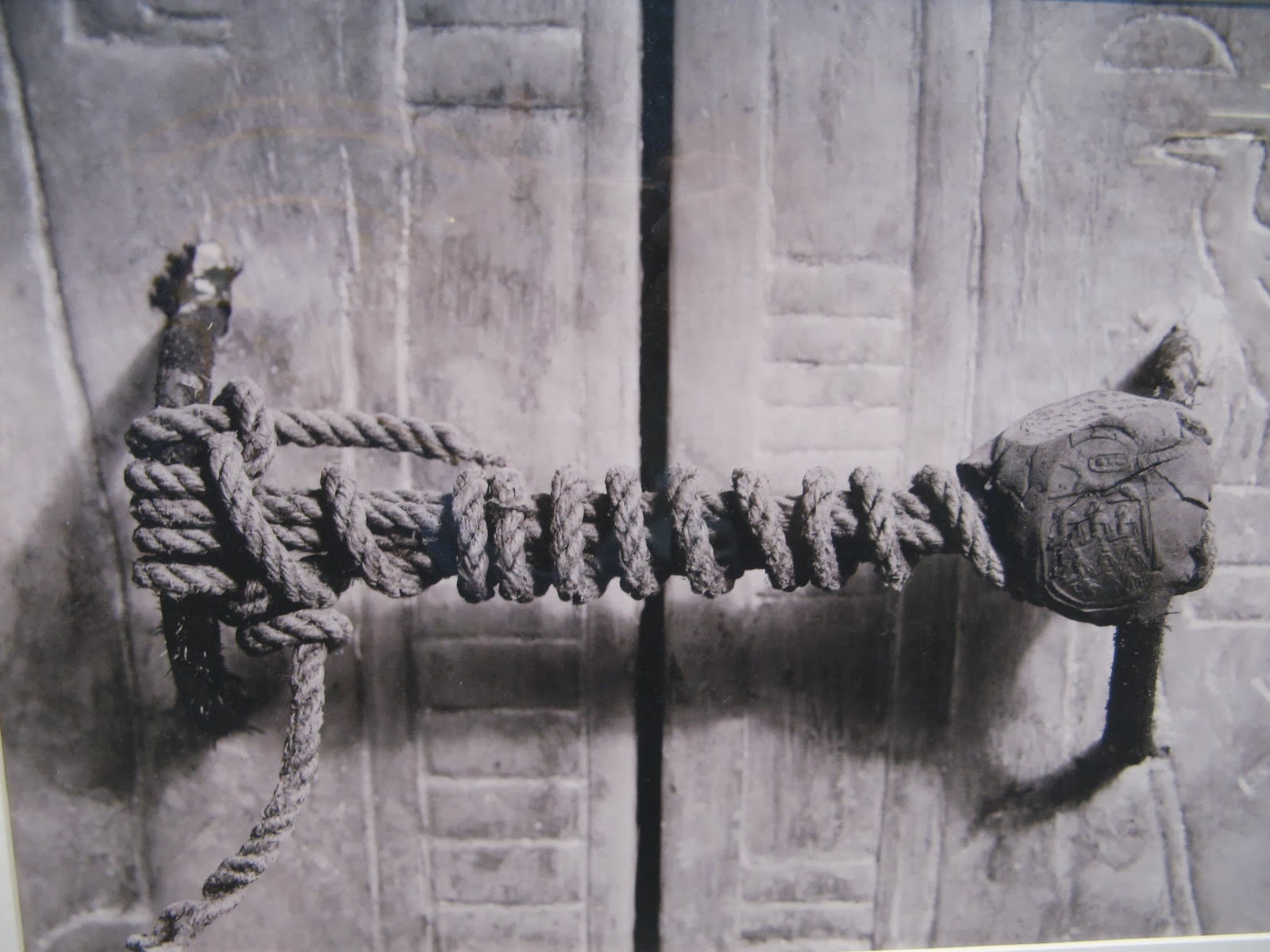
Whip binding with mud seal cartouche.
The Cartouche as a Magic Knot
For the ancient Egyptians, tying and untying knots was of great importance. The ancient Egyptians were perfectly capable of representing a continuous line, but they chose not to because knots and knot tying are particularly part of magical enchantments. The Egyptian magician spends a large part of his time tying knots according to Bruce Trigger et. al.
A magic knot is a point of convergence of the forces which unite the divine and the human worlds he and his colleagues say in The American Discovery of Ancient Egypt, (Nancy Thomas, Gerry D. Scott, Bruce G. Trigger, Los Angeles County Museum of Art, 1995.)
We see the knot-tying image in the sema-tawy image, a motif that shows the gods Horus and Set pulling on opposing ropes with the throne of Egypt in the centre. The image is said to represent unity and shows the king’s name in a cartouche joined to the heart and lungs of a bull. The symbolism of the heart, lungs, and trachea illustrate the complementary relationship between the organs, the lungs must work together to preserve the heart. It is an image of the two lands united by the king.
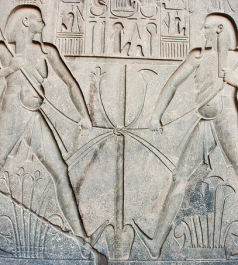
Sema-tawy - Hapi pulls the knot to tie the two lands of Egypt, Upper and Lower Egypt, or the two banks of the river together.
The Book of Coming Forth by Day also gives several examples of the magical power of the knot. In one, knots are tied around the deceased to help her come into the presence of the Deities: “The four knots are tied about me by the guardian of the sky [. . .] the knot was tied about me by Nuet, when I first saw Ma’et, when the gods and the sacred images had not yet been born. I am heaven-born, I am in the presence of the Great Gods.”
In addition to these four knots, there were seven knots, or tesut, that were tied about the deceased to protect him or her. The power of the magical knot is in its ability to both unite and “surround” things. The tied knot is a symbol of the coming together of two things in perfect wholeness, a condition that promotes a positive outcome.
The king wished his name to be preserved through time, to be enduring through time, and to give thanks to the gods forever. As long as a person’s name was said - as long as life was breathed into it by the speaker, the name lived.
Summary
In the captivating realm of Ancient Egypt, cartouches hold intriguing secrets.
The Protective Symbolism of Cartouches
Cartouches, oval enclosures, shielded pharaohs’ names, symbolizing protection and eternity. Crafted precisely, they transitioned from hieroglyphics to enigmatic symbols, showcasing Egypt’s evolving power. Priests and magicians dedicated their lives to understanding these mystical artefacts.
The Connection to Horus’s Encircling Protection
David Ian Lightbody’s research links cartouches to Horus’s encircling protection, influencing Egyptian architecture. The shen ring, an expanded form of the cartouche, represented eternal protection and unity, connecting the pharaoh to cosmic existence.
The Role of Cartouches in Safeguarding the King’s Name
Cartouches played a crucial role in safeguarding the king’s name and preserving their legacy in the afterlife. The cartouche’s magical qualities protected the king from disintegration and chaos, ensuring the continuity of their soul.
Cartouches as Badges of Ownership
Another perspective sees cartouches as badges of ownership. Placing a name on an item or building symbolizes ownership and provides a tangible connection between the owner and the item. Cartouches served as seals of ownership, signifying the king’s dominion over Egypt and their powerful court.
Cartouches and Magic Knots
Ancient Egyptians believed in the significance of tying and untying knots in magical enchantments. The cartouche’s whip binding represented unity, stability, and endurance, protecting the king’s name and maintaining cosmic ma’at.
The Protective Circle of Cartouches
The cartouche could be seen as a magical circle, forming a protective barrier. It encircled and safeguarded the king’s name, preventing disintegration and preserving their existence in the afterlife.
Preserving the Soul through Names
For the ancient Egyptians, the name contained the essence of the person or object. The cartouche protected the king’s name, ensuring their soul’s continuity and preventing the person from being forgotten in eternity.
Concluding Thoughts
So, to conclude it is more likely the cartouche holds the king’s name together in the same way that bandages held his dead body together. The ancient Egyptian were obsessed with thwarting the process of decay. They understood that bodies if left unbound disintegrated into a pile of bones. If his name were damaged or completely destroyed, the soul would be lost and the deceased would be forgotten and fall for nothing. The cartouche was thus designed to hold the king’s name together so that it would remain intact, could be read and said, and so preserved his Ka spirit or his worldly persona. The cartouche protected the king’s name, not his tomb or the adjacent area
For the ancient Egyptians, the cartouches originally had a cultic and religious meaning, since the tying and untying of knots was also of great importance in ancient Egyptian magic. As a modified form of the Schen ring, the cartouche had the same symbolic function: it was supposed to protect the name ( ren ) of the ruler and preserve it for all time. The background was the religious belief that every deceased whose name remains forever, also in the afterlife continue to exist forever. If his name were damaged or completely destroyed, the soul would be lost and the deceased would be forgotten and succumbed to nothingness. The cartouche was intended to prevent this by protectively surrounding the king’s name.
Later, when the sun cult of the god Re reached its peak, another symbolism was added: the loop of the cartouche, which appears to be endless, as compared to the equally endless course of the sun. Since the Egyptians worshipped the pharaoh as Sa-Ra (“son of Re”) and the sun touched all of Egypt, the power of the pharaoh was also considered omnipresent and all-encompassing. Where the sun shone, so was the pharaoh.
It provided the king with one of the many ways the ancient Egyptians believed a person could survive the forces of entropy, decay, and disintegration associated with mortality. The two ropes of the cartouch most probably represented the two ropes of time that were spooled out by the gods (See The Book of Gates).
When shown independently the cartouche took on an iconic significance and replaced the king’s, or more rarely, the queen’s, anthropomorphic image, enabling him or her to be venerated as a divine entity. Conversely, the enclosure of a god’s or goddess’s name in a cartouche served to render the deity more accessible to the human sphere.
The shen ring, which began meaning ’causes to live’ was most probably a symbol of eternity and eternal life.
Sources
- [1] “Lightbody, D., 2012. The Encircling Protection of Horus. Proceedings of the Twelfth Annual Symposium Current Researches in Egyptology, 2011, University of Durham. Abd El Gawad, H. et al. Ed. Oxford: Oxbow: 133-140.
- [2]Cunningham, Scott (2001). Wicca: A Guide for the Solitary Practitioner, 29th edition, Llewellyn Publications.
- [3] Assmann, J. Death and Salvation in Ancient Egypt, Trans: David Lorton, Cornell University Press, Ithaca and London, Original German edition, © 2001 by C. H. Beck, Munich.
- [4] The American Discovery of Ancient Egypt, (Nancy Thomas, Gerry D. Scott, Bruce G. Trigger, Los Angeles County Museum of Art, 1995.)
- [5] Leprohon, R, The Great Name, Ancient Egyptian Royal Titularly, Society of Bible Literature Atlanta, 2013.
#egyptology, #ancientegypt, #Davidlightbody #Brucetrigger #JanAssmann, #cartouche #magic, #ancientegyptiankings, #ancientmagic, #pyramids, #burials, #anthropology #archaeology #pharaohs #eteranllife #lifeafterdeath #religion #ancientreligion #Flinderspetrie
Recent Comments